

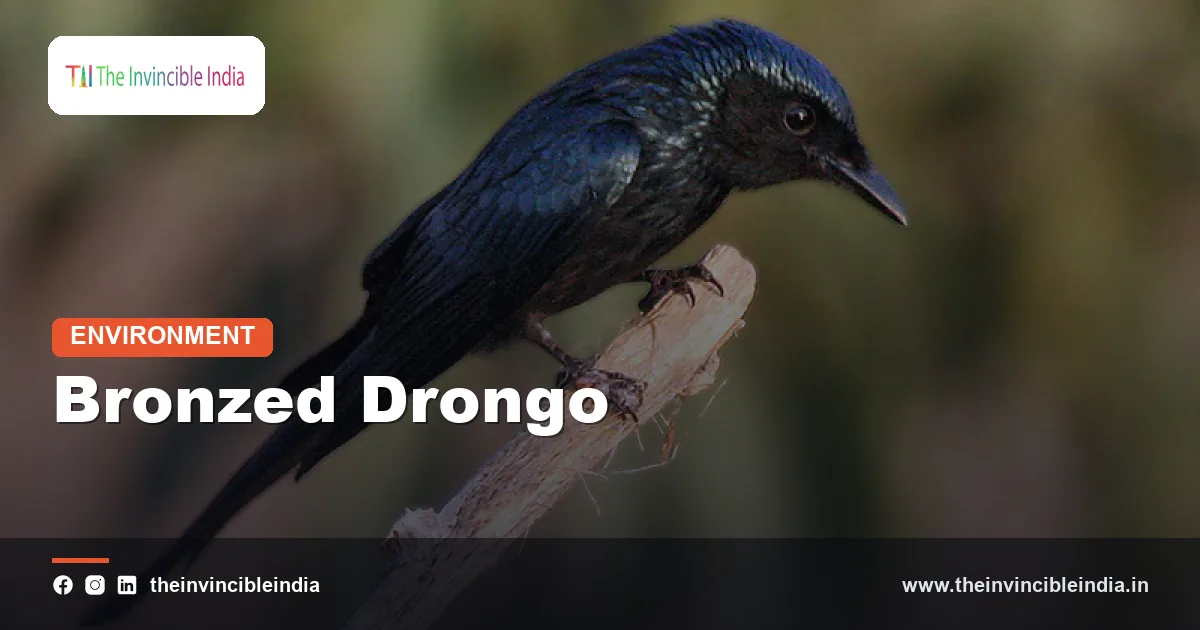
The bronzed drongo (Dicrurus aeneus) is a small, glossy, metallic blue-green and black forest drongo found in the Western Ghats, the Himalayan foothills and the hills of northeast India. It is a canopy bird that hunts insects from open perches, often joins mixed groups of forest birds and drinks nectar from flowering trees. This guide explains how the bronzed drongo looks, where it lives, what it eats, how it breeds and how to tell it from other Indian drongos.
The bronzed drongo is the smallest and most compact of the common Indian drongos, and it behaves differently from the better-known black drongo of farmland. It belongs to shaded, wooded country and is often seen darting between treetops in the company of other species.
| Common name | Bronzed drongo |
|---|---|
| Scientific name | Dicrurus aeneus |
| Family | Dicruridae (drongos), order Passeriformes |
| Size | About 23 cm long; a small drongo with a moderately forked tail |
| Range in India | Western Ghats, hills of the Himalayan foothills, northeast India and patches of the Eastern Ghats; also Sri Lanka and Southeast Asia |
| Habitat | Evergreen, semi-evergreen and moist deciduous forest, mainly in the canopy and mid-storey |
| Diet | Insects caught in the air or gleaned from foliage; flower nectar |
| Breeding | Cup nest of fine twigs and fibres in a tree fork; usually two to four spotted eggs |
| Conservation status | Least Concern on the IUCN Red List |
Key Takeaways
- The bronzed drongo is a small, glossy forest drongo with a metallic bronze-green and blue sheen, found in the Western Ghats, Himalayan foothills and northeast India.
- The bronzed drongo hunts insects by sallying out from a perch, and it also feeds on nectar from flowering forest trees.
- The bronzed drongo frequently joins mixed-species flocks, where it catches insects disturbed by other birds as they move through the canopy.
- The bronzed drongo is smaller than the black drongo, with a shallower fork in the tail and a strong preference for forest rather than open farmland.
- The bronzed drongo builds a cup-shaped nest in a tree fork and, like other drongos, defends it boldly against larger birds.
- The IUCN lists the bronzed drongo as Least Concern, although it depends on tree cover and is affected by forest loss.
What does the bronzed drongo look like?
The bronzed drongo looks like a small, all-dark bird with glossy blue-green and bronze highlights, a short, slightly forked tail and a bright red-brown eye. It measures about 23 centimetres, a little smaller than the black drongo.
In shade the bird appears simply black, but in sunlight the feathers flash a metallic sheen of green, blue and bronze, especially on the upper body, wings and tail. The throat and breast carry small spangles that give a speckled, jewelled look at close range. The bill is black and fairly stout, with bristles at the base. The tail is forked, though the fork is shallower than in most other Indian drongos, and the outer feathers do not curl or form rackets.
Males and females look much the same. Young birds are duller, with less gloss and a browner tone, and they may show pale tips or scalloping on the underparts.
Why does the bronzed drongo shine in sunlight?
The bronzed drongo shines in sunlight because its feathers have a microscopic structure that reflects light in particular colours, rather than relying only on pigments. This is called structural colour, and it explains why the same bird can look plain black in shade and brilliantly metallic in direct light. Many drongos, starlings and sunbirds share this effect.
Where is the bronzed drongo found in India?
The bronzed drongo is found in the Western Ghats of south and western India, along the Himalayan foothills and across the hill forests of northeast India, with some populations in pockets of the Eastern Ghats. Outside India it occurs in Sri Lanka, Nepal and several parts of Southeast Asia.
The species is a resident of wooded hills. It usually keeps to moist forest and avoids dry, open country, which is why it is rarely seen in the dry plains of north-western or central India. In the Himalayan foothills it may move to lower levels in the cold season and return higher as the weather warms.
What kind of forest does the bronzed drongo prefer?
The bronzed drongo prefers evergreen, semi-evergreen and moist deciduous forest, where tall trees form a layered canopy. It is most common at forest edges, along clearings and roads through forest, and in the upper and middle layers where insects and flowers are plentiful. It also uses well-wooded plantations such as coffee, cardamom and tea estates with shade trees.
What does the bronzed drongo eat?
The bronzed drongo eats mainly insects, which it catches in flight or picks from leaves and bark, and it also drinks nectar from flowers. Its prey includes beetles, moths, bugs, flies, termites and other small flying insects.
The hunting method follows the usual drongo pattern. The bird sits on an exposed branch, watches for movement, flies out in a swift curve to seize an insect and returns to a perch. Because the bronzed drongo works in shaded forest, it is more agile among twigs and branches than its open-country relatives and often hovers briefly or gleans from leaf surfaces.
- Aerial prey: flying termites, moths, flies, beetles and small wasps.
- Foliage prey: caterpillars and bugs picked from leaves and twigs.
- Nectar: flowers of forest trees such as silk cotton and coral trees, visited for both nectar and the insects they attract.
The bird may also lift insects that are being stirred up by other birds, a habit that links closely with its life in mixed flocks.
Why does the bronzed drongo join mixed-species flocks?
The bronzed drongo joins mixed-species flocks because moving birds disturb insects that the drongo can catch easily, and the group offers extra eyes for spotting predators. Mixed flocks are a feature of tropical forest, where babblers, warblers, tits, flycatchers and others travel together through the trees.
In such a flock, the drongo often acts as a sentinel. It tends to sit high and watch, raising an alarm when a hawk or other predator appears. Other birds respond to these warnings, and this protection is part of what keeps the flock together. The drongo benefits by feeding on insects flushed by the flock, while the others benefit from its vigilance. Scientists describe this as an association with advantages for several members.
How do mixed flocks work?
Mixed flocks work through a division of roles and feeding levels. Some species forage on trunks, some in foliage and some in the open canopy. Drongos, with their sallying hunting style, usually fly slightly above or beside the group. Flocks may cover a large area through the day and often follow regular routes, so an observer who waits at a quiet forest path may see them pass.
How does the bronzed drongo breed?
The bronzed drongo breeds by building a small cup nest of fine twigs, grass and fibres, often bound with cobweb and placed in a fork of a tree branch, where the female lays a few spotted eggs. The nest is generally set at a good height and is hard to spot among the leaves.
Breeding takes place mainly in the warmer months, with the exact timing varying between the Western Ghats, the Himalayan foothills and the northeast. A clutch commonly contains two to four eggs, which are pale and marked with reddish or brown spots. Both parents take part in building, incubating and feeding. The chicks are fed insects, and the pair guard the nest from other birds and squirrels.
Like larger drongos, a nesting bronzed drongo will fly at intruders much bigger than itself, calling harshly and striking from above.
How can the bronzed drongo be told apart from other drongos?
The bronzed drongo can be told apart from other drongos by its small size, its glossy bronze-green and blue sheen, its shallow tail fork and its forest habitat. Several Indian drongos look dark at a glance, so a comparison of size, tail and habitat helps.
| Drongo | Approximate size | Tail | Typical habitat |
|---|---|---|---|
| Bronzed drongo | About 23 cm | Short, shallow fork | Forest canopy and mixed flocks |
| Black drongo | About 28 cm | Long, deeply forked | Open farmland, villages, roadsides |
| White-bellied drongo | About 24 cm | Long, deeply forked | Open forest and plantations |
| Ashy drongo | About 29 cm | Long, deeply forked | Forest edges and wooded areas |
| Spangled drongo | About 32 cm | Long, with outer feathers curling upward at the tips | Moist forest, mainly eastern and northeast India |
| Greater racket-tailed drongo | About 35 cm or more with tail | Long wire-like feathers with racket tips | Moist forest, Western Ghats and northeast |
If a small, glossy, dark bird with a short tail fork is seen hunting from a high perch inside moist forest, the bronzed drongo is the most likely identification.
What does the bronzed drongo sound like?
The bronzed drongo has a varied voice made up of clear whistles, harsh scolding notes and short musical phrases, and it can imitate the calls of other forest birds. Its calls are usually heard from the treetops, especially in the morning.
The song is more pleasant than the scolding of other drongos, and it carries well through woodland. As with other members of its family, mimicry is part of the repertoire. Birdwatchers may sometimes hear a series of unrelated bird calls coming from a single dark perched bird, and a drongo is often the source.
What role does the bronzed drongo play in the forest?
The bronzed drongo plays three roles in the forest: it controls insect numbers, it pollinates some flowers while feeding on nectar, and it helps warn other birds of predators. Each role links it into the wider forest community.
As an insect eater, it removes moths, beetles and other insects, some of which can harm trees. When it moves from flower to flower to drink nectar, pollen can stick to its head and bill and be carried to the next blossom. Its alarm calls and its readiness to mob predators reduce risk for nearby birds. Healthy populations of insect-eating birds are often used as an indicator of forest condition.
How does the bronzed drongo fit into the drongo family?
The bronzed drongo belongs to Dicruridae, a family of about two dozen glossy, forked-tailed songbirds found in Africa, Asia and Australasia. All drongos share a similar body plan: a dark plumage, a strong bill with bristles, short legs and an upright perching posture.
Within the family, the bronzed drongo is a forest specialist, in contrast to the black drongo that thrives around villages and cultivated fields. This difference shows how closely related birds divide up habitats, with one species taking open ground and another taking the canopy. India hosts several drongos, and in a single hill forest it is possible to find the bronzed drongo, the white-bellied drongo and a racket-tailed or spangled drongo sharing the same general area but using different layers and perches.
Because the family is well known for boldness, drongos hold a respected place in Indian folk observation. Farmers have long noticed the black drongo chasing crows, and forest workers know that a calling drongo often signals a hawk overhead.
Is the bronzed drongo threatened?
The bronzed drongo is not currently considered threatened; the IUCN lists it as Least Concern because it has a very large range and is fairly common in suitable forest. Its numbers, however, depend on the survival of tree cover.
Clearing of forest for agriculture, plantations and settlements can reduce its habitat, especially in the Western Ghats and northeast India, which are regions of rapid land-use change. Most native wild birds in India are protected by the Wildlife (Protection) Act, 1972, which bans hunting and capture. Protecting standing forest and keeping canopy trees on estates helps maintain the species.
How can you watch the bronzed drongo?
The best way to watch the bronzed drongo is to visit moist forest edges or forest roads in the early morning and scan the upper branches for small dark birds perched in the open. Good light brings out the glossy colours.
- Look up: scan the tops of tall trees and dead twigs, which are favourite lookout posts.
- Follow the flocks: when a wave of small birds passes, check for a drongo moving with it.
- Visit flowering trees: blossoming silk cotton and coral trees draw drongos for nectar and insects.
- Use the sun: position yourself so the sun is behind you, and the metallic sheen becomes visible.
- Keep still: sudden movement may send the bird to a higher perch.
Hill sanctuaries, tea and coffee estates with shade trees, and forest rest-house surroundings in the Western Ghats and northeast are good places to look.
Bottom Line
The bronzed drongo is a small, glossy forest drongo of the Western Ghats, Himalayan foothills and northeast India, recognised by its metallic sheen, short tail fork and habit of travelling with mixed bird flocks. It eats insects and nectar, nests in tree forks and stays secure where forest cover remains.
Frequently Asked Questions
What is a bronzed drongo?
A bronzed drongo is a small, glossy blue-green and black drongo that lives in forests of the Western Ghats, Himalayan foothills and northeast India. It is about 23 cm long and hunts insects from perches. It often travels with mixed flocks of forest birds.
Where is the bronzed drongo found in India?
The bronzed drongo is found in the Western Ghats, along the Himalayan foothills, across the northeast and in parts of the Eastern Ghats. It prefers moist evergreen and deciduous forest. It is largely a resident of wooded hills.
What does the bronzed drongo eat?
The bronzed drongo eats insects such as beetles, moths, flies and termites, catching them in the air or picking them from leaves. It also drinks nectar from flowering forest trees. It hunts by sallying out from an exposed perch.
How is the bronzed drongo different from the black drongo?
The bronzed drongo is smaller, glossier and has a shorter, shallower tail fork than the black drongo. It lives inside forest and canopy, whereas the black drongo prefers open farmland and roadsides. Both are insect hunters that perch in the open.
Why does the bronzed drongo join mixed flocks?
The bronzed drongo joins mixed flocks to catch insects that other birds disturb and to share watch against predators. It often sits high and gives alarm calls, which warn other flock members. The association benefits several species in the group.
Is the bronzed drongo rare?
No, the bronzed drongo is not rare; the IUCN lists it as Least Concern because it is widespread and fairly common in suitable forest. Its numbers can fall locally where forest is cleared. It is protected under the Wildlife (Protection) Act, 1972, like most native Indian birds.
{“@context”:”https://schema.org”,”@graph”:[{“@type”:”FAQPage”,”mainEntity”:[{“@type”:”Question”,”name”:”What is a bronzed drongo?”,”acceptedAnswer”:{“@type”:”Answer”,”text”:”A bronzed drongo is a small, glossy blue-green and black drongo that lives in forests of the Western Ghats, Himalayan foothills and northeast India. It is about 23 cm long and hunts insects from perches. It often travels with mixed flocks of forest birds.”}},{“@type”:”Question”,”name”:”Where is the bronzed drongo found in India?”,”acceptedAnswer”:{“@type”:”Answer”,”text”:”The bronzed drongo is found in the Western Ghats, along the Himalayan foothills, across the northeast and in parts of the Eastern Ghats. It prefers moist evergreen and deciduous forest. It is largely a resident of wooded hills.”}},{“@type”:”Question”,”name”:”What does the bronzed drongo eat?”,”acceptedAnswer”:{“@type”:”Answer”,”text”:”The bronzed drongo eats insects such as beetles, moths, flies and termites, catching them in the air or picking them from leaves. It also drinks nectar from flowering forest trees. It hunts by sallying out from an exposed perch.”}},{“@type”:”Question”,”name”:”How is the bronzed drongo different from the black drongo?”,”acceptedAnswer”:{“@type”:”Answer”,”text”:”The bronzed drongo is smaller, glossier and has a shorter, shallower tail fork than the black drongo. It lives inside forest and canopy, whereas the black drongo prefers open farmland and roadsides. Both are insect hunters that perch in the open.”}},{“@type”:”Question”,”name”:”Why does the bronzed drongo join mixed flocks?”,”acceptedAnswer”:{“@type”:”Answer”,”text”:”The bronzed drongo joins mixed flocks to catch insects that other birds disturb and to share watch against predators. It often sits high and gives alarm calls, which warn other flock members. The association benefits several species in the group.”}},{“@type”:”Question”,”name”:”Is the bronzed drongo rare?”,”acceptedAnswer”:{“@type”:”Answer”,”text”:”No, the bronzed drongo is not rare; the IUCN lists it as Least Concern because it is widespread and fairly common in suitable forest. Its numbers can fall locally where forest is cleared. It is protected under the Wildlife (Protection) Act, 1972, like most native Indian birds.”}}]}]}


