

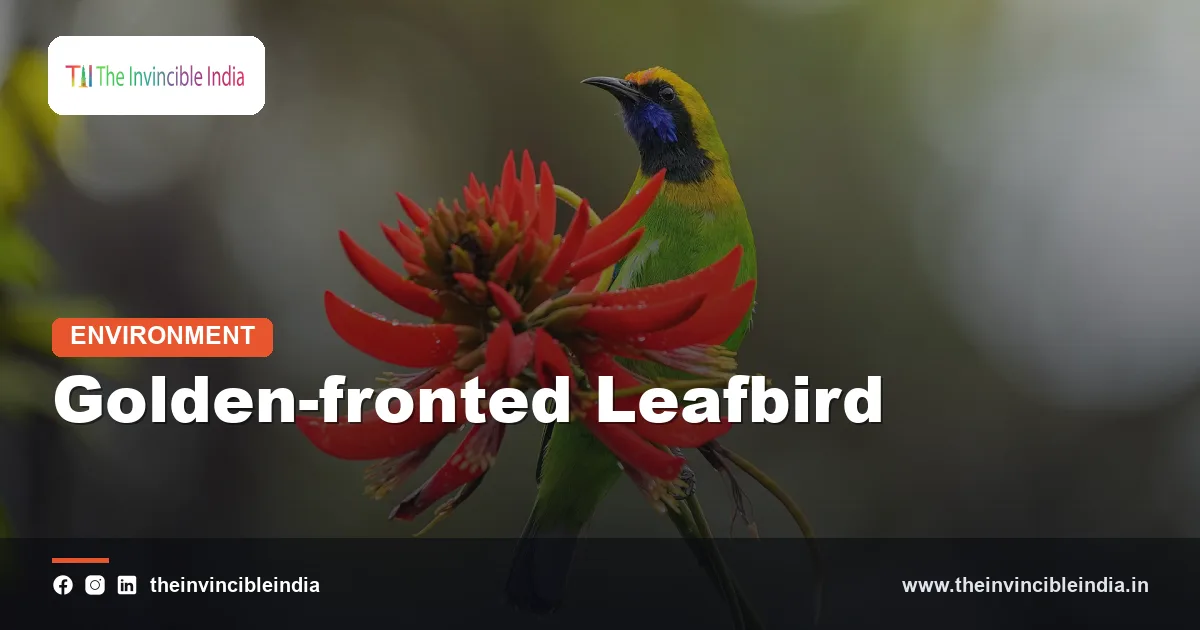
The golden-fronted leafbird (Chloropsis aurifrons) is a leaf-green songbird with an orange-gold forehead, found in the forests, orchards and wooded gardens of India. It feeds on nectar, fruit and insects, pollinates trees as it moves between flowers, and is a gifted mimic of other birds. This guide explains how the golden-fronted leafbird looks, where it lives, what it eats, how it breeds and why it is so easy to miss in the canopy.
Despite its vivid colours, the golden-fronted leafbird is a surprisingly secretive bird, because its green plumage is nearly perfect camouflage among leaves. Its melodious and varied voice is often the best clue that one is nearby.
| Common name | Golden-fronted leafbird |
|---|---|
| Scientific name | Chloropsis aurifrons |
| Family | Chloropseidae (leafbirds), order Passeriformes |
| Size | About 19 cm long; roughly bulbul-sized |
| Range in India | Himalayan foothills, northeast India, central and peninsular India including the Western and Eastern Ghats; also Nepal, Bangladesh, Sri Lanka and Southeast Asia |
| Habitat | Moist and dry deciduous forest, evergreen forest edges, orchards, plantations and large gardens |
| Diet | Flower nectar, fruit and insects |
| Breeding | Small cup nest of fine fibres on a slender high branch; usually two to three eggs |
| Conservation status | Least Concern on the IUCN Red List |
Key Takeaways
- The golden-fronted leafbird is a bulbul-sized, bright green songbird with an orange-gold forehead and, in the male, a black face and throat.
- The golden-fronted leafbird lives across much of India, from the Himalayan foothills and northeast to the peninsular hills, in forests, orchards and wooded gardens.
- The golden-fronted leafbird feeds on nectar, fruit and insects, and it pollinates flowers such as silk cotton and coral trees while feeding.
- The golden-fronted leafbird is a skilled mimic that can reproduce the calls of many other birds in a varied, musical song.
- The golden-fronted leafbird is hard to see because its green plumage blends with foliage, so its voice is usually the first clue to its presence.
- The IUCN lists the golden-fronted leafbird as Least Concern, but the species has been caught for the cage-bird trade, which is illegal in India.
What does the golden-fronted leafbird look like?
The golden-fronted leafbird looks like a small, leaf-green bird with an orange-gold forehead and crown, a black face and throat in the male, and a bright blue edge to the black. It measures about 19 centimetres, similar to a bulbul, with a slim, slightly curved bill.
The body is entirely a rich grass or leaf green, which is slightly paler on the underside. The male has a black mask and bib, outlined by a vivid purplish-blue moustache stripe, and some blue appears on the shoulder of the wing. The orange or golden-yellow forehead sits above the black face and gives the species its name. The bill is black, thin and a little decurved, suited to probing flowers.
The female and young birds are duller than the male. They have less black on the face, a more blue-green tone to the throat and a weaker orange patch on the head. Young birds look mostly green with just hints of the adult face pattern.
Why is the golden-fronted leafbird so hard to spot?
The golden-fronted leafbird is hard to spot because its green body matches the colour of leaves, and it often forages high in dense foliage, moving slowly between branches. Even a brightly marked male can disappear when it sits still in a leafy tree. A sudden flash of orange or black as the bird turns its head is often the first thing a watcher sees.
Where is the golden-fronted leafbird found in India?
The golden-fronted leafbird is found across much of India, including the Himalayan foothills, the northeast, central India and the peninsula with its Western and Eastern Ghats. Outside India, it also lives in Nepal, Bangladesh, Sri Lanka and parts of Southeast Asia.
The bird is absent from the driest north-western deserts and the open treeless plains. It is a resident that stays in the same region through the year, though it may move short distances to follow flowering and fruiting trees.
Which habitats does the golden-fronted leafbird prefer?
The golden-fronted leafbird prefers deciduous forest, forest edges, orchards, plantations and large wooded gardens, where it can find flowers and fruit. It does well where trees are tall and varied, and it is regularly seen in the canopy of mango, silk cotton and banyan trees. In hill country it may be found in the foothills and lower slopes, rather than at high altitude.
What does the golden-fronted leafbird eat?
The golden-fronted leafbird eats nectar, fruit and insects, with nectar being a major food whenever trees are in flower. It uses its fine, curved bill and a brush-like tongue to reach into blossoms.
- Nectar: from flowering trees and climbers, such as silk cotton, coral trees, loranthus and many others.
- Fruit: figs and small berries, which provide sugar and moisture.
- Insects: caterpillars, small bugs, flies and spiders gleaned from leaves and bark.
The bird often hangs upside down or stretches awkwardly to reach a flower. It works methodically through a tree, checking leaf surfaces and flower clusters. During flowering season, several leafbirds may gather in a single tree alongside sunbirds, bulbuls and mynas.
Can the golden-fronted leafbird mimic other birds?
Yes, the golden-fronted leafbird can mimic other birds, and it is regarded as one of the best songsters among Indian forest birds. It reproduces the calls and song phrases of a wide range of species and weaves them into its own song.
A singing leafbird may deliver a continuous sequence of whistles, chirps and imitations, so that an observer hears what sounds like several species coming from a single hidden bird. This ability is shared with other leafbirds, and it explains why the species has often been mistaken for a mixed flock when heard in dense forest. The mimicry is thought to be linked to territory defence and courtship, though scientists are still studying its exact purpose.
The song is usually delivered from a high perch, often in the morning, and it can be loudest in the breeding season. It is one of the most distinctive sounds of an Indian woodland.
How does the golden-fronted leafbird breed?
The golden-fronted leafbird breeds by building a small cup nest of fine rootlets, fibres and grass on a thin, high branch, where the female lays two to three eggs. The nest is lightly woven and often hangs between twigs, which makes it difficult to see from below.
Breeding takes place mainly in the warmer months, with the timing varying between regions and following the flowering and fruiting of trees. The eggs are pale and marked with spots. Both parents take part in rearing the young, which are fed on insects and fruit. The chicks leave the nest after about two to three weeks, although exact periods vary.
Nest sites are usually well above the ground in leafy trees. Because the nest is small and camouflaged, it is rarely discovered by chance, and disturbance can cause the parents to abandon it.
How can the golden-fronted leafbird be told apart from other leafbirds?
The golden-fronted leafbird can be told apart from other leafbirds mainly by its orange-gold forehead, its black face and throat with a blue moustache, and its all-green body. India has three or four leafbirds, and the head pattern separates them.
| Leafbird | Key identification point | Typical range in India |
|---|---|---|
| Golden-fronted leafbird | Orange-gold forehead, black face and throat with blue moustache, green body | Wide: Himalayan foothills, northeast, peninsular India |
| Orange-bellied leafbird | Orange belly, blue on the wings and tail, black face with blue moustache | Himalayan foothills and northeast hills |
| Jerdon’s leafbird | Mostly green with no orange forehead, small black chin patch with a blue moustache | Western Ghats and parts of south and central India |
| Blue-winged leafbird | Blue on the wings and tail, yellowish-green head | Northeast India |
A bird with an orange cap and a dark mask in woodland is likely to be a golden-fronted leafbird. Where ranges overlap, birders pay special attention to the colour of the forehead and the belly.
What is a leafbird, and why is it called that?
A leafbird is a member of Chloropseidae, a small family of fruit-, nectar- and insect-eating songbirds of tropical Asia, and the name comes from their leaf-green plumage. The family contains only one genus, Chloropsis, with roughly a dozen species spread from India across Southeast Asia and the islands of Indonesia.
Leafbirds are close in habit to bulbuls and sunbirds, but they form their own family. They share a slender, slightly curved bill, a brush-tipped tongue for nectar and a habit of living high in the canopy. Most species have a green body with brightly coloured facial markings, and most are accomplished singers and mimics. The golden-fronted leafbird is one of the most widespread species in the family and is often the first leafbird that Indian birdwatchers learn to recognise.
Why is the golden-fronted leafbird green?
The golden-fronted leafbird is green because the colour hides the bird among leaves, protecting it from hawks and other predators that hunt by sight. The green helps both feeding and safety, since a bird that blends with foliage can forage in the open canopy without being noticed.
Colour in birds comes from pigments, structure or a mixture of both. The green of the leafbird is thought to arise from a combination of pigment and the way its feather surface scatters light, which produces a bright yet soft tone. The vivid orange forehead, black face and blue moustache serve a different purpose. These markings are mainly used in signalling to other leafbirds, during territorial displays and courtship, and they are hidden when the bird sits still facing away. This pairing of camouflage and bright signals is a common pattern among tropical forest birds.
- Camouflage: the green body hides the bird from predators and prey.
- Signalling: the face colours are used to show identity and status.
- Display: a male may fluff his head feathers to emphasise the mask during courtship.
Why are leafbirds important to flowering trees?
Leafbirds are important to flowering trees because they carry pollen from one blossom to another as they drink nectar, helping many forest and garden trees to set fruit. The golden-fronted leafbird visits large, nectar-rich flowers in particular.
As the bird pushes its bill into a flower, pollen sticks to its forehead and bill. When it moves to the next blossom, some of this pollen is transferred. Birds that act in this way are called pollinators, and in India they work alongside sunbirds, bulbuls and white-eyes. The golden-fronted leafbird also helps spread seeds, because it swallows small fruits and passes the seeds elsewhere.
Insects eaten by the leafbird add another benefit, since the bird takes caterpillars and bugs from the leaves of trees. Taken together, these roles make the leafbird a quiet contributor to the health of woodland and orchards.
Is the golden-fronted leafbird threatened?
The golden-fronted leafbird is not threatened with extinction; the IUCN rates it as Least Concern because it has a wide range and a large population. It remains a regular bird of Indian woods and gardens.
However, leafbirds have been caught for the cage-bird trade in parts of Asia because of their colour and song, and trapping can reduce local numbers. In India, capturing or keeping wild birds is illegal under the Wildlife (Protection) Act, 1972. Other pressures include loss of forest and old orchard trees and the use of pesticides that remove insect food.
How can you watch the golden-fronted leafbird?
The best way to watch a golden-fronted leafbird is to find a flowering or fruiting tree in the early morning and scan the upper foliage for small green birds that move steadily among the blossoms. Listening for the varied song helps to locate the bird first.
- Choose the right tree: flowering silk cotton, coral trees and fruiting figs draw leafbirds.
- Listen first: a mix of imitations from a hidden perch is a strong clue.
- Look for orange: a flash of golden forehead helps find the bird against the green.
- Use binoculars: the bird is often high, and details of the face are small.
- Stay quiet and still: leafbirds are wary but will return to a favourite tree.
Wooded parks, forest edges and large orchards in the foothills and peninsular hills are all good places. Photographers should avoid playback of calls, since repeated playing can stress the bird.
Bottom Line
The golden-fronted leafbird is a leaf-green, orange-fronted forest songbird of India that feeds on nectar, fruit and insects and mimics other birds with remarkable skill. It is common and secure, helps pollinate trees and is best found by listening for its voice in flowering trees.
Frequently Asked Questions
What is a golden-fronted leafbird?
A golden-fronted leafbird is a leaf-green songbird with an orange-gold forehead, found in the forests, orchards and gardens of India. It is about 19 cm long and feeds on nectar, fruit and insects. The male has a black face and throat edged with blue.
Where does the golden-fronted leafbird live in India?
The golden-fronted leafbird lives in the Himalayan foothills, the northeast, central India and the peninsular hills including the Western and Eastern Ghats. It prefers deciduous forest, forest edges, orchards and large gardens. It is a resident bird that does not make long migrations.
What does the golden-fronted leafbird eat?
The golden-fronted leafbird eats flower nectar, small fruits such as figs and berries, and insects. It uses a fine curved bill and brush-tipped tongue to reach nectar. Insects, especially caterpillars, are also eaten and fed to chicks.
Can the golden-fronted leafbird mimic other birds?
Yes, the golden-fronted leafbird can mimic the calls of many other birds and mixes them into a varied song. A single singing bird may sound like several species at once. The mimicry is thought to help with territory defence and courtship.
How can I tell a golden-fronted leafbird from an orange-bellied leafbird?
A golden-fronted leafbird has an orange-gold forehead and an all-green body, while an orange-bellied leafbird has an orange belly and blue on the wings and tail. Both males have a black face with a blue moustache. The orange-bellied leafbird is restricted mainly to the Himalayan foothills and the northeast.
Is it legal to keep a leafbird as a pet in India?
No, it is illegal to catch or keep a wild leafbird in India, because most native wild birds are protected under the Wildlife (Protection) Act, 1972. Leafbirds have been trapped for the cage-bird trade because of their colour and song. Anyone aware of such trapping can report it to the forest department.
{“@context”:”https://schema.org”,”@graph”:[{“@type”:”FAQPage”,”mainEntity”:[{“@type”:”Question”,”name”:”What is a golden-fronted leafbird?”,”acceptedAnswer”:{“@type”:”Answer”,”text”:”A golden-fronted leafbird is a leaf-green songbird with an orange-gold forehead, found in the forests, orchards and gardens of India. It is about 19 cm long and feeds on nectar, fruit and insects. The male has a black face and throat edged with blue.”}},{“@type”:”Question”,”name”:”Where does the golden-fronted leafbird live in India?”,”acceptedAnswer”:{“@type”:”Answer”,”text”:”The golden-fronted leafbird lives in the Himalayan foothills, the northeast, central India and the peninsular hills including the Western and Eastern Ghats. It prefers deciduous forest, forest edges, orchards and large gardens. It is a resident bird that does not make long migrations.”}},{“@type”:”Question”,”name”:”What does the golden-fronted leafbird eat?”,”acceptedAnswer”:{“@type”:”Answer”,”text”:”The golden-fronted leafbird eats flower nectar, small fruits such as figs and berries, and insects. It uses a fine curved bill and brush-tipped tongue to reach nectar. Insects, especially caterpillars, are also eaten and fed to chicks.”}},{“@type”:”Question”,”name”:”Can the golden-fronted leafbird mimic other birds?”,”acceptedAnswer”:{“@type”:”Answer”,”text”:”Yes, the golden-fronted leafbird can mimic the calls of many other birds and mixes them into a varied song. A single singing bird may sound like several species at once. The mimicry is thought to help with territory defence and courtship.”}},{“@type”:”Question”,”name”:”How can I tell a golden-fronted leafbird from an orange-bellied leafbird?”,”acceptedAnswer”:{“@type”:”Answer”,”text”:”A golden-fronted leafbird has an orange-gold forehead and an all-green body, while an orange-bellied leafbird has an orange belly and blue on the wings and tail. Both males have a black face with a blue moustache. The orange-bellied leafbird is restricted mainly to the Himalayan foothills and the northeast.”}},{“@type”:”Question”,”name”:”Is it legal to keep a leafbird as a pet in India?”,”acceptedAnswer”:{“@type”:”Answer”,”text”:”No, it is illegal to catch or keep a wild leafbird in India, because most native wild birds are protected under the Wildlife (Protection) Act, 1972. Leafbirds have been trapped for the cage-bird trade because of their colour and song. Anyone aware of such trapping can report it to the forest department.”}}]}]}


