

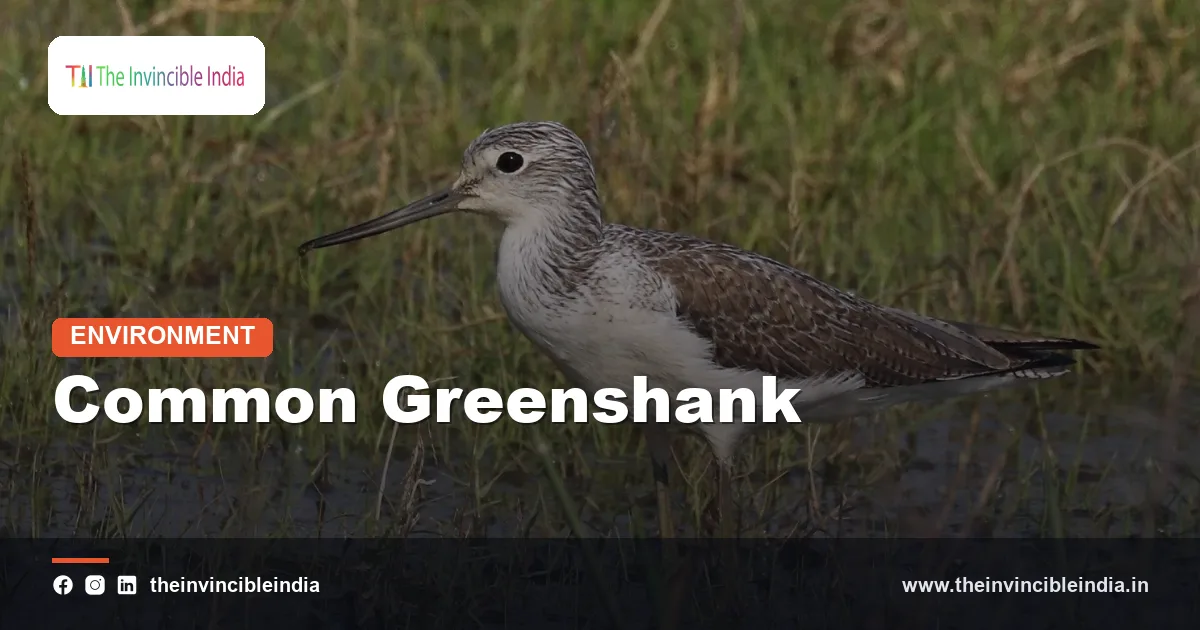
The common greenshank (Tringa nebularia) is a tall, pale grey wading bird with long greenish legs and a slightly upturned bill that breeds in the northern forests of Eurasia and spends the winter on wetlands, estuaries and coasts across India. It is among the most widespread and easily noticed of the larger shorebirds in the country, and it is recognised by its loud, ringing three-note call.
The greenshank is a restless, active feeder that wades in deeper water than most small waders and often chases fish and other prey at speed. The sections below explain how to identify the common greenshank, where it lives in India, what it eats, when it migrates and breeds, and how it differs from similar birds such as the marsh sandpiper and the common redshank.
| Attribute | Details |
|---|---|
| Common name | Common greenshank |
| Scientific name | Tringa nebularia |
| Family | Scolopacidae (sandpipers, snipes and allies) |
| Size | About 30 to 35 cm long, with a wingspan of roughly 55 to 65 cm |
| India range and habitat | Found across the country on lakes, marshes, reservoirs, riverbanks, saltpans, estuaries, mangrove creeks and tidal flats, mostly below the hills |
| Diet | Small fish, aquatic insects, crustaceans, molluscs, worms and tadpoles |
| Breeding and migration | Breeds in northern Eurasia from Scotland and Scandinavia across Siberia; winters in Africa, South Asia, Southeast Asia and Australasia; arrives in India from about August and leaves by April-May |
| Conservation status | Least Concern on the IUCN Red List |
Key Takeaways
- The common greenshank is a tall Eurasian wader, about 30 to 35 cm long, that winters on freshwater and coastal wetlands throughout India.
- The common greenshank is identified by its greenish-yellow legs, its long, slightly upturned grey bill and a white wedge that runs up its back in flight.
- The common greenshank gives a loud, ringing, three-noted “tew-tew-tew” call, which is often the first sign that the bird is nearby.
- The common greenshank hunts by wading, sweeping its bill sideways and chasing small fish, insects and crustaceans in shallow water.
- The common greenshank breeds in the boggy forests of northern Eurasia and reaches India as a passage and winter visitor between roughly August and April.
- The common greenshank is classed as Least Concern by the International Union for Conservation of Nature (IUCN), though it depends on healthy wetlands along the Central Asian Flyway.
What is the common greenshank?
The common greenshank is a large sandpiper of the family Scolopacidae and belongs to the genus Tringa, the group commonly called “shanks” because of their long, brightly coloured legs. The scientific name Tringa nebularia refers to its pale, misty grey colouring, and the name “greenshank” refers to the greenish tint of its legs.
The bird is built for wading. It has a long neck, long legs, a deep-based bill that turns slightly upward, and a streamlined body. It is the largest of the shanks seen regularly in India, bigger than the common redshank, the marsh sandpiper and the wood sandpiper. A close relative, Nordmann’s greenshank (Tringa guttifer), is a much rarer and globally endangered species that winters mostly in parts of Southeast Asia, with only occasional records in eastern India.
The common greenshank is a well-studied species because it breeds across a huge northern range and winters across three continents, which makes it a convenient indicator of wetland health on long flyways.
How do you identify a common greenshank?
A common greenshank is identified by its long, pale greenish legs, its thick grey bill with a slight upward tilt, and its overall pale grey-and-white appearance. In flight, a long white wedge up the back and a plain dark wing complete the picture.
Plumage
In winter the upperparts are pale ash-grey with fine white edging on the feathers, and the underparts are clean white, so the whole bird looks very pale. The face is whitish with a faint grey wash on the sides of the head and neck. In breeding plumage, the back and shoulders become darker and are marked with bold black spots and streaks, and the breast shows dark flecking. Birds seen in India in early spring and late summer often show this darker, more heavily marked plumage as they come into breeding dress.
Bill and legs
The bill is long, stout at the base and grey, with a dark tip, and it curves up very slightly. The legs are long and range from olive-green to yellowish-green, sometimes looking dull grey in poor light. The leg colour distinguishes it from the common redshank, which has bright orange-red legs.
Flight and voice
In flight the bird shows a plain dark upper wing without a bold wing bar and a long white patch from the rump up the lower back. The feet project beyond the tail. The call is a loud, clear and ringing “tchew-tchew-tchew”, usually in three even notes, and it carries a long distance across open water. The call is one of the most reliable ways to identify the species.
Where does the common greenshank live in India?
The common greenshank lives in wetlands across nearly all of India during the non-breeding season, including freshwater lakes, marshes, reservoirs, riverbanks, saltpans, estuaries and tidal mudflats. It prefers open, fairly shallow water with a muddy or sandy edge rather than dense vegetation.
Key habitats and examples include:
- Freshwater lakes and marshes, such as those in Keoladeo National Park, Rajasthan, and Bhoj Wetland, Madhya Pradesh
- Large coastal lagoons such as Chilika Lake in Odisha and Pulicat Lake on the Andhra Pradesh and Tamil Nadu border
- Estuaries, mangrove creeks and tidal flats along the east and west coasts, including the Sundarbans
- Saltpans and coastal wetlands in Gujarat and Tamil Nadu
- Reservoirs, village tanks, flooded fields and sewage-fed wetlands near towns
The bird is found from sea level to moderate elevations and is only a passage visitor in the higher Himalaya. In the north-east, along the Brahmaputra floodplain, it is also a regular winter visitor on riverine sandbars and shallow pools.
When does the common greenshank migrate to and from India?
The common greenshank arrives in India from about August and early September, and most birds leave by April or May to head for their northern breeding grounds. A few non-breeding individuals, often one-year-old birds, remain through the summer on southern coasts and large inland wetlands.
The southward passage begins early. Adults that have finished nesting leave first in July and August, followed by the young of the year, which travel on their own and are paler and more neatly scaled in appearance. The spring passage northward in April and May can bring larger numbers to some coastal and inland wetlands as birds rest and refuel on the way.
Greenshanks may stay in India for the whole winter or continue farther south to Sri Lanka, the Maldives or beyond. They are often described as passage migrants as well as winter visitors, because some stop in India briefly before moving on.
Why does the common greenshank migrate?
The common greenshank migrates because the northern bogs and forest clearings where it breeds freeze in winter and cannot provide food. By moving south, the bird reaches unfrozen shallow water where fish and invertebrates are available all year.
The species follows several flyways. Birds that breed in Europe mainly head to Africa and the Mediterranean, while those from Siberia fly across Central Asia and use the Central Asian Flyway and the East Asian-Australasian Flyway to reach South Asia, Southeast Asia and Australia. India lies on the southern part of the Central Asian Flyway, so large numbers pass through or spend the winter here.
Migration is typically undertaken at night in small flocks that may break up on arrival. The long journeys depend on a chain of stopover wetlands, which is why the loss of any one major site can affect the birds far from where the damage occurs.
What does the common greenshank eat?
The common greenshank eats small fish, aquatic insects, crustaceans, molluscs, worms and tadpoles, and it is more fish-dependent than most of the other shanks. The bird is an opportunistic predator that takes whatever small animals are plentiful in the water around it.
The main prey groups are:
- Small fish such as minnows, fry and gobies
- Aquatic insects and their larvae, including beetles, bugs and dragonfly nymphs
- Crustaceans such as shrimps, prawns and small crabs
- Marine and freshwater worms
- Small snails and other molluscs
- Tadpoles and small frogs
The greenshank has several feeding styles. It may walk slowly and pick prey from the surface, probe the mud, or move its bill from side to side through the water. A well-known technique is the fast chase, in which the bird runs in shallow water with its bill held low and sometimes zigzags after a fish. It also often wades up to its belly in deeper water than smaller waders can use, which gives it access to food that other species cannot reach.
How does the common greenshank behave?
The common greenshank is an alert, wary and active bird that feeds alone or in loose groups and is often the first to give an alarm call. Its sharp, ringing cry warns nearby waders and ducks of danger, and many birdwatchers know the species as the sentinel of a wetland.
Greenshanks can be seen alone, in small parties or with other waders such as stilts, redshanks and ruffs. They roost in groups at high tide or at night, standing on one leg in shallow water or on a sandbank. When disturbed they take off with a loud call and fly a considerable distance before landing again.
The bird bobs its head and body slightly when it is nervous. In contrast to the continuous tail-bobbing of the common sandpiper, the greenshank only occasionally teeters, and its main movement is the steady, high-stepping walk of a long-legged wader.
How does the common greenshank breed?
The common greenshank breeds in the north of Eurasia, in boggy open forest and moorland, where it lays about four eggs in a shallow scrape on the ground. It does not breed in India, so all Indian birds are visitors.
Key features of its breeding are:
- The nest is a simple scrape, often near a fallen log, stump or tussock, where it can watch the surroundings.
- The eggs are buff to greenish with dark blotches that blend with the ground.
- Both parents take turns incubating for about three to four weeks.
- The chicks leave the nest within hours and feed themselves, guarded by the parents.
- The adults often perch on top of trees or stumps and call loudly to defend the area, a behaviour seen in few other waders.
The core breeding range extends from northern Scotland and Scandinavia across the taiga of Russia to the Pacific coast. Because the birds nest in remote areas, many details about their breeding come from long-term studies in northern Europe.
How is the common greenshank different from similar birds?
The common greenshank differs from similar waders in its larger size, greenish legs, pale grey plumage and loud three-note call. Several other medium-sized waders in India share part of this look, so a comparison is helpful.
| Species | Key difference from the common greenshank |
|---|---|
| Marsh sandpiper (Tringa stagnatilis) | Smaller and more slender, with a very thin straight bill and proportionally longer legs |
| Common redshank (Tringa totanus) | Bright orange-red legs, a red-based bill and white trailing edges on the wings |
| Spotted redshank (Tringa erythropus) | Longer, finer bill with a drooping tip, and dark grey winter plumage with red legs |
| Wood sandpiper (Tringa glareola) | Much smaller, with a spotted back and a short straight bill |
| Nordmann’s greenshank (Tringa guttifer) | Thicker, shorter bill with a pale base, and shorter yellowish legs; a rare and endangered species |
The marsh sandpiper is the species most often confused with the greenshank. The key distinctions are the marsh sandpiper’s needle-thin straight bill and delicate size, whereas the greenshank is stout, heavy-billed and noticeably larger.
Is the common greenshank threatened?
The common greenshank is not globally threatened; the IUCN lists it as Least Concern because of its enormous range and large population. Even so, it is vulnerable to the steady loss of wetlands on which it depends.
The principal pressures include:
- Conversion of coastal wetlands and mudflats for ports, aquaculture, industry and housing
- Drainage and pollution of inland lakes and marshes
- Disturbance by people, dogs and vehicles at roosting sites
- Changes to northern breeding habitat through logging, drainage and climate change
Because greenshanks depend on a chain of wetlands from the Arctic to the tropics, long-term protection of key sites such as Ramsar wetlands in India is important. The bird itself is a useful signal: healthy numbers suggest that shallow-water fish and invertebrate life is still intact.
How can you watch common greenshanks in India?
Common greenshanks can be watched by visiting any large, open wetland between September and April and scanning the water edge for a tall, pale wader with green legs. A spotting scope or binoculars helps, since the bird is wary and flies off at the slightest disturbance.
- Visit early in the morning or around the turn of the tide on coastal wetlands.
- Listen for the loud three-note call, which often gives the bird away before it is seen.
- Look for a tall bird feeding in deeper water than the smaller waders around it.
- Check the leg colour, bill shape and size to separate it from the marsh sandpiper and redshanks.
- Observe from a hide, vehicle or distance to avoid flushing flocks.
The species is regularly recorded at sites such as Keoladeo National Park, Chilika Lake, Pulicat Lake, Point Calimere in Tamil Nadu, the Nal Sarovar and Little Rann of Kutch region in Gujarat, and many city lakes. Annual waterbird counts such as the Asian Waterbird Census record the species each January.
Bottom Line
The common greenshank is a tall, pale, green-legged wader that breeds in northern Eurasian bogs and winters on wetlands and coasts throughout India. It is recognised by its upturned bill, white back wedge in flight and ringing three-note call, and it remains common but dependent on a healthy chain of flyway wetlands.
Frequently Asked Questions
Is the common greenshank found in India all year?
The common greenshank is mainly a winter visitor and passage migrant, present from about August to April. A few non-breeding birds, usually young ones, stay through the summer on some coasts and large wetlands.
How can I tell a common greenshank from a marsh sandpiper?
The common greenshank is larger and sturdier, with a thicker, slightly upturned bill, while the marsh sandpiper is smaller and more elegant, with a very thin straight bill and longer legs in proportion. The greenshank also gives a louder three-note call.
What does the common greenshank eat?
The common greenshank eats small fish, aquatic insects, crustaceans, worms, molluscs and tadpoles. It often wades in deeper water than smaller waders and sometimes chases fish with quick zigzag runs.
Does the common greenshank breed in India?
No, the common greenshank does not breed in India. It nests in boggy forests and moorland across northern Eurasia, from Scotland and Scandinavia to eastern Siberia, and visits India only in the non-breeding season.
Why is it called a greenshank?
The bird is called a greenshank because “shank” means leg and its long legs are greenish or yellowish-green. The colour helps separate it from the redshanks, which have orange-red legs.
Is the common greenshank endangered?
No, the common greenshank is listed as Least Concern by the IUCN because it has a very large range and population. It is still affected by the loss and pollution of wetlands along its migration route, so protection of stopover sites matters.
{“@context”:”https://schema.org”,”@graph”:[{“@type”:”FAQPage”,”mainEntity”:[{“@type”:”Question”,”name”:”Is the common greenshank found in India all year?”,”acceptedAnswer”:{“@type”:”Answer”,”text”:”The common greenshank is mainly a winter visitor and passage migrant, present from about August to April. A few non-breeding birds, usually young ones, stay through the summer on some coasts and large wetlands.”}},{“@type”:”Question”,”name”:”How can I tell a common greenshank from a marsh sandpiper?”,”acceptedAnswer”:{“@type”:”Answer”,”text”:”The common greenshank is larger and sturdier, with a thicker, slightly upturned bill, while the marsh sandpiper is smaller and more elegant, with a very thin straight bill and longer legs in proportion. The greenshank also gives a louder three-note call.”}},{“@type”:”Question”,”name”:”What does the common greenshank eat?”,”acceptedAnswer”:{“@type”:”Answer”,”text”:”The common greenshank eats small fish, aquatic insects, crustaceans, worms, molluscs and tadpoles. It often wades in deeper water than smaller waders and sometimes chases fish with quick zigzag runs.”}},{“@type”:”Question”,”name”:”Does the common greenshank breed in India?”,”acceptedAnswer”:{“@type”:”Answer”,”text”:”No, the common greenshank does not breed in India. It nests in boggy forests and moorland across northern Eurasia, from Scotland and Scandinavia to eastern Siberia, and visits India only in the non-breeding season.”}},{“@type”:”Question”,”name”:”Why is it called a greenshank?”,”acceptedAnswer”:{“@type”:”Answer”,”text”:”The bird is called a greenshank because “shank” means leg and its long legs are greenish or yellowish-green. The colour helps separate it from the redshanks, which have orange-red legs.”}},{“@type”:”Question”,”name”:”Is the common greenshank endangered?”,”acceptedAnswer”:{“@type”:”Answer”,”text”:”No, the common greenshank is listed as Least Concern by the IUCN because it has a very large range and population. It is still affected by the loss and pollution of wetlands along its migration route, so protection of stopover sites matters.”}}]}]}


