

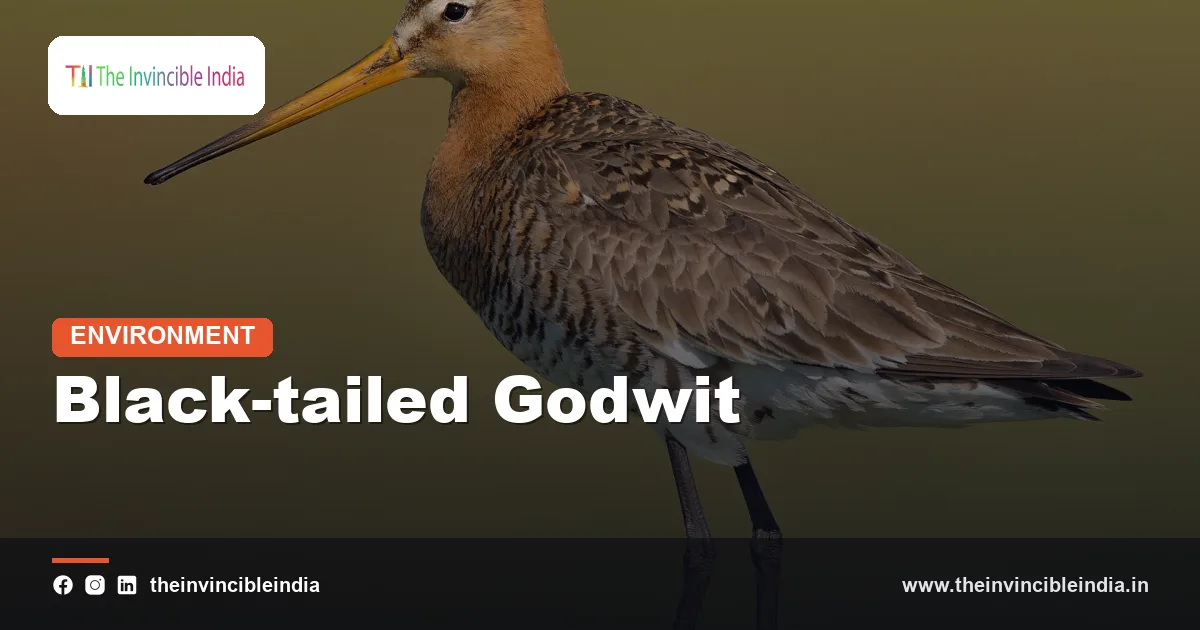
The black-tailed godwit (Limosa limosa) is a large, long-legged wading bird with a very long, straight bill and a tail that is white at the base and black at the tip, and it winters in flocks on wetlands, flooded fields and coasts across India. Most of the birds seen in the country breed on wet grasslands and meadows in Central Asia and Eastern Europe and travel south in the post-monsoon months.
The godwit is among the most striking of the winter waders: in flight it flashes a broad white wing bar and a clean white rump, and on the ground it probes deep into soft mud with its extraordinary bill. The sections below explain what the black-tailed godwit looks like, where and when it is found in India, what it eats, how it migrates and breeds, and how it differs from the bar-tailed godwit and curlews.
| Attribute | Details |
|---|---|
| Common name | Black-tailed godwit |
| Scientific name | Limosa limosa |
| Family | Scolopacidae (sandpipers, snipes, curlews and godwits) |
| Size | About 36 to 44 cm long, with a wingspan of roughly 62 to 70 cm |
| India range and habitat | Winter visitor across much of the country on lakes, marshes, reservoirs, flooded paddy fields, saltpans, estuaries and tidal mudflats, most numerous in the north-west, west and along the coasts |
| Diet | Worms, insects and their larvae, molluscs, crustaceans, small amphibians, and seeds or grain in winter |
| Breeding and migration | Breeds on wet meadows and grassland from Iceland and Western Europe across Central Asia to eastern Siberia; Indian winter visitors arrive from about August-September and leave by April-May |
| Conservation status | Near Threatened on the IUCN Red List |
Key Takeaways
- The black-tailed godwit is a large Eurasian wader, about 36 to 44 cm long, that visits India as a winter migrant between roughly August and April.
- The black-tailed godwit is identified by its very long straight bill, long legs, black-tipped white tail and a bold white stripe along the upper wing in flight.
- The black-tailed godwit probes deep into soft mud and shallow water for worms, insects, molluscs and crustaceans, and it also eats seeds and grain in winter.
- The black-tailed godwit breeds on wet meadows and grasslands in Europe and Asia, and it shows strong brick-red colouring on the head, neck and breast in breeding plumage.
- The black-tailed godwit is listed as Near Threatened by the International Union for Conservation of Nature (IUCN) because its global population has fallen with the loss of wet grassland and wetlands.
- The black-tailed godwit is different from the bar-tailed godwit (Limosa lapponica), which has a barred tail, shorter legs, a slightly upturned bill and a mainly coastal habit.
What is the black-tailed godwit?
The black-tailed godwit is a large shorebird of the family Scolopacidae and belongs to the genus Limosa, the godwits. The scientific name Limosa comes from the Latin word for mud, which describes the muddy places where the birds feed. The word “godwit” is an old English name of uncertain origin that is often said to imitate the bird’s call.
The bird is a tall, elegant wader with a long neck, long legs and a bill that may be longer than the bird’s head and neck combined. There are three recognised subspecies. The nominate Limosa limosa limosa breeds across Europe and western Central Asia, and a large share of the birds that winter in India belong to this group or to the eastern Asian form. The subspecies islandica breeds in Iceland and winters in Western Europe, and the subspecies melanuroides breeds in eastern Siberia and the Russian Far East and winters mainly in Southeast Asia and Australasia.
The godwits are a small group of four species worldwide. Besides the black-tailed godwit, the group includes the bar-tailed godwit, the Hudsonian godwit and the marbled godwit, the last two being American species.
How do you identify a black-tailed godwit?
A black-tailed godwit is identified by its very long, straight, pinkish-based bill, its long legs that project beyond the tail in flight, and a striking black-and-white pattern on the wings and tail. In India the bird is most often seen in its plain winter plumage.
Winter plumage
In winter the upperparts, head, neck and breast are a plain, uniform grey-brown, with paler underparts that fade to white on the belly. A pale eyebrow stripe is visible on the head. The bird can look dull and nondescript when standing, which is why the flight pattern is so useful for identification.
Breeding plumage
In breeding plumage the head, neck and breast become a rich orange-chestnut or brick-red, the back is mottled with black and chestnut, and the flanks show dark barring on a white belly. Birds that start to moult in spring before leaving India sometimes show patches of this colour, giving them a mottled, half-changed look.
Bill, legs and flight pattern
The bill is long and nearly straight, with a pink or orange base and a dark tip. The legs are long and dark. In flight, the bird shows a wide white stripe along the upper wing, a clean white rump and a tail that is white at the base with a broad black band at the end. This black-and-white pattern gives the species its name. The long legs trail behind in flight, and the call is a repeated nasal “wicka-wicka” or “kek-kek”.
Where does the black-tailed godwit live in India?
The black-tailed godwit lives on shallow freshwater and coastal wetlands across large parts of India during winter, including lakes, marshes, reservoirs, flooded fields, saltpans, estuaries and tidal flats. It is more common in the north, north-west and west of the country and along both coasts than in the interior south.
Habitats and well-known sites include:
- Freshwater lakes and marshes such as Keoladeo National Park in Rajasthan and Sultanpur in Haryana
- Large reservoirs and wetlands in Gujarat, including Nal Sarovar and the Little Rann of Kutch
- Coastal lagoons and estuaries such as Chilika Lake in Odisha
- The Gangetic and Brahmaputra floodplains, including seasonally flooded fields
- Saltpans, tidal mudflats and wet fields along the coasts of Maharashtra, Tamil Nadu and Kerala
The black-tailed godwit often uses flooded paddy fields and fish ponds when natural wetlands are scarce, and these agricultural landscapes can hold large flocks in winter. It is rare at high elevations.
When does the black-tailed godwit arrive in India?
The black-tailed godwit arrives in India from about August and September and stays until April or May, with the main wintering period from November to February. Some non-breeding young birds linger on southern coasts into the summer.
Early arrivals in the north-west typically appear in late summer, as adults that have finished breeding leave the northern grasslands in July and August. The numbers build through the autumn as birds from further north and east arrive. In spring the departing flocks gather at big wetlands before moving north, and at this time the birds often show their colourful breeding plumage.
Why does the black-tailed godwit migrate?
The black-tailed godwit migrates because the wet grasslands where it breeds offer rich food and nest sites in summer but become frozen, snow-covered or dry in winter. The bird therefore travels thousands of kilometres to reach warm, soft-bottomed wetlands that still hold food.
Birds that breed in Central Asia and Eastern Europe follow routes that cross the Central Asian Flyway and reach the Indian subcontinent, where many spend the winter. The eastern subspecies uses the East Asian-Australasian Flyway. The Icelandic subspecies makes one of the best-known migrations among waders, flying non-stop across the North Atlantic to the British Isles and Western Europe in a single flight of more than a thousand kilometres.
The related bar-tailed godwit holds the record for the longest known non-stop flight by any bird, flying from Alaska to New Zealand without feeding. The black-tailed godwit’s own migrations are shorter but still demanding, and the birds rely on stopover wetlands in Central Asia, such as lakes and steppe marshes, to rest and refuel.
What does the black-tailed godwit eat?
The black-tailed godwit eats mainly soft-bodied invertebrates such as worms, insects and their larvae, molluscs and crustaceans, which it finds by probing in wet mud. In winter it also eats seeds and grain, and in places it feeds in rice fields.
The main food types are:
- Earthworms and marine worms, taken from deep in soft mud
- Insect larvae, beetles, flies and bugs, especially on breeding grounds
- Snails, small bivalves and other molluscs on estuarine mudflats
- Small crustaceans such as shrimps and crabs
- Tadpoles and small frogs
- Seeds, rice grains and plant matter, particularly in winter and on migration
The long bill is a sensitive tool. The tip is rich in nerve endings, and the bird can feel prey in the mud without seeing it. The godwit pushes its bill in with a quick, stitching, sewing-machine motion, and may submerge the whole head when feeding in deeper water. It feeds both by day and at night, depending on tides and disturbance.
How does the black-tailed godwit behave?
The black-tailed godwit is a social bird that feeds and roosts in flocks, often with other waders such as ruffs, redshanks, stilts and avocets. Flocks of dozens or even hundreds are common on good wetlands during winter.
The birds wade steadily through shallow water, probing as they go, and are wary of approach. They take off together, and the flock wheels as a tight group, flashing the black-and-white wing and tail pattern. At night and at high tide, they roost in dense groups on open mud, sandbanks or shallow pools, often standing on one leg.
Godwits form a loose community with other waders and are often alert to the alarm calls of redshanks and greenshanks. The bird is generally quiet in winter but calls loudly on migration and on the breeding grounds.
How does the black-tailed godwit breed?
The black-tailed godwit breeds on wet meadows, damp grassland and marshy fields in Europe and Asia, laying about four eggs in a shallow scrape in the grass. It does not breed in India, so all the godwits seen in the country are visitors.
Key features of its breeding are:
- Males perform noisy display flights, tumbling and calling over the nesting area, and are strongly territorial.
- The nest is a shallow depression lined with grass in a clump of tall vegetation.
- The eggs are olive-green or buff with brown blotches, providing camouflage.
- Both parents incubate for about three to four weeks and defend the nest by mobbing predators.
- The downy chicks leave the nest soon after hatching and feed themselves under parental guard.
The species is closely tied to farmland meadows in parts of Western Europe, where changes in grassland management and drainage have strongly affected breeding success.
How is the black-tailed godwit different from similar birds?
The black-tailed godwit differs from similar large waders in its straight bill, long legs and black-and-white wing and tail pattern. Several other species share parts of this look, so a quick comparison helps.
| Species | Key difference from the black-tailed godwit |
|---|---|
| Bar-tailed godwit (Limosa lapponica) | Shorter legs, a slightly upturned bill, a barred tail, no broad white wing bar, and a more coastal habit |
| Eurasian curlew (Numenius arquata) | Long downcurved bill, streaked brown plumage and no black-and-white tail |
| Whimbrel (Numenius phaeopus) | Smaller, with a downcurved bill and bold head stripes |
| Spotted redshank (Tringa erythropus) | Much smaller, with red legs and a thinner bill that droops slightly at the tip |
| Common snipe (Gallinago gallinago) | Much smaller, shorter-legged and heavily striped, with a long straight bill held downward |
The simplest check is the bill and the wing and tail pattern. A straight, long-billed wader with a black-tipped white tail and a bold white wing stripe in flight is a black-tailed godwit, and a bird with an upturned bill and a barred tail is a bar-tailed godwit.
Is the black-tailed godwit threatened?
The black-tailed godwit is classed as Near Threatened by the IUCN, meaning that it is close to qualifying for a threatened category. Its global population has declined, mainly because of the loss and degradation of breeding grasslands and wintering wetlands.
The main pressures include:
- Drainage and intensive management of wet meadows in Europe, which reduce nesting success
- Loss of steppe wetlands and grasslands in Central Asia
- Conversion of coastal mudflats and estuaries for ports, industry and aquaculture
- Hunting and disturbance at some staging and wintering sites
- Pollution and drying of inland lakes and marshes
The species is covered by international agreements such as the Convention on Migratory Species (CMS) and the African-Eurasian Waterbird Agreement, and it benefits from the protection of Ramsar sites. Protecting stopover and wintering wetlands in India is one part of a wider effort across the flyways.
How can you watch black-tailed godwits in India?
Black-tailed godwits can be watched by visiting large, open wetlands with shallow water between October and March and scanning mudflats and shallows for tall, long-billed waders in flocks. A spotting scope helps, as the birds are wary and often feed far from the shore.
- Visit reservoirs, lakes and coastal lagoons in the north-west, west and along the coasts.
- Check flooded fields and fish ponds, which can hold feeding flocks.
- Look for a flash of white along the wing and a black-tipped tail when the flock takes off.
- Note the straight bill to separate godwits from curlews and the bar-tailed godwit.
- Stay at a distance and avoid flushing the flock, since waders need undisturbed time to feed.
Sites such as Keoladeo National Park, Sultanpur, Nal Sarovar, the Little Rann of Kutch, Chilika Lake and the Sundarbans are regularly mentioned in bird records for the species.
Bottom Line
The black-tailed godwit is a tall, long-billed wader that breeds on northern wet grasslands and winters in flocks on Indian wetlands, flooded fields and coasts. It is recognised by its straight bill and black-and-white wing and tail pattern, and its Near Threatened status makes the protection of wetlands along its flyways important.
Frequently Asked Questions
Where does the black-tailed godwit come from before it reaches India?
The black-tailed godwits that winter in India breed mainly on wet grasslands and meadows in Eastern Europe and Central Asia, and some may come from farther east in Siberia. They travel south after the breeding season and arrive from about August and September.
How can I tell a black-tailed godwit from a bar-tailed godwit?
The black-tailed godwit has a straight bill, longer legs, a black-tipped white tail and a broad white wing stripe in flight. The bar-tailed godwit has a slightly upturned bill, shorter legs, a barred tail and a more coastal habit.
What does the black-tailed godwit eat?
The black-tailed godwit eats worms, insects and their larvae, molluscs, crustaceans and small amphibians, found by probing in mud and shallow water. In winter it also eats seeds and grain, including rice.
Does the black-tailed godwit breed in India?
No, the black-tailed godwit does not breed in India. It nests on wet meadows and grasslands in Europe and Asia, and the birds seen in India are winter visitors that leave by April or May.
Why is the black-tailed godwit called Near Threatened?
The black-tailed godwit is called Near Threatened because its global population has declined, mostly through the loss and drainage of breeding grasslands and the degradation of wintering wetlands. The IUCN uses this category for species that are close to qualifying as threatened.
Why is it called a godwit?
The name godwit is an old English word of uncertain origin that is often said to imitate the bird’s call. The scientific genus name Limosa comes from the Latin word for mud, which fits the way the birds feed in muddy shallows.
{“@context”:”https://schema.org”,”@graph”:[{“@type”:”FAQPage”,”mainEntity”:[{“@type”:”Question”,”name”:”Where does the black-tailed godwit come from before it reaches India?”,”acceptedAnswer”:{“@type”:”Answer”,”text”:”The black-tailed godwits that winter in India breed mainly on wet grasslands and meadows in Eastern Europe and Central Asia, and some may come from farther east in Siberia. They travel south after the breeding season and arrive from about August and September.”}},{“@type”:”Question”,”name”:”How can I tell a black-tailed godwit from a bar-tailed godwit?”,”acceptedAnswer”:{“@type”:”Answer”,”text”:”The black-tailed godwit has a straight bill, longer legs, a black-tipped white tail and a broad white wing stripe in flight. The bar-tailed godwit has a slightly upturned bill, shorter legs, a barred tail and a more coastal habit.”}},{“@type”:”Question”,”name”:”What does the black-tailed godwit eat?”,”acceptedAnswer”:{“@type”:”Answer”,”text”:”The black-tailed godwit eats worms, insects and their larvae, molluscs, crustaceans and small amphibians, found by probing in mud and shallow water. In winter it also eats seeds and grain, including rice.”}},{“@type”:”Question”,”name”:”Does the black-tailed godwit breed in India?”,”acceptedAnswer”:{“@type”:”Answer”,”text”:”No, the black-tailed godwit does not breed in India. It nests on wet meadows and grasslands in Europe and Asia, and the birds seen in India are winter visitors that leave by April or May.”}},{“@type”:”Question”,”name”:”Why is the black-tailed godwit called Near Threatened?”,”acceptedAnswer”:{“@type”:”Answer”,”text”:”The black-tailed godwit is called Near Threatened because its global population has declined, mostly through the loss and drainage of breeding grasslands and the degradation of wintering wetlands. The IUCN uses this category for species that are close to qualifying as threatened.”}},{“@type”:”Question”,”name”:”Why is it called a godwit?”,”acceptedAnswer”:{“@type”:”Answer”,”text”:”The name godwit is an old English word of uncertain origin that is often said to imitate the bird’s call. The scientific genus name Limosa comes from the Latin word for mud, which fits the way the birds feed in muddy shallows.”}}]}]}


