

The whiskered tern (Chlidonias hybrida) is a small, graceful marsh tern that hawks insects and small fish over freshwater wetlands, paddy fields and lakes across India and much of the Old World. It is one of the commonest and most recognisable waterbirds of Indian wetlands, easily noticed because it flies low and buoyantly over open water, dipping to the surface to snatch food without ever settling.
The whiskered tern gets its name from the pale “whisker” of white feathers that separates its black cap from its dark grey underparts during the breeding season. This explainer covers how to identify the whiskered tern, where it lives in India, what it eats, how it nests on floating vegetation, and why healthy wetlands matter for its survival. Information here is based on stable, widely documented ornithology and was last reviewed on 23 October 2026.
| Attribute | Details |
|---|---|
| Common name | Whiskered tern |
| Scientific name | Chlidonias hybrida |
| Family | Laridae (gulls and terns), in the tern subfamily Sterninae |
| Group | Marsh terns (genus Chlidonias) |
| Size | About 23 to 29 cm in length, with a wingspan of roughly 74 to 78 cm |
| Range | Southern Europe, Africa, southern and eastern Asia, and Australia; resident and migratory in India |
| Diet | Insects, small fish, tadpoles and small frogs |
| Breeding | Colonial; builds a floating nest of plant matter on shallow marsh water and lays 2 to 3 eggs |
| Conservation status | Least Concern on the IUCN Red List |
Key Takeaways
- The whiskered tern (Chlidonias hybrida) is a small marsh tern in the family Laridae, about 23 to 29 cm long.
- In breeding plumage the whiskered tern has a black cap, a white cheek “whisker”, dark grey underparts and a red bill and legs.
- The whiskered tern feeds mainly on insects and small fish, which it picks from the water surface in low, buoyant flight rather than by deep plunge-diving.
- Whiskered terns breed in colonies and build floating nests on shallow, vegetation-rich wetlands, usually laying two to three eggs.
- The IUCN lists the whiskered tern as Least Concern, but the bird depends on healthy freshwater marshes, lakes and paddy landscapes.
- In India the whiskered tern is seen across lakes, reservoirs, jheels and flooded fields, and it is often confused with the white-winged tern and the river tern.
What is the whiskered tern?
The whiskered tern is a small waterbird belonging to the marsh terns, a group of light-bodied terns that feed over inland wetlands rather than the open sea. Its scientific name is Chlidonias hybrida, and it sits in the family Laridae alongside gulls and other terns.
Marsh terns differ from the larger sea terns in several ways. They have shorter, less deeply forked tails, broader wings and a softer, more fluttering flight. They also catch food by swooping and dipping rather than diving headlong into water. The whiskered tern is the largest of the three marsh terns in the genus Chlidonias that occur widely across the Old World; the other two are the white-winged tern and the black tern.
The word “hybrida” in the scientific name was given because early naturalists thought the bird looked like a cross between a gull and a tern. That impression is easy to understand, because the whiskered tern has a stockier build and a gull-like grey back, yet the slim bill and agile flight of a tern. Modern classification places the bird firmly among the terns.
How do you identify a whiskered tern?
A whiskered tern is identified mainly by its season-dependent plumage, its slightly forked tail and its habit of flying low over water while looking down. Plumage changes greatly between the breeding and non-breeding seasons, which is the main source of confusion for beginners.
Breeding plumage
In breeding dress the whiskered tern has a solid black cap running from the forehead to the nape. The cheeks and throat are white, forming the pale “whisker” that gives the bird its name. The body is pearly or slate grey above, and the underparts are a notably darker grey, almost sooty on the belly. The bill and legs turn deep red. The undertail feathers stay white, and a thin white band is visible at the shoulder when the bird is seen from the side.
Non-breeding plumage
Outside the breeding season the whiskered tern looks much paler. The underparts become white, the forehead turns white, and the crown is streaked with black and white. A dark patch remains behind the eye and ear, and the bill and legs fade to dull dark red or blackish. Juvenile birds show brownish scaling on the back and a darker bill.
Comparison with similar birds
| Bird | Key identification clues |
|---|---|
| Whiskered tern | Larger marsh tern; grey underparts and white cheek stripe in breeding dress; red bill and legs; pale grey rump in all seasons |
| White-winged tern | Black body with white wing coverts and white tail in breeding dress; black legs and bill; white rump in non-breeding plumage |
| River tern | Larger, deeply forked tail; yellow bill; typically seen along rivers rather than marshes |
| Gull-billed tern | Heavy, short black bill; paler overall; often hunts over dry land and fields as well as water |
Where is the whiskered tern found in India?
The whiskered tern is found across most of India wherever there are shallow freshwater wetlands, including lakes, village ponds, reservoirs, marshes, jheels, slow rivers and flooded paddy fields. It is regarded as a common resident in many regions and a local or winter visitor in others, depending on rainfall and water levels.
In India the bird is associated with large wetland complexes. Keoladeo National Park in Rajasthan, Chilika Lagoon in Odisha, Kolleru Lake in Andhra Pradesh, Sultanpur in Haryana and many Ramsar-listed wetlands support flocks of marsh terns at different times of year. Flocks also gather over village tanks in peninsular India and floodplains in the Gangetic plains and the Brahmaputra valley.
Globally the whiskered tern has an extremely wide range. The nominate subspecies breeds in southern Europe and north-west Africa, other subspecies occur in sub-Saharan Africa and in Australia, and the subspecies javanicus ranges from the Indian subcontinent through South-East Asia. Many Indian birds are local movers, shifting with the monsoon as seasonal wetlands fill and dry.
What does the whiskered tern eat?
The whiskered tern eats mainly insects and other small aquatic animals, including dragonflies, beetles, grasshoppers, tadpoles, small frogs and small fish. Its diet is opportunistic, and it takes whatever is abundant at the water surface or just above it.
Hunting happens in low, searching flight. The bird glides slowly with its head bent downward, scans the water, and then dips in a quick swoop to pick prey from the surface with its bill. Unlike sea terns, it rarely plunges below the surface. It may also snatch flying insects directly from the air, particularly after rain, when winged termites and other insects emerge in large numbers.
This feeding habit makes the whiskered tern a useful indicator and a natural controller of insects around paddy fields and wetlands. Farmers in some regions treat flocks over flooded fields as a welcome sign, because the birds remove large numbers of insects that could otherwise damage crops.
How does the whiskered tern breed?
The whiskered tern breeds in loose colonies on shallow, vegetation-rich wetlands, and it builds a floating nest from water plants. The nest is a small, shallow platform made of stems and leaves, anchored among floating or emergent vegetation such as water lilies, reeds or rushes.
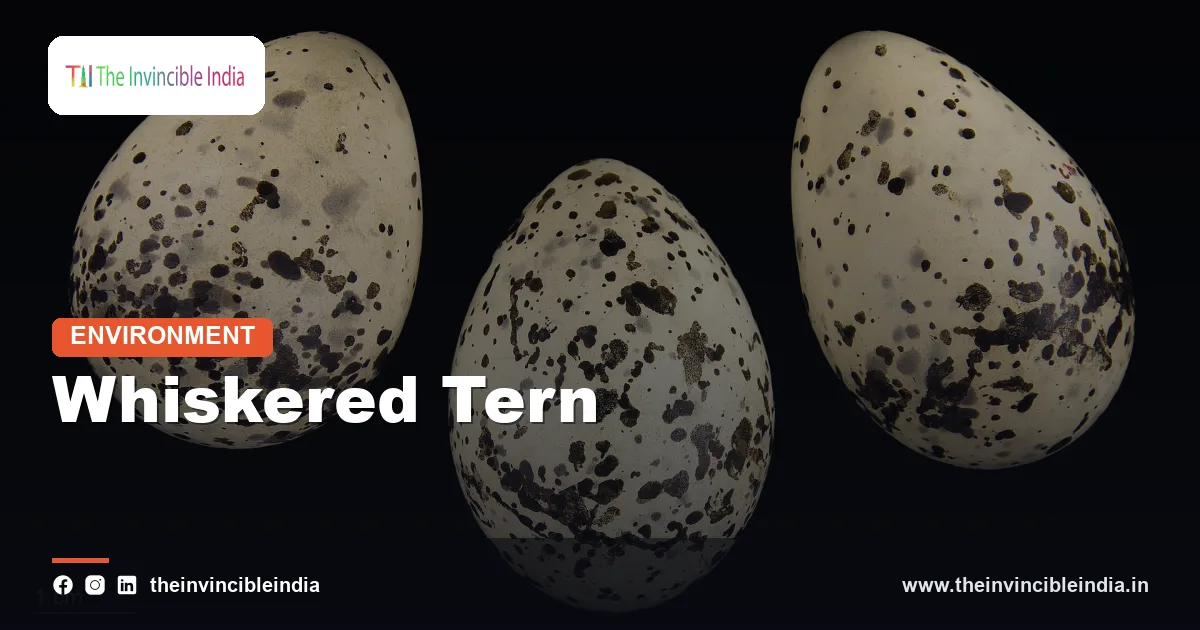
The female usually lays two to three eggs, which are olive or buff with dark blotches that help them blend into the vegetation. Both parents share incubation, which lasts around three weeks. The chicks are covered in mottled down, leave the nest quickly and are fed by both parents with insects and small fish until they can fly, which takes roughly a month.
In India, breeding is closely tied to the monsoon, which fills marshes and encourages plant growth and insect abundance. Many colonies form between roughly July and October in northern regions, while timing varies in the south and east with local rainfall. A colony is vulnerable to sudden changes in water level, because a rapid drop leaves floating nests stranded, and a sharp rise can drown them.
How does the whiskered tern behave?
The whiskered tern is a social bird that feeds, roosts and nests in flocks, and it is noisy in colonies. Its call is a short, rasping “kerrk” or “kik”, often given repeatedly as flocks wheel over water.
Outside the breeding season, whiskered terns roost in groups on mudflats, floating vegetation, exposed branches or small islets. They often share wetlands with other waterbirds such as egrets, herons, stilts and other terns. When disturbed, the entire flock lifts off and circles together before settling again.
Defence of the colony is shared. Adults mob predators such as crows, harriers or snakes that approach the nesting area, calling loudly and diving at the intruder. This collective defence helps small, exposed floating nests survive against ground and aerial predators.
What are the main subspecies and distribution patterns?
Ornithologists recognise several subspecies of the whiskered tern, each tied to a broad geographic region. The grouping shows how widely the species has spread, and it helps explain why the bird looks and behaves slightly differently in different continents.
| Subspecies | Typical region |
|---|---|
| Chlidonias hybrida hybrida | Southern Europe, north-west Africa and parts of western and central Asia |
| Chlidonias hybrida javanicus | Indian subcontinent, South-East Asia and east Asia |
| Chlidonias hybrida delalandii | Sub-Saharan Africa and Madagascar |
| Chlidonias hybrida fluviatilis | Australia and parts of New Guinea |
The Indian population mostly belongs to the subspecies javanicus. Some northern populations are partial migrants, moving south or toward larger permanent wetlands in the cooler months, while peninsular birds often remain close to home and move only short distances.
Why do wetlands matter for the whiskered tern?
Wetlands matter for the whiskered tern because the bird depends on them for food, nesting platforms and safe roosting. Without shallow, productive freshwater with plentiful vegetation and insects, a colony cannot form or raise young.
The main pressures on the whiskered tern in India are the same as those on wetlands generally. These include drainage and reclamation for agriculture and construction, pollution from sewage and agricultural runoff, invasive weeds such as water hyacinth that smother open water, and sudden changes in water level caused by dams and irrigation releases. Heavy use of pesticides in paddy fields can also reduce insect prey and may poison the birds indirectly.
Because the whiskered tern is widespread, it is currently classified as Least Concern by the International Union for Conservation of Nature (IUCN). That status means its global population is not considered at imminent risk, but local declines can still happen when specific wetlands degrade. Protecting wetlands under the Ramsar Convention, the Wetlands (Conservation and Management) Rules and national and state programmes helps the species and the many other waterbirds that share its habitat.
How can you watch whiskered terns responsibly?
You can watch whiskered terns responsibly by observing from a distance, avoiding disturbance to colonies and visiting wetlands at the right season. Binoculars and a field guide are usually enough to see their behaviour clearly.
- Visit shallow wetlands, lake edges and flooded fields in the early morning or late afternoon, when the birds are most active.
- Keep well back from nesting colonies, because even a brief disturbance can cause parents to leave eggs or chicks exposed to heat and predators.
- Avoid using boats, drones or loud sounds near floating nests.
- Note the plumage to separate the whiskered tern from the white-winged tern, particularly outside the breeding season.
- Record sightings on citizen-science platforms such as eBird, which helps scientists track wetland birds across India.
Birdwatchers often find that the whiskered tern is one of the easiest marsh terns to photograph, since it flies low and repeatedly returns to the same patch of water to feed.
Bottom Line
The whiskered tern is a widespread, adaptable marsh tern whose presence signals a healthy shallow wetland with plenty of insects, fish and floating vegetation. Protecting lakes, marshes and the flooded landscapes of rural India keeps this elegant waterbird flying over them.
Frequently Asked Questions
What is a whiskered tern?
A whiskered tern is a small marsh tern, scientifically named Chlidonias hybrida, that feeds over freshwater wetlands. It belongs to the family Laridae, measures about 23 to 29 cm and is named for the white cheek stripe that contrasts with its black cap in breeding plumage.
Where can I see whiskered terns in India?
Whiskered terns can be seen at lakes, reservoirs, jheels, marshes and flooded paddy fields across India. Well-known wetlands such as Keoladeo National Park, Chilika Lagoon and Kolleru Lake regularly host flocks, depending on the season and water levels.
What does a whiskered tern eat?
A whiskered tern eats mainly insects, small fish, tadpoles and small frogs. It picks prey from the water surface or catches insects in flight, usually by swooping low rather than diving deep.
How is a whiskered tern different from a white-winged tern?
A whiskered tern is larger and has a red bill and legs with grey underparts in breeding plumage, while a white-winged tern has a black body, white wing patches and black legs. In non-breeding plumage, the whiskered tern has a pale grey rump, whereas the white-winged tern shows a white rump.
Does the whiskered tern migrate?
The whiskered tern is both resident and migratory in India, depending on the region. Many birds make short local movements with the monsoon and water levels, while some northern populations move south or toward larger wetlands in the cooler months.
Is the whiskered tern endangered?
No, the whiskered tern is not endangered; the IUCN classifies it as Least Concern because it has a very wide range and a large population. Local colonies can still decline when wetlands are drained, polluted or choked by invasive plants.
{“@context”:”https://schema.org”,”@graph”:[{“@type”:”FAQPage”,”mainEntity”:[{“@type”:”Question”,”name”:”What is a whiskered tern?”,”acceptedAnswer”:{“@type”:”Answer”,”text”:”A whiskered tern is a small marsh tern, scientifically named Chlidonias hybrida, that feeds over freshwater wetlands. It belongs to the family Laridae, measures about 23 to 29 cm and is named for the white cheek stripe that contrasts with its black cap in breeding plumage.”}},{“@type”:”Question”,”name”:”Where can I see whiskered terns in India?”,”acceptedAnswer”:{“@type”:”Answer”,”text”:”Whiskered terns can be seen at lakes, reservoirs, jheels, marshes and flooded paddy fields across India. Well-known wetlands such as Keoladeo National Park, Chilika Lagoon and Kolleru Lake regularly host flocks, depending on the season and water levels.”}},{“@type”:”Question”,”name”:”What does a whiskered tern eat?”,”acceptedAnswer”:{“@type”:”Answer”,”text”:”A whiskered tern eats mainly insects, small fish, tadpoles and small frogs. It picks prey from the water surface or catches insects in flight, usually by swooping low rather than diving deep.”}},{“@type”:”Question”,”name”:”How is a whiskered tern different from a white-winged tern?”,”acceptedAnswer”:{“@type”:”Answer”,”text”:”A whiskered tern is larger and has a red bill and legs with grey underparts in breeding plumage, while a white-winged tern has a black body, white wing patches and black legs. In non-breeding plumage, the whiskered tern has a pale grey rump, whereas the white-winged tern shows a white rump.”}},{“@type”:”Question”,”name”:”Does the whiskered tern migrate?”,”acceptedAnswer”:{“@type”:”Answer”,”text”:”The whiskered tern is both resident and migratory in India, depending on the region. Many birds make short local movements with the monsoon and water levels, while some northern populations move south or toward larger wetlands in the cooler months.”}},{“@type”:”Question”,”name”:”Is the whiskered tern endangered?”,”acceptedAnswer”:{“@type”:”Answer”,”text”:”No, the whiskered tern is not endangered; the IUCN classifies it as Least Concern because it has a very wide range and a large population. Local colonies can still decline when wetlands are drained, polluted or choked by invasive plants.”}}]}]}


