

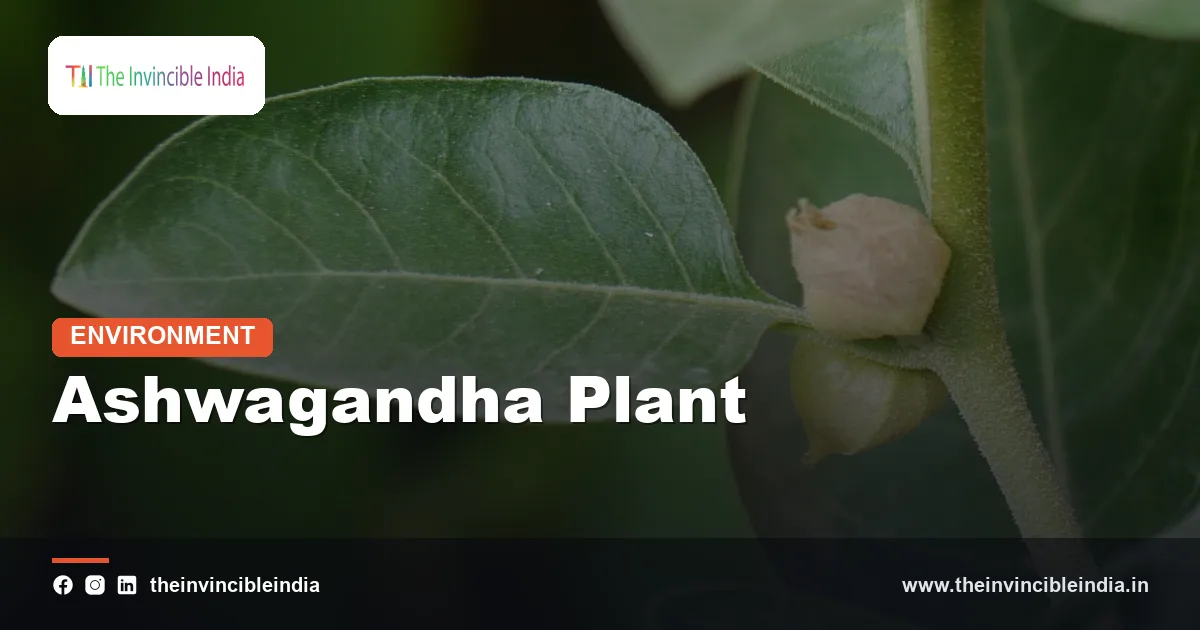
The plant known as ashwagandha (Withania somnifera) is a small, woody shrub of the nightshade family whose roots have been used in Ayurveda, India’s traditional system of medicine, for many centuries. It grows wild in the dry regions of India and is also cultivated as a commercial medicinal crop, particularly in Madhya Pradesh and Rajasthan, where its dried roots are traded in large quantities.
Ashwagandha is sometimes called Indian ginseng or winter cherry, and it is classed in Ayurveda as a rasayana, a rejuvenating tonic. This explainer describes what the ashwagandha plant looks like, where and how it is grown in India, what its traditional uses are, and what readers should keep in mind about safety. Ayurvedic uses described here are traditional claims and not proven medical advice; please consult a qualified professional before using any herbal product. Content was last reviewed on 23 October 2026.
| Attribute | Details |
|---|---|
| Common names | Ashwagandha, Indian ginseng, winter cherry, asgandh |
| Botanical name | Withania somnifera (L.) Dunal |
| Family | Solanaceae (nightshade family) |
| Part used | Mainly the dried root; leaves and seeds have smaller traditional uses |
| Where grown in India | Madhya Pradesh (Mandsaur and Neemuch), Rajasthan (including Nagaur), Gujarat, Maharashtra, Haryana and Punjab, plus wild stands in dry zones |
| Active compounds | Withanolides (steroidal lactones), alkaloids, saponins and sitoindosides |
| Traditional uses | Rasayana (rejuvenating tonic), used for strength, vitality, sleep and stress in Ayurveda |
| Cultivation | Rain-fed or lightly irrigated crop on well-drained sandy loam; sown in the monsoon and harvested after roughly five to six months |
Key Takeaways
- Ashwagandha is the common name of Withania somnifera, a shrub in the nightshade family (Solanaceae) native to the drier parts of India.
- In Ayurveda, ashwagandha root is classed as a rasayana, or rejuvenating tonic, and is traditionally associated with strength, vitality and calm.
- The name ashwagandha is Sanskrit and is commonly explained as referring to the smell of a horse, which the fresh root is said to resemble.
- Madhya Pradesh and Rajasthan are the main ashwagandha-growing states in India, with mandis at Neemuch, Mandsaur and Nagaur important for trade.
- The main bioactive compounds in ashwagandha are withanolides, which researchers study, but traditional uses should not be treated as proven medical claims.
- People who are pregnant, have thyroid or autoimmune conditions, or take regular medicines should speak to a qualified doctor before using ashwagandha.
What is ashwagandha?
Ashwagandha is a perennial shrub, Withania somnifera, whose root is one of the best-known ingredients in Ayurvedic medicine. The plant belongs to the Solanaceae family, the same broad family that includes tomato, potato, brinjal and chilli.
The common names reflect the plant’s long history. “Ashwagandha” comes from Sanskrit, with “ashwa” meaning horse and “gandha” meaning smell, and the name is traditionally explained as a reference to the strong, horse-like odour of the fresh root. It is also said to describe the vigour a horse shows, which ties to the herb’s traditional reputation as a strength-giving tonic. The species name “somnifera” means sleep-inducing in Latin, reflecting its old use as a calming herb.
Ashwagandha is referred to as Indian ginseng in English, although it is botanically unrelated to true ginseng (the genus Panax). The comparison arose because both are valued as traditional adaptogenic tonics, meaning herbs believed to help the body cope with stress.
What does the ashwagandha plant look like?
The ashwagandha plant is a branching, greyish-green shrub that usually grows between 30 cm and about 1.5 metres tall, with a thick, fleshy tap root. Its stems and young leaves are covered in fine, star-shaped hairs that give the plant a soft, felted look.
- Leaves: Simple, oval and dull green, arranged alternately, often in pairs of unequal size.
- Flowers: Small, bell-shaped and greenish-yellow, borne in clusters in the leaf axils.
- Fruit: A round berry that ripens from green to orange-red and is enclosed in a papery, lantern-like calyx, much as in the related Cape gooseberry.
- Root: Long, tapering and cream to light brown, with a characteristic earthy aroma; this is the part most commonly dried and traded.
The plant tolerates dry conditions, poor soils and moderate heat, and it can survive for several years in the wild. In cultivation it is usually grown as an annual or short-lived crop and harvested for its roots.
Where does ashwagandha grow in India?
Ashwagandha grows wild and under cultivation in the drier plains of India, with Madhya Pradesh and Rajasthan as the leading producing states. Within Madhya Pradesh, the districts of Mandsaur and Neemuch are particularly known for cultivation and for a regional trade in roots, and in Rajasthan the area around Nagaur is similarly important.
The crop is also grown in Gujarat, Maharashtra, Haryana, Punjab, Uttar Pradesh and parts of southern India. Wild populations are found in the dry and sub-tropical regions across the country, often along roadsides, field edges and waste ground. The species also occurs in parts of Africa, the Middle East and South Asia beyond India.
India is widely regarded as one of the world’s main sources of ashwagandha root, and the herb is also exported in processed form as powders and extracts. The National Medicinal Plants Board (NMPB), set up in 2000 under what is now the Ministry of AYUSH, promotes the conservation and cultivation of medicinal plants such as ashwagandha.
How is ashwagandha cultivated?
Ashwagandha is cultivated as a low-input, rain-fed crop that suits dry, well-drained soils. Farmers prefer sandy loam or light red soils with a slightly alkaline to neutral reaction, and waterlogged ground should be avoided because the roots rot easily.
Sowing
The crop is propagated by seed, which is often broadcast or sown in rows at the beginning of the monsoon, typically between July and September depending on the region. Seeds germinate within a week or two, and seedlings are thinned to leave sufficient space for roots to develop.
Growth and care
The crop needs relatively little irrigation and few fertilisers. It performs best in regions with moderate rainfall and a dry spell as it matures. Weeding in the early stages is important, and the plant is comparatively free of serious pests, although aphids, leaf-eating insects and some fungal diseases can affect fields in humid seasons.
Harvest and processing
Harvesting is done roughly five to six months after sowing, when the leaves begin to dry and the berries turn red. Whole plants are uprooted, and the roots are separated, washed, cut into short pieces and dried in the sun. Dried roots are graded by thickness and colour, with thicker, whiter, firmer roots generally fetching higher prices. The red berries are collected as seed for the next crop.
What are the traditional uses of ashwagandha?
In Ayurveda, ashwagandha is traditionally used as a rasayana to promote strength, vitality and resilience, and it is described in classical texts such as the Charaka Samhita and the Sushruta Samhita. These descriptions form part of a traditional knowledge system, and they should be understood as traditional claims rather than proven medical treatments.
- Tonic for strength and vitality: Traditionally given to the weak, elderly or those recovering from illness.
- Sleep and calm: The species name somnifera reflects its old use as a calming herb taken in the evening.
- Stress and fatigue: Modern wellness products often market ashwagandha as an adaptogen, a term for herbs thought to help the body adapt to stress.
- Joint and muscle support: Traditional preparations were used externally and internally for stiffness and weakness.
- Reproductive health: Ayurvedic texts describe it as a vajikarana (vitality-enhancing) herb for men and women.
Common traditional forms include root powder (churna) taken with milk, ghee or honey, decoctions, medicated oils for massage and compound formulations. Dosage and combinations in traditional practice are individualised, which is why consultation with a trained Ayurvedic practitioner is advised.
What compounds are found in ashwagandha?
The key compounds in ashwagandha are withanolides, a group of steroidal lactones, along with alkaloids, saponins, flavonoids and iron-containing compounds. Withaferin A and withanolide D are among the best-known withanolides, and researchers study them because they are largely unique to Withania and some related nightshade plants.
The chemical profile varies between plants. Factors such as soil, climate, plant part, harvest time and the chemical type (chemotype) of the plant can all change the withanolide content. For this reason, extracts sold commercially are often standardised to a stated percentage of withanolides.
Scientific interest in ashwagandha has grown in recent decades, with laboratory studies and clinical trials examining its effects on stress, sleep and other measures. The quality and findings of studies vary, and the evidence is still developing. Consumers should treat popular health claims with caution and rely on advice from qualified healthcare professionals.
How does ashwagandha compare with similar Ayurvedic plants?
Ashwagandha is one of several well-known Ayurvedic herbs, and each is traditionally associated with a different emphasis. The table below summarises some stable, traditional associations and the plant parts used.
| Herb | Botanical name | Part used | Traditional association |
|---|---|---|---|
| Ashwagandha | Withania somnifera | Root | Strength, vitality and calm |
| Shatavari | Asparagus racemosus | Tuberous root | Women’s health and cooling tonic |
| Giloy (guduchi) | Tinospora cordifolia | Stem | Immunity and fever |
| Brahmi | Bacopa monnieri | Whole herb | Memory and mental clarity |
| Tulsi | Ocimum tenuiflorum | Leaves | Respiratory and general wellbeing |
These associations come from Ayurvedic tradition. They show how ashwagandha fits within a wider pharmacopoeia, where several herbs are often combined in a single formulation.
Is ashwagandha safe to take?
Ashwagandha is generally regarded as well tolerated when used in moderate amounts for short periods, but safety depends on the person, the dose and the product. Mild side effects reported in some users include stomach upset, loose stools and drowsiness.
Certain groups are advised to be cautious or to avoid it unless a doctor approves. These include pregnant women, because traditional sources and some safety reviews advise against use in pregnancy, as well as people with thyroid disorders, autoimmune conditions, hormone-sensitive conditions or those awaiting surgery. Ashwagandha may interact with sedatives, thyroid medicines, blood-sugar and blood-pressure medicines, and immunosuppressants.
Because herbal products are not uniformly regulated across the world, quality varies. People should buy from reputable sources, avoid exceeding label doses and consult a qualified doctor or registered Ayurvedic practitioner before starting any supplement, especially when taking regular medication.
Why does ashwagandha matter for Indian agriculture and conservation?
Ashwagandha matters because it is a high-value medicinal crop that grows on dry, marginal land, giving farmers in semi-arid regions an alternative to staple crops. It requires less water than many conventional crops, and the dried root commands a steady demand from the Ayurvedic and herbal industries.
Contract farming, mandi trade in Madhya Pradesh and Rajasthan, and government schemes for medicinal plants have all supported cultivation. At the same time, overharvesting of wild plants and mixed-quality roots remain concerns, so quality standards, good agricultural practices and organised cultivation are encouraged to protect wild populations and ensure consistent quality.
Bottom Line
Ashwagandha is a hardy Indian shrub whose root occupies a central place in Ayurveda as a traditional tonic. Its cultivation supports farmers in dry regions, while its traditional uses should be treated as traditional rather than proven, and professional advice is sensible before use.
Frequently Asked Questions
What is ashwagandha?
Ashwagandha is a shrub, Withania somnifera, of the nightshade family whose dried root is a major herb in Ayurveda. It is traditionally used as a rejuvenating tonic and is also called Indian ginseng or winter cherry, although it is not related to true ginseng.
Why is it called ashwagandha?
The name ashwagandha comes from Sanskrit words meaning horse and smell, and it is traditionally explained as a reference to the horse-like odour of the fresh root. Some traditions also link the name to the strength and vigour associated with horses.
Where is ashwagandha grown in India?
Ashwagandha is grown mainly in Madhya Pradesh and Rajasthan, with Mandsaur, Neemuch and Nagaur being important centres. It is also cultivated in Gujarat, Maharashtra, Haryana and Punjab, and wild plants occur in many dry regions.
Which part of the ashwagandha plant is used?
The dried root is the main part used in Ayurveda and in commercial herbal products. Leaves and seeds have some traditional and regional uses, but roots are the most widely traded and studied part of the plant.
Is ashwagandha proven to work?
Ashwagandha has long traditional uses and has been studied in laboratory and clinical research, but evidence is still developing and traditional claims are not the same as proven medical treatment. It is best to discuss any use with a qualified doctor or Ayurvedic practitioner.
Who should avoid ashwagandha?
Pregnant women, people with thyroid or autoimmune conditions, and those taking regular medicines or awaiting surgery should avoid ashwagandha unless a doctor approves. It may interact with sedatives, thyroid medicines and drugs for blood sugar or blood pressure.
{“@context”:”https://schema.org”,”@graph”:[{“@type”:”FAQPage”,”mainEntity”:[{“@type”:”Question”,”name”:”What is ashwagandha?”,”acceptedAnswer”:{“@type”:”Answer”,”text”:”Ashwagandha is a shrub, Withania somnifera, of the nightshade family whose dried root is a major herb in Ayurveda. It is traditionally used as a rejuvenating tonic and is also called Indian ginseng or winter cherry, although it is not related to true ginseng.”}},{“@type”:”Question”,”name”:”Why is it called ashwagandha?”,”acceptedAnswer”:{“@type”:”Answer”,”text”:”The name ashwagandha comes from Sanskrit words meaning horse and smell, and it is traditionally explained as a reference to the horse-like odour of the fresh root. Some traditions also link the name to the strength and vigour associated with horses.”}},{“@type”:”Question”,”name”:”Where is ashwagandha grown in India?”,”acceptedAnswer”:{“@type”:”Answer”,”text”:”Ashwagandha is grown mainly in Madhya Pradesh and Rajasthan, with Mandsaur, Neemuch and Nagaur being important centres. It is also cultivated in Gujarat, Maharashtra, Haryana and Punjab, and wild plants occur in many dry regions.”}},{“@type”:”Question”,”name”:”Which part of the ashwagandha plant is used?”,”acceptedAnswer”:{“@type”:”Answer”,”text”:”The dried root is the main part used in Ayurveda and in commercial herbal products. Leaves and seeds have some traditional and regional uses, but roots are the most widely traded and studied part of the plant.”}},{“@type”:”Question”,”name”:”Is ashwagandha proven to work?”,”acceptedAnswer”:{“@type”:”Answer”,”text”:”Ashwagandha has long traditional uses and has been studied in laboratory and clinical research, but evidence is still developing and traditional claims are not the same as proven medical treatment. It is best to discuss any use with a qualified doctor or Ayurvedic practitioner.”}},{“@type”:”Question”,”name”:”Who should avoid ashwagandha?”,”acceptedAnswer”:{“@type”:”Answer”,”text”:”Pregnant women, people with thyroid or autoimmune conditions, and those taking regular medicines or awaiting surgery should avoid ashwagandha unless a doctor approves. It may interact with sedatives, thyroid medicines and drugs for blood sugar or blood pressure.”}}]}]}


