

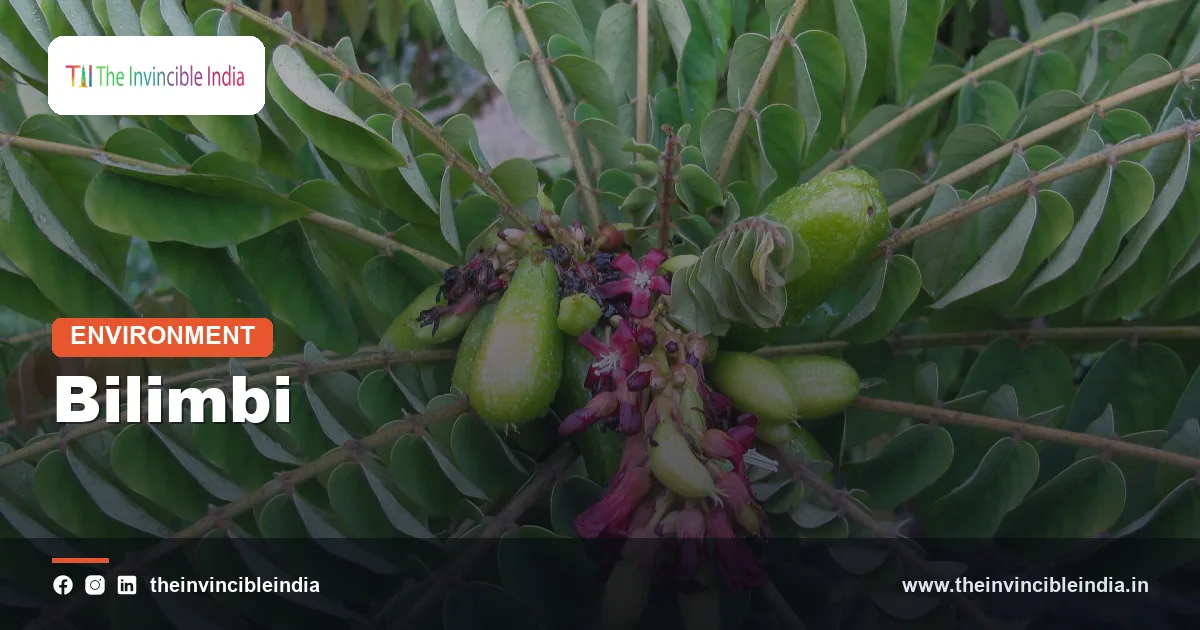
The bilimbi (Averrhoa bilimbi) is an intensely sour, cucumber-shaped fruit that grows in clusters directly on the trunk and branches of a small tropical tree, and it is widely used in South Indian pickles, fish curries and cooling drinks. Also called tree sorrel or cucumber tree in English, the bilimbi is a close relative of the star fruit and is a familiar sight in home gardens along the western coast of India, especially in Kerala, Karnataka, Goa and the Konkan.
The bilimbi is rarely eaten raw in quantity because of its sharp acidity, so it works as a souring ingredient in the kitchen in the way tamarind or kokum does. This explainer covers what the bilimbi is, how it differs from the star fruit, where it grows in India, how the tree flowers and fruits, how the fruit is used, and what to know about its acidity.
| Quick Fact | Detail |
|---|---|
| Common names | Bilimbi, tree sorrel, cucumber tree; ilumbi or irumban puli in Malayalam, bimbul in Konkani and Marathi, bimbuli in Kannada |
| Scientific name | Averrhoa bilimbi |
| Plant family | Oxalidaceae (the wood sorrel family, which also includes the star fruit) |
| Native region | Believed to originate in Southeast Asia and the Malay archipelago; naturalised across the tropics |
| Where grown in India | Kerala, coastal Karnataka, Goa, Konkan, Tamil Nadu, Andhra Pradesh, West Bengal, the north-east and the Andaman and Nicobar Islands |
| Season | Fruits borne several times a year, with the heaviest crops commonly in the warm, wet months |
| Part used | Fruit, used fresh, salted, dried or pickled; flowers and leaves have minor traditional uses |
| Main taste and chemistry | Very sour, rich in organic acids including oxalic acid |
| Notable fact | Fruit grows in bunches straight from the trunk and main branches, a habit called cauliflory |
Key Takeaways
- The bilimbi (Averrhoa bilimbi) is a sour tropical fruit of the wood sorrel family, closely related to the star fruit (Averrhoa carambola).
- Bilimbi fruit grows in clusters directly on the trunk and thick branches of the tree, a feature known as cauliflory.
- The bilimbi is grown mainly in the humid coastal belt of Kerala, Karnataka, Goa and the Konkan, and also in other warm, moist regions of India.
- Bilimbi is used as a souring agent in fish curries, pickles, chutneys, squashes and sun-dried salted preserves rather than eaten as a sweet fruit.
- Bilimbi contains oxalic acid and other organic acids, so people prone to kidney stones are usually advised to eat it only in moderation.
- A bilimbi tree is easy to raise in a home garden, because it grows well from seed, tolerates heat and humidity, and fruits several times a year.
What Is the Bilimbi?
The bilimbi is the fruit of Averrhoa bilimbi, a small evergreen tropical tree that is cultivated for its very sour, juicy and crunchy fruit. The fruit is usually between 4 and 10 centimetres long, shaped somewhat like a small cucumber or a short green finger, and the skin is thin, glossy and slightly ribbed.
A young bilimbi is bright green and very firm, and as it ripens it turns pale yellowish-green and becomes almost translucent and watery. Inside there is soft, juicy, acidic flesh and a few flat seeds. The taste is sharply sour, with little sweetness, which is why the fruit is regarded as a culinary souring ingredient and not as a dessert fruit.
The English names “cucumber tree” and “tree sorrel” describe the shape of the fruit and the sorrel-like sourness of its leaves and juice. Regional names in India are many, and they differ by language and coast, but the fruit is easily recognised by its clustered, trunk-borne growth.
How Is the Bilimbi Related to the Star Fruit?
The bilimbi is a close relative of the star fruit, since both belong to the genus Averrhoa in the family Oxalidaceae. The star fruit, or carambola (Averrhoa carambola), has a five-ribbed waxy fruit that forms a star shape when sliced across, while the bilimbi has a smoother, narrower, cylindrical fruit.
The two species share compound leaves with many small leaflets, small clustered flowers and a high content of organic acids. They differ in fruit shape, in the position of fruit on the tree and in taste, because the star fruit has sweet and sweet-sour forms, while the bilimbi is uniformly acidic.
| Feature | Bilimbi | Star fruit (carambola) |
|---|---|---|
| Scientific name | Averrhoa bilimbi | Averrhoa carambola |
| Fruit shape | Cylindrical, cucumber-like, slightly ribbed | Five prominent ribs, star-shaped in cross-section |
| Where fruit forms | In bunches on the trunk and main branches | On smaller twigs and branches |
| Taste | Strongly sour | Sour to sweet-sour, depending on variety |
| Main use | Cooking, pickling, souring agent | Eaten fresh, juiced, sliced as garnish |
Where Is the Bilimbi Grown in India?
The bilimbi is grown mainly in the warm, humid regions of southern and western India, and the Malabar coast of Kerala and the coastal belt of Karnataka, Goa and the Konkan are its best-known homes. It also grows in Tamil Nadu, Andhra Pradesh, West Bengal, Assam and the Andaman and Nicobar Islands.
The tree needs heat, humidity and protection from cold. It does best in tropical lowland conditions with well-distributed rain, and it is damaged by frost, which keeps it out of colder northern plains and hills. In the drier interior, it can still be grown with regular watering.
Most bilimbi trees in India are not part of commercial orchards. They stand in backyards, near wells, along compound walls and in coconut or areca gardens, and the fruit is generally harvested for household cooking and local sale. Small quantities are sold fresh in village and town markets in coastal regions, and the fruit is also processed by home enterprises into pickles, squashes and dried preserves.
What Does a Bilimbi Tree Look Like?
A bilimbi tree is a slender, short-trunked evergreen that usually grows 5 to 10 metres tall, with an open crown of drooping branches and long compound leaves. Each leaf carries many pairs of small, oval leaflets arranged along a central stalk, giving the tree a feathery appearance.
The flowers are small, star-like and reddish-purple to maroon, and they appear in loose clusters that sprout straight from the trunk and older branches. This trunk-flowering habit, called cauliflory, is shared with trees such as jackfruit and cocoa, and it explains why bilimbi fruit appears in hanging bunches along the wood and not at the branch tips.
The fruit takes roughly two months to develop after flowering. As clusters mature, they can weigh down the branches, and a mature tree in a good season can carry a large number of fruits at once. Because the wood is somewhat brittle, strong winds can break branches that carry a heavy load.
When Is the Bilimbi in Season?
The bilimbi fruits more than once a year, with the main crops usually appearing in the warm and wet months and a lighter crop at other times. The tree can flower and fruit through much of the year in humid coastal climates, so the fruit is available over several months in many households.
Regional timing differs. In Kerala, for example, the fruit is commonly available around the monsoon and the months before and after it, while trees in other regions may peak in different months. Careful growers note their own tree’s rhythm.
The fruit does not keep well fresh, since it bruises easily and softens within a few days. This is why it is so often turned into pickles, salted and sun-dried pieces and syrups, which preserve the sourness for use through the year.
How Is the Bilimbi Used in Indian Cooking?
The bilimbi is used in Indian cooking mainly as a souring ingredient, in the way tamarind, kokum or raw mango is used. Its sharp acidity brightens fish curries, vegetable stews, lentil dishes and chutneys, and it is a particular favourite in coastal cuisines.
Common uses
- Fish curry: whole or sliced bilimbi is added to Kerala-style meen curry in place of, or alongside, kudampuli (Malabar tamarind).
- Pickles: the fruit is salted and cured with chilli, mustard and oil to make a sharp, long-lasting pickle.
- Dried bilimbi: fruit is salted and sun-dried so that it can be stored and added to curries when fresh fruit is out of season.
- Chutneys and thokku: crushed or minced bilimbi is cooked with coconut, chilli and spices.
- Juice and squash: the fruit is blended with water, sugar or jaggery to make a cooling drink or a sweetened syrup.
- Preserves: bilimbi is cooked with sugar to make jams and candied pieces that soften the sourness.
Eating a raw bilimbi can make the mouth pucker, so many people dip pieces in salt and chilli powder, or sweeten the juice with sugar or jaggery. A pinch of salt rubbed on the cut fruit also reduces some of the sharpness.
What Is in the Bilimbi? Is It Healthy to Eat?
The bilimbi is a watery fruit that is low in calories and contains organic acids, vitamin C and small amounts of fibre and minerals. Its sourness comes mostly from acids, including oxalic acid, which gives the fruit its sharp edge and also makes it useful as a mild cleaning agent.
The same oxalic acid means that the fruit should be eaten with some care. People who have had kidney stones, or who have been advised to limit oxalate in their diet, are usually told to avoid large amounts of oxalate-rich foods, which can include bilimbi and star fruit. Anyone with kidney disease should seek advice from a doctor before eating the fruit or its juice regularly.
Folk traditions in India and elsewhere describe various uses for bilimbi leaves, flowers and fruit in home remedies, and some laboratory studies have examined extracts. These traditional uses are not proven medical treatments. The fruit is best seen as a flavouring ingredient and a source of tartness, not as a medicine.
How Is the Bilimbi Grown?
The bilimbi is grown from seed or from cuttings and layers, and it needs warmth, moisture and well-drained soil. It is one of the easier tropical fruit trees to establish in a home garden, as long as winters are mild.
Climate and soil
The tree prefers a hot, humid climate with regular rain and fertile, well-drained soil that is rich in organic matter. It tolerates light shade and does well in coconut gardens. Frost, strong cold and long dry spells reduce growth, so cooler regions are less suitable.
Propagation and care
- Seeds germinate readily and produce seedlings that begin to fruit within a few years.
- Air layering and cuttings are used to keep desirable fruiting traits and to speed up bearing.
- Regular watering during dry weather supports flowering and fruit set.
- Mulching and compost improve vigour, and removing dead wood keeps the crown healthy.
- Fruit is hand-picked or knocked gently from clusters to avoid bruising.
Pests and diseases are generally minor in home gardens, although fruit flies, mealybugs and fungal spots can affect fruit in wet seasons. Good drainage and clean harvesting help to limit problems.
What Other Uses Does the Bilimbi Have?
Besides cooking, the bilimbi has household uses that come from the acidity of its juice. In many coastal homes, bilimbi juice has traditionally been used to clean tarnished brass and copper vessels, to remove rust or ink stains from cloth, and to bleach light stains.
These uses depend on the oxalic acid in the juice, which reacts with metal oxides and stains. Because the same acid can irritate skin and eyes, the juice should be handled with ordinary care, and used cleaning solutions should not be swallowed.
The tree itself has value as a shade tree in compounds and as an ornamental plant, thanks to its feathery leaves and its curious trunk-borne flowers. The flowers attract bees and other insects, and the fruit is eaten by birds and small mammals.
Why Does the Bilimbi Matter?
The bilimbi matters because it is a clear example of a minor fruit that supports regional food traditions, home economies and garden biodiversity without needing large-scale farming. For many coastal families, one tree supplies souring fruit for fish curries and pickles throughout the year.
The fruit also shows how India’s cuisines draw sourness from many plants, including tamarind, kokum, raw mango, lemon and bilimbi. Each region has its own preference, and those preferences shape the character of local dishes. Protecting and planting such trees keeps these culinary differences alive.
Bottom Line
The bilimbi is a sharply sour, trunk-fruiting tree crop of the humid Indian coast, valued as a kitchen souring ingredient and a hardy garden tree. It is better treated as a flavouring than as a snack, and people who need to limit oxalate should eat it in moderation.
Frequently Asked Questions
What is bilimbi?
Bilimbi is the very sour, cucumber-shaped fruit of the tropical tree Averrhoa bilimbi, a relative of the star fruit. It grows in clusters directly on the trunk and branches and is used mainly as a souring ingredient in Indian cooking.
Is bilimbi the same as star fruit?
No, bilimbi and star fruit are different species of the same genus, Averrhoa. The star fruit has five ribs and forms a star when sliced, while the bilimbi is smoother, narrower and much more sour.
Where is bilimbi grown in India?
Bilimbi is grown mainly in the humid coastal regions of Kerala, Karnataka, Goa and the Konkan. It is also found in Tamil Nadu, Andhra Pradesh, West Bengal, the north-east and the Andaman and Nicobar Islands.
How is bilimbi used in cooking?
Bilimbi is used as a souring agent in fish curries, pickles, chutneys and dried salted preserves. It plays a role similar to tamarind, kokum or raw mango, and it is also made into juice and squash.
Is bilimbi safe for people with kidney stones?
People with a history of kidney stones are usually advised to limit bilimbi, because the fruit contains oxalic acid. Anyone with kidney problems should check with a doctor before eating it or drinking its juice regularly.
Can bilimbi be grown at home?
Yes, bilimbi can be grown at home in warm, humid regions from seed, cuttings or air layers. The tree likes fertile, well-drained soil and regular water, cannot tolerate frost, and can bear fruit several times a year.
{“@context”:”https://schema.org”,”@graph”:[{“@type”:”FAQPage”,”mainEntity”:[{“@type”:”Question”,”name”:”What is bilimbi?”,”acceptedAnswer”:{“@type”:”Answer”,”text”:”Bilimbi is the very sour, cucumber-shaped fruit of the tropical tree Averrhoa bilimbi, a relative of the star fruit. It grows in clusters directly on the trunk and branches and is used mainly as a souring ingredient in Indian cooking.”}},{“@type”:”Question”,”name”:”Is bilimbi the same as star fruit?”,”acceptedAnswer”:{“@type”:”Answer”,”text”:”No, bilimbi and star fruit are different species of the same genus, Averrhoa. The star fruit has five ribs and forms a star when sliced, while the bilimbi is smoother, narrower and much more sour.”}},{“@type”:”Question”,”name”:”Where is bilimbi grown in India?”,”acceptedAnswer”:{“@type”:”Answer”,”text”:”Bilimbi is grown mainly in the humid coastal regions of Kerala, Karnataka, Goa and the Konkan. It is also found in Tamil Nadu, Andhra Pradesh, West Bengal, the north-east and the Andaman and Nicobar Islands.”}},{“@type”:”Question”,”name”:”How is bilimbi used in cooking?”,”acceptedAnswer”:{“@type”:”Answer”,”text”:”Bilimbi is used as a souring agent in fish curries, pickles, chutneys and dried salted preserves. It plays a role similar to tamarind, kokum or raw mango, and it is also made into juice and squash.”}},{“@type”:”Question”,”name”:”Is bilimbi safe for people with kidney stones?”,”acceptedAnswer”:{“@type”:”Answer”,”text”:”People with a history of kidney stones are usually advised to limit bilimbi, because the fruit contains oxalic acid. Anyone with kidney problems should check with a doctor before eating it or drinking its juice regularly.”}},{“@type”:”Question”,”name”:”Can bilimbi be grown at home?”,”acceptedAnswer”:{“@type”:”Answer”,”text”:”Yes, bilimbi can be grown at home in warm, humid regions from seed, cuttings or air layers. The tree likes fertile, well-drained soil and regular water, cannot tolerate frost, and can bear fruit several times a year.”}}]}]}


