

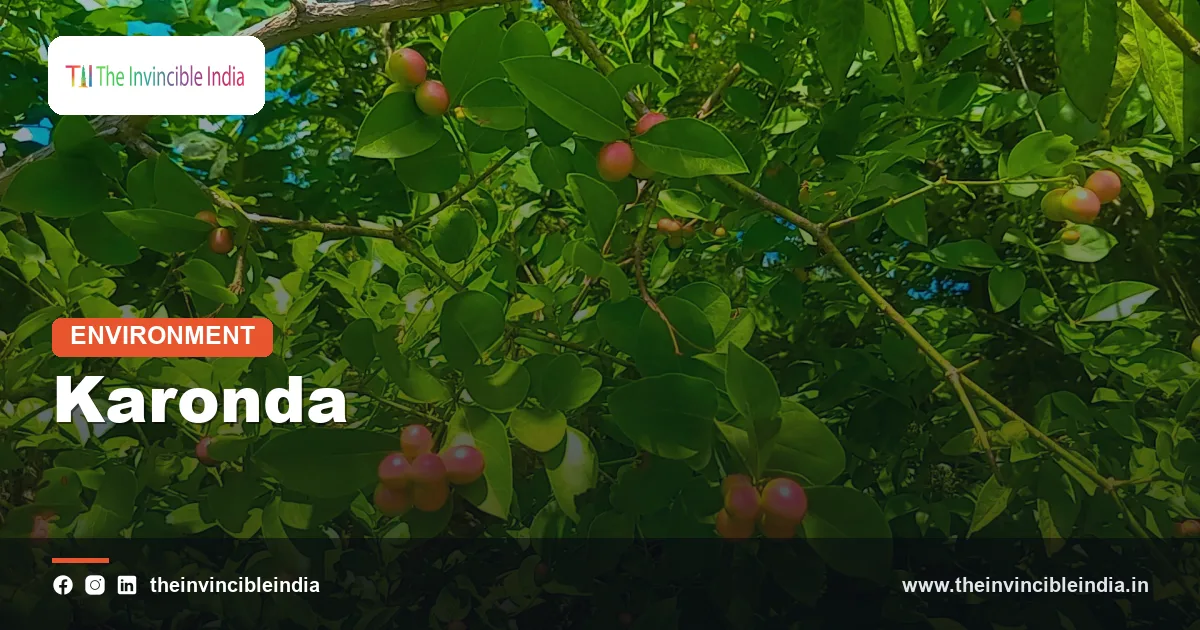
The karonda (Carissa carandas) is a tart, plum-sized berry that grows on a hardy, thorny evergreen shrub native to India, and it is best known as a pickle fruit that is also made into jams, chutneys and squashes. Called karaunda in Hindi and Christ’s thorn or Bengal currant in English, the karonda is valued as much for the toughness of its shrub, which survives drought, poor soil and neglect, as for the sharp-sweet berries it bears.
The karonda is a minor fruit crop that sits at the border between a garden plant, a hedge and an orchard species. This explainer covers what the karonda is, where it grows in India, what the shrub looks like, when it fruits, how the berries are eaten and preserved, and how the plant is cultivated.
| Quick Fact | Detail |
|---|---|
| Common names | Karonda, karaunda, Christ’s thorn, Bengal currant; karvand in Marathi |
| Scientific name | Carissa carandas (also written as Carissa congesta in older literature) |
| Plant family | Apocynaceae (the dogbane family, which also includes oleander and periwinkle) |
| Native region | India and neighbouring parts of South Asia |
| Where grown in India | Maharashtra, Gujarat, Rajasthan, Madhya Pradesh, Uttar Pradesh, Bihar, Punjab, Haryana and the Western Ghats and Himalayan foothills in the wild |
| Season | Flowers in spring and early summer; berries ripen mostly in the monsoon and post-monsoon months |
| Part used | Unripe green or pink berries for pickles; ripe dark berries for jams, squashes and eating |
| Plant type | Dense, evergreen, spiny shrub, usually 2 to 3 metres tall, with milky latex |
| Notable fact | The shrub tolerates drought and poor soil and is widely planted as a thorny, fragrant-flowered hedge |
Key Takeaways
- The karonda (Carissa carandas) is a spiny evergreen shrub of the dogbane family, native to India, which produces small tart berries.
- Karonda berries turn from green to pink to deep purple-black as they ripen, and the unripe berries are the main ingredient of karonda pickle.
- The karonda plant is drought-tolerant and thrives in poor, dry soils, which makes it a popular hedge and a useful crop for arid and semi-arid regions of India.
- Karonda flowers are white, star-shaped and sweetly scented, and they are visited by bees and other insects.
- The karonda is used in pickles, chutneys, jams, jellies, squashes and sauces, and the berries are valued for a tangy flavour and an attractive colour.
- Every green part of the karonda shrub contains white milky latex, and the thorns are sharp, so gardeners handle the plant with care.
What Is the Karonda?
The karonda is the berry of Carissa carandas, a thorny, bushy evergreen shrub that belongs to the same plant family as oleander. The berries are small, usually 1 to 3 centimetres across, round to oval, and they grow in clusters at the tips of the branches.
When young, the berries are pale green with a slight pinkish blush and are hard, sharply sour and rich in white latex. As they ripen, they turn bright pink, then red, and finally a deep purple that is almost black. A fully ripe berry is soft, juicy and pleasantly sweet-sour, with a flavour that people often compare to cranberry or a tart plum.
The berries contain a few small flat seeds, and the skin is thin and edible. The English name “Bengal currant” refers to the berry’s resemblance to a currant, while “Christ’s thorn” is a name linked to the spiny branches. The karonda has long been used in Indian households, particularly in the northern, central and western states.
Where Does the Karonda Grow in India?
The karonda grows across much of India, in both wild and cultivated forms, and it is especially common in the drier regions of central, western and northern India. The shrub is native to the country and occurs naturally in the Western Ghats, the Himalayan foothills and scrub forests of the plains.
Cultivation is most common in Maharashtra, Gujarat, Rajasthan, Madhya Pradesh, Uttar Pradesh, Bihar, Punjab and Haryana, where it is grown in home gardens, along field boundaries and in small orchards. It is also planted in several southern states. The plant’s wide tolerance of soil and climate explains why it has been distributed so widely.
Production is small and mostly local. Fresh berries are sold in season in town and village markets, and the unripe fruit is sold to households and small food makers that prepare pickles. National production figures for the karonda are not widely reported, and the crop is generally considered a minor fruit of semi-arid horticulture.
What Does a Karonda Shrub Look Like?
A karonda shrub is a dense, rounded evergreen, usually 2 to 3 metres tall, with branches that fork repeatedly and carry paired, sharp thorns. The leaves are small, oval, thick and glossy, and they grow opposite each other along the stems.
The flowers are white, sometimes tinged pink, and star-shaped with five narrow petals. They are fragrant, with a scent often compared to jasmine, and they open in clusters at the branch tips. Karonda flowers draw bees, butterflies and moths, and the plant is sometimes grown just for its fragrance and its ornamental value.
The thorn-bearing branches make the karonda an effective living fence. Planted closely, the shrubs form a thick barrier that discourages animals and people from crossing, and farmers in several states have long used karonda hedges around gardens, orchards and fields. The shrub can be clipped into shape, and it recovers well after pruning.
When Is the Karonda in Season?
The karonda season in India runs mainly through the monsoon and the months just after it, with berries ripening from roughly July into autumn in many regions. Plants flower in spring and early summer, and the berries take a few months to mature.
Exact timing varies with climate and variety, and in some areas a second, lighter flowering and fruiting period occurs. Unripe green or pink berries are harvested earlier for pickles, while ripe purple-black berries are picked later for jam, squash and eating.
The berries are best used soon after harvest, although unripe fruit keeps for a few days if it is kept cool and dry. The usual way to extend their availability is to preserve them in oil, salt or sugar.
How Is the Karonda Used in Indian Kitchens?
The karonda is used in Indian kitchens mainly as a pickle fruit, and the tart green berries are cut or left whole and preserved with oil, salt and spices. The firm texture and sharp acidity of unripe karonda make it well suited to pickling, because the pieces stay crunchy and take up the flavours of mustard, fenugreek, chilli and fennel.
Common uses
- Pickle: raw green or pink berries are preserved in mustard oil or sesame oil with spices, a favourite in northern and central India.
- Chutney: berries are cooked with sugar or jaggery and spices to make a sweet-sour chutney.
- Jam and jelly: ripe berries are cooked with sugar to produce a deep red-purple preserve with a tangy edge.
- Squash and syrup: the pulp is extracted and sweetened as a cooling drink base.
- Sauce and filling: karonda pulp is used in sauces, pie fillings and desserts in some regional and modern recipes.
- Fresh eating: fully ripe berries are eaten fresh, often with a pinch of salt.
The strong colour of ripe karonda also makes it useful as a natural colourant in preserves and drinks, where it gives a deep reddish tint without artificial dye.
What Is in the Karonda Berry?
The karonda berry contains water, natural sugars, organic acids, vitamin C and pigments called anthocyanins, and it is often noted for its iron content. Food composition studies describe the fruit as a modest source of several minerals, but values depend on the stage of ripeness, the variety and the soil.
The tart taste comes from organic acids, which decrease as the berry ripens while the sugar content rises. The red and purple colours of ripe berries are due to anthocyanin pigments, which are also found in many other dark fruits. Because the figures vary, it is more accurate to describe the karonda as a nutritious, colourful, acidic berry than to quote exact nutrient values.
In traditional Indian practice, various parts of the plant have been used in home remedies, and the fruit has been valued in folk systems of medicine. These uses are traditional and not established treatments, and the berry should be eaten as food rather than as medicine. Anyone managing a medical condition should follow the advice of a doctor.
How Is the Karonda Cultivated?
The karonda is cultivated by planting seedlings, cuttings or layers in sunny, well-drained sites, and it needs far less water and care than most fruit crops. The shrub is hardy and adapts to sandy, rocky and saline soils where many other fruits fail.
Climate and soil
The karonda thrives in hot, dry and semi-arid conditions, and it can also grow in moderately humid areas. Light frost may damage young shoots, but established plants tolerate a range of temperatures. Good drainage matters more than soil richness, and waterlogged ground is harmful.
Propagation and planting
- Seeds are used to raise seedlings, although plants grown from seed vary in berry size, colour and quality.
- Cuttings, layering and budding or grafting are used to multiply superior selections and produce uniform fruit.
- Plants are spaced widely for orchards, or closely for hedges, and young plants need watering until they establish.
- Pruning shapes the shrub and encourages new fruiting wood, since flowers and fruit form on young growth.
Agricultural universities and research institutes in India have identified and released improved karonda selections with larger berries and better fruit quality. Yields depend on the variety, the age of the plant and the care it receives, and a mature shrub can bear fruit for many years.
Why Is the Karonda Useful for Dry Regions?
The karonda is useful for dry regions because it survives drought, grows in poor soil and still gives a marketable crop with minimal inputs. This makes the shrub a practical choice for farmers in semi-arid areas with limited water, where fruit options are few.
The shrub also protects land. Its dense growth and spreading roots help to bind soil, its thorny habit makes it a stock-proof boundary, and its flowers support pollinators. These qualities have led to its use in wasteland plantings, as well as in village hedgerows.
| Benefit | How the karonda provides it |
|---|---|
| Drought tolerance | Hardy shrub that survives long dry spells once established |
| Soil adaptability | Grows in sandy, stony and mildly saline soils |
| Living fence | Dense, thorny branches form a barrier around fields and gardens |
| Income from fruit | Unripe berries for pickle and ripe berries for jam and squash |
| Support for pollinators | Fragrant flowers visited by bees, butterflies and moths |
| Low input needs | Requires little fertiliser, water or protection compared with many orchard fruits |
How Is the Karonda Different From Related Carissa Plants?
The karonda differs from related Carissa plants in size, fruit and use, even though they belong to the same genus. The genus Carissa includes several thorny shrubs found in Africa, Asia and Australia.
- Carissa carandas, the karonda, is the Indian species grown for pickle and preserve fruit.
- Carissa spinarum is a wild thorny shrub of Indian scrub forests, with small dark berries that are eaten locally.
- Carissa macrocarpa, the Natal plum, is a South African species grown in warm regions as an ornamental and a dessert fruit.
Because common names overlap, it is helpful to use the scientific name when buying plants or reading research.
Is the Karonda Safe to Handle and Eat?
The ripe karonda berry is safe to eat as food, but the plant’s latex and thorns call for care when handling. All green parts of the shrub contain milky sap, and the sharp paired spines can cause painful scratches.
Gardeners generally wear gloves when pruning or picking, and they pick berries gently from the thorny clusters. Unripe berries are very sour and are not usually eaten raw, but they are cooked or pickled. As with any fruit, people with allergies or medical conditions should eat it in moderation and watch for any reaction. Other parts of the plant, such as roots and leaves, are not eaten as food.
Bottom Line
The karonda is a rugged, thorny Indian shrub that gives tart, colourful berries for pickles and preserves. It deserves attention as a drought-hardy minor fruit that needs little water, protects soil and provides a seasonal harvest in some of India’s driest regions.
Frequently Asked Questions
What is karonda?
Karonda is the tart berry of Carissa carandas, a thorny evergreen shrub native to India. The berries turn from green to pink to purple-black as they ripen and are used mainly in pickles, jams and chutneys.
What is karonda called in English?
Karonda is commonly called Christ’s thorn or Bengal currant in English. In Hindi the name is karaunda, and in Marathi the fruit is called karvand.
Is karonda eaten raw or cooked?
Both forms are used, depending on ripeness. Unripe green or pink karonda is very sour and is usually pickled or cooked, while fully ripe purple-black berries are sweet-sour and can be eaten fresh or made into jam.
When does karonda fruit in India?
Karonda mainly fruits during the monsoon and the months after it, roughly from July into autumn in many regions. The shrub flowers earlier, in spring and early summer, and exact timing varies with climate.
Can karonda grow in dry areas?
Yes, karonda grows well in dry and semi-arid areas because the shrub tolerates drought, heat and poor soil. It needs good drainage and some watering while young, and it survives with little care once established.
Why is karonda used as a hedge?
Karonda is used as a hedge because its dense, forked branches carry sharp thorns that form a thick, stock-proof barrier. The shrub also produces fragrant flowers and edible berries, and it can be clipped without losing vigour.
{“@context”:”https://schema.org”,”@graph”:[{“@type”:”FAQPage”,”mainEntity”:[{“@type”:”Question”,”name”:”What is karonda?”,”acceptedAnswer”:{“@type”:”Answer”,”text”:”Karonda is the tart berry of Carissa carandas, a thorny evergreen shrub native to India. The berries turn from green to pink to purple-black as they ripen and are used mainly in pickles, jams and chutneys.”}},{“@type”:”Question”,”name”:”What is karonda called in English?”,”acceptedAnswer”:{“@type”:”Answer”,”text”:”Karonda is commonly called Christ’s thorn or Bengal currant in English. In Hindi the name is karaunda, and in Marathi the fruit is called karvand.”}},{“@type”:”Question”,”name”:”Is karonda eaten raw or cooked?”,”acceptedAnswer”:{“@type”:”Answer”,”text”:”Both forms are used, depending on ripeness. Unripe green or pink karonda is very sour and is usually pickled or cooked, while fully ripe purple-black berries are sweet-sour and can be eaten fresh or made into jam.”}},{“@type”:”Question”,”name”:”When does karonda fruit in India?”,”acceptedAnswer”:{“@type”:”Answer”,”text”:”Karonda mainly fruits during the monsoon and the months after it, roughly from July into autumn in many regions. The shrub flowers earlier, in spring and early summer, and exact timing varies with climate.”}},{“@type”:”Question”,”name”:”Can karonda grow in dry areas?”,”acceptedAnswer”:{“@type”:”Answer”,”text”:”Yes, karonda grows well in dry and semi-arid areas because the shrub tolerates drought, heat and poor soil. It needs good drainage and some watering while young, and it survives with little care once established.”}},{“@type”:”Question”,”name”:”Why is karonda used as a hedge?”,”acceptedAnswer”:{“@type”:”Answer”,”text”:”Karonda is used as a hedge because its dense, forked branches carry sharp thorns that form a thick, stock-proof barrier. The shrub also produces fragrant flowers and edible berries, and it can be clipped without losing vigour.”}}]}]}


