

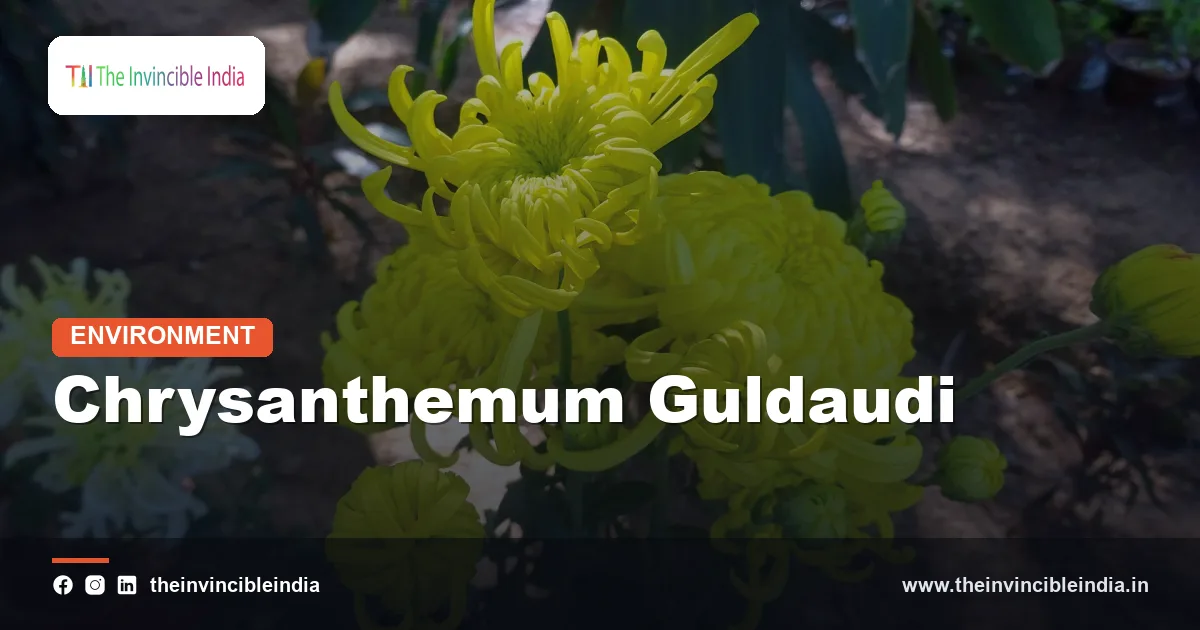
The chrysanthemum (Chrysanthemum x morifolium), known in Hindi and Urdu as guldaudi, is a perennial flowering plant of the daisy family that is grown across India for its autumn and winter blooms, which are used in gardens, flower shows, cut-flower arrangements and temple garlands. Chrysanthemum flowers range from small buttons to large shaggy globes and come in nearly every colour except true blue.
Chrysanthemum plants bloom when nights grow longer, which is why guldaudi flowers appear in Indian gardens from October to January, in the same season as winter festivals and flower shows. The plant is native to East Asia, where gardeners have selected it for more than two thousand years, and thousands of named cultivars now exist around the world.
| Attribute | Details |
|---|---|
| Common names | Chrysanthemum, mum, guldaudi (Hindi and Urdu); shevanti or shevanthi in Marathi and parts of the south, samanthi in Tamil, chandramallika in Bengali |
| Scientific name | Chrysanthemum x morifolium (garden hybrid; also placed under Dendranthema in some older references) |
| Family | Asteraceae (daisy or sunflower family) |
| Origin | East Asia, with China as the main centre of domestication |
| Where grown in India | Gardens and commercial fields across the plains and hills, including Karnataka, Tamil Nadu, Maharashtra, West Bengal, Haryana and Uttarakhand |
| Flowering season | Mainly October to January in India, because the plant is a short-day species |
| Uses | Garden and pot plant, cut flower, loose flowers for garlands and offerings, flower-show exhibit, herbal tea in East Asia |
| Notable facts | Its name comes from the Greek words for gold and flower; it is the emblem of the Japanese Imperial family and one of the most widely traded cut flowers in the world |
Key Takeaways
- The chrysanthemum is a perennial member of the daisy family (Asteraceae) that was first domesticated in China more than two thousand years ago.
- Guldaudi, the Hindi and Urdu name for the chrysanthemum, refers to plants that flower mainly in the Indian autumn and winter, from October to January.
- The chrysanthemum is a short-day plant, so it forms flower buds only when nights become long enough, and growers can shift its bloom time with shade cloth or artificial light.
- Chrysanthemum flowers are grouped into forms such as single, anemone, pompon, spoon, spider, incurved and reflexed, based on the shape of their petals.
- Chrysanthemum plants are propagated mostly from cuttings and basal suckers, not from seed, so that each cultivar keeps its colour and flower form.
- In India the chrysanthemum serves as a garden ornamental, a pot plant, a cut flower and a loose flower for garlands and religious offerings.
What is a chrysanthemum?
A chrysanthemum is a flowering herb of the genus Chrysanthemum in the daisy family, grown for its dense, many-petalled flower heads. What looks like a single flower is actually a composite head made of many tiny florets packed together, which is the defining feature of the Asteraceae family that also includes sunflowers, marigolds, zinnias and dahlias.
Two kinds of florets make up a chrysanthemum head. The outer ray florets look like petals and give the flower its colour and form, while the inner disc florets form a small central button in single and semi-double types. In fully double cultivars, the disc florets are almost completely replaced by extra ray florets, which gives the heavy, rounded look of exhibition blooms.
The garden chrysanthemum is a hybrid of several East Asian species, so botanists write it with a multiplication sign as Chrysanthemum x morifolium. Taxonomists have revised the genus several times, and some references list garden mums under Dendranthema, but nurseries, growers and gardeners in India still use the name chrysanthemum almost everywhere.
The plant itself is a bushy, semi-woody perennial that usually grows between 30 and 120 centimetres tall depending on the cultivar and training. Its leaves are lobed, aromatic and a dull green, and its stems become firmer toward the base as the season advances. In the Indian climate it is often treated as a seasonal crop and renewed from cuttings each year.
Where does the chrysanthemum come from?
The chrysanthemum comes from East Asia, and China is regarded as the place where it was first domesticated, with records of cultivation going back more than two thousand years. Early Chinese growers valued the plant for its flowers and also for herbal uses, and they selected larger and more varied blooms over many centuries.
The plant travelled to Japan, probably around the eighth century, where it became a major cultural symbol and where breeders developed elaborate exhibition forms. From Japan and China it reached Europe in the seventeenth and eighteenth centuries, and European and American nurseries then produced a huge range of new cultivars. The name itself combines the Greek words chrysos, meaning gold, and anthemon, meaning flower, a reference to the yellow forms known to early observers.
In India the chrysanthemum arrived through garden and trade routes and was adopted widely in hill stations and plains alike. It is not a native Indian species, but it has become so common in winter gardens, nurseries and flower markets that most people treat it as an everyday Indian flower. Regional names such as shevanti, samanthi and chandramallika show how thoroughly it has entered local languages.
What are the types and flower forms of chrysanthemum?
Chrysanthemum flowers are classified by the shape of their ray florets and the overall form of the head, and the main groups are single, anemone, pompon, spoon, spider, incurved, reflexed and decorative. Breeders and flower-show judges use these groups to compare cultivars fairly, and growers use them to match a variety to its purpose.
| Flower form | Description | Typical use |
|---|---|---|
| Single | One or a few rows of petal-like florets around a visible central disc, like a daisy | Garden beds and pots |
| Anemone | Raised, cushion-like disc surrounded by flat or tubular rays | Garden beds and cut flowers |
| Pompon and button | Small, tightly packed, ball-shaped heads with short rays | Pots, edging, bunches |
| Spoon | Tubular florets that open into a spoon-shaped tip | Pots and exhibition |
| Spider and quill | Long, thin, tubular rays that hang or curl loosely | Exhibition and cut flowers |
| Incurved | Large globe with petals curving inward toward the centre | Exhibition and standard cut flowers |
| Reflexed | Rays that curve outward and downward, giving a shaggy look | Exhibition and garden display |
Growers also classify chrysanthemum plants by habit. Standard types carry one large bloom per stem after the side buds are removed, a practice called disbudding. Spray types are left to carry many smaller blooms on each stem, and they are the main choice for pots, garden beds and bunches of cut flowers. Loose-flower types are grown in the field and harvested stem by stem for garlands and offerings.
Colour range is wide, covering white, yellow, gold, bronze, orange, pink, red, maroon, lavender and purple. A true blue chrysanthemum does not occur naturally, although laboratory work on colour pigments has attracted attention in recent years.
When and where is the chrysanthemum grown in India?
The chrysanthemum is grown in India mainly for the October to January season, and it can be found from the Himalayan foothills to the southern peninsula in home gardens, nurseries and commercial fields. It is one of the most familiar flowers in Indian winter gardens and a regular sight in city flower markets in the cooler months.
Several states have well-established commercial production. Karnataka and Tamil Nadu supply large volumes of loose flowers for garlands and religious use, Maharashtra and West Bengal supply both cut and loose flowers to big city markets, and Haryana, Uttar Pradesh and Uttarakhand grow flowers for the northern markets. Each region fits its planting time to local climate, so the harvest window shifts from one place to another.
In cooler hill districts, the chrysanthemum also performs well because the plant dislikes extreme heat during flower development. Many growers in the plains prefer the cooler months for flowering so that the blooms hold their colour and last longer on the plant. In very hot regions, shade structures or greenhouse cooling help protect the flowers.
Flower shows held by horticultural societies and botanical gardens across India often feature chrysanthemum displays in winter, with large pots, trained forms and competitive classes. These shows help gardeners compare cultivars and also support nurseries that supply cuttings.
Why does the chrysanthemum flower in autumn?
The chrysanthemum flowers in autumn because it is a short-day plant, meaning it begins forming flower buds only when the night length passes a certain threshold. As days shorten after the monsoon, the plant senses the longer nights through light-sensitive pigments in its leaves and switches from leaf growth to flowering.
For most commercial cultivars, bud initiation begins when day length falls to roughly 14 hours or less, and full flower development needs still shorter days. The exact threshold differs between varieties, which is why breeders sort cultivars into response groups that flower about six to fifteen weeks after short-day treatment begins.
This sensitivity gives growers a powerful tool. In greenhouses, black cloth drawn over plants in the evening artificially shortens the day and brings flowers forward, while lights switched on for a few hours at night break the long night and delay flowering. Producers use these techniques to supply chrysanthemums for specific festival dates and for year-round markets in many countries.
For home gardeners the lesson is simple. A chrysanthemum placed next to a bright street light or a verandah bulb may delay its buds, so plants should sit where nights are naturally dark during the flowering weeks.
How is the chrysanthemum grown and propagated?
The chrysanthemum is grown mainly from cuttings or basal suckers rather than from seed, because seedlings vary widely and do not reproduce the parent flower. A grower takes a terminal cutting about five to seven centimetres long from a healthy stock plant, roots it in a light medium such as sand or coco peat, and transplants it once roots appear.
Soil, light and water
Chrysanthemum plants prefer well-drained, fertile loam with a slightly acidic to neutral reaction, around pH 6 to 7. They need at least five or six hours of direct sun each day and regular but moderate watering. Waterlogged soil is a major cause of failure, since roots rot quickly when drainage is poor.
Pinching, staking and feeding
Pinching, which means removing the growing tip a few weeks after planting, makes the plant bushy and increases the number of flower stems. Tall cultivars need stakes or support nets to stop heavy blooms from bending the stems. Regular feeding with balanced fertiliser during vegetative growth, followed by a potash-rich feed as buds form, supports bud size and colour.
After flowering
When flowering ends, growers cut the stems back to a few centimetres above the soil. New basal shoots, called suckers, then emerge and can be separated as the next year’s plants. Many Indian gardeners renew their stock every year from these suckers or from fresh cuttings, since old clumps lose vigour and produce smaller flowers.
Pot culture works well on terraces and balconies, using a loose potting mix with compost and a pot at least 25 to 30 centimetres wide for a full plant.
What pests and diseases affect chrysanthemum plants?
Chrysanthemum plants are affected mainly by sap-sucking insects such as aphids, thrips and spider mites, by leaf miners and caterpillars, and by fungal problems such as leaf spots, powdery mildew, wilt and root rot. Most of these problems rise in crowded, humid or poorly drained conditions.
- Aphids and thrips: Soft-bodied insects that feed on young shoots and buds, causing curled leaves and distorted flowers.
- Spider mites: Tiny mites that thrive in hot, dry spells and leave a fine webbing and a speckled look on leaves.
- Leaf miners: Larvae that tunnel inside leaves and leave pale winding trails.
- Powdery mildew and leaf spots: Fungal diseases that appear as white powdery patches or dark spots, especially in humid weather.
- White rust: A fungal rust disease of chrysanthemums that is closely watched by plant protection authorities because it can spread through cuttings.
- Wilt and root rot: Soil-borne problems that follow waterlogging and repeated planting in the same soil.
Good practice includes taking cuttings only from healthy stock plants, spacing plants for air movement, watering at the base of the plant, rotating the planting site and removing infected leaves early. Growers who need chemical control follow label directions and local agricultural advice.
What is the chrysanthemum used for?
The chrysanthemum is used as a garden ornamental, a pot plant, a cut flower, a loose flower for garlands and religious offerings, and in East Asia as a herbal tea. Its long-lasting blooms and wide colour range make it one of the most commercially valuable flowers in the world.
- Garden and pots: Spray and pompon types are used for bedding, borders and container displays in winter.
- Cut flowers: Standard and spray types are cut for bouquets and arrangements, and their vase life of two weeks or more is among the longest of common cut flowers.
- Garlands and offerings: Loose chrysanthemum flowers are strung into garlands, hair adornments and decorations for temples, weddings and festivals, especially in southern and western India.
- Herbal tea: In China and neighbouring countries, dried flowers of selected cultivars are steeped to make chrysanthemum tea.
- Research and air quality studies: The plant was included in a well-known late-1980s indoor plant study on air purification, although a few potted plants do little to clean air in a normal room.
The insecticide pyrethrum comes from related daisy species, Tanacetum cinerariifolium and Tanacetum coccineum, which were once classified within the chrysanthemum genus. The garden chrysanthemum is not the main source of pyrethrum.
What does the chrysanthemum mean in culture?
The chrysanthemum symbolises longevity, autumn and nobility in East Asia, and it is the best-known flower emblem of Japan. A stylised sixteen-petalled chrysanthemum serves as the crest of the Japanese Imperial family, and the throne of the Japanese monarch is called the Chrysanthemum Throne.
In China, the chrysanthemum is one of the Four Gentlemen, a classical group of plum blossom, orchid, bamboo and chrysanthemum that artists and poets have celebrated for centuries. The Double Ninth Festival, observed on the ninth day of the ninth lunar month, is traditionally associated with chrysanthemum viewing and chrysanthemum drinks.
In parts of Europe, such as France and Italy, chrysanthemums are linked with remembrance and are placed on graves around All Saints’ Day on 1 November. In India there is no single ritual tradition for the flower. It is a festival and garland flower in many regions, valued for its freshness in the cool season and its low cost compared with some other garland flowers.
How does the chrysanthemum differ from marigold, aster and dahlia?
The chrysanthemum differs from marigold, aster and dahlia mainly in its genus, its short-day flowering habit and the aromatic, lobed foliage of the plant, even though all four belong to the daisy family. People often confuse them because their flower heads look alike at a glance.
- Marigold (Tagetes): A native of the Americas, usually grown as an annual from seed, with a strong smell and flowering in many seasons.
- China aster (Callistephus chinensis): An annual grown from seed, with broader leaves and a flowering window that is largely tied to season and sowing date.
- Dahlia: A Mexican plant that grows from tuberous roots, with larger and more varied flower forms and a taller, softer stem.
- Chrysanthemum: A perennial from East Asia that is propagated from cuttings and suckers, has deeply lobed aromatic leaves and flowers in response to long nights.
One useful field test is the leaf. Rub a chrysanthemum leaf between the fingers and a sharp, herbal fragrance is released. The leaf is also lobed and slightly grey-green underneath, unlike the smoother leaves of many other daisy relatives.
Bottom Line
The chrysanthemum, or guldaudi, is an East Asian daisy relative that has become a fixture of Indian winter gardens, flower markets and shows. Its short-day flowering habit explains its autumn bloom, and its propagation by cuttings explains why so many named cultivars remain true to type.
Frequently Asked Questions
What is guldaudi in English?
Guldaudi is the Hindi and Urdu name for the chrysanthemum, a flowering plant of the daisy family. It blooms in the Indian autumn and winter and is grown in gardens, pots and commercial fields. Other regional names include shevanti, samanthi and chandramallika.
When does the chrysanthemum bloom in India?
The chrysanthemum blooms in India mainly from October to January. It is a short-day plant, so it forms flower buds when nights become longer in autumn. Growers can shift the bloom time by using shade cloth or artificial light.
Is the chrysanthemum native to India?
No, the chrysanthemum is not native to India. It originated in East Asia, with China as the main centre of domestication, and spread to India through garden and trade routes. It is now grown so widely that it is treated as a common Indian garden flower.
How do you grow a chrysanthemum from cuttings?
To grow a chrysanthemum from a cutting, take a healthy shoot tip about five to seven centimetres long and root it in sand or coco peat. Keep the medium moist and the cutting in bright shade until roots form. Then plant it in well-drained soil in a sunny spot and pinch the tip after a few weeks to make the plant bushy.
Why are chrysanthemum plants usually grown from cuttings and not seed?
Chrysanthemum plants are grown from cuttings because seedlings do not reliably match the parent in colour or flower form. Garden chrysanthemums are complex hybrids, so seed gives a mixed result. Cuttings and suckers are exact copies of the parent plant.
Can chrysanthemum flowers be eaten or used for tea?
Dried flowers of selected chrysanthemum cultivars are brewed as a herbal tea in China and neighbouring countries. The tea is made from varieties grown for that purpose, not from ornamental plants treated with garden chemicals. Anyone with an allergy to daisy-family plants should be careful before trying it.
{“@context”:”https://schema.org”,”@graph”:[{“@type”:”FAQPage”,”mainEntity”:[{“@type”:”Question”,”name”:”What is guldaudi in English?”,”acceptedAnswer”:{“@type”:”Answer”,”text”:”Guldaudi is the Hindi and Urdu name for the chrysanthemum, a flowering plant of the daisy family. It blooms in the Indian autumn and winter and is grown in gardens, pots and commercial fields. Other regional names include shevanti, samanthi and chandramallika.”}},{“@type”:”Question”,”name”:”When does the chrysanthemum bloom in India?”,”acceptedAnswer”:{“@type”:”Answer”,”text”:”The chrysanthemum blooms in India mainly from October to January. It is a short-day plant, so it forms flower buds when nights become longer in autumn. Growers can shift the bloom time by using shade cloth or artificial light.”}},{“@type”:”Question”,”name”:”Is the chrysanthemum native to India?”,”acceptedAnswer”:{“@type”:”Answer”,”text”:”No, the chrysanthemum is not native to India. It originated in East Asia, with China as the main centre of domestication, and spread to India through garden and trade routes. It is now grown so widely that it is treated as a common Indian garden flower.”}},{“@type”:”Question”,”name”:”How do you grow a chrysanthemum from cuttings?”,”acceptedAnswer”:{“@type”:”Answer”,”text”:”To grow a chrysanthemum from a cutting, take a healthy shoot tip about five to seven centimetres long and root it in sand or coco peat. Keep the medium moist and the cutting in bright shade until roots form. Then plant it in well-drained soil in a sunny spot and pinch the tip after a few weeks to make the plant bushy.”}},{“@type”:”Question”,”name”:”Why are chrysanthemum plants usually grown from cuttings and not seed?”,”acceptedAnswer”:{“@type”:”Answer”,”text”:”Chrysanthemum plants are grown from cuttings because seedlings do not reliably match the parent in colour or flower form. Garden chrysanthemums are complex hybrids, so seed gives a mixed result. Cuttings and suckers are exact copies of the parent plant.”}},{“@type”:”Question”,”name”:”Can chrysanthemum flowers be eaten or used for tea?”,”acceptedAnswer”:{“@type”:”Answer”,”text”:”Dried flowers of selected chrysanthemum cultivars are brewed as a herbal tea in China and neighbouring countries. The tea is made from varieties grown for that purpose, not from ornamental plants treated with garden chemicals. Anyone with an allergy to daisy-family plants should be careful before trying it.”}}]}]}


