

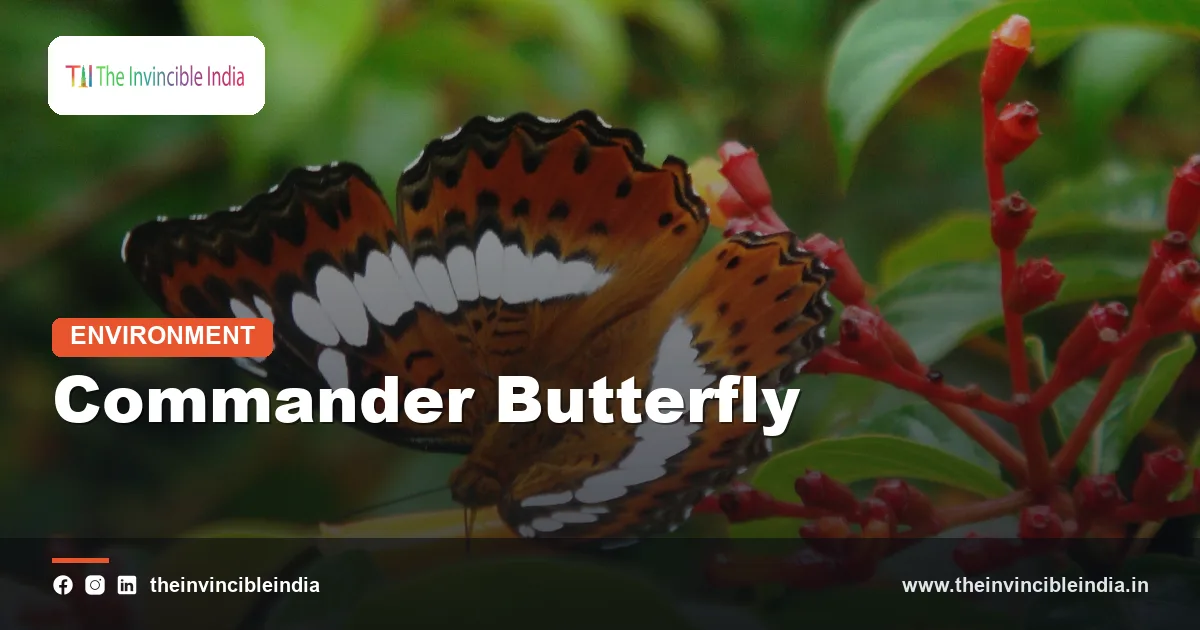
The commander butterfly (Moduza procris) is a medium-sized, orange-brown and white-banded forest butterfly of the family Nymphalidae, known for its slightly scalloped wings, gliding flight and its fondness for shaded forest trails. In India the commander butterfly lives in the moist forests of the Western Ghats and other peninsular hills, the Himalayan foothills and the north-east, and it is one of the more elegant members of the “sailor” group of butterflies.
This article explains what the commander butterfly looks like, where it lives in India, what its caterpillars feed on, how it flies and how it differs from similar species. It is a plain-language reference for students, trail walkers and amateur butterfly watchers.
Quick Facts: Commander Butterfly
| Attribute | Detail |
|---|---|
| Common name | Commander |
| Scientific name | Moduza procris (formerly placed in the genus Limenitis) |
| Family | Nymphalidae (brush-footed butterflies), subfamily Limenitidinae |
| Wingspan | Roughly 55 to 75 millimetres |
| Host plants | Shrubs and small trees of the madder family (Rubiaceae), such as Mussaenda and Wendlandia |
| Range and habitat in India | Moist deciduous and evergreen forest, forest edges and shaded trails in the Western Ghats, peninsular hills, Himalayan foothills and north-east India |
| Flight season and broods | Several broods in a year; seen through most of the year in the south, with peaks during and after the monsoon |
| Notable feature | Orange-brown wings with a pale band and scalloped margins, and a graceful flap-and-glide flight |
Key Takeaways
- The commander butterfly (Moduza procris) is a brush-footed butterfly with orange-brown wings crossed by a pale band.
- Caterpillars of the commander feed on shrubs and trees of the madder family, including Mussaenda and Wendlandia.
- In India the commander butterfly is found in the Western Ghats, other peninsular hills, the Himalayan foothills and the north-eastern states.
- The commander flies with a few quick wingbeats followed by a long glide, a pattern shared with the sailor butterflies of the genus Neptis.
- Male commanders are often seen on forest paths, taking minerals from damp soil and feeding on animal droppings and rotting fruit.
- The commander butterfly depends on shaded, moist forest with intact undergrowth, which makes it a useful indicator of forest health.
What is the commander butterfly?
The commander butterfly is a forest-dwelling nymphalid butterfly, scientifically named Moduza procris, belonging to the subfamily Limenitidinae, a group that includes the admirals, sailors and sergeants. It was long placed in the genus Limenitis, and older field guides may still use that name.
The species is widely distributed through tropical Asia, from the Indian subcontinent and Sri Lanka through South-East Asia and into parts of southern China and the Indonesian islands. Because the butterfly occupies such a large area, several regional subspecies have been described, and their colour and pattern differ slightly from place to place.
Like all nymphalids, the commander has reduced front legs, so it appears to stand on four legs. Its relatives in the Limenitidinae are known for the distinctive “flap and glide” flight, with wings held flat and still during the glide, a pattern that makes them easy to recognise on a forest trail even before the colours are visible.
How does the commander butterfly look?
The commander butterfly has rich orange-brown wings that are crossed by a broad pale band and bordered with dark brown or black. Its wing margins are slightly scalloped, especially on the hindwing, which gives the insect a neat, slightly angular outline.
The key identification features are:
- Upper side: a deep orange-brown ground colour, a pale cream or white band running across the wings, and dark borders with small pale spots.
- Underside: a paler and more patterned surface, with the band repeated, small markings near the body and a reddish-brown tone. The underside is useful for confirming identification when the butterfly rests with wings closed.
- Wing shape: a rounded forewing and a hindwing with a gently waved margin.
- Body: dark above and lighter below, with the club-ended antennae typical of butterflies.
The sexes are broadly similar, though females are generally a little larger and have a slightly broader wing shape. Subspecies differ in the width of the pale band and the darkness of the ground colour, so individuals from the Western Ghats may look somewhat different from those in the north-east.
Where does the commander butterfly live in India?
The commander butterfly lives in moist forest across much of peninsular India, the Himalayan foothills and the north-east, and it is particularly associated with the Western Ghats. It prefers a humid, shaded environment with a good shrub layer, and it avoids open, dry or heavily disturbed land.
In practice, naturalists most often encounter the commander in the following habitats:
- evergreen and semi-evergreen forest in the Western Ghats, from the lowlands to moderate hill elevations;
- moist deciduous forest in the peninsular hills and the central Indian forests where humidity is sufficient;
- forest in the foothills of the Himalaya and in the humid north-eastern states;
- shaded forest roads, streamsides and clearings where host shrubs grow.
Its distribution generally follows the distribution of its host plants and the presence of cool, moist conditions. In the south it can be seen through much of the year, while in cooler northern foothills it is more seasonal and appears mainly during the warmer, wetter months.
What do commander caterpillars eat?
Commander caterpillars eat the leaves of plants in the madder family, Rubiaceae, with Mussaenda and Wendlandia among the best-known host plants. These are shrubs and small trees that grow along forest edges, in clearings and on the lower layers of moist forest.
The female lays her eggs singly on the host leaf, often on the upper surface or near the tip. The newly hatched caterpillar begins to feed at the leaf edge and often builds a small perch of leaf fragments and silk, from which it eats. As it grows, it becomes green, with fleshy, spiny projections along the body, which helps it merge with the leaf it is eating.
Because Mussaenda is also grown as an ornamental garden shrub, the commander is occasionally seen near hill-station gardens and plantation roads that adjoin forest. These records should not be mistaken for a sign that the butterfly can live in town gardens, since it generally needs the forest nearby.
What is the life cycle of the commander butterfly?
The commander butterfly develops through four stages, egg, caterpillar, pupa and adult, and completes the cycle in roughly one to two months in warm conditions. Several generations may follow one another in a year.
| Stage | What happens | Approximate appearance |
|---|---|---|
| Egg | Laid singly on a host leaf | Small, rounded, pale green |
| Caterpillar (larva) | Feeds on madder-family leaves and moults several times | Green, with fleshy, spiny projections and a camouflaged outline |
| Pupa (chrysalis) | Hangs from the host plant while the adult form develops | Angular and leaf-coloured, resembling a curled leaf |
| Adult | Feeds, mates and lays eggs | Orange-brown with a pale band and scalloped margins |
The caterpillar and pupa both rely on camouflage rather than on chemical defence. The green, uneven shape of the pupa helps it pass for a dried or folded leaf. The adult emerges, expands and dries its wings, and begins to explore its territory within hours.
How does the commander butterfly fly and behave?
The commander butterfly flies with a few quick wingbeats followed by a long, steady glide on flat wings, and it usually flies at low to medium height along forest paths. This flap-and-glide style conserves energy, and it is characteristic of the sailor and sergeant butterflies.
Several behaviours are typical of the species:
- Males perch on leaves at the edge of a trail or clearing and chase other butterflies that pass through.
- Individuals frequently bask with their wings open in patches of sunlight, then fold or half-close them in shade.
- When disturbed, the commander moves off in a gliding flight and often returns to the same perch.
- Activity peaks in the morning and again in the late afternoon, with a quieter midday in hot weather.
The butterfly is not especially shy. Quiet watchers can often approach closely, especially when the insect is feeding at the ground. Sudden shadows and fast movements, however, are likely to make it leave its perch.
What do adult commander butterflies feed on?
Adult commander butterflies feed mainly on moisture and minerals from damp soil, animal droppings, rotting fruit and tree sap, and they visit flowers less often than many other butterflies. This diet is common among forest nymphalids.
Males gather at wet patches along streams and forest roads to take up dissolved salts and amino acids. This behaviour is called “mud-puddling”, and the minerals gained are important for the males’ reproduction. In some forests the commander is seen in mixed groups with sailors, crows and other species at the same damp spot.
When the butterfly does visit flowers, it generally takes nectar from small shrubs along the forest margin. The commander rarely visits open gardens and fields, as its feeding sites are concentrated in the shaded forest interior.
How can the commander be told apart from similar butterflies?
The commander butterfly is told apart from similar species chiefly by its orange-brown ground colour, scalloped hindwing margin and flap-and-glide flight. Several other forest butterflies, especially sailors and sergeants, share parts of this pattern, so a comparison helps.
| Butterfly | Main colour | Distinguishing sign |
|---|---|---|
| Commander (Moduza procris) | Orange-brown with a pale band | Scalloped hindwing margin and warm orange ground colour |
| Sailors (Neptis species) | Black or dark brown with white bands | No orange ground colour; narrower, striped wings |
| Sergeants (Athyma species) | Black with white bands | Cleaner black and white contrast |
| Chestnut-coloured admirals and rajahs | Brown or orange tones | Different wing shape and more rounded outlines |
Photographs of both upper and lower wing surfaces help in the field. The commander’s underside, with its repeated pale band and reddish tones, rarely matches the plain black-and-white pattern of the sailors.
Why does the commander butterfly matter for forests?
The commander butterfly matters because it is a sensitive indicator of moist, undisturbed forest and because it forms part of the forest food web. Butterflies respond quickly to changes in humidity, canopy cover and plant diversity, so their presence reflects the condition of the habitat.
- Prey species: eggs, caterpillars and adults feed birds, lizards, spiders and predatory insects.
- Pollination in small measure: although it feeds mostly on moisture and fruit, the adult visits some flowers and may carry pollen on its body.
- Habitat indicator: a healthy commander population signals that host shrubs and shaded trails are still present.
- Education: the species is a good introduction to the behaviour of the sailor group and to nymphalid anatomy.
Threats include the clearing of forest understorey, the loss of streamside vegetation and widespread pesticide use near forest edges. Restricting collection and keeping trails and host plants undisturbed are simple ways of protecting the butterfly.
Bottom Line
The commander butterfly is a graceful, orange-brown forest butterfly of the Western Ghats, the peninsular hills, the Himalayan foothills and the north-east. It is easy to recognise by its pale band, scalloped wings and gliding flight, and it depends on moist forest with madder-family host plants. Watching it quietly on a shaded trail is one of the most rewarding small pleasures of Indian forest walks.
Frequently Asked Questions
What is the commander butterfly?
The commander butterfly, Moduza procris, is an orange-brown forest butterfly with a pale band across its wings. It belongs to the family Nymphalidae and the subfamily Limenitidinae. It is found in moist forests across India and much of tropical Asia.
Where is the commander butterfly found in India?
The commander butterfly is found in the Western Ghats, other peninsular hills, the Himalayan foothills and the north-eastern states. It prefers moist, shaded forest with a good shrub layer. It is seldom seen in dry, open country.
What do commander caterpillars eat?
Commander caterpillars eat the leaves of shrubs and small trees in the madder family, Rubiaceae. Mussaenda and Wendlandia are among the best-known host plants. The green caterpillars are camouflaged against the leaves on which they feed.
How does the commander butterfly fly?
The commander butterfly flies with a few quick wingbeats followed by a long glide on flat wings. This flap-and-glide style is typical of the sailors and sergeants. It helps the butterfly save energy while it patrols forest paths.
What do adult commander butterflies eat?
Adult commander butterflies mainly take moisture and minerals from damp soil, animal droppings, rotting fruit and tree sap. They visit flowers less often than many butterflies. Males in particular gather at wet patches to obtain salts.
Is the commander butterfly rare?
The commander butterfly is not generally considered rare within its habitat, but it depends on moist forest and can disappear where undergrowth is cleared. It is more commonly seen in the Western Ghats and the north-east than in dry regions. Protecting forest understorey and avoiding collection help the species survive.
{“@context”:”https://schema.org”,”@graph”:[{“@type”:”FAQPage”,”mainEntity”:[{“@type”:”Question”,”name”:”What is the commander butterfly?”,”acceptedAnswer”:{“@type”:”Answer”,”text”:”The commander butterfly, Moduza procris, is an orange-brown forest butterfly with a pale band across its wings. It belongs to the family Nymphalidae and the subfamily Limenitidinae. It is found in moist forests across India and much of tropical Asia.”}},{“@type”:”Question”,”name”:”Where is the commander butterfly found in India?”,”acceptedAnswer”:{“@type”:”Answer”,”text”:”The commander butterfly is found in the Western Ghats, other peninsular hills, the Himalayan foothills and the north-eastern states. It prefers moist, shaded forest with a good shrub layer. It is seldom seen in dry, open country.”}},{“@type”:”Question”,”name”:”What do commander caterpillars eat?”,”acceptedAnswer”:{“@type”:”Answer”,”text”:”Commander caterpillars eat the leaves of shrubs and small trees in the madder family, Rubiaceae. Mussaenda and Wendlandia are among the best-known host plants. The green caterpillars are camouflaged against the leaves on which they feed.”}},{“@type”:”Question”,”name”:”How does the commander butterfly fly?”,”acceptedAnswer”:{“@type”:”Answer”,”text”:”The commander butterfly flies with a few quick wingbeats followed by a long glide on flat wings. This flap-and-glide style is typical of the sailors and sergeants. It helps the butterfly save energy while it patrols forest paths.”}},{“@type”:”Question”,”name”:”What do adult commander butterflies eat?”,”acceptedAnswer”:{“@type”:”Answer”,”text”:”Adult commander butterflies mainly take moisture and minerals from damp soil, animal droppings, rotting fruit and tree sap. They visit flowers less often than many butterflies. Males in particular gather at wet patches to obtain salts.”}},{“@type”:”Question”,”name”:”Is the commander butterfly rare?”,”acceptedAnswer”:{“@type”:”Answer”,”text”:”The commander butterfly is not generally considered rare within its habitat, but it depends on moist forest and can disappear where undergrowth is cleared. It is more commonly seen in the Western Ghats and the north-east than in dry regions. Protecting forest understorey and avoiding collection help the species survive.”}}]}]}


