

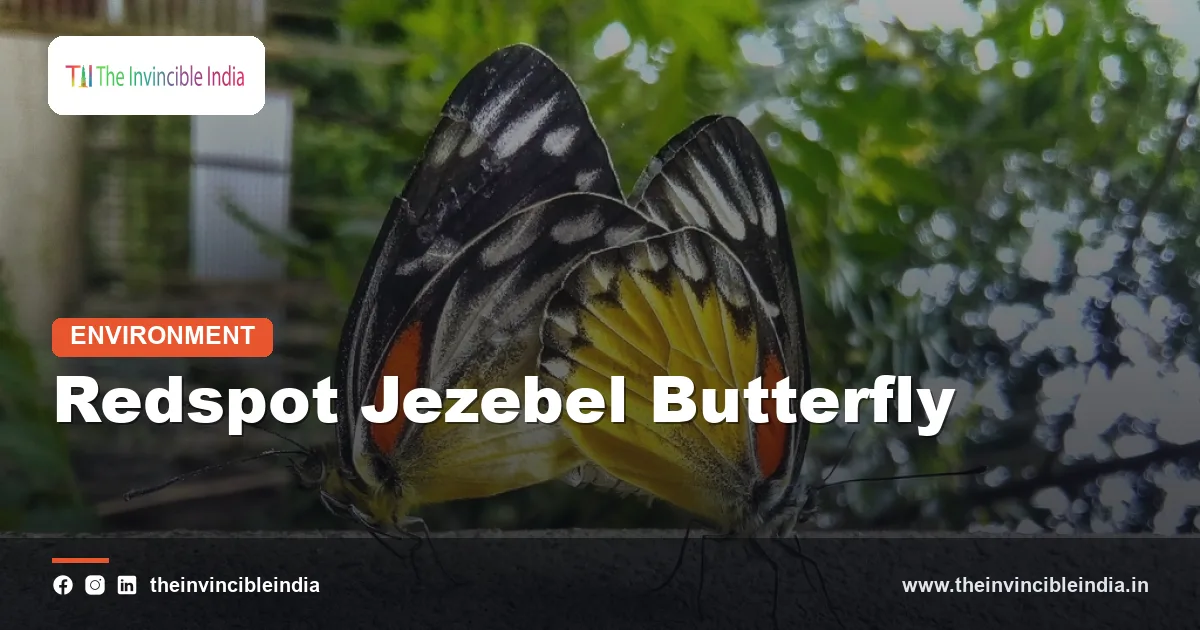
The redspot jezebel (Delias descombesi) is a white and black pierid butterfly of India whose underwings carry vivid red and yellow spots that warn predators it is unpalatable, and it is found mainly in the forests of the Himalayan foothills and the north-east. Its caterpillars feed on mistletoes, which are parasitic plants growing on forest trees, so the butterfly is most often seen high in the canopy or fluttering around flowering trees.
The redspot jezebel belongs to the family Pieridae, the whites and yellows, and to the genus Delias, whose members are known as jezebels. This article explains how to identify the redspot jezebel, what its warning colours mean, where it lives, what its gregarious caterpillars eat, and how it differs from other jezebels in India.
| Quick Facts: Redspot Jezebel | |
|---|---|
| Common name | Redspot jezebel (also written red-spot jezebel) |
| Scientific name | Delias descombesi (Boisduval, 1836) |
| Family | Pieridae (whites and yellows) |
| Wingspan | Roughly 6 to 8 cm |
| Host plants | Mistletoes of the family Loranthaceae, which are semi-parasitic shrubs on forest trees |
| Range in India | Eastern Himalayan foothills and north-eastern states; also Myanmar and parts of South-East Asia |
| Habitat | Evergreen and semi-evergreen hill forest, forest edges and clearings, usually in the foothills and lower mountains |
| Flight season | Seen over many months in warm regions, with peaks after the monsoon; several broods in a year |
| Notable features | Warning (aposematic) colours on the underside, mistletoe-feeding caterpillars, slow gliding flight, often high in trees |
Key Takeaways
- The redspot jezebel (Delias descombesi) is a pierid butterfly of India with white upper wings and a bright red, yellow and black underside.
- The red and yellow spots of the redspot jezebel are warning colours, called aposematic colouration, that advertise unpalatability to birds and other predators.
- Caterpillars of the redspot jezebel feed on mistletoes of the family Loranthaceae, which are semi-parasitic plants growing on forest trees.
- The redspot jezebel is found in the eastern Himalayan foothills and north-eastern India, as well as in neighbouring parts of South-East Asia.
- Jezebel caterpillars of the genus Delias typically live in groups, and their pupae hang on silk attached to a twig or leaf.
- The redspot jezebel is mostly a forest species, so it depends on intact hill forest that supports both its host mistletoes and flowering trees.
What is the redspot jezebel?
The redspot jezebel is a medium-sized forest butterfly of the family Pieridae, known for its bold red-spotted underside. Its scientific name is Delias descombesi, and the species was described by the French entomologist Jean Baptiste Boisduval in the nineteenth century.
The family Pieridae contains the whites, yellows, sulphurs and albatrosses. Most pierids are plain and easily seen in open country, but the jezebels of the genus Delias are different. They are mostly forest butterflies with striking patterns, and the genus is especially diverse in New Guinea and the surrounding islands. A smaller number of Delias species reach India, where they are found chiefly in the hills and in the north-east.
The common name “jezebel” is used for the whole group of Delias butterflies, and the word “redspot” refers to the red markings that are most conspicuous on the underside of the hindwing.
How can you identify the redspot jezebel?
The redspot jezebel can be identified by its white upper wings with black veins and a dark border, and by an underside that is richly marked with yellow and red. The contrast between the plain upper side and the bright lower side is the key feature of the species.
Key identification features
- Upper wings that are chiefly white or cream, with black veins and a black margin that is broader in females.
- A hindwing underside with yellow and red patches, which are visible when the butterfly rests with closed wings.
- A slow, fluttering or gliding flight, usually at tree height.
- A medium body, with the weak, floating flight typical of pierids that rely on chemical defence rather than speed.
- Rounded wings without tails.
When feeding at flowers, the butterfly often keeps its wings closed, which exposes the underside and its warning pattern. When the wings are opened to bask, the paler upper surface becomes visible. Females tend to appear darker and more heavily marked than males, which is common among Delias butterflies.
Where is the redspot jezebel found in India?
The redspot jezebel is found in India in the eastern Himalayan foothills and the north-eastern states, in forested hill country. Outside India its range extends through Myanmar and into parts of South-East Asia, following the belt of humid hill forest.
The butterfly is most often found in:
- Evergreen and semi-evergreen forest on lower and middle hill slopes.
- Forest edges, clearings and roadside trees where mistletoes grow in good numbers.
- Stream valleys, where flowering trees and shrubs provide nectar.
- Well-wooded hill gardens and tea or coffee plantations that retain shade trees.
Because the redspot jezebel depends on mistletoes growing on forest trees, it is largely absent from dry plains and open country. For readers in other parts of India, the more widespread common jezebel (Delias eucharis) is the species most often seen, as it occurs across much of the peninsula and the plains.
What do the red and yellow spots on the redspot jezebel mean?
The red and yellow spots on the redspot jezebel are warning colours that tell predators the butterfly is unpleasant to eat. This strategy is called aposematism, and it depends on bright, contrasting colours that predators can learn to remember.
The unpalatability is believed to come from the caterpillar’s diet. Mistletoes are known to contain chemicals that can be stored in the body of the feeding insect, and a caterpillar that eats them can pass the compounds on to the adult. A bird that tastes a jezebel once is likely to avoid similar butterflies afterwards.
The pattern is useful in another way. Because the vivid colours are on the underside, they are displayed when the butterfly is at rest, which is when it is most vulnerable. When the wings are closed, the bright pattern is on show, and when the butterfly flies, the pale upper surface flashes in the sunlight, which makes it a confusing target.
Several jezebels share similar warning colours, and this shared signal helps all of them. This kind of resemblance between unpalatable species is called Müllerian mimicry.
What does the redspot jezebel caterpillar eat?
The redspot jezebel caterpillar eats the leaves of mistletoes in the family Loranthaceae, a group of semi-parasitic shrubs that grow on the branches of host trees. Jezebel caterpillars in general are specialist feeders on mistletoes and related plants, and they are rarely found on ordinary garden plants.
Mistletoes grow in the crowns of trees, so the caterpillars and the egg-laying females are often found well above the ground. The female lays her eggs in clusters on the leaves, and the young caterpillars feed together. As they grow, they stay in groups and may move along a branch in a line. Their hairy bodies and bright warning colours are another signal of toxicity.
The group behaviour has some benefits: a cluster of brightly coloured caterpillars is easier for predators to remember, and the larvae share the effort of feeding on tough leaves. Mistletoes are not generally harmful to the health of the host tree in small numbers, so the caterpillars do no damage of concern. Heavy mistletoe infestations can weaken trees, and in that case jezebel caterpillars act as a mild natural check.
What is the life cycle of the redspot jezebel?
The life cycle of the redspot jezebel has four stages, egg, caterpillar, pupa and adult, and in warm conditions it can be completed in about a month or two. Several generations are possible in a year wherever the climate stays mild and mistletoes remain in leaf.
| Stage | What it looks like | What happens |
|---|---|---|
| Egg | Small, spindle-shaped and pale, laid in clusters | Placed on mistletoe leaves; hatches in about a week |
| Caterpillar | Hairy, brightly coloured and gregarious | Feeds in groups on mistletoe leaves and grows through several stages called instars |
| Pupa (chrysalis) | Angular and boldly patterned, held upright by a silk girdle | Hangs on a twig or leaf; metamorphosis occurs inside |
| Adult | White butterfly with a red, yellow and black underside | Feeds on nectar, mates and lays eggs on mistletoe; lives for a few weeks |
The pupae of jezebels often carry a pattern of black and yellow or white, which again appears to advertise unpalatability. The chrysalis is attached by the tail end and held by a thin band of silk, as in other pierids.
How is the redspot jezebel different from other jezebels?
The redspot jezebel differs from other Indian jezebels mainly in the arrangement of red and yellow markings on the underside of the hindwing and in its geographic range. Several Delias species look broadly alike on the upper side, so the underside pattern and the locality are the best clues.
| Butterfly | Scientific name | Region in India | Useful clue |
|---|---|---|---|
| Redspot jezebel | Delias descombesi | Eastern Himalayan foothills, north-east | Red and yellow spots on a dark-bordered underside |
| Common jezebel | Delias eucharis | Most of the peninsula and plains | Bright yellow and red patches near the base of the hindwing underside |
| Painted jezebel | Delias hyparete | Hill forests of the Himalaya, the north-east and parts of southern India | Patterned underside with yellow and red spots, similar overall look |
| Red-base jezebel | Delias pasithoe | Eastern Himalaya and north-eastern India | Prominent red base on the hindwing underside |
Identification in the field often depends on the exact arrangement of spots, so photographs of the underside are helpful. Local butterfly checklists and guides are the most reliable way to confirm which jezebel occurs in a given forest.
How does the redspot jezebel behave?
The redspot jezebel flies slowly and gracefully, often at the level of the forest canopy, and it visits flowering trees and shrubs for nectar. Its relaxed flight is typical of unpalatable butterflies, which do not need to flee quickly because predators tend to avoid them.
Behaviours that observers commonly note include:
- Canopy flying: The butterfly spends much of its time around the crowns of trees where its host mistletoes grow.
- Nectaring: It feeds at flowers, often with the wings held closed, so the warning colours are on display.
- Mud-puddling: Males sometimes gather at damp ground to drink minerals, usually in the company of other pierids.
- Roosting: At night it rests on twigs and leaves, often in groups, with the wings closed.
Binoculars are useful for watching the species. A pair with a close focus lets the observer study the underside pattern of a butterfly feeding high in a tree without disturbing it.
Is the redspot jezebel threatened?
The redspot jezebel is not regarded as a rare species across its forest range, but its dependence on mistletoes and on hill forest makes it sensitive to habitat change. Clearing of forest, felling of large old trees and heavy pesticide use near forest edges can all reduce local populations.
Butterflies in India fall under the Wildlife (Protection) Act, 1972, which regulates the collection of wild animals in protected areas. Responsible watching and photography are the best ways to enjoy the species. Useful habits include keeping to marked trails, leaving mistletoe on trees in forest areas and avoiding the removal of host plants.
Records of sightings, with date, place and photographs, add to public knowledge of the species. Community butterfly surveys in the north-east and the Himalayan states depend on such records.
Bottom Line
The redspot jezebel is a canopy-dwelling pierid whose white upper wings hide a red and yellow warning pattern. Its life is tied to mistletoes and humid hill forest, so protecting the forests of the Himalayan foothills and the north-east is the surest way to keep this butterfly flying.
Frequently Asked Questions
What is the scientific name of the redspot jezebel?
The scientific name of the redspot jezebel is Delias descombesi. It belongs to the family Pieridae, the whites and yellows. The species was described by Jean Baptiste Boisduval in the nineteenth century.
What do redspot jezebel caterpillars eat?
Redspot jezebel caterpillars eat the leaves of mistletoes in the family Loranthaceae. These are semi-parasitic plants that grow on the branches of forest trees. The caterpillars feed in groups and are often found high above the ground.
Why does the redspot jezebel have red and yellow spots?
The redspot jezebel has red and yellow spots to warn predators that it is unpalatable. This kind of warning colouration is called aposematism. The distasteful quality is believed to come from chemicals taken in through the caterpillar’s mistletoe diet.
Where is the redspot jezebel found in India?
The redspot jezebel is found in the eastern Himalayan foothills and the north-eastern states of India. It lives in humid evergreen and semi-evergreen hill forest. It is also found in neighbouring Myanmar and parts of South-East Asia.
Is the redspot jezebel the same as the common jezebel?
No, the redspot jezebel (Delias descombesi) is a different species from the common jezebel (Delias eucharis). Both belong to the same genus and have similar white upper wings and bright undersides. The common jezebel is far more widespread across the Indian peninsula and plains.
Is the redspot jezebel a poisonous butterfly?
The redspot jezebel is not dangerous to humans, but it is believed to be unpalatable to predators such as birds. Its bright warning colours advertise this to attackers. Handling the butterfly is unnecessary and can damage its delicate wings.
{“@context”:”https://schema.org”,”@graph”:[{“@type”:”FAQPage”,”mainEntity”:[{“@type”:”Question”,”name”:”What is the scientific name of the redspot jezebel?”,”acceptedAnswer”:{“@type”:”Answer”,”text”:”The scientific name of the redspot jezebel is Delias descombesi. It belongs to the family Pieridae, the whites and yellows. The species was described by Jean Baptiste Boisduval in the nineteenth century.”}},{“@type”:”Question”,”name”:”What do redspot jezebel caterpillars eat?”,”acceptedAnswer”:{“@type”:”Answer”,”text”:”Redspot jezebel caterpillars eat the leaves of mistletoes in the family Loranthaceae. These are semi-parasitic plants that grow on the branches of forest trees. The caterpillars feed in groups and are often found high above the ground.”}},{“@type”:”Question”,”name”:”Why does the redspot jezebel have red and yellow spots?”,”acceptedAnswer”:{“@type”:”Answer”,”text”:”The redspot jezebel has red and yellow spots to warn predators that it is unpalatable. This kind of warning colouration is called aposematism. The distasteful quality is believed to come from chemicals taken in through the caterpillar’s mistletoe diet.”}},{“@type”:”Question”,”name”:”Where is the redspot jezebel found in India?”,”acceptedAnswer”:{“@type”:”Answer”,”text”:”The redspot jezebel is found in the eastern Himalayan foothills and the north-eastern states of India. It lives in humid evergreen and semi-evergreen hill forest. It is also found in neighbouring Myanmar and parts of South-East Asia.”}},{“@type”:”Question”,”name”:”Is the redspot jezebel the same as the common jezebel?”,”acceptedAnswer”:{“@type”:”Answer”,”text”:”No, the redspot jezebel (Delias descombesi) is a different species from the common jezebel (Delias eucharis). Both belong to the same genus and have similar white upper wings and bright undersides. The common jezebel is far more widespread across the Indian peninsula and plains.”}},{“@type”:”Question”,”name”:”Is the redspot jezebel a poisonous butterfly?”,”acceptedAnswer”:{“@type”:”Answer”,”text”:”The redspot jezebel is not dangerous to humans, but it is believed to be unpalatable to predators such as birds. Its bright warning colours advertise this to attackers. Handling the butterfly is unnecessary and can damage its delicate wings.”}}]}]}


