

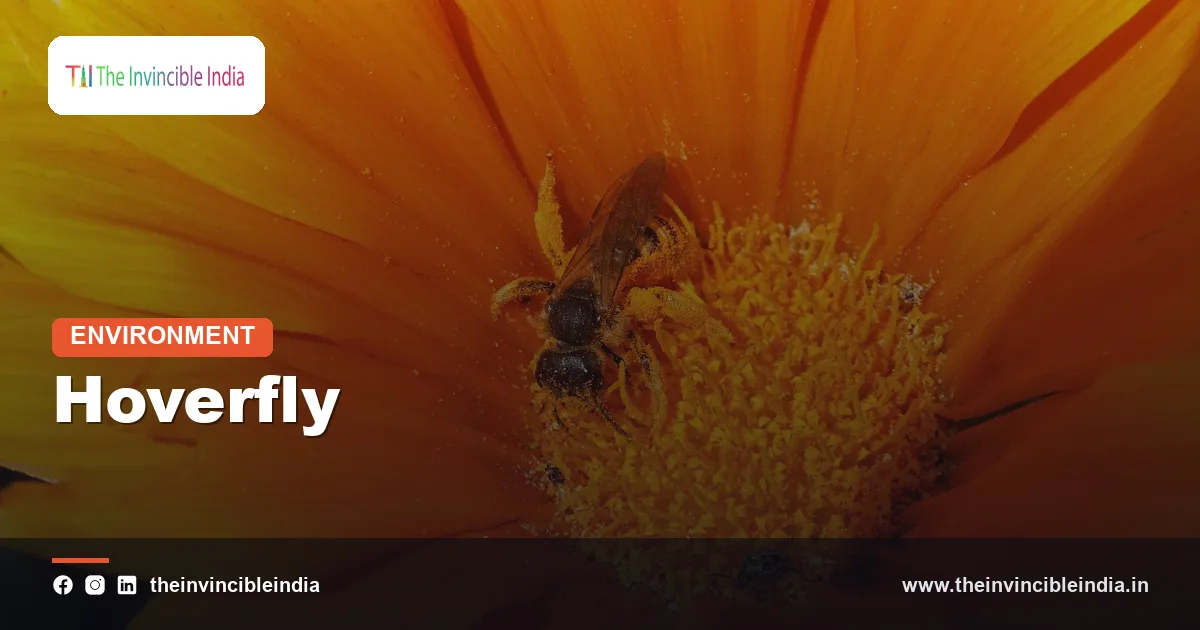
The hoverfly is a small to medium-sized fly of the family Syrphidae that hovers motionless in the air at flowers, often resembles a bee or wasp, and is harmless to people while serving as both a pollinator and a natural pest controller. Hoverflies are also known as flower flies, and they are among the most common and useful insects found in Indian gardens, farms and forest edges.
The hoverfly is easy to overlook or mistake for a stinging insect, but it has no sting and only two wings. Adults feed on nectar and pollen, while the larvae of many species eat aphids and other soft-bodied pests. This explainer describes how to recognise a hoverfly, how its life cycle works, why it mimics bees, and how gardeners and farmers in India can attract it.
Quick Facts: Hoverfly
| Scientific group | Family Syrphidae (flower flies or syrphid flies) |
|---|---|
| Order | Diptera (true flies) |
| Size | Mostly about 6 to 20 mm long; some tropical species are larger |
| Habitat in India | Gardens, crop fields, grasslands, forest edges, hill meadows and city parks across the country |
| Adult diet | Nectar and pollen from flowers |
| Larval diet | Varies by species: aphids and other soft-bodied insects, decaying matter, microbes in water, or plant tissue |
| Life cycle | Egg, three larval stages, puparium (pupa) and adult; a few weeks in warm weather |
| Ecological role | Pollinator and biological control agent; some species also recycle decaying matter |
| Notable features | Hovers in mid-air, mimics bees and wasps, has one pair of wings and cannot sting |
Key Takeaways
- The hoverfly is a true fly of the family Syrphidae, and it has only two wings even though many species look like bees or wasps.
- Hoverflies are harmless to humans because they have no sting and do not bite.
- Adult hoverflies feed on nectar and pollen and are important pollinators of wild plants, vegetables and fruit crops.
- The larvae of many hoverfly species eat aphids, which makes the hoverfly a valuable natural enemy of crop and garden pests.
- Hoverflies resemble bees and wasps through Batesian mimicry, a harmless-for-dangerous disguise that discourages predators.
- Gardeners attract hoverflies by growing small-flowered plants such as coriander, marigold and cosmos, and by limiting broad-spectrum insecticides.
What is a hoverfly?
A hoverfly is a true fly in the family Syrphidae, known for its ability to hold a fixed position in the air above a flower before darting away. More than six thousand species of hoverflies are known worldwide, and they occur on every continent except Antarctica.
Hoverflies belong to the insect order Diptera, the same order that includes house flies, mosquitoes and robberflies. The name Diptera means two wings. This is the quickest way to separate a hoverfly from a bee or wasp, which have four wings. The second pair of wings in a fly has been reduced to small club-shaped balancing organs called halteres.
The family is divided into several subfamilies. The best-known are the Syrphinae, whose larvae are mainly predators of aphids, and the Eristalinae, whose larvae include scavengers in water and decaying matter. Species in India include the banded flower fly (Episyrphus balteatus), the drone fly (Eristalis tenax) and Ischiodon scutellaris, which is commonly noted in Indian fields as an aphid predator.
How can you recognise a hoverfly?
A hoverfly can be recognised by its two wings, large eyes, very short antennae and habit of hovering and darting at flowers. Many species have yellow-and-black stripes on the abdomen, but a close look shows a fly-like head and a smooth, almost hairless body.
The following features help to separate hoverflies from the insects they imitate.
- Wings: A hoverfly has one pair of wings, while bees and wasps have two pairs.
- Antennae: Hoverflies have very short, stubby antennae, while bees and wasps have longer, elbowed ones.
- Eyes: Hoverflies have large eyes that often meet at the top of the head in males.
- Behaviour: Hoverflies hover and move suddenly, and they settle with a light, delicate touch rather than crawling busily over flowers.
- Waist: Bees and wasps often show a narrow waist, whereas most hoverflies have a broader attachment between thorax and abdomen.
- Wing veins: Most hoverflies have a false, wing-length vein that runs parallel to the edge of the wing, a feature that experts use for identification.
The colour patterns vary widely. Some Indian species are slim and wasp-like with yellow bands, while others are stout, hairy and bee-like. Drone flies look like honeybees in size and colour and are often seen on flowers and decaying fruit.
How does the life cycle of the hoverfly work?
The life cycle of the hoverfly has four stages, egg, larva, pupa and adult, and in warm parts of India it can be completed in a few weeks. Several generations can therefore appear in a year, with the highest numbers usually during the cooler flowering season.
Egg
The female hoverfly lays tiny, elongated white eggs, often singly or in small groups. Species whose larvae eat aphids choose to lay their eggs near aphid colonies, usually on the leaves or stems of infested plants, so that the newly hatched larvae find prey immediately.
Larva
The larva is a legless, maggot-like creature that can be green, brown, pale or translucent. Aphid-eating larvae are blind and move slowly, searching with a swaying motion of the head until they touch a prey item. They seize the aphid, lift it and suck out its body contents. A single larva can eat many hundreds of aphids during its development.
Pupa and adult
The larva forms a teardrop-shaped puparium, which is the hardened last larval skin, usually attached to a leaf or stem or lying in the soil. The adult emerges after several days and starts feeding on nectar and pollen. Females need protein from pollen to mature their eggs.
In cooler regions, hoverflies may pass the winter as larvae, pupae or adults. Some species undertake long seasonal migrations, with huge numbers travelling together, though this is better documented in temperate regions than in India.
What do hoverflies eat?
Adult hoverflies eat nectar and pollen, while the diet of hoverfly larvae depends on the species and ranges from aphids to decaying matter. Adults obtain sugars and energy from nectar and use pollen as a protein source, visiting a wide variety of flowers with open, accessible blooms.
The larval diets fall into broad groups.
| Larval type | What the larva eats | Example habitat | Role |
|---|---|---|---|
| Aphid eaters (predatory) | Aphids, thrips, small caterpillars and other soft-bodied insects | Crops, vegetables, shrubs, roses | Natural pest control |
| Rat-tailed maggots | Bacteria and decaying matter in stagnant, rich water | Puddles, drains, manure pits | Recycling of organic matter |
| Decay feeders | Rotting wood, fungi and organic debris | Tree holes, leaf litter, compost | Nutrient recycling |
| Plant feeders | Tissue of bulbs, stems or leaves | Bulb crops, some wild plants | A minority; may be a pest locally |
The rat-tailed maggot of the drone fly carries a long, telescopic breathing tube, which it extends to the surface of the water while feeding in the oxygen-poor sludge below. Although it lives in unpleasant places, it is harmless and does not bite.
Why do hoverflies look like bees and wasps?
Hoverflies look like bees and wasps because the resemblance protects them from predators such as birds, a strategy known as Batesian mimicry. Predators that have learned to avoid stinging insects tend to leave similarly marked flies alone, even though the hoverfly has no sting.
The mimicry can be very detailed. Some hoverflies copy the colour pattern of wasps, some the fuzzy, striped bodies of bumblebees and some the shape and colour of honeybees. Many also copy behaviour. A threatened hoverfly may buzz loudly, curve its abdomen like a wasp, or move in a jerky way that suggests a sting.
The disguise is not perfect, and some predators, such as certain flycatchers, dragonflies and robberflies, still hunt hoverflies. Even so, the strategy is successful enough that it has evolved many times within the family, which is why Syrphidae contains so many bee-like and wasp-like species.
Why are hoverflies important pollinators?
Hoverflies are important pollinators because the adults visit large numbers of flowers for nectar and pollen and carry pollen between plants on their bodies. They are among the most frequent flower visitors after bees, and in some habitats, such as cool hill meadows or cold-weather crops, they are among the most active pollinators.
Hoverflies are efficient in several ways.
- They are active in a wide range of weather, including cool and overcast days when bees stay inside.
- They visit many crops, including coriander, carrot, onion, mustard, sunflower and many fruit trees.
- Their hairy bodies carry pollen, and their long flights allow it to move across a field.
- Migratory species can carry pollen over very long distances.
Hoverflies are not a replacement for honeybees and wild bees, but they supplement bees, especially for crops of the carrot, onion and mustard families. Researchers increasingly regard flower flies as a neglected pollinator group, and protecting them benefits both wild plants and food production.
How do hoverflies help farmers and gardeners?
Hoverflies help farmers and gardeners by providing free pest control, because their larvae eat aphids that would otherwise damage vegetables, cereals, pulses and ornamental plants. This service is a kind of biological control, which means managing pests with their natural enemies rather than chemicals.
Aphids are small sap-sucking bugs that multiply fast and weaken plants. They also spread plant viruses and leave behind sticky honeydew. Where hoverfly larvae are present, aphid colonies are often cleared within days. Hoverflies work alongside ladybird beetles, lacewings and parasitic wasps, and together these natural enemies form the backbone of integrated pest management.
Several practical steps encourage hoverflies.
- Grow flowers: Small, open flowers such as coriander, fennel, dill, marigold, cosmos, zinnia and sweet alyssum offer accessible nectar.
- Leave some wild margins: Flowering weeds along field edges give food when crops are not in bloom.
- Tolerate a few aphids: A small aphid colony attracts egg-laying females, and the larvae will control it.
- Reduce spraying: Broad-spectrum insecticides kill larvae and adults. Selective or botanical products used carefully are less harmful.
- Provide water and shelter: Shallow water, mulch and leaf litter support some species.
Hoverflies also have a role beyond fields and gardens. In forests and meadows, they pollinate wild flowers that feed birds and mammals, and the rat-tailed and decay-feeding larvae help break down dead plant and animal matter. Because a single family performs pollination, pest control and recycling, hoverfly diversity is often used by ecologists as a rough sign of how healthy a habitat is. Simple counts of flower flies on a transect walk are a popular citizen-science activity in many countries.
Are hoverflies dangerous to people?
No, hoverflies are not dangerous to people: they cannot sting, they do not bite, and they carry no known harm to humans. A hoverfly that lands on the skin may lick the sweat for its salts, which feels like a gentle tickle.
The danger lies in the confusion. People may swat a hoverfly or spray it, believing it to be a wasp. Learning to spot the two wings and the hovering flight prevents unnecessary killing of useful insects. Rat-tailed maggots found in drains or manure are also harmless to humans, although they may look unpleasant.
Bottom Line
The hoverfly is a harmless, two-winged fly that disguises itself as a bee or wasp, pollinates flowers as an adult and, in many species, protects plants as a larva by eating aphids. A few flowers and less spraying are usually enough to bring this small helper to an Indian garden.
Frequently Asked Questions
What is a hoverfly?
A hoverfly is a small to medium-sized fly of the family Syrphidae that hovers in the air at flowers. Many look like bees or wasps but have only two wings and cannot sting. Adults pollinate flowers and many larvae eat aphids.
Can a hoverfly sting or bite?
No, a hoverfly cannot sting and does not bite. Its bee-like stripes are only a disguise to discourage predators. It is harmless to people and pets.
How is a hoverfly different from a bee?
A hoverfly has one pair of wings, very short antennae and large eyes, whereas a bee has two pairs of wings and longer antennae. Hoverflies also hover and dart in the air. Bees usually crawl over flowers and carry pollen in baskets or hairs on the legs or body.
What do hoverfly larvae eat?
Many hoverfly larvae eat aphids and other small soft-bodied insects, but the diet depends on the species. Some larvae feed on decaying matter, fungi or bacteria in water, and a few feed on plants. The aphid-eating kinds are valued as natural pest control.
Are hoverflies good for gardens?
Yes, hoverflies are good for gardens because adults pollinate flowers and many larvae control aphids. Growing small-flowered plants such as coriander, marigold and cosmos attracts them. Avoiding broad-spectrum insecticides keeps them alive.
Why do hoverflies hover?
Hoverflies hover mainly to hold a position while feeding at flowers or while males guard a territory and watch for females. Their fast, precisely controlled wingbeats let them stay still, move sideways and shoot away suddenly. This flight skill also helps them escape predators.
{“@context”:”https://schema.org”,”@graph”:[{“@type”:”FAQPage”,”mainEntity”:[{“@type”:”Question”,”name”:”What is a hoverfly?”,”acceptedAnswer”:{“@type”:”Answer”,”text”:”A hoverfly is a small to medium-sized fly of the family Syrphidae that hovers in the air at flowers. Many look like bees or wasps but have only two wings and cannot sting. Adults pollinate flowers and many larvae eat aphids.”}},{“@type”:”Question”,”name”:”Can a hoverfly sting or bite?”,”acceptedAnswer”:{“@type”:”Answer”,”text”:”No, a hoverfly cannot sting and does not bite. Its bee-like stripes are only a disguise to discourage predators. It is harmless to people and pets.”}},{“@type”:”Question”,”name”:”How is a hoverfly different from a bee?”,”acceptedAnswer”:{“@type”:”Answer”,”text”:”A hoverfly has one pair of wings, very short antennae and large eyes, whereas a bee has two pairs of wings and longer antennae. Hoverflies also hover and dart in the air. Bees usually crawl over flowers and carry pollen in baskets or hairs on the legs or body.”}},{“@type”:”Question”,”name”:”What do hoverfly larvae eat?”,”acceptedAnswer”:{“@type”:”Answer”,”text”:”Many hoverfly larvae eat aphids and other small soft-bodied insects, but the diet depends on the species. Some larvae feed on decaying matter, fungi or bacteria in water, and a few feed on plants. The aphid-eating kinds are valued as natural pest control.”}},{“@type”:”Question”,”name”:”Are hoverflies good for gardens?”,”acceptedAnswer”:{“@type”:”Answer”,”text”:”Yes, hoverflies are good for gardens because adults pollinate flowers and many larvae control aphids. Growing small-flowered plants such as coriander, marigold and cosmos attracts them. Avoiding broad-spectrum insecticides keeps them alive.”}},{“@type”:”Question”,”name”:”Why do hoverflies hover?”,”acceptedAnswer”:{“@type”:”Answer”,”text”:”Hoverflies hover mainly to hold a position while feeding at flowers or while males guard a territory and watch for females. Their fast, precisely controlled wingbeats let them stay still, move sideways and shoot away suddenly. This flight skill also helps them escape predators.”}}]}]}


