

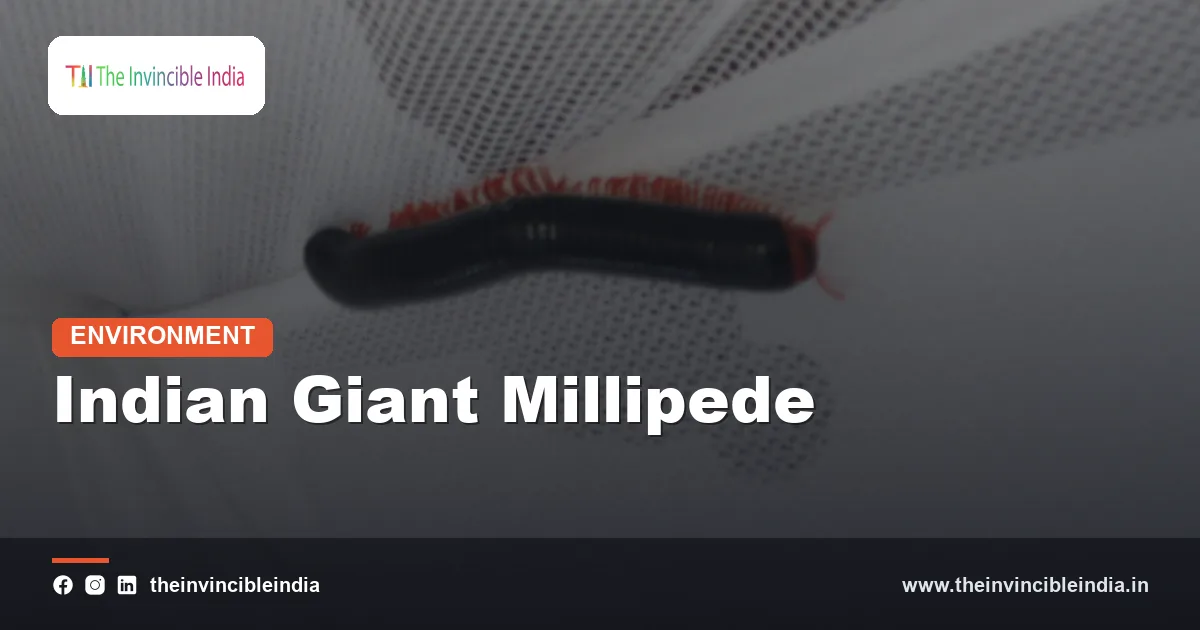
The Indian giant millipede is a large, cylindrical, many-legged arthropod of Indian forests, plantations and gardens that feeds on rotting leaves and wood, curls into a tight coil when disturbed, and is not venomous. Belonging to the class Diplopoda, it is a slow, harmless recycler of dead plant matter, and one of the most commonly seen big invertebrates on damp ground during the monsoon.
Many people mistake the Indian giant millipede for a centipede and fear it as a biter. In fact the two animals are very different: the millipede has no venom fangs, eats decaying plants rather than prey, and relies on coiling and a smelly chemical defence rather than attack. This article explains what the Indian giant millipede is, where it lives, what it eats, how it defends itself, how it breeds, and why it matters for soil and gardens.
| Quick Facts | Details |
|---|---|
| Common name | Indian giant millipede (also called giant millipede or, in Hindi, often lumped with kankhajura) |
| Typical species group | Large millipedes of the order Spirostreptida, such as species of the genus Thyropygus |
| Class and phylum | Diplopoda; Arthropoda |
| Size | Commonly about 10 to 15 cm long, with a cylindrical body roughly the width of a pencil to a finger |
| Range and habitat in India | Moist forests, plantations, gardens and leaf litter, especially in the Western Ghats, the northeast and other humid regions |
| Diet | Detritivore: decaying leaves, rotting wood, fallen fruit and organic matter in soil |
| Legs | Two pairs of legs on most body segments, giving dozens to a few hundred legs |
| Life cycle | Eggs laid in soil; young hatch with few segments and add segments with each moult; lives several years |
| Danger to humans | Not venomous and does not bite; defensive fluid can irritate skin and eyes |
Key Takeaways
- The Indian giant millipede is a harmless, slow-moving detritivore that eats dead leaves and rotting wood rather than living animals.
- A millipede has two pairs of legs on most body segments, and no millipede has a thousand legs; the number varies from a few dozen to a few hundred in Indian species.
- The Indian giant millipede has no venom and no biting fangs, and it defends itself by coiling and by releasing an irritating, bad-smelling fluid.
- Millipedes differ from centipedes: millipedes have rounded bodies, two pairs of legs per segment and eat plant matter, while centipedes are flat, have one pair of legs per segment and are venomous predators.
- By breaking down leaf litter, the Indian giant millipede returns nutrients to the soil and helps make forests, gardens and farms more fertile.
- The Indian giant millipede is most visible in the monsoon, when rain brings it out of the soil and across paths, lawns and walls.
What is the Indian giant millipede?
The Indian giant millipede is a large millipede, an arthropod of the class Diplopoda, found across the humid parts of India. The name is a common-language label rather than a single formal species: it covers several big, round-bodied millipedes, many belonging to the order Spirostreptida, such as species of the genus Thyropygus, that reach around 10 to 15 cm in length.
Like insects, spiders and crustaceans, the Indian giant millipede is an arthropod, meaning it has a hard jointed outer skeleton, a segmented body and jointed legs. Unlike insects, which have six legs and three body parts, millipedes have long bodies made of many near-identical segments, each with legs. The head carries a pair of short antennae, simple eyes or eye clusters, and chewing mouthparts.
The word millipede means “thousand feet”, but that is an exaggeration. The record for the most legs belongs to a rare species from California with several hundred, and the common Indian giant millipede has far fewer, typically some dozens to a few hundred legs depending on the species and its age.
In everyday Indian speech, one local name is often used for both millipedes and centipedes. This confusion lies behind many needless fears, because the two animals behave in very different ways.
Where does the Indian giant millipede live?
The Indian giant millipede lives in damp, shaded places with plenty of rotting plant matter, which includes forests, plantations, gardens, orchards and the edges of fields across much of India. It is especially abundant in high-rainfall regions such as the Western Ghats, the northeast and the Himalayan foothills, and it can also be found in towns wherever there is moist ground and leaf litter.
Millipedes lose water through their thin outer skin more easily than insects, so the Indian giant millipede avoids dry heat. By day it hides in:
- Leaf litter and the layer of loose decaying plant matter on the soil surface
- Rotting logs, stumps and bark
- Compost heaps, mulch and damp garden corners
- Tunnels and burrows in soft soil, and under stones or pots
The giant millipede is largely nocturnal and most active in the humid hours of night and after rain. During hot, dry months it retreats deeper into the soil and may remain inactive for long periods. When the first monsoon showers arrive, many emerge together, and large numbers can be found crossing roads, courtyards and forest paths. This seasonal appearance is why many people think of them as a “rainy-season” creature.
A related group found in southern India, the giant pill millipedes of the genus Arthrosphaera, lives in the Western Ghats and rolls into a ball rather than a coil. These are a different kind of millipede, but they share the same habitat and the same recycling role.
What does the Indian giant millipede look like?
The Indian giant millipede looks like a long, smooth, glossy tube, usually dark brown, black or reddish-brown, made of many rings with short legs tucked beneath. The body is round in cross-section, and each visible ring is built from two fused segments, which is why most segments carry two pairs of legs.
The main features of the Indian giant millipede include:
- Rounded, hard body: a cylindrical shell that is stiffened with calcium and protects the animal from small predators.
- Short legs in rows: the legs move in smooth, rippling waves that run along the body, giving the animal a graceful gliding walk.
- Small head with short antennae: the antennae are used for touching and smelling the ground as the animal feels its way forward.
- Stink glands: tiny pores along the sides of the body release defensive fluid.
- Coloured bands or rims: in some species the body segments have lighter or reddish edges that warn predators that the animal tastes unpleasant.
The slow, rippling walk of the Indian giant millipede is built for pushing through leaf litter and soil rather than for speed. Its many short legs give strong pushing power, so it can bulldoze through loose, damp earth.
What does the Indian giant millipede eat?
The Indian giant millipede is a detritivore, which means it eats dead and decaying plant material such as fallen leaves, rotting wood and the organic crumbs in soil. It does not hunt, bite or kill other animals, and it does not feed on healthy living plants in any serious way.
Its chewing mouthparts scrape and grind soft, partly rotted material, which has usually already been softened by fungi and bacteria. Typical foods include:
- Fallen and half-decayed leaves in forests and gardens
- Soft rotting wood and bark
- Decomposing fruit and vegetable matter in compost
- Fungi-rich litter and bits of soil with organic content
The Indian giant millipede also swallows tiny amounts of soil and grit to help grind its food, and it needs calcium for its hard shell, which it gets from soil, rotting leaves and sometimes from limestone-rich ground. Occasionally, in gardens, a hungry millipede may nibble soft seedlings, tender roots or ripe strawberries lying on the soil, but this is minor compared with the damage done by insects such as caterpillars and beetles.
Digestion in the millipede is relatively inefficient, so its droppings still contain a lot of partly broken-down plant matter. This is useful, because the fragmented droppings expose more surface to fungi and bacteria, which finish the decay and release nutrients.
How does the Indian giant millipede defend itself?
The Indian giant millipede defends itself mainly by curling into a tight spiral coil with its head tucked inside and by releasing an irritating, foul-smelling fluid from pores along its body. Because it is slow and has no venom or bite, these passive defences protect it from most predators.
The defence usually proceeds in steps:
- The animal stops moving and tucks its head and soft underside into the centre of a flat spiral.
- The hard, rounded outer plates form a protective shield around the vulnerable legs and belly.
- If the threat continues, defensive glands along the sides release a liquid with quinones and other irritating chemicals.
The fluid has a sharp, medicinal smell, and it may stain skin brown or yellowish and sting the eyes or any cuts. It can discourage ants, beetles, birds and small mammals. Some other millipede groups in the world produce hydrogen cyanide in their defensive fluids, but the effect on a human is usually mild skin irritation.
It is wise to wash hands after handling a millipede, avoid touching the face or eyes, and rinse the eyes thoroughly with plenty of clean water if the fluid gets in. Most people never have a problem, since the animal produces the fluid only when roughly handled.
Is the Indian giant millipede dangerous or venomous?
The Indian giant millipede is not venomous and not dangerous to people; it has no fangs, no sting and no ability to bite in a harmful way. Its only chemical weapon is a defensive secretion that can cause temporary skin irritation, and it uses that only when it is being squeezed or attacked.
The fear of millipedes comes largely from confusion with centipedes. The table below shows the most useful differences.
| Feature | Millipede | Centipede |
|---|---|---|
| Body shape | Rounded, tube-like | Flattened |
| Legs per segment | Two pairs on most segments | One pair per segment |
| Speed | Slow and steady | Fast and darting |
| Diet | Decaying plant matter | Insects and other animals |
| Venom | None | Yes, delivered by modified front legs |
| Defence | Coils and releases irritant fluid | Bites or runs away |
| Behaviour when touched | Curls up | Flees or bites |
The Indian giant millipede is harmless to pets in most cases, but dogs or cats that chew one may drool or vomit because of the taste of the secretions. Millipedes do not infest houses in the way that cockroaches do and do not damage buildings, furniture or clothing. They are accidental visitors that wander in when the ground outside is flooded or very dry.
How does the Indian giant millipede reproduce and grow?
The Indian giant millipede reproduces by laying eggs in the soil, and the young grow by shedding their outer skin and adding body segments with each moult. This pattern of growth, in which new segments are added as the animal matures, is typical of millipedes.
In breeding, the male uses a pair of modified legs, called gonopods, to transfer sperm to the female. The male often climbs onto the female’s back and holds on, and the two may stay together for a long time. Afterwards, the female lays her eggs in a small chamber in damp soil or rotting wood. In some millipedes she lines or seals the nest with soil and droppings to protect the eggs from drying out and from fungi.
The young hatch into small, pale versions of the adults with only a few body segments and just three pairs of legs. Over a series of moults, the young millipede adds segments and legs until it reaches its adult form. During each moult the animal often hides in a sealed chamber in the soil, where it is safe while its new skin hardens. It then eats its old skin, which recycles precious calcium.
The Indian giant millipede grows slowly and can live for several years, with large species living a few years or longer in good conditions. Because they mature slowly and produce relatively few offspring compared with insects, millipede populations recover slowly if their habitat is lost.
Why is the Indian giant millipede important for soil and gardens?
The Indian giant millipede is important because it breaks dead leaves and wood into small fragments, speeding decomposition and returning nutrients such as nitrogen, phosphorus and calcium to the soil. Ecologists call this role the work of a decomposer or detritivore, and it keeps forests and gardens fertile.
The benefits of the Indian giant millipede include:
- Litter breakdown: chewing leaves into smaller pieces so fungi and bacteria can finish the job faster.
- Nutrient cycling: returning nutrients to the soil in droppings that plants can absorb.
- Soil structure: mixing organic matter into the soil as it burrows, which improves aeration and water movement.
- Food web link: serving as prey for birds, frogs, toads, lizards, shrews and mongooses, and for certain beetles and ants.
In composting systems and mulched gardens, a few millipedes are a sign of healthy, active decay. Gardeners seldom need to control them. If large numbers appear around seedlings, simple measures such as removing excess damp mulch from the base of plants usually solve the problem without chemicals.
Chemical pesticides in gardens and plantations can harm millipedes and other soil invertebrates, reducing the natural recycling of leaf litter. Leaving some leaf litter and rotting wood in a garden corner provides habitat for them.
What should you do when you find an Indian giant millipede?
When you find an Indian giant millipede, the best response is to leave it alone or move it gently outdoors to a damp, shaded spot, because it is harmless and useful. There is no need to kill it, spray it or use pesticides.
Practical tips include:
- Use a stick, piece of paper or a gloved hand to lift the animal, and wash your hands afterwards.
- Place it under leaf litter or near a hedge, away from roads, where it can resume feeding.
- Reduce entries into the house by sealing gaps under doors and fixing leaks that create damp corners.
- Keep children from squeezing it, since a frightened millipede releases its irritant fluid.
- Do not collect wild millipedes as pets; the giant African millipede is the species commonly kept, and it needs specialised care.
Observing the Indian giant millipede in a garden is a good way to introduce children to soil ecology. Its slow, calm movements, its coiling response and its role in recycling leaves make it an easy and safe animal to watch.
Bottom Line
The Indian giant millipede is a gentle, plant-eating recycler with a rounded body, countless short legs and a habit of curling up when disturbed. It is harmless to humans, valuable for soil health and best left unharmed.
Frequently Asked Questions
Is the Indian giant millipede poisonous?
The Indian giant millipede is not venomous and cannot sting or bite in any harmful way. It can release a defensive fluid that irritates skin and eyes and stains the skin brown. Washing the area with water is usually enough.
How many legs does the Indian giant millipede have?
The Indian giant millipede has dozens to a few hundred legs, not a thousand, depending on the species and its age. Most body segments carry two pairs of legs. Young millipedes have far fewer legs and add more as they grow.
What is the difference between a millipede and a centipede?
A millipede has a rounded body, two pairs of legs per segment and eats decaying plants, while a centipede has a flat body, one pair of legs per segment and is a venomous predator. Millipedes move slowly and coil up, whereas centipedes are fast and bite. The Indian giant millipede is a millipede and is harmless.
Why do millipedes appear during the monsoon?
Millipedes appear during the monsoon because rain floods their soil burrows and the damp, humid air lets them move on the surface without drying out. The Indian giant millipede is also searching for food and mates at this time. They usually disappear again when the weather turns dry.
What does the Indian giant millipede eat?
The Indian giant millipede eats dead and decaying plant matter such as fallen leaves, rotting wood and fruit. It is a detritivore, so it does not hunt animals. By grinding up this material it helps fungi and bacteria complete decomposition.
Why does a millipede curl up when touched?
A millipede curls into a coil to protect its soft legs and underside behind its hard, rounded outer plates. The Indian giant millipede has no venom or fast escape, so coiling is its first defence. If handled roughly, it also releases an irritating fluid.
{“@context”:”https://schema.org”,”@graph”:[{“@type”:”FAQPage”,”mainEntity”:[{“@type”:”Question”,”name”:”Is the Indian giant millipede poisonous?”,”acceptedAnswer”:{“@type”:”Answer”,”text”:”The Indian giant millipede is not venomous and cannot sting or bite in any harmful way. It can release a defensive fluid that irritates skin and eyes and stains the skin brown. Washing the area with water is usually enough.”}},{“@type”:”Question”,”name”:”How many legs does the Indian giant millipede have?”,”acceptedAnswer”:{“@type”:”Answer”,”text”:”The Indian giant millipede has dozens to a few hundred legs, not a thousand, depending on the species and its age. Most body segments carry two pairs of legs. Young millipedes have far fewer legs and add more as they grow.”}},{“@type”:”Question”,”name”:”What is the difference between a millipede and a centipede?”,”acceptedAnswer”:{“@type”:”Answer”,”text”:”A millipede has a rounded body, two pairs of legs per segment and eats decaying plants, while a centipede has a flat body, one pair of legs per segment and is a venomous predator. Millipedes move slowly and coil up, whereas centipedes are fast and bite. The Indian giant millipede is a millipede and is harmless.”}},{“@type”:”Question”,”name”:”Why do millipedes appear during the monsoon?”,”acceptedAnswer”:{“@type”:”Answer”,”text”:”Millipedes appear during the monsoon because rain floods their soil burrows and the damp, humid air lets them move on the surface without drying out. The Indian giant millipede is also searching for food and mates at this time. They usually disappear again when the weather turns dry.”}},{“@type”:”Question”,”name”:”What does the Indian giant millipede eat?”,”acceptedAnswer”:{“@type”:”Answer”,”text”:”The Indian giant millipede eats dead and decaying plant matter such as fallen leaves, rotting wood and fruit. It is a detritivore, so it does not hunt animals. By grinding up this material it helps fungi and bacteria complete decomposition.”}},{“@type”:”Question”,”name”:”Why does a millipede curl up when touched?”,”acceptedAnswer”:{“@type”:”Answer”,”text”:”A millipede curls into a coil to protect its soft legs and underside behind its hard, rounded outer plates. The Indian giant millipede has no venom or fast escape, so coiling is its first defence. If handled roughly, it also releases an irritating fluid.”}}]}]}


