

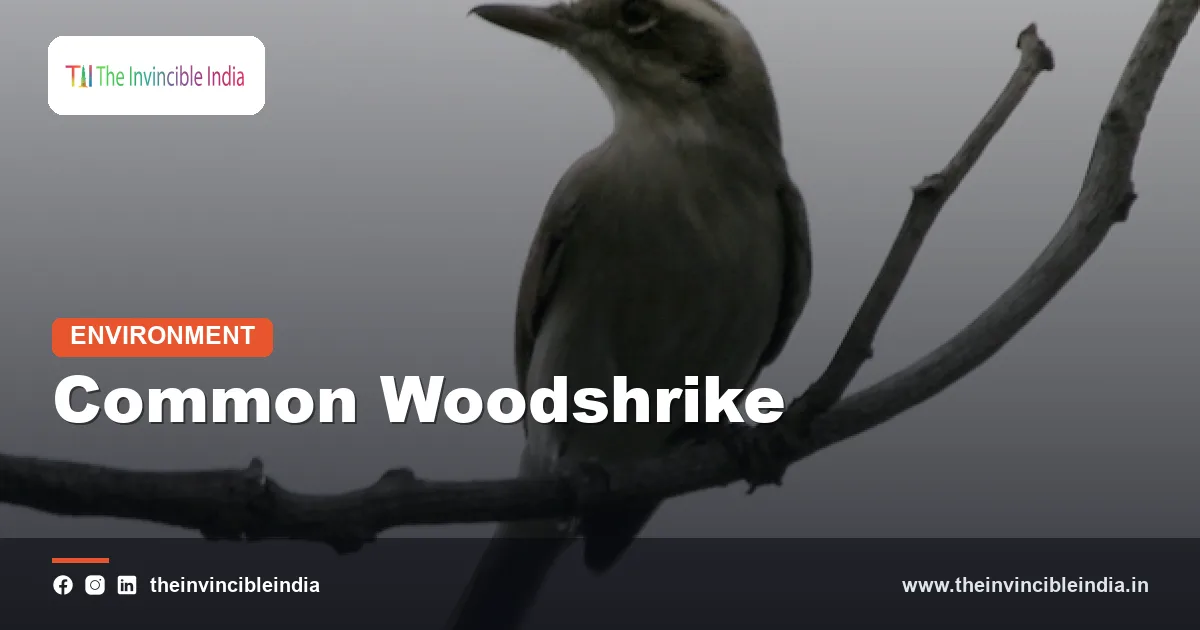
The common woodshrike (Tephrodornis pondicerianus) is a plain grey-brown songbird of open woodland and scrub that is recognised by a broad dark mask through the eye, a pale stripe above it and a clear, whistled song. Found across most of peninsular India and the plains and foothills of the subcontinent, the common woodshrike is a modest bird that rewards patient attention, because it feeds almost entirely on insects and quietly keeps tree foliage free of pests.
Despite its name, the common woodshrike is not a true shrike, and it belongs to a group of insect-eating forest birds that have been moved between several families by taxonomists. This article explains how to identify the species, where it lives in India, what it eats, how it builds its tiny camouflaged nest and why this unflashy bird is worth knowing.
| Fact | Detail |
|---|---|
| Common name | Common woodshrike |
| Scientific name | Tephrodornis pondicerianus |
| Family | Vangidae (the woodshrikes and their allies); older works place it in Campephagidae or in a separate woodshrike family |
| Size | About 16 to 18 cm long, with a stout bill and a medium-length tail |
| Range and habitat in India | Open deciduous woodland, scrub forest, plantations, orchards and well-wooded gardens across much of the peninsula, the plains and the lower hills |
| Diet | Insects such as caterpillars, beetles, bugs and flying insects, caught in foliage and in the air |
| Breeding | Builds a small cup of bark and grass bound with spider web on a tree fork; usually two or three eggs; both parents share the work |
| Conservation status | Least Concern on the IUCN Red List; protected under the Wildlife (Protection) Act, 1972 |
Key Takeaways
- The common woodshrike is a grey-brown songbird of about 16 to 18 cm with a white stripe above the eye and a broad dark eye-mask.
- The common woodshrike shows a white rump and white-edged outer tail feathers in flight, which help to separate it from similar-sized brown birds.
- The common woodshrike is not a true shrike; it is an insect-eating bird of the woodshrike group that is now usually placed in the family Vangidae.
- The common woodshrike builds a tiny cup nest of bark and fine grass, bound with spider web and camouflaged with lichen, on a forked branch.
- The common woodshrike has a clear, whistled song of rising notes and is often heard in pairs calling to each other in open woodland.
- The common woodshrike is classified as Least Concern by the IUCN because it is widespread and tolerates scrub, plantations and light forest.
What is the common woodshrike?
The common woodshrike is a medium-small, insect-eating songbird whose scientific name is Tephrodornis pondicerianus. The species name refers to Pondicherry, from where the bird was described in the eighteenth century, and the genus name is from Greek words meaning “ash-coloured bird”, which fits its soft grey-brown plumage.
The bird is often confused with a shrike because of its stout, slightly hooked bill and its habit of perching upright on a bare branch, but it is not a close relative of the true shrikes (family Laniidae). Its nearest relatives are other woodshrikes and the flycatcher-shrikes, and recent classifications usually place them in the family Vangidae, which is better known for the helmetshrikes and vangas of Africa and Madagascar.
What are the other woodshrikes of India?
The common woodshrike has two relatives in India. The large woodshrike is a bigger bird of the forests of the Himalayan foothills and the northeast, and the Malabar woodshrike is a species of the Western Ghats. In older books, some of these birds were treated as a single species, which explains why the literature can be confusing.
- Common woodshrike: the widespread species of open woodland and scrub across the peninsula and plains.
- Large woodshrike: a larger woodshrike of hill forests in the north and northeast.
- Malabar woodshrike: a species associated with the evergreen and moist forests of the Western Ghats.
How can you identify the common woodshrike?
The common woodshrike can be identified by its brownish-grey upperparts, whitish underparts, white stripe above the eye, broad dark brown mask through the eye and a prominent white rump. Together, the white eyebrow and the dark mask give the bird a masked, slightly stern expression that is visible even at a distance.
The crown and back are grey-brown, the wings are darker brown, and the underparts are pale, becoming buff or greyish on the breast. The bill is stout and slightly hooked at the tip, and the legs are dark. In flight, the pale rump and the white edges of the outer tail feathers are good field marks, and the bird often shows a flash of white as it moves between trees.
How do males and females differ?
Male and female common woodshrikes look similar, but the male has a darker, blacker eye-mask while the female’s mask is brown and less crisp. Young birds are mottled, with pale spots on the upperparts and a less distinct mask. The difference between the sexes is subtle, so most birdwatchers simply record the bird as a woodshrike without attempting to sex it.
| Feature | Common woodshrike | Similar bird and how it differs |
|---|---|---|
| Eye pattern | White stripe above a broad dark mask | Bar-winged flycatcher-shrike is black and white and has a black cap |
| Rump | White, visible in flight | Large cuckooshrike has a plain grey rump |
| Size | About 16 to 18 cm | Brown shrike is similar in size but has a rusty tail and a hooked, more upright pose |
| Behaviour | Gleans insects from foliage and calls in pairs | Shrikes drop to the ground from a low perch |
Where does the common woodshrike live in India?
The common woodshrike lives in open woodland, scrub forest and well-treed countryside across most of peninsular India and in the plains and lower hills of the wider subcontinent. It is generally absent from the driest deserts, from dense evergreen forest interiors and from high mountain altitudes.
Beyond India, the species occurs in Sri Lanka, Nepal, Bangladesh and Pakistan and extends eastwards into parts of Southeast Asia. Within India the bird is most visible in dry and moist deciduous woodland, scrub jungle and plantations, and is less likely to be found in thick evergreen forests, where other woodshrike species may take its place.
What habitats does it use?
The common woodshrike uses light woodland where trees are separated by open ground, since it prefers to forage in the middle and upper layers of the vegetation. It will use gardens and tree-lined roads where trees are large enough, and it is a regular sight in some city parks and campuses.
- Open dry and moist deciduous forest.
- Scrub forest and thorn woodland with scattered trees.
- Mango orchards, plantations and groves.
- Well-wooded gardens, campuses and tree-lined avenues.
What does the common woodshrike eat?
The common woodshrike eats insects, and it takes caterpillars, beetles, bugs, flies and other small invertebrates from the leaves and twigs of trees. It forages mostly in the middle and upper parts of the tree, either picking prey off foliage or darting out to catch a flying insect and returning to a perch.
The bird’s hooked bill is well suited to gripping slippery caterpillars and chewing insects with hard cases. Pairs and small family groups move from tree to tree through the day, and they sometimes join mixed foraging flocks with other woodland birds. A bird that takes so many caterpillars and leaf-eating insects plays a useful role in keeping woodland, orchards and gardens healthy.
How does it hunt?
The common woodshrike hunts using several simple methods that it switches between depending on the prey.
- Gleaning: searching leaves, twigs and branches and picking insects from the surface.
- Sallying: flying out briefly from a perch to catch a passing insect in the air, then returning.
- Hopping: moving along branches in short flights and hops to flush hidden insects.
What does the common woodshrike sound like?
The common woodshrike has a clear, melodious whistled song that rises in pitch and then trails off, and it is one of the pleasant sounds of dry Indian woodland. The song is often described as a series of ringing whistles, and it is given by both members of a pair, sometimes answering each other from separate trees.
Besides the main song, the species has shorter whistled and chattering calls that it uses to keep in touch with its mate. Birdwatchers often find the bird by sound before they find it by sight, because it spends much of its time in the canopy where the leaves hide its plain colours. The voice is most frequent in the breeding season but can be heard throughout the year.
How does the common woodshrike nest?
The common woodshrike builds a small, neat cup nest on a forked branch and usually lays two or three eggs. The nest is made of fine bark, grass and plant fibres, which the birds bind together with spider web, and its outside is decorated with lichen or bark so that it looks like a knot on the branch.
Because the nest is so small and well disguised, it is very hard to see from the ground. Both parents take part in building the nest, incubating the eggs and feeding the nestlings. In most of India the breeding season falls in the warm, dry months before and during the early monsoon, although local timing varies with climate and food supply.
What is the nest cycle?
- The pair selects a horizontal fork in a tree, often at a moderate height.
- Both birds weave bark, fibres and grass into a compact cup and bind it with web.
- Lichen or bark flakes are stuck on the outside for camouflage.
- The eggs are incubated by both parents, who also guard the nest and may drive off intruders.
- Both parents feed the chicks with caterpillars and other soft insects until they fledge.
Is the common woodshrike threatened?
The common woodshrike is not threatened and is classified as Least Concern by the International Union for Conservation of Nature (IUCN). It has a large range, it adapts to modified habitats and it remains fairly common in suitable woodland across India, and as a wild bird it is protected under the Wildlife (Protection) Act, 1972.
The species does face the same pressures as other woodland birds, including the clearing of scrub forest, the felling of mature trees and the heavy use of pesticides in orchards and plantations that reduces its insect food. Because it tolerates mixed landscapes, the best support for the bird is to keep scattered large trees in farmland, gardens and roadsides.
Why is the common woodshrike useful?
The common woodshrike is useful because it eats large numbers of leaf-eating insects and acts as a signal of woodland that still supports a normal insect community. Where it is present, the tree canopy usually offers enough insect food and nesting sites for other small birds too.
How can you see a common woodshrike?
You can see a common woodshrike by walking through open deciduous woodland or a well-treed garden in the morning and listening for its whistled song. Once you hear it, scan the middle branches of nearby trees for a grey-brown bird with a dark eye-mask.
- Visit early in the day, when the birds sing most and move between trees.
- Look at the mid-canopy rather than the ground; the species rarely descends low.
- Watch for pairs, since the birds usually stay together and call to each other.
- Use the white rump seen in flight as a clue when the bird crosses a gap between trees.
- Check mixed-species flocks, as the bird sometimes travels with them.
The species is regularly recorded in dry forest reserves, in scrub sanctuaries and in village groves, so it is a good target for a first woodland birding trip in many states.
Bottom Line
The common woodshrike is a quiet, grey-brown insect-eater with a distinctive eye-mask, a pleasant whistled song and a beautifully camouflaged nest. It is widespread and not at risk, and it benefits from the simple step of leaving scattered mature trees standing.
Frequently Asked Questions
What is a common woodshrike?
A common woodshrike is a grey-brown songbird, Tephrodornis pondicerianus, found in open woodland and scrub across India and the wider subcontinent. It has a white stripe above the eye, a broad dark eye-mask and a white rump. Despite its name it is not a true shrike and feeds mainly on insects.
How big is the common woodshrike?
The common woodshrike is about 16 to 18 cm long. It has a stout, slightly hooked bill and a medium-length tail. Its size is similar to that of a bulbul or a small shrike.
What does the common woodshrike eat?
The common woodshrike eats insects such as caterpillars, beetles, bugs and flies. It picks them from leaves and twigs or catches them in short flights from a perch. It plays a useful role in controlling leaf-eating insects in woodland and orchards.
Where is the common woodshrike found in India?
The common woodshrike is found in open woodland, scrub forest, plantations and gardens across most of peninsular India and in the plains and lower hills. It is mostly absent from deserts and high mountains. It also occurs in Sri Lanka and in parts of Southeast Asia.
How does the common woodshrike build its nest?
The common woodshrike builds a small cup of bark, grass and fibres on a forked branch and binds it with spider web. The outside is covered with lichen or bark so that it blends into the branch. Both parents help build the nest, incubate two or three eggs and feed the chicks.
Is the common woodshrike related to shrikes?
No, the common woodshrike is not a close relative of the true shrikes, which belong to the family Laniidae. It is placed with the woodshrikes and flycatcher-shrikes, usually in the family Vangidae. The name comes from its shrike-like bill and upright perch.
{“@context”:”https://schema.org”,”@graph”:[{“@type”:”FAQPage”,”mainEntity”:[{“@type”:”Question”,”name”:”What is a common woodshrike?”,”acceptedAnswer”:{“@type”:”Answer”,”text”:”A common woodshrike is a grey-brown songbird, Tephrodornis pondicerianus, found in open woodland and scrub across India and the wider subcontinent. It has a white stripe above the eye, a broad dark eye-mask and a white rump. Despite its name it is not a true shrike and feeds mainly on insects.”}},{“@type”:”Question”,”name”:”How big is the common woodshrike?”,”acceptedAnswer”:{“@type”:”Answer”,”text”:”The common woodshrike is about 16 to 18 cm long. It has a stout, slightly hooked bill and a medium-length tail. Its size is similar to that of a bulbul or a small shrike.”}},{“@type”:”Question”,”name”:”What does the common woodshrike eat?”,”acceptedAnswer”:{“@type”:”Answer”,”text”:”The common woodshrike eats insects such as caterpillars, beetles, bugs and flies. It picks them from leaves and twigs or catches them in short flights from a perch. It plays a useful role in controlling leaf-eating insects in woodland and orchards.”}},{“@type”:”Question”,”name”:”Where is the common woodshrike found in India?”,”acceptedAnswer”:{“@type”:”Answer”,”text”:”The common woodshrike is found in open woodland, scrub forest, plantations and gardens across most of peninsular India and in the plains and lower hills. It is mostly absent from deserts and high mountains. It also occurs in Sri Lanka and in parts of Southeast Asia.”}},{“@type”:”Question”,”name”:”How does the common woodshrike build its nest?”,”acceptedAnswer”:{“@type”:”Answer”,”text”:”The common woodshrike builds a small cup of bark, grass and fibres on a forked branch and binds it with spider web. The outside is covered with lichen or bark so that it blends into the branch. Both parents help build the nest, incubate two or three eggs and feed the chicks.”}},{“@type”:”Question”,”name”:”Is the common woodshrike related to shrikes?”,”acceptedAnswer”:{“@type”:”Answer”,”text”:”No, the common woodshrike is not a close relative of the true shrikes, which belong to the family Laniidae. It is placed with the woodshrikes and flycatcher-shrikes, usually in the family Vangidae. The name comes from its shrike-like bill and upright perch.”}}]}]}


