

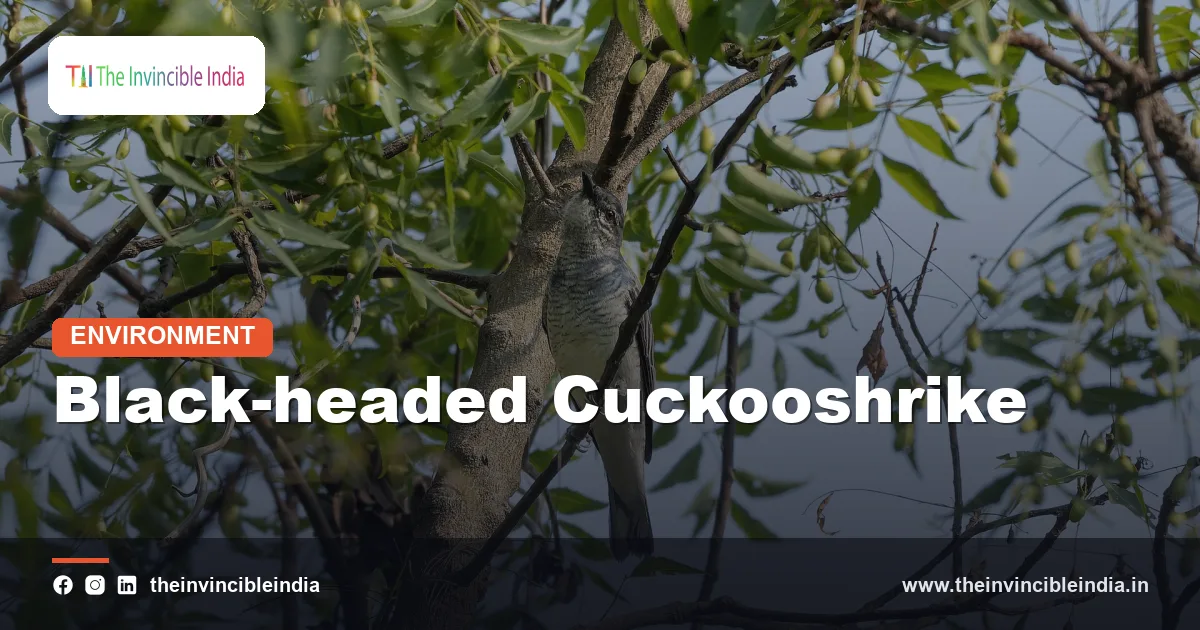
The black-headed cuckooshrike (Lalage melanoptera) is a slim, grey songbird of the family Campephagidae whose male wears a glossy black hood over the head, throat and upper breast, and it lives in open forest and wooded country across much of India. A lively, insect-eating bird of the middle and upper branches, the black-headed cuckooshrike is smaller and daintier than the better-known large cuckooshrike and is most often noticed when it flits across a clearing or calls with a clear, whistled note.
The female black-headed cuckooshrike lacks the hood and is a quiet grey-and-white bird with barring below, so the two sexes can look like different species. This article explains how to identify both, where the bird lives in India, what it eats, how it nests and what is known about its movements and status.
| Fact | Detail |
|---|---|
| Common name | Black-headed cuckooshrike |
| Scientific name | Lalage melanoptera (formerly placed in the genus Coracina) |
| Family | Campephagidae (cuckooshrikes, minivets and trillers) |
| Size | About 18 to 20 cm long; slim body and a fairly long tail |
| Range and habitat in India | Open deciduous forest, scrub, groves, orchards and wooded country in the peninsula, central India and the Himalayan foothills |
| Diet | Mainly insects and caterpillars, with some berries and small fruit |
| Breeding | Builds a small cup of fine twigs and roots bound with spider web on a horizontal branch; usually two or three eggs |
| Conservation status | Least Concern on the IUCN Red List; protected under the Wildlife (Protection) Act, 1972 |
Key Takeaways
- The black-headed cuckooshrike is a slim grey bird of about 18 to 20 cm, and the male has a glossy black head, throat and upper breast.
- The female black-headed cuckooshrike has no black hood and shows pale grey-brown upperparts with a barred whitish belly.
- The black-headed cuckooshrike belongs to the family Campephagidae, whose name means “caterpillar eaters”, and it feeds mainly on insects and caterpillars.
- The black-headed cuckooshrike lives in open forest, scrub, groves and orchards in India and moves locally with the seasons.
- The black-headed cuckooshrike builds a tiny cup nest of twigs bound with spider web on a horizontal branch and usually lays two or three eggs.
- The black-headed cuckooshrike is classified as Least Concern by the IUCN because it is widespread across the Indian subcontinent.
What is the black-headed cuckooshrike?
The black-headed cuckooshrike is a slim, medium-small, insect-eating songbird of the tree canopy, and its scientific name is Lalage melanoptera. In older books it is placed in the genus Coracina with the large cuckooshrike, but current checklists usually place it with the trillers in Lalage.
The bird belongs to the family Campephagidae, a group of tree-dwelling birds that includes cuckooshrikes, minivets and trillers. The family name comes from Greek words meaning “caterpillar eater”, a good description of the group’s diet. Members share a stout bill with a slight hook, a soft, dense plumage and stiff feathers on the lower back.
The species is mainly associated with the Indian subcontinent, where it is a familiar bird of dry woodland. It is smaller and less conspicuous than the large cuckooshrike, and it tends to be seen in more open, drier country.
Is it a cuckoo or a shrike?
The black-headed cuckooshrike is neither a cuckoo nor a shrike. The first part of its name is a reference to the grey, barred look of some members of the family, and the second part is a reference to the stout, hooked bill. Taxonomists place the family near the woodshrikes, drongos and other medium-sized insect-eating songbirds.
How can you identify the black-headed cuckooshrike?
The adult male black-headed cuckooshrike can be identified by its glossy black head, throat and upper breast, which contrasts with its pale grey back, whitish belly, black wings and white-tipped black tail. The bold black hood is unlike any other small grey Indian forest bird of this shape, so the male is easy to name once seen well.
The upperparts, from the nape to the rump, are a clean light grey, and the underparts below the black bib are soft grey fading to white on the belly. The wings are black with pale grey edges, and the tail is black, with white tips on the outer feathers that show clearly in flight. The bill and legs are black.
What does the female look like?
The female black-headed cuckooshrike lacks the black hood and has pale grey-brown upperparts, a pale eyebrow, a dusky line through the eye and whitish underparts that are finely barred with grey. Her wings and tail are darker than the back, and the tail has pale tips. Young birds resemble the female, with additional pale scaling on the upperparts.
| Feature | Adult male | Adult female |
|---|---|---|
| Head | Glossy black hood extending to the upper breast | Grey-brown with a pale eyebrow and a dusky eye-stripe |
| Back and rump | Clean light grey | Pale grey-brown |
| Underparts | Pale grey to white below the hood | Whitish with fine grey barring |
| Wings and tail | Black, with white tips on outer tail feathers | Dark brown, with pale tips |
Which birds look similar?
The most likely confusion is with other cuckooshrikes. The large cuckooshrike is much bigger, all grey, and has only a black mask rather than a full hood. The black-winged cuckooshrike male is a dark slate-grey bird without a hooded appearance. Female and young black-headed cuckooshrikes can resemble other barred cuckooshrikes and trillers, so size, tail pattern and habitat help to separate them.
Where does the black-headed cuckooshrike live in India?
The black-headed cuckooshrike lives in open deciduous forest, scrub and wooded country across much of peninsular and central India and in the Himalayan foothills. It prefers drier, more open habitats than the large cuckooshrike and is less common in dense evergreen forest.
The species is mostly resident, but it makes local seasonal movements, and in some areas it appears or increases in numbers at particular times of year. These movements follow food supply and weather rather than a fixed long-distance route, so a birdwatcher may find the species easy to see in one season and scarce in another in the same place.
What habitats does it use?
- Open dry and moist deciduous forest with scattered tall trees.
- Scrub forest and thorn woodland.
- Mango groves, orchards and plantations.
- Wooded gardens, parks and tree-lined roads.
- Forested foothills and lower hill slopes.
In all these habitats, the bird occupies the middle to upper levels of the trees, where it can forage among foliage and fly easily between trees.
What does the black-headed cuckooshrike eat?
The black-headed cuckooshrike eats mainly insects and caterpillars, which it picks from leaves and twigs in the canopy. Grasshoppers, beetles, bugs and other small invertebrates are also taken, and the bird eats berries and small fruit at certain times of year.
The bird forages methodically, moving along branches in short flights and hops, peering at leaves and flicking its wings. Sometimes it darts out from a perch to catch a flying insect. A single bird or pair will often work through several trees in an area before moving on, and it may join mixed foraging flocks that pass through the woodland.
Why are caterpillar-eaters important?
Caterpillar-eating birds are important because leaf-eating caterpillars can strip trees of their foliage. By taking large numbers of caterpillars, the black-headed cuckooshrike and its relatives help to limit defoliation in forests and orchards. The presence of such birds is a sign that the canopy still supports a healthy insect community.
How does the black-headed cuckooshrike behave?
The black-headed cuckooshrike is an active, alert bird that usually keeps to the upper half of a tree and moves from tree to tree in short, undulating flights. It is often seen alone or in pairs, sometimes in small groups, and it shuffles its wings alternately after landing, a trait shared with other cuckooshrikes.
The bird is fairly shy and will often keep to the far side of a branch or fly off when approached. In the early morning and late afternoon it is more active and more likely to perch in the open. The pair stay in contact with calls, and in the breeding season the male may become more conspicuous as he sings and patrols the territory.
What does the black-headed cuckooshrike sound like?
The black-headed cuckooshrike has a clear, whistled voice that includes thin, ringing notes and a rippling trill. The call is not as loud as that of the large cuckooshrike but is clear enough to carry through open woodland, and it often gives away the bird’s presence before it is seen.
The calls are used to keep contact between mates and to advertise territory. Birdwatchers often find the species by following the sound to the upper branches of a tree and scanning for a small grey bird with a dark head. The voice is most frequent in the breeding season and in the early part of the day.
How does the black-headed cuckooshrike breed?
The black-headed cuckooshrike builds a small, shallow cup nest of fine twigs, roots and plant fibres, bound together with spider web and placed on a horizontal branch of a tree. The nest is very small for the size of the bird and is camouflaged so that it looks like a knot or a bulge in the branch.
The female lays a small clutch, normally two or three eggs, and the pair share nest duties. The breeding season varies by region but generally runs from spring into the monsoon, when insects are abundant. Both parents bring caterpillars and other soft insects to the chicks, which leave the nest after a few weeks but are fed by the adults for some time after fledging.
What is the nesting sequence?
- The pair chooses a horizontal branch, often fairly high in a tall tree.
- Fine twigs and roots are bound with spider web into a shallow cup.
- The eggs are incubated, and the adults guard the nest.
- Both parents bring caterpillars and insects to the nestlings.
- Fledged young remain with the adults for a period of feeding and learning.
Is the black-headed cuckooshrike threatened?
The black-headed cuckooshrike is not threatened and is classified as Least Concern by the International Union for Conservation of Nature (IUCN). The species has a large range across the Indian subcontinent and is fairly common in suitable habitat, and in India it is protected under the Wildlife (Protection) Act, 1972.
Like most canopy birds, it depends on trees and on a plentiful insect supply. Clearing of woodland, felling of large roadside and farm trees and heavy pesticide use can all reduce local numbers. Maintaining scattered native trees, groves and open woodland is the most direct way to support the species.
How can you see a black-headed cuckooshrike?
You can see a black-headed cuckooshrike by visiting open dry woodland, scrub or an orchard in the early morning and scanning the middle and upper branches for a slim grey bird. A clear, whistled call is often the best clue.
- Visit early, when the birds call and forage actively.
- Scan the canopy rather than the ground; the species is arboreal.
- Look for the dark hood of the male as it flies between trees.
- Watch for the alternate wing-shuffle after the bird lands.
- Use binoculars to separate females from other barred birds.
Dry deciduous forest reserves, scrub sanctuaries and the groves around villages are good places to search, and the bird is regularly recorded on organised bird walks in many states.
Bottom Line
The black-headed cuckooshrike is a slim, grey canopy bird whose male wears a striking black hood. It is widespread and secure in India, and it is best conserved by protecting open woodland and scattered large trees.
Frequently Asked Questions
What is a black-headed cuckooshrike?
A black-headed cuckooshrike is a slim grey songbird, Lalage melanoptera, found in open forest and wooded country in India. The male has a glossy black hood on the head, throat and upper breast, and the female lacks the hood. It feeds on insects and caterpillars in the tree canopy.
How big is the black-headed cuckooshrike?
The black-headed cuckooshrike is about 18 to 20 cm long. It has a slim body and a fairly long tail. It is much smaller than the large cuckooshrike.
How can I tell male and female black-headed cuckooshrikes apart?
The male has a glossy black head, throat and upper breast, while the female has a grey-brown head and a barred whitish belly. The female also has a pale eyebrow and a dusky eye-stripe. Both have darker wings and tails with pale tips.
What does the black-headed cuckooshrike eat?
The black-headed cuckooshrike eats mainly insects and caterpillars that it picks from leaves and twigs, and it sometimes catches flying insects in short flights. It also eats berries and small fruit. Its diet makes it useful in controlling leaf-eating insects.
Where is the black-headed cuckooshrike found in India?
The black-headed cuckooshrike is found in open deciduous forest, scrub, groves and orchards across much of peninsular and central India and in the Himalayan foothills. It prefers drier, more open habitat than the large cuckooshrike. It makes local seasonal movements, so numbers can vary through the year.
Is the black-headed cuckooshrike endangered?
No, the black-headed cuckooshrike is not endangered and is classified as Least Concern by the IUCN. It has a large range and is fairly common in suitable habitat. It still depends on trees, so woodland loss and heavy pesticide use are the main local concerns.
{“@context”:”https://schema.org”,”@graph”:[{“@type”:”FAQPage”,”mainEntity”:[{“@type”:”Question”,”name”:”What is a black-headed cuckooshrike?”,”acceptedAnswer”:{“@type”:”Answer”,”text”:”A black-headed cuckooshrike is a slim grey songbird, Lalage melanoptera, found in open forest and wooded country in India. The male has a glossy black hood on the head, throat and upper breast, and the female lacks the hood. It feeds on insects and caterpillars in the tree canopy.”}},{“@type”:”Question”,”name”:”How big is the black-headed cuckooshrike?”,”acceptedAnswer”:{“@type”:”Answer”,”text”:”The black-headed cuckooshrike is about 18 to 20 cm long. It has a slim body and a fairly long tail. It is much smaller than the large cuckooshrike.”}},{“@type”:”Question”,”name”:”How can I tell male and female black-headed cuckooshrikes apart?”,”acceptedAnswer”:{“@type”:”Answer”,”text”:”The male has a glossy black head, throat and upper breast, while the female has a grey-brown head and a barred whitish belly. The female also has a pale eyebrow and a dusky eye-stripe. Both have darker wings and tails with pale tips.”}},{“@type”:”Question”,”name”:”What does the black-headed cuckooshrike eat?”,”acceptedAnswer”:{“@type”:”Answer”,”text”:”The black-headed cuckooshrike eats mainly insects and caterpillars that it picks from leaves and twigs, and it sometimes catches flying insects in short flights. It also eats berries and small fruit. Its diet makes it useful in controlling leaf-eating insects.”}},{“@type”:”Question”,”name”:”Where is the black-headed cuckooshrike found in India?”,”acceptedAnswer”:{“@type”:”Answer”,”text”:”The black-headed cuckooshrike is found in open deciduous forest, scrub, groves and orchards across much of peninsular and central India and in the Himalayan foothills. It prefers drier, more open habitat than the large cuckooshrike. It makes local seasonal movements, so numbers can vary through the year.”}},{“@type”:”Question”,”name”:”Is the black-headed cuckooshrike endangered?”,”acceptedAnswer”:{“@type”:”Answer”,”text”:”No, the black-headed cuckooshrike is not endangered and is classified as Least Concern by the IUCN. It has a large range and is fairly common in suitable habitat. It still depends on trees, so woodland loss and heavy pesticide use are the main local concerns.”}}]}]}


