

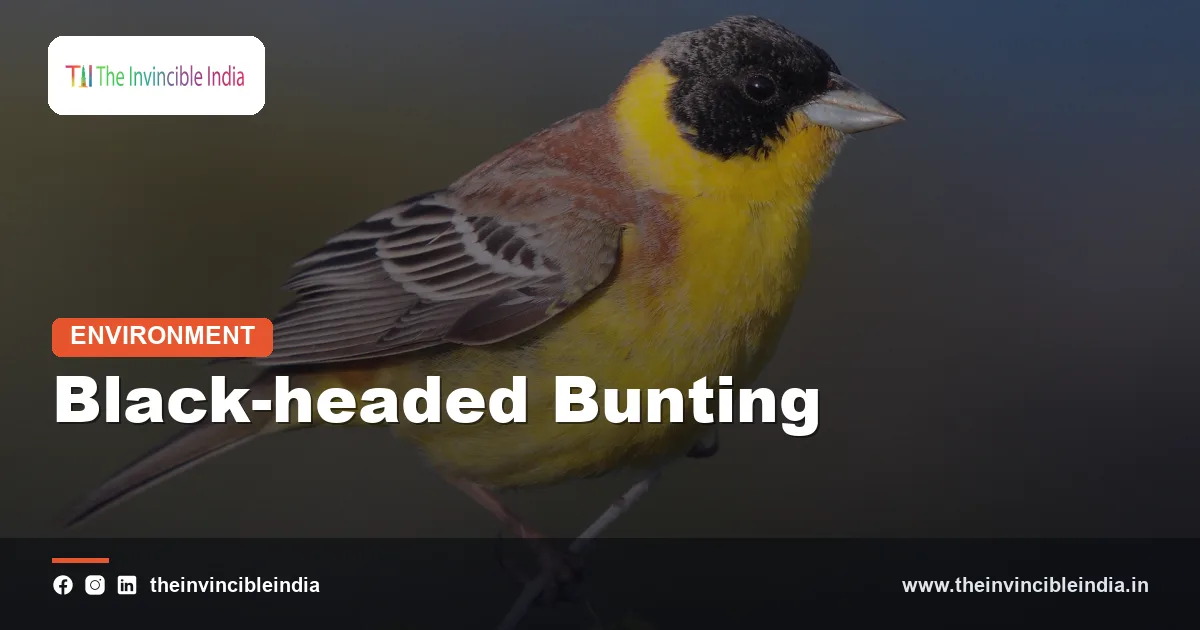
The black-headed bunting (Emberiza melanocephala) is a sparrow-sized seed-eating bird of the bunting family Emberizidae, a winter visitor to India in which the breeding male has a glossy black head, bright yellow underparts and a chestnut back. Every year, large flocks that breed in south-eastern Europe and south-west Asia travel to the Indian subcontinent, where they spend the cooler months on farmland, grassland and thorn scrub, especially in the west and centre of the country.
The black-headed bunting is among the most numerous winter migrants of Indian cropland, and its flocks can run into hundreds or thousands. Its habit of feeding on ripening grain has made it a familiar bird to farmers in several states, while its yellow and black colours make it a favourite with birdwatchers in spring.
Black-headed Bunting Quick Facts
| Attribute | Detail |
|---|---|
| Common name | Black-headed bunting |
| Scientific name | Emberiza melanocephala |
| Family | Emberizidae (buntings) |
| Size | About 16 to 17 cm, slightly larger than a house sparrow |
| Range in India | Winter visitor, mainly to the west, centre and south; most numerous in Gujarat, Rajasthan, Maharashtra and Karnataka |
| Habitat | Open farmland, grassland, scrub, thorn forest and field edges with scattered trees |
| Diet | Cereal grain and weed seeds in winter; insects and seeds in the breeding season |
| Migration and breeding | Breeds from south-eastern Europe to Iran; arrives in India from about August and leaves in April or May |
| Conservation status | Least Concern on the IUCN Red List, although numbers are reported to be declining in parts of its range |
Key Takeaways
- The black-headed bunting is a sparrow-sized bird, about 16 to 17 cm long, with the scientific name Emberiza melanocephala and a place in the bunting family Emberizidae.
- The male black-headed bunting in breeding plumage has a black head, bright yellow underparts and a rich chestnut back, while the female is a pale, streaky buff bird.
- The black-headed bunting breeds in south-eastern Europe and south-west Asia and spends the winter mainly in India, where it is most abundant in the western and central regions.
- The black-headed bunting feeds on grain and weed seeds and often gathers in large flocks in ripening sorghum, millet and wheat fields, sometimes causing local crop damage.
- The black-headed bunting is often confused with the red-headed bunting, a close relative that has a chestnut-red head and olive-green back instead of a black head.
- The IUCN lists the black-headed bunting as Least Concern, although its European breeding population has been reported to decline in some countries.
What is the black-headed bunting?
The black-headed bunting is a medium-small songbird in the bunting family that breeds in the Balkans, Turkey, the Caucasus and Iran and winters mainly in India. Buntings are seed-eating birds with strong conical bills, closely related to finches and sparrows but distinguished by details of the bill and skeleton.
The species is a strongly migratory bird that makes a long journey every year between its European and Asian breeding areas and its Indian wintering grounds. Almost the whole world population is thought to winter on the Indian subcontinent, which makes India the key area for the species outside the breeding season.
The scientific name Emberiza melanocephala combines the genus name for buntings with a Greek-derived epithet meaning “black-headed”. The species is a close relative of the red-headed bunting, with which it occasionally hybridises where their breeding ranges meet.
What does the black-headed bunting look like?
An adult male black-headed bunting in breeding plumage has a solid black head, a bright yellow throat, breast and belly, and a plain chestnut back and rump. The contrast between the black cap, the yellow underparts and the reddish mantle makes it one of the most striking buntings.
Male in winter plumage
When the males first arrive in India, they look much duller than in spring. Their black head is hidden by greyish-buff feather tips, giving a mottled look, and the yellow underparts are paler. These fringes wear off gradually through the winter, so a flock in March can look noticeably brighter than the same flock in October.
Female and juvenile
The female black-headed bunting is a pale, sandy-brown bird with darker streaks on the back and the upper breast, a pale buff underside and a faint yellowish wash under the tail. Young birds resemble females but are usually more heavily streaked.
Size and bill
The black-headed bunting is about 16 to 17 cm long, with a stout, grey-pinkish bill suited to crushing seeds. The tail is relatively long and the body appears slim and upright compared with a sparrow.
Where is the black-headed bunting found in India?
The black-headed bunting is found in India mainly in the west and centre of the country, with large concentrations in Gujarat, Rajasthan, Madhya Pradesh, Maharashtra and northern Karnataka. It also reaches the south and parts of the north in smaller numbers.
The bird prefers dry, open country with cultivation, rather than dense forest or wet regions. The habitats it commonly uses include:
- Fields of sorghum (jowar), pearl millet (bajra), wheat and other cereals.
- Dry grassland, fallow land and open scrub.
- Thorn forest with acacia and other spiny trees used for roosting.
- Orchards, irrigation canal banks and village outskirts.
- Roadside edges and open ground near water bodies.
It is much scarcer in the far east, the north-east and the wet Western Ghats. In the evenings, flocks gather to roost in dense thorny trees or tall grass, often in the company of other seed-eating birds such as weaverbirds, sparrows and finches.
When does the black-headed bunting arrive and leave India?
The black-headed bunting generally arrives in India from about August to October, with the first birds appearing in the north-west, and departs in March to May. The timing varies with the year, the weather and the local ripening of crops.
The migration is timed to the harvest cycle. Birds reach India as the kharif crops of sorghum and millet are ripening, giving them an abundant food supply. By the time they leave, the rabi harvest is finished, and their body weight has increased to cover the long flight back to the breeding grounds.
| Period | Black-headed bunting activity |
|---|---|
| August to October | Arrival in north-western and western India; flocks build up in ripening fields |
| November to February | Wintering in farmland and scrub; communal roosts form in thorn trees |
| March to April | Males moult into black-headed breeding plumage; birds fatten for departure |
| May to July | Birds on their breeding grounds in south-eastern Europe and south-west Asia |
What does the black-headed bunting eat?
The black-headed bunting eats mainly grain and weed seeds, taking cereals such as sorghum, millet and wheat from fields as they ripen. On its breeding grounds, it also feeds on insects and spiders, which are especially important for nestlings.
In India, the bird forages on the ground or perches on the heads of standing crops, pulling at the grain. Flocks move together and can strip the ripening heads in a field quickly, which is why some farmers regard the species as a pest. The damage is local and seasonal, and it varies from year to year.
Traditional methods of reducing losses include scaring birds with noise, using bird scarers, covering crops with netting and adjusting sowing times. Although crop loss can be significant locally, the bird also eats the seeds of many weeds and some insects, so its overall effect on agriculture is mixed.
How does the black-headed bunting breed?
The black-headed bunting breeds in the northern summer on its European and Asian breeding grounds, building a cup nest on the ground or low in a shrub and laying about four to six eggs. It does not breed in India, where it appears only as a winter visitor.
The nest is made of grass, rootlets and plant fibres and is usually hidden in a tussock, among low vegetation or in a small bush. The eggs are pale bluish or greenish-white with dark spots and streaks. The female incubates, and both parents feed the nestlings with insects collected from nearby fields and meadows.
Males sing from a perch on top of a bush or wire in spring, giving a short, rich, rather jingling song. Males sometimes start singing in India before departure in March and April, which gives birdwatchers a chance to hear it without travelling to Europe.
How is the black-headed bunting different from the red-headed bunting?
The black-headed bunting differs from the red-headed bunting mainly in head and back colour, since the male black-headed has a black head and chestnut back, while the male red-headed has a chestnut-red head and a green-olive back. The two are close relatives and often share the same winter habitats in India.
| Feature | Black-headed bunting | Red-headed bunting |
|---|---|---|
| Male head | Black | Chestnut-red |
| Male back | Chestnut | Olive-green with streaks |
| Male underparts | Bright yellow | Yellow, with the chestnut colour extending onto the upper breast |
| Typical Indian wintering area | West, centre and south | North-west and central parts |
| Female | Pale buff with yellowish under tail | Pale and difficult to separate without close study |
Females and young birds of the two species are extremely hard to tell apart in the field and are often identified by the colour of the rump and under-tail feathers. Experienced observers rely on a combination of features, and mixed flocks of both species can occur.
Is the black-headed bunting a crop pest?
The black-headed bunting is sometimes a local crop pest, because large winter flocks can feed heavily on ripening sorghum, millet and wheat. The damage is concentrated in the western and central states where the birds are most abundant.
The scale of the problem depends on the number of birds and the stage of the crop. Flocks that arrive when the grain is in the milky or hard-dough stage can cause visible losses in a few days. Other seed-eating birds, such as parakeets, weavers and sparrows, often contribute to the same losses, and the contribution of each species is difficult to measure.
Because the birds are migratory and shared with many other countries, killing them in large numbers is not a recommended answer. Non-lethal methods, such as scaring, mixed cropping and staggered sowing, are generally preferred.
Is the black-headed bunting threatened?
The black-headed bunting is not globally threatened and is classified as Least Concern on the IUCN Red List. Its breeding range is large and its numbers are considerable, but declines have been reported in parts of south-eastern Europe.
The main concerns for the species are habitat change on the breeding grounds, such as the intensification of agriculture, and pressures on migration routes. In India, the use of pesticides on cereal fields and hunting or trapping of small birds in some regions may affect local populations. Maintaining a mosaic of fields, grassland and scrub supports this species and many others.
Monitoring is limited, and the large flocks can be hard to count. Citizen-science records from eBird and similar platforms help track arrival dates, flock sizes and any changes over time.
Where and how can the black-headed bunting be watched?
The black-headed bunting can be watched from late autumn to early spring in open farmland of western and central India, especially in the early morning and evening when flocks are feeding or moving to roost. Late winter is the best time to see males with clear black heads.
- Scan the heads of standing crops and the edges of harvested fields.
- Look along wires and fences, where birds perch between feeding bouts.
- Visit roost sites in thorny trees at dusk to see large numbers arriving together.
- Check flocks carefully for red-headed buntings and other species mixed among them.
- Remain quiet and use a vehicle as a hide, since the flocks flush easily.
Grassland and scrub areas in Gujarat, Rajasthan, Maharashtra and Karnataka are reliable places. Visiting during March improves the chance of seeing males in near-complete breeding plumage.
Bottom Line
The black-headed bunting is a yellow-and-black winter visitor that arrives in huge numbers in Indian farmland and leaves in spring for its breeding grounds in south-eastern Europe and south-west Asia. It feeds on grain and weed seeds, is not globally threatened, and is best seen in March when males turn fully black-headed.
Frequently Asked Questions
What is a black-headed bunting?
The black-headed bunting is a small seed-eating bird, scientifically named Emberiza melanocephala, that belongs to the bunting family. The breeding male has a black head, yellow underparts and a chestnut back. It breeds in south-eastern Europe and south-west Asia and winters mainly in India.
When can the black-headed bunting be seen in India?
The black-headed bunting can be seen in India from about August to May, with the main wintering period from November to March. Birds arrive in late summer or autumn and leave by April or May. Males show their full black head best in late winter and early spring.
Is the black-headed bunting the same as the red-headed bunting?
The black-headed bunting is not the same as the red-headed bunting, although they are close relatives. The male black-headed has a black head and chestnut back, while the male red-headed has a chestnut-red head and an olive-green back. Females of the two species are very hard to separate.
What does the black-headed bunting eat?
The black-headed bunting eats mainly grain and weed seeds, including sorghum, millet and wheat. It also eats insects and spiders, especially during the breeding season to feed its young. In India, it forages in flocks on the ground and on standing crops.
Does the black-headed bunting breed in India?
The black-headed bunting does not breed in India. It nests in south-eastern Europe, Turkey, the Caucasus and Iran, building a cup nest on the ground or low in a shrub. In India it appears only as a non-breeding winter visitor.
Is the black-headed bunting a threatened species?
The black-headed bunting is not threatened globally and is rated Least Concern by the IUCN. It has a large range and a large population. Some declines have been recorded on the European breeding grounds, so the species is monitored.
{“@context”:”https://schema.org”,”@graph”:[{“@type”:”FAQPage”,”mainEntity”:[{“@type”:”Question”,”name”:”What is a black-headed bunting?”,”acceptedAnswer”:{“@type”:”Answer”,”text”:”The black-headed bunting is a small seed-eating bird, scientifically named Emberiza melanocephala, that belongs to the bunting family. The breeding male has a black head, yellow underparts and a chestnut back. It breeds in south-eastern Europe and south-west Asia and winters mainly in India.”}},{“@type”:”Question”,”name”:”When can the black-headed bunting be seen in India?”,”acceptedAnswer”:{“@type”:”Answer”,”text”:”The black-headed bunting can be seen in India from about August to May, with the main wintering period from November to March. Birds arrive in late summer or autumn and leave by April or May. Males show their full black head best in late winter and early spring.”}},{“@type”:”Question”,”name”:”Is the black-headed bunting the same as the red-headed bunting?”,”acceptedAnswer”:{“@type”:”Answer”,”text”:”The black-headed bunting is not the same as the red-headed bunting, although they are close relatives. The male black-headed has a black head and chestnut back, while the male red-headed has a chestnut-red head and an olive-green back. Females of the two species are very hard to separate.”}},{“@type”:”Question”,”name”:”What does the black-headed bunting eat?”,”acceptedAnswer”:{“@type”:”Answer”,”text”:”The black-headed bunting eats mainly grain and weed seeds, including sorghum, millet and wheat. It also eats insects and spiders, especially during the breeding season to feed its young. In India, it forages in flocks on the ground and on standing crops.”}},{“@type”:”Question”,”name”:”Does the black-headed bunting breed in India?”,”acceptedAnswer”:{“@type”:”Answer”,”text”:”The black-headed bunting does not breed in India. It nests in south-eastern Europe, Turkey, the Caucasus and Iran, building a cup nest on the ground or low in a shrub. In India it appears only as a non-breeding winter visitor.”}},{“@type”:”Question”,”name”:”Is the black-headed bunting a threatened species?”,”acceptedAnswer”:{“@type”:”Answer”,”text”:”The black-headed bunting is not threatened globally and is rated Least Concern by the IUCN. It has a large range and a large population. Some declines have been recorded on the European breeding grounds, so the species is monitored.”}}]}]}


