

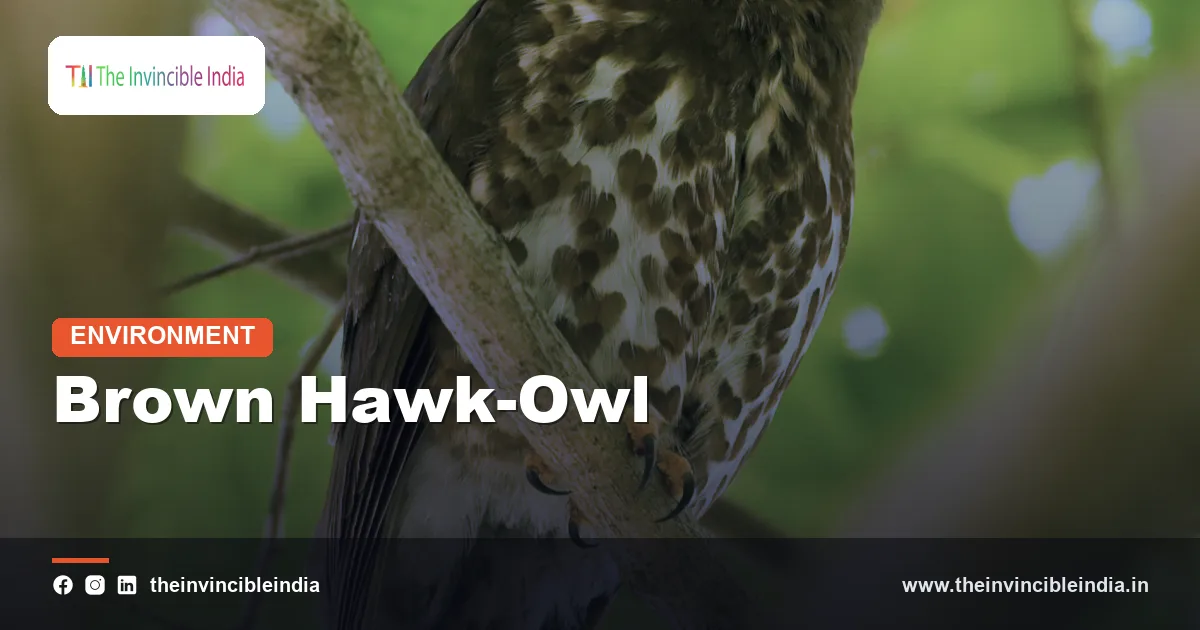
The brown hawk-owl (Ninox scutulata), also called the brown boobook, is a medium-sized, slim, long-tailed owl of South and Southeast Asia that lives in wooded country, gardens and mangroves and hunts large insects and small animals at dusk and during the night. In India the brown hawk-owl is a widespread resident, and most people meet it as a soft, repeated two-note call drifting from a tree in a park, a farmhouse orchard or a forest edge.
Unlike the round-faced barn owl or the ear-tufted eagle-owls, the brown hawk-owl has a flat, hawk-like head and a long tail, which is how it earned its English name. This article explains how to identify the species, where it lives, what it eats, how it breeds and why it matters, using stable, well-established facts about the bird.
| Quick Facts: Brown Hawk-Owl | |
|---|---|
| Common names | Brown hawk-owl, brown boobook |
| Scientific name | Ninox scutulata |
| Family | Strigidae (typical owls) |
| Size | About 27 to 33 cm in length; a slim, long-tailed owl |
| Range | South and Southeast Asia; widespread resident across much of India, including the Western Ghats, peninsular and eastern India, the Himalayan foothills and the Northeast |
| Habitat | Open woodland, plantations, gardens, village groves, mangroves and forest edges |
| Diet | Mainly large insects such as beetles, moths and grasshoppers; also small birds, bats, rodents, lizards and frogs |
| Breeding | Nests in tree hollows; usually three to five white eggs laid in the dry season, roughly February to May in much of India |
| Conservation status | Least Concern on the IUCN Red List; owls are protected in India under the Wildlife (Protection) Act, 1972 |
Key Takeaways
- The brown hawk-owl is a slim, dark-brown owl with white underparts streaked in reddish-brown, bright yellow eyes and no ear tufts.
- The brown hawk-owl is also known as the brown boobook because it belongs to the genus Ninox, a group of small owls often called boobooks or hawk-owls.
- The call of the brown hawk-owl is a soft, rising two-note “oo-uk” repeated at a steady pace, usually after dusk.
- The brown hawk-owl feeds mostly on large flying insects and often hunts around street lights where moths and beetles gather.
- The brown hawk-owl nests in natural tree hollows and old woodpecker or barbet holes, so old trees are essential to its breeding.
- The brown hawk-owl is classed as Least Concern globally, but loss of old hollow trees and illegal trapping of owls remain local threats.
What is the brown hawk-owl?
The brown hawk-owl is a small to medium-sized owl in the family Strigidae, the typical owls, and it is the best-known Asian member of the genus Ninox. The genus is mostly found in Australasia, and its members are called hawk-owls or boobooks because many have a hawk-like profile and a call that sounds like the word “boo-book”.
The brown hawk-owl is one of the few Ninox owls found on the Asian mainland, and it is widely distributed from the Indian subcontinent through Southeast Asia to parts of southern China and the Indonesian archipelago. Over its large range, ornithologists have described several subspecies that differ slightly in the shade of the brown plumage and the amount of streaking on the belly.
In India the brown hawk-owl is a resident bird, which means it stays in the same region through the year and does not undertake a long seasonal migration. Some northern forms elsewhere in Asia move south in winter, and the taxonomy of the wider group has been revised several times, so older field guides may list the same owl under slightly different names.
How can you identify a brown hawk-owl?
A brown hawk-owl can be identified by its dark chocolate-brown back, white underparts boldly streaked with reddish-brown, large round yellow eyes and a long tail with pale bars, without any ear tufts or a clear facial disc. The head looks small and flat, and when the bird sits upright on a branch it is easy to mistake it at first glance for a falcon or a small hawk.
Key identification features
- Head: rounded and rather flat, with a dark brown crown and a darker patch around the eyes, and no ear tufts.
- Eyes: bright yellow and prominent, set in a face that lacks the heart-shaped or dish-shaped facial disc seen in many owls.
- Upperparts: uniform dark brown, with a few pale spots on the shoulders in some birds.
- Underparts: white or buffy white, with thick reddish-brown streaks that make the breast look patterned.
- Tail: noticeably long for an owl, crossed by several pale bars; it is often seen hanging straight down when the bird perches.
- Size: roughly the size of a pigeon in length but much slimmer and lighter in build.
Males and females look alike, and young birds are paler and fluffier, with less sharply defined streaks. Because the brown hawk-owl is active mostly in the evening and at night, it is usually identified by the combination of its call and its silhouette against a darkening sky.
Where does the brown hawk-owl live in India?
The brown hawk-owl lives across much of India in open deciduous and evergreen woodland, plantations, village groves, well-wooded gardens, mangroves and forest edges, from the plains to the lower hills. It is recorded in the Western Ghats, the peninsular plateau, the eastern states, the Himalayan foothills and the Northeast, and island populations occur in the Andaman and Nicobar group, where the exact taxonomic treatment has changed over time.
The bird prefers places that combine a few large old trees for roosting and nesting with open space for hunting. It is therefore common in mango orchards, teak and sal woodland, coffee and tea estates with shade trees, and even large urban gardens and university campuses. It generally avoids dense, closed-canopy interior forest and treeless open country.
During the day the brown hawk-owl roosts quietly in a leafy tree, often close to the trunk, where its brown plumage blends into the shadows. Birdwatchers usually find a roosting bird only when small birds begin to mob it or when it is flushed by a noise.
What does the brown hawk-owl eat?
The brown hawk-owl eats mainly large insects, including beetles, moths, grasshoppers, crickets and termite alates, and it supplements this diet with small birds, bats, rodents, lizards and frogs. Insects form the bulk of its prey, which sets it apart from larger owls that depend largely on rats and other mammals.
Typical prey
- Large beetles and moths, often taken in flight after being spotted against the sky.
- Grasshoppers, crickets and the winged reproductive stage of termites that emerge after the first monsoon rains.
- Small birds roosting in foliage, and occasionally small bats leaving their daytime roosts.
- Small rodents, geckos and other lizards, and occasionally frogs near water.
Because it eats so many insects that damage crops and trees, the brown hawk-owl acts as a natural pest controller around orchards, plantations and farmland edges.
How does the brown hawk-owl hunt?
The brown hawk-owl hunts by watching from a perch and then flying out in a short, agile sally to snatch prey, a method often compared with that of a flycatcher or a small hawk. It begins hunting around dusk and is active through the night, and it can often be seen hawking insects over open ground at twilight.
The bird has large eyes adapted to low light and soft, fringed flight feathers that make its wingbeats almost silent. It frequently returns to the same perch after each sortie. Large insects are caught with the feet or sometimes with the bill and are often eaten on the wing or on the perch.
Brown hawk-owls are well known for visiting street lights, lit verandas and lamps at night, because moths and beetles are drawn to the light. Birdwatchers in towns and hill stations often get their best views of the species at such spots, where the owl perches on a nearby wire or branch and darts out repeatedly.
What does the brown hawk-owl sound like?
The brown hawk-owl produces a soft, mellow, two-syllable call usually written as “oo-uk” or “wuk-oo”, with the second note slightly higher or sharper, repeated at a measured rhythm of several calls in a row. The sound is gentle and carries well on still evenings, and in the breeding season both birds of a pair may call in turn.
The call is the most reliable way to detect the species. A listener may hear it just after sunset, again through the night and sometimes before dawn. Other calls include a harsher alarm note and a begging call from young birds in the nest.
Many people in towns and villages know this call without knowing the bird, since the owl rarely shows itself while calling. The sound is often described as a soft, hollow, repeated “ooh-ook”, quite different from the loud hooting of eagle-owls and the screech of the barn owl.
How does the brown hawk-owl breed?
The brown hawk-owl breeds in natural cavities in trees, and in India the nesting season generally falls in the dry months, roughly from February to May, though the timing varies with region and climate. The pair does not build a nest; the female lays her eggs on the bare floor of a hollow, which may be an old woodpecker or barbet hole or a natural rot cavity in a large trunk or branch.
A typical clutch has three to five white, rounded eggs, and the female does most of the incubation while the male brings food. After hatching, the chicks are fed by both parents on a diet rich in insects, and the young leave the hollow after several weeks, often staying near the parents for some time afterwards.
The dependence on tree holes means that the species suffers when old trees are felled for timber, for roadside widening or for tidying gardens. Retaining dead and hollow limbs, wherever they pose no danger, helps cavity-nesting birds including owls, barbets, hornbills and mynas.
How is the brown hawk-owl different from other Indian owls?
The brown hawk-owl differs from other Indian owls in its slim hawk-like body, long tail, lack of ear tufts and streaked white underparts. Several small and medium-sized owls overlap with it in range, and comparing a few key features avoids confusion.
| Owl | Size | Head and face | Key feature |
|---|---|---|---|
| Brown hawk-owl | About 27 to 33 cm | Flat, rounded head; no ear tufts; yellow eyes | Long barred tail; reddish-brown streaks on white underparts |
| Spotted owlet | About 21 cm | Round head; no ear tufts; yellow eyes with a white brow | White-spotted brown upperparts; often active in daylight near buildings |
| Jungle owlet | About 20 to 23 cm | Barred head; yellow eyes | Finely barred plumage and a rapid, rolling call |
| Collared scops owl | About 23 cm | Small ear tufts; dark eyes | Pale collar on the nape; whistling “poo” call |
| Barn owl | About 33 to 39 cm | White heart-shaped facial disc; dark eyes | Pale golden and white plumage; a hissing screech |
The spotted owlet is the owl most often seen in Indian towns, and it is smaller and stockier than the brown hawk-owl, with spotted rather than streaked plumage. The collared scops owl is also small, but it shows ear tufts and has dark eyes. These differences, together with the call, make field identification straightforward once the features are known.
Why is the brown hawk-owl also called a boobook?
The brown hawk-owl is also called the brown boobook because the genus Ninox includes the Australian boobook, a small owl whose call sounds like “boo-book”, and the name has been applied to many close relatives. The word “hawk-owl” refers to the hawk-like shape of these owls, with their long tails and less owl-like faces.
The name “boobook” is therefore a borrowing from an Australian bird’s call, and it can seem odd to hear it applied to an Indian owl whose call is a softer “oo-uk”. Both names remain in use, and recent checklists tend to prefer “brown boobook” for the Asian mainland form in some regions, while “brown hawk-owl” is still very common in Indian field guides and bird records.
Taxonomists have also separated some island and northern populations as distinct species in recent decades. For an Indian birdwatcher, the practical point is that the brown hawk-owl or brown boobook seen in a typical Indian garden or forest belongs to the widespread resident group described in this article.
Is the brown hawk-owl threatened?
The brown hawk-owl is not globally threatened and is listed as Least Concern by the International Union for Conservation of Nature (IUCN), mainly because it has a very large range and is fairly common in suitable habitat. Its population is considered stable overall, though local declines occur where forests and old trees disappear.
Main pressures on the species
- Loss of nest trees: felling of large old trees removes the hollows the species needs for breeding.
- Habitat conversion: clearing of woodland and mangrove for construction and farming reduces hunting areas.
- Pesticide use: heavy spraying reduces insect prey and can poison birds that eat contaminated insects.
- Road deaths: owls that hunt along roads and around lights are sometimes hit by vehicles.
- Illegal trapping: superstition and the cage-bird trade lead to illegal capture of owls in parts of India, although the practice is against the law.
Owls as a group are protected under the Wildlife (Protection) Act, 1972, which prohibits hunting, trapping and trade in wild birds. Reporting suspected trapping to the forest department or a wildlife helpline is the recommended response.
Why does the brown hawk-owl matter?
The brown hawk-owl matters because it controls populations of night-flying insects and small vertebrates, and because its presence indicates that old trees and a reasonably healthy insect community still exist in an area. Like other owls, it sits near the top of the food web at night and links insects, rodents and bats to the wider ecosystem.
The bird also draws people to nature at the edge of the city. Evening bird walks in parks and campuses often include the owl as a highlight, and its call is a familiar part of the night soundscape in many Indian towns. Recording sightings on citizen-science platforms such as eBird helps researchers track its distribution and seasonal calling patterns.
Simple actions help the species: keeping old trees, reducing night lighting where it is not needed, avoiding broad-spectrum pesticides in gardens, and teaching children that owls are harmless wild birds and not omens. A quiet evening spent listening for the soft “oo-uk” call is often enough to confirm that a brown hawk-owl is living nearby.
Bottom Line
The brown hawk-owl is a slim, yellow-eyed, long-tailed owl that lives quietly in Indian woods, orchards and gardens, calling “oo-uk” after dusk and feeding mainly on insects. It is common and safe at present, but it depends on old hollow trees, so protecting such trees is the best way to keep it in the neighbourhood.
Frequently Asked Questions
What is a brown hawk-owl?
A brown hawk-owl is a slim, long-tailed, medium-sized owl, scientifically named Ninox scutulata, found across South and Southeast Asia including much of India. It has dark brown upperparts, white underparts streaked with reddish-brown and yellow eyes, and it has no ear tufts. It hunts mostly insects at dusk and during the night.
Is the brown hawk-owl the same as the brown boobook?
Yes, brown boobook is another common name for the brown hawk-owl. The name comes from the genus Ninox, whose members are called boobooks or hawk-owls. Some recent checklists prefer one name and some the other, and taxonomists have split a few island and northern populations into separate species.
What does the brown hawk-owl eat?
The brown hawk-owl eats mainly large insects such as beetles, moths, grasshoppers and termite alates. It also takes small birds, bats, rodents, lizards and frogs. It often hunts around street lights where insects gather at night.
What sound does a brown hawk-owl make?
The brown hawk-owl makes a soft, mellow two-note call, usually written as “oo-uk”, repeated steadily after dusk. The call is gentler than the hoot of an eagle-owl and the screech of a barn owl. It is the most reliable way to find the species, because the bird itself is often hidden in foliage.
Where does the brown hawk-owl nest?
The brown hawk-owl nests in tree hollows, including old woodpecker and barbet holes and natural cavities in large trunks. It lays about three to five white eggs, generally in the dry months from around February to May in much of India. It builds no nest, so the loss of old hollow trees directly affects breeding.
Is the brown hawk-owl endangered?
No, the brown hawk-owl is not endangered and is listed as Least Concern by the IUCN because it has a very large range and is fairly common. Local threats include the felling of old trees, pesticide use and illegal trapping. Owls are protected in India under the Wildlife (Protection) Act, 1972.
{“@context”:”https://schema.org”,”@graph”:[{“@type”:”FAQPage”,”mainEntity”:[{“@type”:”Question”,”name”:”What is a brown hawk-owl?”,”acceptedAnswer”:{“@type”:”Answer”,”text”:”A brown hawk-owl is a slim, long-tailed, medium-sized owl, scientifically named Ninox scutulata, found across South and Southeast Asia including much of India. It has dark brown upperparts, white underparts streaked with reddish-brown and yellow eyes, and it has no ear tufts. It hunts mostly insects at dusk and during the night.”}},{“@type”:”Question”,”name”:”Is the brown hawk-owl the same as the brown boobook?”,”acceptedAnswer”:{“@type”:”Answer”,”text”:”Yes, brown boobook is another common name for the brown hawk-owl. The name comes from the genus Ninox, whose members are called boobooks or hawk-owls. Some recent checklists prefer one name and some the other, and taxonomists have split a few island and northern populations into separate species.”}},{“@type”:”Question”,”name”:”What does the brown hawk-owl eat?”,”acceptedAnswer”:{“@type”:”Answer”,”text”:”The brown hawk-owl eats mainly large insects such as beetles, moths, grasshoppers and termite alates. It also takes small birds, bats, rodents, lizards and frogs. It often hunts around street lights where insects gather at night.”}},{“@type”:”Question”,”name”:”What sound does a brown hawk-owl make?”,”acceptedAnswer”:{“@type”:”Answer”,”text”:”The brown hawk-owl makes a soft, mellow two-note call, usually written as “oo-uk”, repeated steadily after dusk. The call is gentler than the hoot of an eagle-owl and the screech of a barn owl. It is the most reliable way to find the species, because the bird itself is often hidden in foliage.”}},{“@type”:”Question”,”name”:”Where does the brown hawk-owl nest?”,”acceptedAnswer”:{“@type”:”Answer”,”text”:”The brown hawk-owl nests in tree hollows, including old woodpecker and barbet holes and natural cavities in large trunks. It lays about three to five white eggs, generally in the dry months from around February to May in much of India. It builds no nest, so the loss of old hollow trees directly affects breeding.”}},{“@type”:”Question”,”name”:”Is the brown hawk-owl endangered?”,”acceptedAnswer”:{“@type”:”Answer”,”text”:”No, the brown hawk-owl is not endangered and is listed as Least Concern by the IUCN because it has a very large range and is fairly common. Local threats include the felling of old trees, pesticide use and illegal trapping. Owls are protected in India under the Wildlife (Protection) Act, 1972.”}}]}]}


