

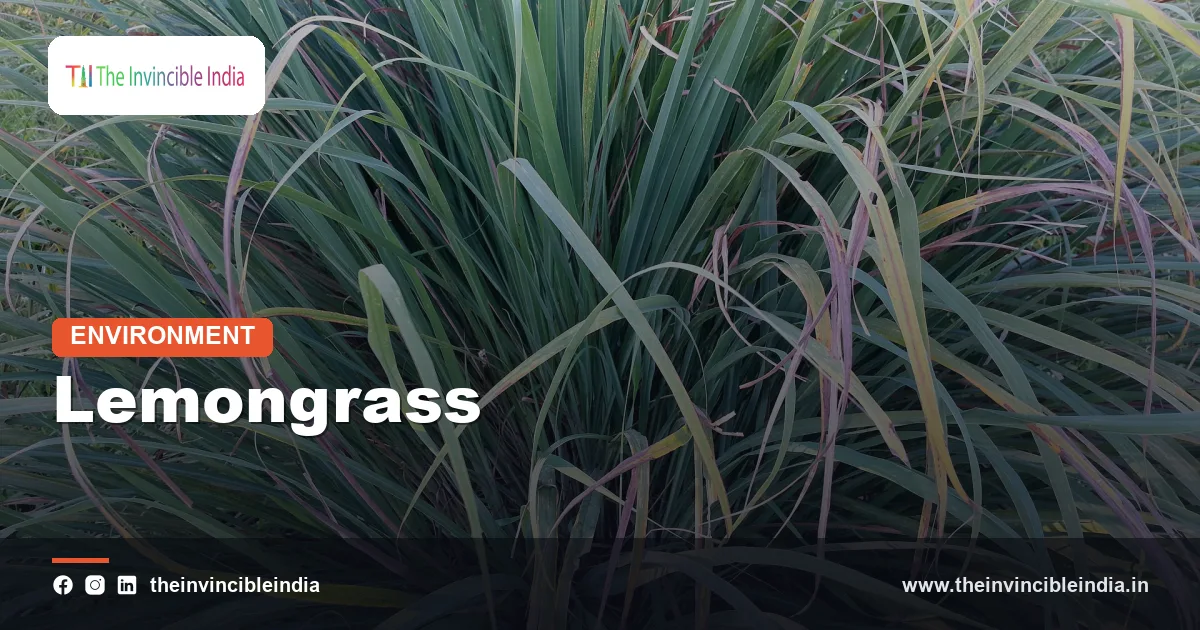
Lemongrass is a tall, aromatic tropical grass of the genus Cymbopogon, grown across India for its lemon-scented leaves and stalks, which are used in tea, cooking, perfumery and as the source of an essential oil rich in citral. The two cultivated species most often called lemongrass are West Indian lemongrass (Cymbopogon citratus) and East Indian lemongrass (Cymbopogon flexuosus), and the latter is the main commercial type in India. The plant is a familiar sight in kitchen gardens, where a single clump provides fragrant leaves for a hot cup of tea.
In India, lemongrass is both a household herb and an important crop for the aromatic industry, especially in Kerala, Uttar Pradesh, Madhya Pradesh and Maharashtra. This article explains what lemongrass is, how it is grown, what the oil contains, how it is used in food and daily life, and how it differs from related grasses such as citronella and palmarosa.
| Attribute | Detail |
|---|---|
| Scientific name | Cymbopogon citratus (West Indian) and Cymbopogon flexuosus (East Indian, also called Cochin or Malabar grass) |
| Family | Poaceae (the grass family) |
| Where grown in India | Kerala (Odakkali and the Cochin region), Uttar Pradesh, Uttarakhand, Madhya Pradesh, Maharashtra, Karnataka, Assam and the north-east, and home gardens across the country |
| Season | Planted at the start of the monsoon or in spring; a perennial that is harvested several times a year, for roughly four to five years |
| Part used | Leaf blades and the swollen base of the stalk; essential oil is distilled from the fresh or partly dried herb |
| Uses | Herbal tea, soups and curries, essential oil for perfumery, soaps and flavours, source of citral for other aroma chemicals, mosquito-repellent products, traditional medicine |
| Main aroma compound | Citral, a mixture of the isomers geranial and neral, which gives the lemony smell |
| Notable facts | Grows in clumps up to about 1 to 2 metres; propagated by slips or root divisions; thrives in warm, humid climates with well-drained soil |
Key Takeaways
- Lemongrass is a perennial grass of the genus Cymbopogon whose leaves and stalks contain citral, the compound responsible for its lemon-like fragrance and flavour.
- East Indian lemongrass, Cymbopogon flexuosus, is the main commercial species in India, and Kerala has long been associated with its cultivation and oil production.
- Lemongrass is propagated by slips or clump divisions rather than by seed, and a single planting can be harvested several times a year for several years.
- Lemongrass oil is obtained by steam distillation and is used in perfumery, soaps, flavours and as a raw material for aroma chemicals.
- In Indian homes, lemongrass is used mostly as a tea herb, while in South-East Asian cooking the tender stalk base is a staple flavouring.
- Lemongrass is not the same as citronella grass or palmarosa, which are related Cymbopogon species with different oil compositions.
What is lemongrass?
Lemongrass is a clump-forming perennial grass with long, narrow, sharp-edged leaves and a pale, fibrous, bulbous base, and it releases a strong lemon scent when the leaves are crushed. The plant grows into dense tufts that can reach one to two metres in height, and it rarely flowers in many cultivated types, particularly West Indian lemongrass.
The genus Cymbopogon contains many aromatic grasses, including citronella, palmarosa and the lemongrasses. They are found in the tropics and sub-tropics of Asia, Africa and the Americas. In India, several of these grasses grow wild in dry grasslands, hill slopes and wasteland, and some have been brought into cultivation as commercial aromatic crops.
Where does lemongrass grow in India?
Lemongrass grows in India mainly in warm, humid and sub-humid regions, and Kerala is the traditional centre of East Indian lemongrass oil production, while Uttar Pradesh, Uttarakhand, Madhya Pradesh, Maharashtra, Karnataka and Assam are also notable growing areas. The Cochin or Malabar grass of Kerala gave India an early reputation as a world supplier of lemongrass oil.
The crop adapts well to poor and marginal soils, and it tolerates dry spells better than many crops once established. Research on its cultivation is carried out by the Central Institute of Medicinal and Aromatic Plants (CIMAP) in Lucknow, which belongs to the Council of Scientific and Industrial Research (CSIR), and by the Aromatic and Medicinal Plants Research Station in Odakkali, Kerala, which works on high-citral varieties.
How is lemongrass cultivated?
Lemongrass is cultivated by planting slips, which are rooted pieces of the clump, at the beginning of the monsoon or in spring, and the first harvest comes roughly three to four months later. Because the plant does not usually set viable seed in cultivation, farmers depend on vegetative propagation, which keeps the plant true to the chosen variety.
The principal steps in farming are as follows.
- Land preparation: The field is ploughed to a fine tilth and farmyard manure is mixed in.
- Planting: Slips are planted in rows with enough spacing for the clumps to spread.
- Care: Weeding in the early months and light fertiliser help the clumps establish. The crop needs little irrigation once established.
- Harvest: The grass is cut a few inches above the ground at intervals of about two to three months, so a well-managed field gives multiple cuttings in a year.
- Distillation: The cut herb is allowed to wilt a little and is then steam-distilled to obtain the oil.
Lemongrass is generally unpalatable to grazing animals, which makes it suited to areas where cattle or wild animals damage other crops. Its dense root system also helps to hold soil on slopes.
What is lemongrass oil and what does it contain?
Lemongrass oil is a pale yellow to amber essential oil extracted from the leaves by steam distillation, and its main component is citral, which usually makes up a large share of the oil. Citral is a mixture of two isomers, geranial (citral A) and neral (citral B), and gives the oil its sharp, fresh, lemon-like scent.
The oil yield from a fresh crop is small, typically a fraction of one per cent of the fresh weight of the herb, which is why large areas and efficient distillation are required for commercial production. The quality of the oil is judged mainly by its citral content, and high-citral varieties have been developed by Indian research stations.
What is lemongrass oil used for?
- Perfumery and soaps: The citrus note is used in soaps, detergents, room fresheners and cosmetics.
- Flavours: Citral is used in food flavourings, drinks and confectionery.
- Aroma chemicals: Citral from lemongrass oil is converted into compounds such as ionones, which are used to make fragrances and in the production of vitamin A intermediates.
- Insect-repellent products: Lemongrass oil is used in some mosquito-repellent creams and candles.
How is lemongrass used in Indian homes and cooking?
Lemongrass is used in Indian homes mainly as a flavouring for tea, and the fresh leaves are boiled with water, tea leaves, ginger and sometimes tulsi to give a light lemony infusion. In Kerala, Assam and the north-east, the herb is also used in soups, fish dishes and chutneys.
Outside India, the tender white base of the stalk is a core ingredient in Thai, Vietnamese, Indonesian and Malaysian cooking, where it is bruised and simmered in curries, soups and pastes. The leaves are tough and are usually used only to flavour liquids and then removed, while the soft inner part of the stalk is thinly sliced or pounded. Many Indian restaurants and home cooks now use lemongrass in fusion dishes inspired by these cuisines.
| Form | How it is used |
|---|---|
| Fresh leaves | Boiled in tea (chai) or herbal infusions |
| Tender stalk base | Sliced or pounded for soups, curries and pastes |
| Dried leaves | Herbal tea bags and blends |
| Essential oil | Soaps, cosmetics, flavours, aromatherapy, repellents |
What is lemongrass tea and is it safe to drink?
Lemongrass tea is a herbal infusion made by steeping fresh or dried lemongrass leaves in hot water, and for most healthy adults, drinking it in ordinary food amounts is considered safe. It has a light citrus taste, contains no caffeine and is commonly drunk hot, sometimes with honey, ginger or mint.
Traditional systems of medicine in India and other tropical countries use lemongrass for digestive comfort, fever and cold, although such traditional uses are not a substitute for medical treatment. Pregnant women, people with medical conditions and those on medication should seek a doctor’s advice before taking concentrated extracts or large quantities. The essential oil is meant for external or controlled use and should not be swallowed.
How is lemongrass different from citronella and palmarosa?
Lemongrass differs from citronella and palmarosa in the chemical composition of its oil: lemongrass oil is dominated by citral, citronella oil by citronellal and geraniol, and palmarosa oil by geraniol. All three are grasses of the genus Cymbopogon, and they look broadly similar, but their smells and industrial uses are different.
- Lemongrass (Cymbopogon flexuosus and C. citratus): Sharp lemon scent; citral-rich oil; used in tea, flavours and as a citral source.
- Citronella (Cymbopogon winterianus and C. nardus): Fresh, slightly floral citrus scent; used in insect repellents, candles and soaps.
- Palmarosa (Cymbopogon martinii var. motia): Rose-like scent; used in perfumery and for geraniol production.
Many people mistakenly call citronella grass lemongrass because the plants look alike. A gardener can usually tell them apart by the aroma of a crushed leaf and the base of the clump, as citronella tends to have a reddish-tinged base.
Why does lemongrass matter for Indian farmers?
Lemongrass matters for Indian farmers because it is a low-input perennial cash crop that grows on poor soil, resists grazing and gives repeated harvests for several years. It provides a steady income to small farmers, particularly in rain-fed and marginal areas where cereals and vegetables are risky.
The crop also supports a small processing industry, since distillation units can be set up at village or cluster level. India has traditionally been among the important producers and exporters of lemongrass oil, although the market price swings with global demand. Government and research bodies, including CSIR through its Aroma Mission, have promoted aromatic crops as a way of improving rural incomes.
How can lemongrass be grown at home?
Lemongrass can be grown at home by planting a rooted stalk or clump division in a large pot or garden bed that gets full sun and drains well. The plant is easy to start: a fresh stalk from the market with the base intact can be placed in water until roots appear, and then potted.
- Choose a sunny spot and a pot at least 30 centimetres deep.
- Use loose, well-drained soil mixed with compost.
- Water regularly but do not let the roots sit in standing water.
- Cut outer leaves near the base for tea, and divide the clump every year or two when it becomes crowded.
In regions that are cold in winter, the plant may die back above ground and sprout again with the return of warm weather. The crushed leaves are also kept near seating areas by many households because their scent is liked and is believed to discourage mosquitoes, though a plant alone is not a reliable protection against mosquito-borne disease.
Which lemongrass varieties and species are grown in India?
The lemongrass grown in India falls into two main species groups: East Indian lemongrass (Cymbopogon flexuosus), which is grown for oil, and West Indian lemongrass (Cymbopogon citratus), which is the common kitchen and tea type. The East Indian type produces more oil with a high citral content, while the West Indian type has thicker, fleshier stalks that are better suited to cooking.
Indian research institutes have released improved selections of East Indian lemongrass with higher oil yield and citral content, among them Pragati and Krishna, which came from CIMAP in Lucknow. Farmers choose varieties according to oil yield, citral percentage, tolerance to local pests and the length of the harvesting cycle. The following table sets out the main differences.
| Feature | East Indian lemongrass | West Indian lemongrass |
|---|---|---|
| Scientific name | Cymbopogon flexuosus | Cymbopogon citratus |
| Main use | Commercial essential oil | Kitchen herb, tea, home gardens |
| Flowering | Flowers freely in many types | Rarely flowers in cultivation |
| Stalk | Slimmer, more fibrous | Thicker, fleshier base |
| Propagation | Seed or slips | Slips and clump division |
What happens to lemongrass after harvest?
After harvest, lemongrass is usually wilted in the shade for a few hours and then taken quickly to a distillation unit, since delay and over-drying reduce the oil. In steam distillation, steam passes through the chopped herb and carries the volatile oil with it, and the vapour is then cooled so that the oil separates from the water layer.
The spent grass left after distillation is not wasted. It is commonly used as fuel for the boiler, as mulch or compost, and in some places as thatch or bedding. The oil is stored in clean, dry, airtight containers away from light and heat to preserve its citral content.
Bottom Line
Lemongrass is a hardy aromatic grass that serves as a kitchen herb, a tea ingredient and the source of a commercially valuable citral-rich oil. In India it links home gardens with a long-standing aromatic farming industry, and it is best understood as a distinct species group from citronella and palmarosa.
Frequently Asked Questions
What is lemongrass used for?
Lemongrass is used for making herbal tea, flavouring soups and curries, and producing an essential oil used in soaps, perfumes and flavours. The fresh leaves and the tender stalk base are used in the kitchen. The oil is used in industry and in aromatherapy products.
Which part of lemongrass is used in cooking?
The tender white base of the stalk is the part of lemongrass most used in cooking, because it is softer and more fragrant than the leaves. The base is sliced, bruised or pounded for curries, soups and pastes. The tough upper leaves are mainly used to flavour tea and broths and are then discarded.
Is lemongrass the same as citronella?
No, lemongrass and citronella are different species of the same genus, Cymbopogon. Lemongrass oil is rich in citral, while citronella oil is rich in citronellal and geraniol. Citronella is used mainly for repellents and soaps, and lemongrass is used for tea, food and flavours.
How long does lemongrass take to grow?
Lemongrass is usually ready for its first cutting about three to four months after planting slips, and then it can be harvested again every two to three months. A well-managed field produces for roughly four to five years before it needs replanting. A home plant can be trimmed as soon as the clump is well established.
Where is lemongrass grown in India?
Lemongrass is grown in Kerala, Uttar Pradesh, Uttarakhand, Madhya Pradesh, Maharashtra, Karnataka, Assam and other warm states. Kerala is the traditional centre of East Indian lemongrass oil production. Home gardens across the country also grow the plant for tea.
Is lemongrass tea safe every day?
Lemongrass tea is generally considered safe for most healthy adults in normal food amounts, but there is no standard daily limit. People who are pregnant, have medical conditions or take medicines should check with a doctor first. Concentrated extracts and the essential oil should not be taken without professional advice.
{“@context”:”https://schema.org”,”@graph”:[{“@type”:”FAQPage”,”mainEntity”:[{“@type”:”Question”,”name”:”What is lemongrass used for?”,”acceptedAnswer”:{“@type”:”Answer”,”text”:”Lemongrass is used for making herbal tea, flavouring soups and curries, and producing an essential oil used in soaps, perfumes and flavours. The fresh leaves and the tender stalk base are used in the kitchen. The oil is used in industry and in aromatherapy products.”}},{“@type”:”Question”,”name”:”Which part of lemongrass is used in cooking?”,”acceptedAnswer”:{“@type”:”Answer”,”text”:”The tender white base of the stalk is the part of lemongrass most used in cooking, because it is softer and more fragrant than the leaves. The base is sliced, bruised or pounded for curries, soups and pastes. The tough upper leaves are mainly used to flavour tea and broths and are then discarded.”}},{“@type”:”Question”,”name”:”Is lemongrass the same as citronella?”,”acceptedAnswer”:{“@type”:”Answer”,”text”:”No, lemongrass and citronella are different species of the same genus, Cymbopogon. Lemongrass oil is rich in citral, while citronella oil is rich in citronellal and geraniol. Citronella is used mainly for repellents and soaps, and lemongrass is used for tea, food and flavours.”}},{“@type”:”Question”,”name”:”How long does lemongrass take to grow?”,”acceptedAnswer”:{“@type”:”Answer”,”text”:”Lemongrass is usually ready for its first cutting about three to four months after planting slips, and then it can be harvested again every two to three months. A well-managed field produces for roughly four to five years before it needs replanting. A home plant can be trimmed as soon as the clump is well established.”}},{“@type”:”Question”,”name”:”Where is lemongrass grown in India?”,”acceptedAnswer”:{“@type”:”Answer”,”text”:”Lemongrass is grown in Kerala, Uttar Pradesh, Uttarakhand, Madhya Pradesh, Maharashtra, Karnataka, Assam and other warm states. Kerala is the traditional centre of East Indian lemongrass oil production. Home gardens across the country also grow the plant for tea.”}},{“@type”:”Question”,”name”:”Is lemongrass tea safe every day?”,”acceptedAnswer”:{“@type”:”Answer”,”text”:”Lemongrass tea is generally considered safe for most healthy adults in normal food amounts, but there is no standard daily limit. People who are pregnant, have medical conditions or take medicines should check with a doctor first. Concentrated extracts and the essential oil should not be taken without professional advice.”}}]}]}


