

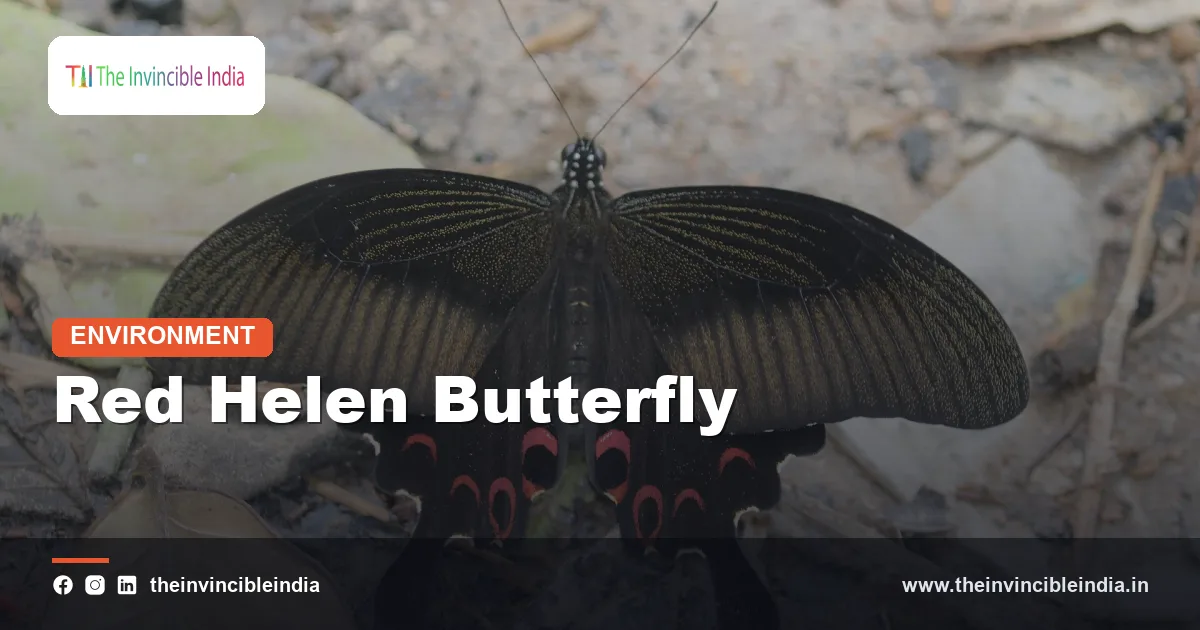
The red Helen (Papilio helenus) is a large black swallowtail butterfly of Indian forests, recognised by a broad white patch on each hindwing and red crescent-shaped markings near the lower edge of the wing. The red Helen belongs to the swallowtail family Papilionidae, and in India it is found in the Western Ghats, the Himalayan foothills and the northeast, where its caterpillars feed on plants of the citrus family.
The red Helen is one of the larger butterflies seen on a forest walk, and it is often spotted gathering at damp ground beside streams or visiting flowers at the forest edge. This explainer describes how to identify the red Helen, where it lives in India, what it eats, how its life cycle unfolds and how it differs from look-alike swallowtails such as the Mormons and the Paris peacock.
Quick Facts: Red Helen Butterfly
| Scientific name | Papilio helenus Linnaeus, 1758 |
|---|---|
| Family | Papilionidae (swallowtails) |
| Wingspan | Roughly 10 to 15 centimetres |
| Appearance | Black wings with a large white patch on the hindwing and red crescents near the lower hindwing edge; little or no tail |
| Host plants | Plants of the citrus family (Rutaceae), including Toddalia asiatica, Zanthoxylum, Glycosmis, Clausena and Citrus species |
| Range in India | Western Ghats and hills of the south, Himalayan foothills and northeastern India |
| Habitat | Moist deciduous and evergreen forests, forest edges, streams and shaded roadsides |
| Broods | More than one generation a year in warm, moist areas, with adults most numerous during and after the monsoon |
| Status | Widespread across its range and not regarded as globally threatened |
Key Takeaways
- The red Helen (Papilio helenus) is a large black swallowtail butterfly with a wingspan of roughly 10 to 15 centimetres.
- The red Helen is identified by the large white patch on its hindwing and by the red crescent markings near the lower edge of the wing.
- The red Helen occurs in the Western Ghats, the Himalayan foothills and northeast India, and it also ranges across southern and eastern Asia.
- The caterpillars of the red Helen feed on the leaves of citrus-family plants (Rutaceae), such as Toddalia asiatica and wild Citrus species.
- The male red Helen often gathers at wet sand and mud beside streams to take up minerals, a behaviour called mud-puddling.
- The scientific name helenus commemorates Helenus, a Trojan prince in Greek myth, and was given by the naturalist Carl Linnaeus in 1758.
What is the red Helen butterfly?
The red Helen butterfly is a large, powerful swallowtail in the genus Papilio that has black wings, a white hindwing patch and red markings, and it is one of the best-known forest swallowtails of southern and eastern Asia. The species is placed in the family Papilionidae, which also includes the mormons, the birdwings and the roses.
The red Helen is a strong flier that often glides at medium height along forest roads and streams. Unlike many swallowtails, it has a rounded hindwing with little or no tail, and this gives its outline a more compact shape. Both sexes look much alike, which sets it apart from some other swallowtails in which the females take several different forms.
Linnaeus described the species in 1758. He named a group of swallowtails after heroes of the Trojan War, and the red Helen was named for Helenus, a son of King Priam of Troy who was known as a prophet. The common name “red Helen” refers to the red markings on its wings and not to Helen of Troy.
How do you identify a red Helen?
A red Helen is identified by its large black wings, the broad white patch on the hindwing and the red crescents near the lower edge of the hindwing, together with its tailless or nearly tailless outline. The white patch is the most obvious feature when the butterfly is seen in flight or at rest with the wings open.
| Feature | What to look for |
|---|---|
| Size | Large swallowtail, wingspan roughly 10 to 15 centimetres |
| Forewing | Black or dark brown, with paler streaks between the veins |
| Hindwing upperside | A broad white or cream patch in the middle of the wing and red marking near the lower edge |
| Hindwing underside | Browner, with a white patch and a row of red crescents near the margin |
| Tail | Absent or very short, so the hindwing looks rounded or scalloped |
| Flight | Strong and quick, with deep wing beats, usually at moderate height |
Males and females
The two sexes of the red Helen look broadly similar, although females tend to be slightly larger and a little duller. Males are seen more often at mud patches, while females spend more time searching for host plants on which to lay their eggs.
Regional forms
Different populations across Asia show small differences in the size of the white patch and the amount of red, and several subspecies are recognised. Observers in the Western Ghats, the Himalayan foothills and the northeast may notice slight variations from place to place, but the combination of black wings, white hindwing patch and red crescents remains consistent.
Where is the red Helen found in India?
The red Helen is found in the forests of the Western Ghats and other hill regions of southern India, along the Himalayan foothills and in northeast India, where there is enough rainfall to keep forest and host plants green. It prefers shaded, moist woodland and is commonly seen along forest roads, streams and edges.
Beyond India, the red Helen ranges across Sri Lanka, Nepal, Bhutan, Bangladesh, Myanmar and much of Southeast Asia and East Asia, reaching as far as southern China and Japan. This broad range makes it a widespread species, although its numbers within any single forest depend on the local supply of host plants.
Preferred habitat
The red Helen favours moist deciduous and evergreen forests from the lowlands up to mid-hill elevations. It frequents shaded paths, stream banks and clearings where citrus-family shrubs grow. Dry open land, bare ground and heavily cleared areas hold few individuals.
What does the red Helen eat?
The adult red Helen feeds on flower nectar and on minerals from damp soil, while the caterpillar eats leaves of plants in the citrus family, Rutaceae. The butterfly therefore needs both nectar-rich flowers and suitable host plants in the same area.
Adult food: nectar and minerals
Adults visit many flowers, especially brightly coloured, clustered blooms such as lantana, ixora and other shrubs along forest edges. Males also collect at wet sand, mud and animal droppings along streams, where they absorb salts and other nutrients. This mud-puddling is common among swallowtails and often draws several species to the same spot.
Caterpillar food: host plants
Females lay their eggs on young leaves of citrus-family plants. Recorded host plants include the climbing shrub Toddalia asiatica (wild orange tree), prickly ash trees of the genus Zanthoxylum, shrubs of the genus Glycosmis, Clausena species and wild or cultivated Citrus such as lemon. The plants used differ between regions and forest types.
The aromatic oils in these plants guide the female to the correct leaf, and the same chemicals help protect the caterpillars from some predators.
What is the life cycle of the red Helen?
The red Helen has a complete life cycle of four stages: egg, caterpillar (larva), pupa (chrysalis) and adult butterfly. In warm, humid forest, the cycle takes several weeks, so more than one generation can be produced in a year.
| Stage | Description |
|---|---|
| Egg | Small, round and pale; laid singly on young leaves of a host plant |
| Caterpillar | Young caterpillars are dark with a pale patch and resemble bird droppings; later stages are green with eye-like markings and a hidden scent organ behind the head |
| Pupa (chrysalis) | Green or brownish, held upright on a twig by a silk pad and a silk girdle, resembling a broken stub or leaf |
| Adult | Emerges with soft, folded wings that expand and harden within hours; feeds, mates and lays eggs |
Defences of the caterpillar
Caterpillars of the red Helen use the same defences as most swallowtails. The young stages mimic bird droppings, which most predators avoid. The older green caterpillars rest on the upper side of leaves, and when disturbed they extend a forked, orange-red organ called the osmeterium from behind the head. It releases a pungent smell that discourages small predators and parasitic insects.
Seasonality
In the Western Ghats and northeast India, adults can be found for much of the year, but they are most numerous during and after the monsoon, when new growth of host plants is plentiful. In cooler hills, the butterfly is active mainly in the warmer months, and winter is passed as a pupa.
How does the red Helen behave?
The red Helen is a strong, wary flier that spends its day travelling between flowers, host plants and damp patches along forest paths. Several behaviours help observers find it.
- Mud-puddling: Males gather in small groups at damp sand and mud, often with other swallowtails, and may stay still for a long time while they drink.
- Nectaring: Adults visit flowers but keep their wings fluttering, which makes close photographs a challenge.
- Patrolling: Males fly along forest roads and stream lines in search of females.
- Basking: In cool morning light, butterflies open their wings in sunny gaps to warm up.
- Roosting: At night, adults rest among foliage with their wings closed.
How is the red Helen different from the Mormons and the Paris peacock?
The red Helen differs from the Mormons mainly in its larger size, its rounded or nearly tailless hindwing and its single broad white patch, and it differs from the Paris peacock in having no glittering blue-green scales. Several large black swallowtails share the same forests, so it helps to compare a few features.
| Species | Key points |
|---|---|
| Red Helen (Papilio helenus) | Large; black wings; one broad white hindwing patch; red markings near the lower hindwing edge; little or no tail |
| Common Mormon (Papilio polytes) | Smaller; males are black with a row of white patches; females occur in several forms, some mimicking other butterflies |
| Great Mormon (Papilio memnon) | Large and dark; the sexes differ and females occur in more than one form |
| Paris peacock (Papilio paris) | Black with a glittering blue-green hindwing patch and a short tail |
The red Helen is sometimes confused with the female forms of the Mormons, which can have white and red patterns on the hindwing. The red Helen is generally larger, shows a single bold white patch and has a more rounded hindwing.
Why is the red Helen important to forests?
The red Helen is important to forests because it pollinates flowers, serves as food for birds, lizards and other predators, and acts as a visible indicator of healthy woodland. Butterflies respond quickly to changes in vegetation and climate, so records of the red Helen help scientists understand the condition of forest habitats.
Adults carry pollen between flowers as they feed on nectar, although they are less efficient pollinators than bees. Eggs, caterpillars and pupae are eaten by birds, spiders, wasps and other insects, so the species forms a link in forest food webs.
What threats does the red Helen face?
The red Helen is not considered globally threatened, but its populations depend on intact forest, so loss of forest, removal of host plants and degradation of stream banks can reduce local numbers. Pesticide use at forest edges, fragmentation of habitat and collection for trade are additional pressures on butterflies in general.
- Habitat loss: Felling and conversion of moist forest remove host plants and nectar sources.
- Fragmentation: Roads, plantations and settlements isolate small forest patches.
- Pesticides: Spraying near forest edges and orchards can kill caterpillars and adults.
- Climate change: Shifts in rainfall and temperature may change the timing of broods and the range at different elevations.
- Collection: Butterflies are sometimes collected for decorative trade, and collecting in protected areas is prohibited under Indian wildlife law.
How can people watch and help red Helens?
People can watch and help the red Helen by protecting native forest, keeping citrus-family host plants and nectar flowers near the forest edge, avoiding pesticides and photographing butterflies without catching them. Small actions at home also help.
- Plant host plants: Native citrus-family shrubs and, where suitable, a lemon or curry-leaf plant can support caterpillars in gardens near forest.
- Offer nectar: Native flowering shrubs give adults food through the season.
- Skip the sprays: Even small amounts of insecticide kill caterpillars.
- Watch quietly: Visit stream banks and damp forest tracks in the morning, and avoid disturbing mud-puddling groups.
- Share records: Citizen-science platforms and butterfly societies use sightings to track changes in range and season.
Bottom Line
The red Helen is a large, bold swallowtail whose black wings, white hindwing patch and red markings make it one of the easiest forest butterflies to recognise. It depends on intact woodland with citrus-family host plants, nectar flowers and damp stream banks, so its presence is a useful sign of a healthy forest.
Frequently Asked Questions
What is the red Helen butterfly?
The red Helen is a large black swallowtail butterfly, Papilio helenus, with a white patch on the hindwing and red markings near the lower wing edge. It lives in forests of India and across southern and eastern Asia. Its wingspan is roughly 10 to 15 centimetres.
Where is the red Helen found in India?
The red Helen is found in the Western Ghats and other southern hills, the Himalayan foothills and northeast India. It prefers moist forests, shaded roads and stream banks. Outside India, it occurs in Sri Lanka and in many parts of Southeast and East Asia.
What do red Helen caterpillars eat?
Red Helen caterpillars eat the leaves of citrus-family plants, Rutaceae. Recorded host plants include Toddalia asiatica, Zanthoxylum, Glycosmis, Clausena and Citrus species. The female lays single eggs on young leaves.
Why is it called the red Helen?
The butterfly is called the red Helen because of its scientific name, Papilio helenus, and its red wing markings. The species name honours Helenus, a Trojan prince in Greek myth, and was given by Linnaeus in 1758. The name does not refer to Helen of Troy.
How can the red Helen be told apart from the Common Mormon?
The red Helen is larger than the Common Mormon, has one broad white patch on the hindwing and has a rounded, nearly tailless hindwing. The Common Mormon is smaller, has a distinct tail and shows a row of smaller white patches in the male. Female Common Mormons occur in several forms, which can cause confusion.
Is the red Helen butterfly rare or protected?
The red Helen is a widespread species that is not regarded as globally threatened, but it depends on healthy forest. Collecting butterflies in protected areas is prohibited under Indian wildlife law, and some species are specifically scheduled. Anyone interested should check current legal protection before handling or collecting any butterfly.
{“@context”:”https://schema.org”,”@graph”:[{“@type”:”FAQPage”,”mainEntity”:[{“@type”:”Question”,”name”:”What is the red Helen butterfly?”,”acceptedAnswer”:{“@type”:”Answer”,”text”:”The red Helen is a large black swallowtail butterfly, Papilio helenus, with a white patch on the hindwing and red markings near the lower wing edge. It lives in forests of India and across southern and eastern Asia. Its wingspan is roughly 10 to 15 centimetres.”}},{“@type”:”Question”,”name”:”Where is the red Helen found in India?”,”acceptedAnswer”:{“@type”:”Answer”,”text”:”The red Helen is found in the Western Ghats and other southern hills, the Himalayan foothills and northeast India. It prefers moist forests, shaded roads and stream banks. Outside India, it occurs in Sri Lanka and in many parts of Southeast and East Asia.”}},{“@type”:”Question”,”name”:”What do red Helen caterpillars eat?”,”acceptedAnswer”:{“@type”:”Answer”,”text”:”Red Helen caterpillars eat the leaves of citrus-family plants, Rutaceae. Recorded host plants include Toddalia asiatica, Zanthoxylum, Glycosmis, Clausena and Citrus species. The female lays single eggs on young leaves.”}},{“@type”:”Question”,”name”:”Why is it called the red Helen?”,”acceptedAnswer”:{“@type”:”Answer”,”text”:”The butterfly is called the red Helen because of its scientific name, Papilio helenus, and its red wing markings. The species name honours Helenus, a Trojan prince in Greek myth, and was given by Linnaeus in 1758. The name does not refer to Helen of Troy.”}},{“@type”:”Question”,”name”:”How can the red Helen be told apart from the Common Mormon?”,”acceptedAnswer”:{“@type”:”Answer”,”text”:”The red Helen is larger than the Common Mormon, has one broad white patch on the hindwing and has a rounded, nearly tailless hindwing. The Common Mormon is smaller, has a distinct tail and shows a row of smaller white patches in the male. Female Common Mormons occur in several forms, which can cause confusion.”}},{“@type”:”Question”,”name”:”Is the red Helen butterfly rare or protected?”,”acceptedAnswer”:{“@type”:”Answer”,”text”:”The red Helen is a widespread species that is not regarded as globally threatened, but it depends on healthy forest. Collecting butterflies in protected areas is prohibited under Indian wildlife law, and some species are specifically scheduled. Anyone interested should check current legal protection before handling or collecting any butterfly.”}}]}]}


