

The chestnut-streaked sailer (Neptis jumbah) is a large, black-and-white brush-footed butterfly of Indian forests and wooded gardens that glides on stiff, flattened wings and takes its name from the chestnut-brown streaks on its underside. The chestnut-streaked sailer is one of the bigger members of the sailer genus Neptis and is a familiar sight along shaded paths in hill and plains forests.
Sailers are named for their unhurried, sailing style of flight, and the chestnut-streaked sailer shows this habit clearly: a few quick flaps, then a long level glide. This article explains how to recognise the chestnut-streaked sailer, where it lives in India, what its caterpillars feed on, how it behaves and how it differs from its common look-alikes.
| Quick Facts: Chestnut-streaked Sailer | |
|---|---|
| Common name | Chestnut-streaked sailer |
| Scientific name | Neptis jumbah |
| Family | Nymphalidae (brush-footed butterflies), subfamily Limenitidinae |
| Wingspan | Roughly 60 to 75 mm |
| Caterpillar host plants | Reported hosts include plants of the buckthorn family (Rhamnaceae), such as Ziziphus and Ventilago; records can vary by region |
| Range and habitat in India | Forests and forest edges of the Western Ghats, peninsular India, the Himalayan foothills and the north-east; also shaded gardens and plantations |
| Flight season and broods | Seen over many months in warm regions; several broods in a year, often more numerous around the monsoon and the months that follow |
| Notable features | Dark upperside with bold white bands; chestnut-brown streaks and white markings on the underside; stiff-winged gliding flight |
| Conservation status in India | Widespread and not regarded as threatened |
Key Takeaways
- The chestnut-streaked sailer (Neptis jumbah) is a large sailer butterfly, with a wingspan of roughly 60 to 75 mm, found in forests and wooded areas of India.
- The chestnut-streaked sailer is named for the chestnut-brown streaks on the underside of its wings, which separate it from the smaller common sailer.
- Sailers glide on stiff, flattened wings after a few quick flaps, a flight style that gives the group its name.
- Caterpillars of the chestnut-streaked sailer are reported to feed on buckthorn-family plants such as Ziziphus and Ventilago.
- The chestnut-streaked sailer belongs to the family Nymphalidae and the subfamily Limenitidinae, shared with the sergeants of the genus Athyma.
- The chestnut-streaked sailer is widespread and not considered threatened, though it depends on native shrubs and healthy forest edges.
What is the chestnut-streaked sailer butterfly?
The chestnut-streaked sailer is a forest butterfly in the genus Neptis, a large group of sailers found across Africa and Asia. Neptis jumbah is among the larger Asian sailers and ranges widely through southern and south-eastern Asia, including much of India.
Like all sailers, the chestnut-streaked sailer is a member of the family Nymphalidae, the brush-footed butterflies. In adults of this family the front pair of legs is small and brush-like, so only four legs are used for standing and walking. The sailers share a subfamily, Limenitidinae, with the sergeants, the admirals and related genera, and they are often recognised by a dark ground colour crossed with white bands.
The English name describes the underside pattern, in which chestnut-brown streaks run through the white markings. Among sailers, the chestnut-streaked sailer is easily noticed because of its size and the sharpness of its markings, and it is often one of the first sailers a beginner learns to recognise.
How can you identify a chestnut-streaked sailer?
A chestnut-streaked sailer can be identified by its dark brown to black upperside with bold white bands and spots, together with an underside that shows chestnut-brown streaks and white markings, all on a large, broad-winged body. Its size, the white band pattern and the chestnut colouring on the underside are the key features.
Upperside
The upperside is dark and carries a series of white marks. On the forewing the white markings form a broken band of spots and streaks, and the hindwing carries a broad white band running across the middle. When the butterfly basks with its wings fully open, these white bands stand out sharply against the dark ground colour.
Underside
The underside shows the pattern that gives the species its name. The ground colour is warm brown, and the white bands of the upperside appear as white streaks bordered by chestnut shading. This makes the underside look richer and more streaked than the underside of the smaller sailers. When the butterfly folds its wings at rest, this is the pattern that is visible from the side.
Size and sexes
The wingspan is roughly 60 to 75 mm, which is noticeably larger than that of the common sailer. The two sexes look similar, and females are slightly larger and rounder-winged. Because the sexes are so alike, observers generally identify the species by size, band pattern and underside colour, not by sex.
Why is it called a sailer butterfly?
A sailer butterfly is called a sailer because it holds its wings flat and glides smoothly on air currents, much like a boat sailing across calm water. This gliding flight is the defining behaviour of the genus Neptis, to which the chestnut-streaked sailer belongs.
The flight is distinctive. The butterfly makes a series of rapid, shallow wingbeats, then stops flapping and glides with the wings held nearly motionless and level. The pattern repeats, and the result looks effortless. Sergeants in the genus Athyma fly in a similar manner, which is one reason the two groups are often confused at first glance.
The gliding style saves energy and allows the butterfly to move along forest paths and edges while watching for mates, rivals and resting places. It also gives birdwatchers and butterfly watchers a useful clue: a dark, stiff-winged butterfly sailing past at head height is very often a sailer or a sergeant.
Where does the chestnut-streaked sailer live in India?
The chestnut-streaked sailer lives in forests and forest edges across India, including the Western Ghats, parts of peninsular India, the Himalayan foothills and the north-eastern states. It prefers moist, partly shaded habitat that contains the shrubs and small trees its caterpillars need.
Typical places to look include:
- Forest trails and clearings in moist deciduous and evergreen forest.
- Stream banks and damp patches, where adults settle to take up minerals.
- Plantation borders and scrub woodland containing buckthorn-family shrubs.
- Large gardens and campuses with mature trees, especially near wooded hills.
Beyond India, the species occurs in Sri Lanka and through Southeast Asia. Within its range, local presence is determined by vegetation and shade, not by altitude alone, and the butterfly is found from low-lying forests up to moderate elevations in the hills.
What does the chestnut-streaked sailer caterpillar eat?
The caterpillar of the chestnut-streaked sailer is reported to eat the leaves of plants in the buckthorn family (Rhamnaceae), with Ziziphus and Ventilago commonly mentioned as hosts. Host records can differ between regions, so the exact plants used depend on what grows locally.
The female lays her eggs singly on the leaves of the host plant, often at the tip or edge of a leaf. After hatching, the young caterpillar feeds on the leaf and grows through several moults. Caterpillars in the sailer group are generally green or brown with fleshy projections, so that they resemble parts of the plant and are hard for predators to find.
Because the host plants are native shrubs and climbers of forest edges and scrub, the chestnut-streaked sailer is a useful marker of habitat that still holds a diversity of native vegetation. Where such plants are cleared, the butterfly becomes scarce even though stray adults may pass through.
How does the chestnut-streaked sailer behave?
The chestnut-streaked sailer behaves as a sun-loving, shade-edge butterfly that basks with wings flat, glides along paths, defends perches and visits damp ground and rotting fruit. These habits make it relatively approachable for patient observers.
- Basking: The butterfly rests on a leaf in a patch of sun with wings spread, warming its flight muscles before it flies.
- Territorial behaviour: Males often hold a favourite perch and chase away intruders, returning again and again to the same leaf.
- Mud-puddling: Adults visit wet sand, mud and stream edges to take up salts and minerals.
- Feeding: Sailers show a preference for fermenting fruit, sap and similar sources, and are less often seen on nectar flowers.
- Short flights: When disturbed, the butterfly typically glides to another perch nearby instead of leaving the area.
What is the life cycle of the chestnut-streaked sailer?
The chestnut-streaked sailer completes the standard four-stage butterfly life cycle of egg, caterpillar, chrysalis and adult, and the whole cycle usually takes about a month or a little longer depending on temperature. In warm regions the species produces several overlapping broods in a year.
| Stage | Description |
|---|---|
| Egg | Laid singly on the leaf of a host plant and hatching within days |
| Caterpillar | Feeds on host leaves; camouflaged, with fleshy projections along the body; grows through several moults |
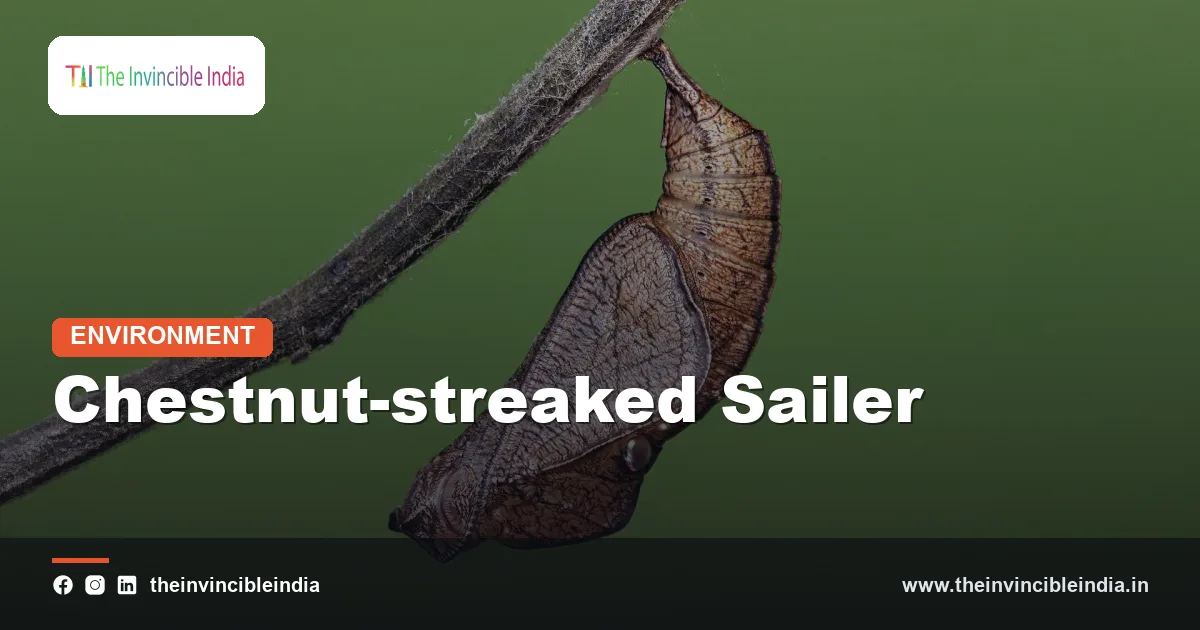
| Chrysalis | Hangs from the host plant; shape and colour help it pass for a curled or dried leaf |
| Adult | Emerges, dries and hardens its wings, mates and lays eggs; lives for a few weeks |
Because broods overlap, adults can be seen across many months in the warmer parts of the country. Numbers usually rise during and after the monsoon, when new leaf growth on host plants supports many caterpillars. In cooler hill areas the butterfly may be seen for a shorter period of the year.
How is the chestnut-streaked sailer different from the common sailer?
The chestnut-streaked sailer differs from the common sailer mainly in its larger size, broader white bands and the chestnut-brown streaks on the underside. The common sailer (Neptis hylas) is a smaller, more slender butterfly with narrower white bands and a yellower or paler brown underside.
| Feature | Chestnut-streaked sailer | Common sailer |
|---|---|---|
| Scientific name | Neptis jumbah | Neptis hylas |
| Size | Larger; wingspan roughly 60 to 75 mm | Smaller and more slender |
| White bands | Broad and bold | Narrower and neater |
| Underside | Chestnut-brown streaks with white markings | Paler brown with narrow white streaks |
| Typical habitat | Forests, forest edges and shaded gardens | Forests, gardens, parks and towns |
The chestnut-streaked sailer can also be compared with the common sergeant (Athyma perius), which has a similar black-and-white look. The sergeant has broad white bands and an orange-brown underside, whereas the sailers have streakier white marks. Careful photographs of both the upperside and the underside make the identification much easier.
Which other sailers share its habitat in India?
Several other sailers share the forests and gardens where the chestnut-streaked sailer lives, and learning the group together makes identification easier. Each sailer has a dark ground colour with white marks, but the width, shape and arrangement of those marks differ from species to species.
- Common sailer (Neptis hylas): A smaller, slender sailer that is also frequent in gardens and towns.
- Clear sailer: A small sailer with neat white bands and a clean look on the underside.
- Sullied sailer: A sailer with a more muted, smudged white pattern than the bold chestnut-streaked sailer.
- Short-banded sailer: A sailer in a related genus, with a shorter, stubbier band on the forewing.
Because the chestnut-streaked sailer is the largest and boldest of these, it is a useful reference species. Once its size and chestnut-streaked underside are familiar, the smaller sailers are easier to sort out by comparison.
Why does the chestnut-streaked sailer matter to forest ecosystems?
The chestnut-streaked sailer matters because it is a link in the forest food web and an indicator of healthy understorey vegetation. Each stage of its life interacts with other species.
- Eggs, caterpillars and chrysalises are food for birds, lizards, spiders and predatory insects.
- Adults recycle nutrients by feeding on fruit, sap and damp soil.
- Occasional flower visits can contribute to pollination.
- The butterfly’s reliance on native shrubs shows whether forest edges and scrub are still intact.
Butterflies are widely used in biodiversity monitoring because they are easy to see, quick to respond to habitat change and attractive to citizen scientists. A large sailer like Neptis jumbah is especially good for beginners to record.
How can you see and help the chestnut-streaked sailer?
You can see a chestnut-streaked sailer by walking slowly along a shaded forest trail or wooded garden edge on a warm, bright morning and scanning sunlit leaves for a large dark butterfly with white bands. You can help it by protecting native shrubs and avoiding pesticides near wooded areas.
- Look near stream crossings and damp ground, where adults gather in the morning.
- Stand still near a favourite perch, since males often return to it.
- Photograph both sides of the wings, since the underside is key to identification.
- Retain native buckthorn-family shrubs along forest edges and plantation borders.
- Record sightings on public biodiversity platforms or in community butterfly counts.
Watching and photographing is preferable to collecting. Conserving forest edges, stream banks and shaded gardens benefits not only this sailer but also many other butterflies and insects that share its habitat.
Bottom Line
The chestnut-streaked sailer is a large, dark, white-banded butterfly with chestnut streaks beneath and a graceful gliding flight. It is widespread in Indian forests, easy to distinguish from the smaller common sailer once its underside is seen, and a good indicator of native shrubs at forest edges.
Frequently Asked Questions
What is the scientific name of the chestnut-streaked sailer?
The scientific name of the chestnut-streaked sailer is Neptis jumbah. It belongs to the family Nymphalidae and the subfamily Limenitidinae, in the sailer genus Neptis.
Why is it called a chestnut-streaked sailer?
It is called a chestnut-streaked sailer because of the chestnut-brown streaks on the underside of its wings and its gliding, sailing flight. The word sailer refers to the way the butterfly glides on flattened wings after a few quick flaps.
What does a chestnut-streaked sailer look like?
A chestnut-streaked sailer looks like a large dark butterfly with bold white bands on the upperside and chestnut-brown streaks with white marks on the underside. Its wingspan is roughly 60 to 75 mm, which is larger than that of the common sailer.
Where is the chestnut-streaked sailer found in India?
The chestnut-streaked sailer is found in forests and forest edges across India, including the Western Ghats, the Himalayan foothills and the north-east. It prefers moist, partly shaded habitat with native shrubs.
What do chestnut-streaked sailer caterpillars eat?
Chestnut-streaked sailer caterpillars are reported to eat leaves of buckthorn-family plants such as Ziziphus and Ventilago. Host records vary by region, so local plants influence where the butterfly breeds.
Is the chestnut-streaked sailer rare?
No, the chestnut-streaked sailer is not rare and is regarded as a widespread species in India. Its numbers can still fall locally if forest edges and native host shrubs are removed.
{“@context”:”https://schema.org”,”@graph”:[{“@type”:”FAQPage”,”mainEntity”:[{“@type”:”Question”,”name”:”What is the scientific name of the chestnut-streaked sailer?”,”acceptedAnswer”:{“@type”:”Answer”,”text”:”The scientific name of the chestnut-streaked sailer is Neptis jumbah. It belongs to the family Nymphalidae and the subfamily Limenitidinae, in the sailer genus Neptis.”}},{“@type”:”Question”,”name”:”Why is it called a chestnut-streaked sailer?”,”acceptedAnswer”:{“@type”:”Answer”,”text”:”It is called a chestnut-streaked sailer because of the chestnut-brown streaks on the underside of its wings and its gliding, sailing flight. The word sailer refers to the way the butterfly glides on flattened wings after a few quick flaps.”}},{“@type”:”Question”,”name”:”What does a chestnut-streaked sailer look like?”,”acceptedAnswer”:{“@type”:”Answer”,”text”:”A chestnut-streaked sailer looks like a large dark butterfly with bold white bands on the upperside and chestnut-brown streaks with white marks on the underside. Its wingspan is roughly 60 to 75 mm, which is larger than that of the common sailer.”}},{“@type”:”Question”,”name”:”Where is the chestnut-streaked sailer found in India?”,”acceptedAnswer”:{“@type”:”Answer”,”text”:”The chestnut-streaked sailer is found in forests and forest edges across India, including the Western Ghats, the Himalayan foothills and the north-east. It prefers moist, partly shaded habitat with native shrubs.”}},{“@type”:”Question”,”name”:”What do chestnut-streaked sailer caterpillars eat?”,”acceptedAnswer”:{“@type”:”Answer”,”text”:”Chestnut-streaked sailer caterpillars are reported to eat leaves of buckthorn-family plants such as Ziziphus and Ventilago. Host records vary by region, so local plants influence where the butterfly breeds.”}},{“@type”:”Question”,”name”:”Is the chestnut-streaked sailer rare?”,”acceptedAnswer”:{“@type”:”Answer”,”text”:”No, the chestnut-streaked sailer is not rare and is regarded as a widespread species in India. Its numbers can still fall locally if forest edges and native host shrubs are removed.”}}]}]}


