

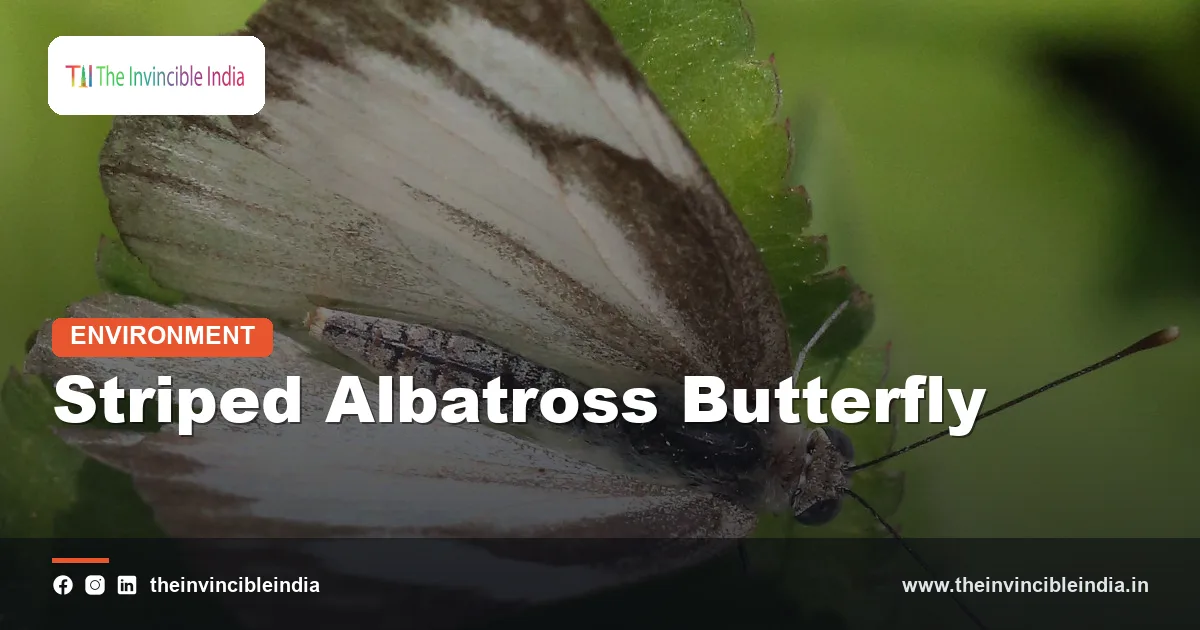
The striped albatross (Appias libythea) is a medium-sized white pierid butterfly with black streaks along the veins at the tips of its forewings, found in the gardens, scrub and forest edges of India, and it is a swift flier that often gathers at damp ground. The striped albatross belongs to the whites and yellows family Pieridae and is among the more frequently seen albatross butterflies of the Indian region.
The name "albatross" is borrowed from the sea bird and hints at the long, powerful flight of these butterflies. This article explains how to identify the striped albatross, where it lives in India, what its caterpillars eat, how it behaves and how it differs from similar white butterflies.
| Quick Facts: Striped Albatross | |
|---|---|
| Common name | Striped albatross |
| Scientific name | Appias libythea |
| Family | Pieridae (whites and yellows), subfamily Pierinae |
| Wingspan | Roughly 50 to 65 mm |
| Caterpillar host plants | Plants of the caper family (Capparaceae), including Capparis, Cadaba and Crateva |
| Range and habitat in India | Gardens, scrub, deciduous forest and forest edges across peninsular India, the Western Ghats and many other parts of the country |
| Flight season and broods | Several broods a year; seen in many months, with seasonal forms in the wet and dry seasons |
| Notable features | White wings with black-streaked veins near the forewing tip; strong flight; males gather at damp mud |
| Conservation status in India | Widespread and not regarded as threatened |
Key Takeaways
- The striped albatross (Appias libythea) is a white pierid butterfly with a wingspan of roughly 50 to 65 mm and black-streaked veins near the forewing tip.
- The striped albatross is a strong, fast flier that is found in gardens, scrub and forest edges across India.
- Caterpillars of the striped albatross feed on caper-family plants such as Capparis, Cadaba and Crateva.
- Male striped albatrosses often gather in groups at wet sand or mud to absorb salts, a behaviour called mud-puddling.
- The striped albatross shows seasonal forms, with wet-season and dry-season individuals differing in their markings.
- The striped albatross is widespread in India and is not considered threatened.
What is the striped albatross butterfly?
The striped albatross is a butterfly of the genus Appias, a group of white and cream pierids known as albatrosses, which are found in tropical Asia, Africa and Australasia. Appias libythea is a widespread member of the genus in India and across South and Southeast Asia.
The family Pieridae includes the whites, yellows, sulphurs, jezebels and albatrosses. These butterflies are mostly white, yellow or orange, and their caterpillars are slim and green. Adults use all six legs for walking, in contrast to the brush-footed butterflies, whose forelegs are reduced.
Albatross butterflies get their English name from their long, strong flight, which can carry them over considerable distances. The striped albatross is generally smaller than some other albatross species, but it shares their powerful, direct wingbeats and their habit of gathering on wet ground.
How can you identify a striped albatross?
A striped albatross can be identified by its white wings with black streaks along the veins near the tip of the forewing, a narrow dark border and a pale underside, together with its strong, rapid flight. The black vein streaks give it the "striped" look that gives the species its name.
Male
The male is mostly white. The forewing tip carries black or dark grey streaks that run along the veins and form a toothed margin, while the hindwing is largely clean white. On the underside, the wings are white with a faint yellowish or greenish tinge and thin dark vein lines. In flight, the male appears as a bright white butterfly with a dark wingtip.
Female
The female is more heavily marked than the male. Her wings show more dark scaling on the margins and veins, and the ground colour may be slightly dusky or tinted. These differences make the female look darker and more strongly patterned, although she is still recognisable as an albatross by her shape and strong flight.
Seasonal forms
The striped albatross occurs in seasonal forms, which means that individuals emerging in the wet season look somewhat different from those emerging in the dry season. The difference is usually seen in the underside pattern and in the amount of dark marking. This is common among butterflies of tropical regions with distinct rainy and dry periods.
Where does the striped albatross live in India?
The striped albatross lives in gardens, scrub, deciduous forest and forest edges across much of India, including peninsular India and the Western Ghats. It is a butterfly of open, sunlit country with patches of shade and with caper-family host plants close by.
Places where it is regularly seen include:
- Gardens, parks and farm edges with flowering plants.
- Scrub jungle, where Capparis and related shrubs grow.
- Deciduous and semi-evergreen forests with open clearings.
- Stream banks, damp sandy tracks and roadside puddles.
Outside India, the striped albatross ranges through Sri Lanka and Southeast Asia. Its strong flight allows it to colonise new areas easily, and it may appear in places that do not hold its host plants, though breeding requires those plants to be present.
Gardens in towns and cities can also support the striped albatross when they include flowering plants for adults and caper-family shrubs for caterpillars. Even a small hedge of native shrubs on a campus or farm boundary may be enough to sustain a breeding colony, provided that pesticide use is limited and a few damp patches remain through the dry months.
What does the striped albatross caterpillar eat?
The caterpillar of the striped albatross eats the leaves of caper-family plants (Capparaceae), including Capparis, Cadaba and Crateva. These shrubs, climbers and small trees grow in scrub, along rivers and in forest edges, and many contain mustard-oil compounds that make them unpalatable to most herbivores.
The female lays eggs on young leaves of the host plant, and the caterpillars that hatch feed on the soft tissue. Like other pierid caterpillars, they are green and slender, which matches the leaves they feed on. They grow through several moults before pupating.
The reliance on caper-family plants links the striped albatross to the same plants used by several other pierids. Where Capparis scrub is intact, a number of white butterflies can breed side by side. Where it is cleared, all of them lose a home at the same time.
How does the striped albatross behave?
The striped albatross behaves as an energetic, fast-flying butterfly that feeds at flowers, gathers at damp ground and often travels over long distances. It rarely sits still, and photographing one usually requires patience.
- Strong flight: The butterfly flies swiftly and directly, often at a height of a few metres above the ground.
- Mud-puddling: Males settle in groups on wet sand or mud to take up salts and minerals.
- Nectar feeding: Adults visit many flowers, especially in gardens and along forest edges.
- Local movements: Some albatross butterflies move in numbers across a region, particularly during certain seasons.
- Roosting: At night, individuals rest on twigs or leaves with wings closed.
Because the striped albatross is such a restless flier, observers often have the best luck at spots where the butterflies are forced to stop, such as flowering shrubs, drinking sites and mud patches. Early morning and late afternoon are generally good times, when the butterflies feed more steadily and are less skittish. A long lens or a patient approach, with slow movements and no sudden shadows, makes close photographs far easier.
What is the life cycle of the striped albatross?
The striped albatross follows the standard four-stage butterfly life cycle of egg, caterpillar, chrysalis and adult, and one generation typically takes about a month in warm weather. Several generations follow each other in a year, so adults can be seen in many months.
| Stage | Description |
|---|---|
| Egg | Laid on young leaves of a caper-family plant; pale and spindle-shaped, as in many pierids |
| Caterpillar | Slender and green; feeds on leaves and grows through several moults |
| Chrysalis | Held upright on a twig by a tail attachment and a silk girdle; green or pale, blending with foliage |
| Adult | Emerges, dries its wings and begins to feed, roam and mate; lives for a few weeks |
Temperature and the freshness of host leaves control the speed of development. After rains, new leaf growth supports many caterpillars, and the butterflies may become more numerous. This explains why seasonal forms and seasonal peaks are a common feature of the species.
How is the striped albatross different from other white butterflies?
The striped albatross differs from other white butterflies mainly in the black-streaked veins near the forewing tip, its medium size and its fast direct flight. Several pierids look alike at a quick glance, so a comparison table is useful.
| Butterfly | Scientific name | Distinguishing clue |
|---|---|---|
| Striped albatross | Appias libythea | White with black-streaked veins near the forewing tip; strong flight |
| Common wanderer | Pareronia valeria | Larger; male pale with black veins and margin; female darker |
| Common gull | Cepora nerissa | Smaller white with black borders and a yellow-tinted underside |
| Pioneer | Belenois aurota | White with dark veins and a bold open flight |
| Common albatross | Appias albina | A related albatross, with more extensive white and a different wingtip pattern |
The simplest approach is to photograph the butterfly at rest, with wings open if possible, and to check the pattern at the tip of the forewing. The striped streaks along the veins are the feature most closely tied to the name.
Why does the striped albatross have wet-season and dry-season forms?
The striped albatross has wet-season and dry-season forms because butterflies in tropical regions are shaped by the temperature and humidity experienced by the caterpillar and chrysalis, and these conditions differ between the rainy and dry periods. This phenomenon is called seasonal polyphenism.
In practice, a brood that develops during the wet season may look slightly different from a brood that develops in the dry season, especially on the underside of the wings. Scientists who study such forms have suggested that the dry-season pattern can offer better camouflage among dried vegetation, while the wet-season pattern suits the greener surroundings. The idea is general to many tropical butterflies, and the details vary between species. For observers, seasonal forms are a reminder to record the date as well as the place when photographing a butterfly, since the same species can look different at different times of year.
Which other albatross butterflies occur in India?
Several other albatross butterflies of the genus Appias occur in India, and the striped albatross is one of the group. The genus includes species that differ in size, in the extent of dark marking and in the regions where they are found.
- Common albatross (Appias albina): A widespread albatross that is sometimes seen in large numbers.
- Chocolate albatross (Appias lyncida): A species whose female has a darker, chocolate-toned appearance.
- Lesser albatross: A smaller albatross with more restricted distribution.
- Striped albatross (Appias libythea): The species described here, distinguished by its black-streaked veins.
Because these species overlap in habitat, careful observation of the wingtip pattern, the underside colour and the sex of the individual is needed to separate them. A recent regional checklist can help to confirm which albatrosses occur in a particular state.
Why does the striped albatross matter?
The striped albatross matters because it is a pollinator, a prey species and a pointer to the health of scrub and garden habitat. Its life connects it with plants, predators and the wider ecosystem.
- Adults visit flowers and move pollen between plants while feeding.
- Eggs, caterpillars and chrysalises are food for birds, lizards, spiders and wasps.
- The butterfly depends on native caper-family plants, which indicates intact scrub.
- Its bright white colour and swift flight make it a popular subject for butterfly walks.
Butterflies respond quickly to changes in habitat and climate, so species like the striped albatross are valuable for long-term monitoring by citizen scientists and researchers.
How can you see and help the striped albatross?
You can see a striped albatross by visiting a garden, scrub patch or forest edge on a warm, sunny morning and looking for fast white butterflies near flowers and damp ground. You can help it by keeping native caper-family shrubs and by reducing pesticide use.
- Check wet sand and stream margins, where males gather in groups.
- Plant nectar-rich flowers in gardens to attract adults.
- Retain native Capparis and related shrubs in hedges and scrub.
- Avoid broad insecticide spraying near flowering plants.
- Photograph the butterfly when it feeds or puddles, because it rarely rests otherwise.
Observation and photography are always better than collecting. Recording sightings on public biodiversity platforms contributes useful data on distribution and seasonal changes.
Bottom Line
The striped albatross is a white pierid butterfly with black-streaked veins at the forewing tip, a strong flight and a habit of puddling at damp ground. It breeds on caper-family plants and is widespread and not threatened in India, but it depends on native scrub and flowering habitats.
Frequently Asked Questions
What is the scientific name of the striped albatross butterfly?
The scientific name of the striped albatross is Appias libythea. It belongs to the family Pieridae and the subfamily Pierinae, in the albatross genus Appias.
What does a striped albatross look like?
A striped albatross looks like a white butterfly with black streaks along the veins near the tip of the forewing. The female is more heavily marked than the male, and the wingspan is roughly 50 to 65 mm.
What do striped albatross caterpillars eat?
Striped albatross caterpillars eat the leaves of caper-family plants such as Capparis, Cadaba and Crateva. The female lays her eggs on young leaves of these host plants.
Why is it called an albatross butterfly?
It is called an albatross butterfly because of its long, powerful flight, which recalls the sea bird of the same name. The word striped refers to the black streaks along the veins near the forewing tip.
Why do striped albatross butterflies gather on mud?
Striped albatross butterflies gather on mud or wet sand to absorb salts and minerals that are scarce in nectar. This behaviour, called mud-puddling, is seen mainly in males.
Is the striped albatross butterfly common in India?
Yes, the striped albatross is widespread in India and is not regarded as threatened. Local numbers can still decline when scrub, forest edges and native host plants are cleared.
{“@context”:”https://schema.org”,”@graph”:[{“@type”:”FAQPage”,”mainEntity”:[{“@type”:”Question”,”name”:”What is the scientific name of the striped albatross butterfly?”,”acceptedAnswer”:{“@type”:”Answer”,”text”:”The scientific name of the striped albatross is Appias libythea. It belongs to the family Pieridae and the subfamily Pierinae, in the albatross genus Appias.”}},{“@type”:”Question”,”name”:”What does a striped albatross look like?”,”acceptedAnswer”:{“@type”:”Answer”,”text”:”A striped albatross looks like a white butterfly with black streaks along the veins near the tip of the forewing. The female is more heavily marked than the male, and the wingspan is roughly 50 to 65 mm.”}},{“@type”:”Question”,”name”:”What do striped albatross caterpillars eat?”,”acceptedAnswer”:{“@type”:”Answer”,”text”:”Striped albatross caterpillars eat the leaves of caper-family plants such as Capparis, Cadaba and Crateva. The female lays her eggs on young leaves of these host plants.”}},{“@type”:”Question”,”name”:”Why is it called an albatross butterfly?”,”acceptedAnswer”:{“@type”:”Answer”,”text”:”It is called an albatross butterfly because of its long, powerful flight, which recalls the sea bird of the same name. The word striped refers to the black streaks along the veins near the forewing tip.”}},{“@type”:”Question”,”name”:”Why do striped albatross butterflies gather on mud?”,”acceptedAnswer”:{“@type”:”Answer”,”text”:”Striped albatross butterflies gather on mud or wet sand to absorb salts and minerals that are scarce in nectar. This behaviour, called mud-puddling, is seen mainly in males.”}},{“@type”:”Question”,”name”:”Is the striped albatross butterfly common in India?”,”acceptedAnswer”:{“@type”:”Answer”,”text”:”Yes, the striped albatross is widespread in India and is not regarded as threatened. Local numbers can still decline when scrub, forest edges and native host plants are cleared.”}}]}]}


