

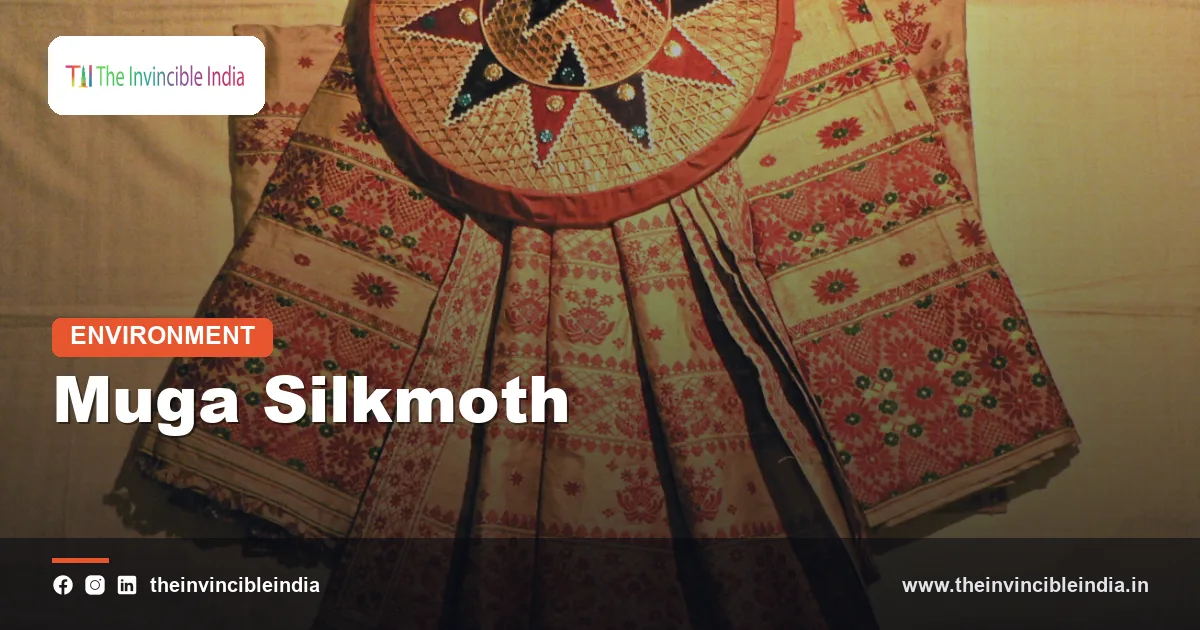
The muga silkmoth (Antheraea assamensis) is a large wild silk moth of the family Saturniidae, native to the Brahmaputra valley of Assam, whose cocoons yield the naturally golden, glossy muga silk found nowhere else in commercial quantity in the world. The moth is semi-domesticated, meaning that its caterpillars are reared outdoors on living host trees rather than indoors on cut leaves. Muga silk is a Geographical Indication (GI) product of Assam and one of the four major commercial silks produced in India.
This guide explains what the muga silkmoth is, how its life cycle works, what it eats, how muga silk is made, and why the fabric is valued so highly. It also covers the threats facing muga rearing and how the silk differs from India’s other silks.
| Attribute | Details |
|---|---|
| Scientific name | Antheraea assamensis (Helfer, 1837) |
| Family | Saturniidae (giant silk moths) |
| Wingspan | Broad wings spanning well over 10 cm, with females larger than males |
| Host plants | Som (Persea bombycina) and soalu (Litsea polyantha), both members of the laurel family |
| Range | Brahmaputra valley of Assam, with small-scale rearing in parts of neighbouring north-eastern states |
| Broods | Multivoltine, with about five to six rearing seasons a year in Assam |
| Product | Muga silk, a golden-yellow wild silk |
| Recognition | Muga silk of Assam is protected as a Geographical Indication, registered in 2007 |
Key Takeaways
- The muga silkmoth (Antheraea assamensis) is a large moth of the family Saturniidae that is reared mainly in Assam for its golden cocoons.
- Muga silk is naturally golden-yellow, becomes glossier with washing and use, and is known for exceptional durability.
- Muga silkmoth caterpillars feed on the leaves of som (Persea bombycina) and soalu (Litsea polyantha) trees, and are usually reared in the open on living trees.
- The muga silkmoth is multivoltine, producing several generations a year in Assam, each with its own traditional name.
- Muga silk of Assam carries a Geographical Indication tag registered in 2007, and India is the only country that produces all four main commercial silks: mulberry, tasar, eri and muga.
- Muga rearing is a heritage livelihood, but it faces pressure from changing weather, disease, pests, loss of host trees and competition from cheaper fabrics.
What is the muga silkmoth?
The muga silkmoth is a large, semi-domesticated silk moth, scientifically named Antheraea assamensis, whose caterpillars spin the cocoons from which muga silk is reeled. It belongs to the Saturniidae, the family that includes the world’s biggest moths, and it is a close relative of the tasar silkmoth (Antheraea mylitta) of central and eastern India.
The English name comes from the Assamese word muga, often explained as meaning amber-coloured or dark yellow, which matches the golden tone of the silk. The scientific name refers to Assam, the state where the moth is found and where it has been reared for centuries.
Unlike the mulberry silkworm (Bombyx mori), which is fully domesticated and reared indoors, the muga silkmoth stays close to its wild habits. Its caterpillars live on open-air host trees, and the adults are strong fliers. This is why muga silk is classed among the wild or non-mulberry silks, often grouped under the name vanya silk.
What does the muga silkmoth look like?
The adult muga silkmoth is a robust, brown to reddish-brown moth with broad wings marked by pale lines and transparent eyespot windows, while the caterpillar is plump and green. Like other saturniids, the adult has feathery antennae, especially in the male, and a heavy, furry body.
The moth
The wings carry bands, fine wavy lines and a small, translucent patch on each wing. The female is bigger and bulkier than the male, with less feathery antennae. Adults have reduced mouthparts and do not feed, so their short lives depend on the fat reserves stored by the caterpillar.
The caterpillar
The caterpillar is green, stout and covered with sparse, fine hairs, and it grows through five stages called instars. In the final instar it is large and heavy and eats a great deal of foliage. Its green colour makes it hard to spot among the leaves.
The cocoon
The cocoon is oval, firm and golden to pale brown, usually hung from a leaf or twig by a silk stalk. The silk of the cocoon is a single continuous filament, but it is bound by natural gum, so it must be treated before reeling.
Where is the muga silkmoth found?
The muga silkmoth is found in the Brahmaputra valley of Assam, where the warm, humid climate and the presence of the host trees support rearing for most of the year. Assam accounts for nearly all muga silk produced in India, and therefore for almost all production worldwide.
The districts of upper and central Assam, including Lakhimpur, Dhemaji, Sivasagar, Jorhat, Golaghat and Dibrugarh, have traditionally been important for rearing. Small-scale rearing also takes place in neighbouring states such as Meghalaya and Nagaland. The weaving of the silk is concentrated in other places, particularly Sualkuchi in the Kamrup district on the north bank of the Brahmaputra, which is well known as a silk-weaving town.
Climate matters greatly. The moth does best in the humid conditions typical of the Brahmaputra plain, and sharp swings in temperature, heavy rain or drought can reduce cocoon yields. This close tie to a specific region is part of the reason muga silk qualified for a Geographical Indication.
What does the muga silkmoth eat?
Muga silkmoth caterpillars eat the leaves of two main host trees, som (Persea bombycina) and soalu (Litsea polyantha), both in the laurel family, Lauraceae. Som is the preferred food plant and is the basis of most commercial rearing, while soalu serves as a secondary host, particularly in certain seasons.
A few other laurel-family plants have been reported as food for the species in some places, but these two trees are the main ones. Rearers maintain plantations or groves of som and soalu around their homes and fields, and the trees are pruned so that fresh, tender shoots are always available.
- Som: a medium to large evergreen tree with leathery leaves, grown in orchards and homestead plots.
- Soalu: a tree of similar form, used to extend the feeding season.
- Leaf quality: young, tender leaves produce healthier caterpillars and better cocoons.
The quality of the leaves directly affects the quality of the silk. Poorly managed plantations, shortage of fresh foliage and pests on the trees all reduce yields, so care of the host trees is as important as care of the worms.
What is the life cycle of the muga silkmoth?
The muga silkmoth passes through four stages, egg, larva, pupa and adult, and completes a full generation in roughly two months in warm weather and longer in the cool season. Because it is multivoltine, it produces several generations a year.
Egg
The female lays oval, light-coloured eggs in batches on leaves or on rearing trays, and the eggs hatch in about a week or so under warm conditions. Rearers gather the eggs, known as seed, and place them in the care of the plantation.
Larva
The caterpillar passes through five instars over about four to five weeks, eating leaves almost continuously. Rearers move young caterpillars to the trees and watch for predators, such as ants, birds, lizards and wasps, as well as for disease.
Pupa
When fully grown, the caterpillar climbs to a suitable spot, often with the help of the rearer, and spins its cocoon. Inside the cocoon it changes into a pupa, a stage that lasts for a couple of weeks in warm weather and much longer in winter, when the pupa can pass through a resting phase.
Adult
The adult moth emerges, mates and lays eggs within a few days, since it does not feed. A portion of the cocoons is therefore kept back as seed stock so that moths can emerge, mate and begin the next generation.
| Stage | Approximate duration | Key point |
|---|---|---|
| Egg | About 7 to 10 days | Hatches into tiny caterpillars |
| Larva | About 4 to 5 weeks, five instars | Feeds on som and soalu leaves |
| Pupa | About 2 to 3 weeks in warm season, longer in winter | Develops inside the golden cocoon |
| Adult | A few days | Does not feed; mates and lays eggs |
How many broods does the muga silkmoth have in a year?
The muga silkmoth has about five to six broods a year in Assam, each known by a traditional local name that reflects the season. These rearing seasons differ in the quality and quantity of the silk they produce.
The traditional names include Jethua, Aherua, Bhodia, Kotia, Jarua and Chotua. The autumn and winter crops, such as Kotia and Jarua, are generally regarded as the best for cocoon quality and silk, while the hot, humid summer crops are more vulnerable to disease and give poorer yields. Rearers therefore choose the timing of their seed and rearing carefully.
The ability to rear several crops a year is valuable for livelihoods, because families receive income at more than one time during the year. It also means that the rearer must keep seed cocoons and healthy host trees ready for several cycles.
How is muga silk made?
Muga silk is made by collecting cocoons, boiling them in an alkaline solution to loosen the gum, and then reeling or spinning the filament into yarn that is woven by hand. The process is largely done by families and small groups, and much of it is still manual.
- Harvesting: cocoons are collected from the rearing trees or trays once the caterpillars have finished spinning.
- Degumming: the cocoons are boiled in a mild alkali solution, traditionally one made from ash of plants such as banana, to soften the natural gum, sericin.
- Reeling: filaments are drawn from the softened cocoons and combined into thread, often using a simple reeling device.
- Spinning and weaving: the yarn is spun and then woven on handlooms, most famously in Sualkuchi and across rural Assam.
The silk keeps its natural golden colour because it is difficult to bleach, and it is usually not dyed heavily. The fabric is stiff at first and becomes softer and shinier with repeated washing, which is why a well-kept muga garment can last for decades and may be passed from one generation to the next.
Why is muga silk so valuable?
Muga silk is valuable because it is rare, naturally golden, very durable and produced almost exclusively in one region of India. These features make it one of the most prized silks in the country.
- Natural colour: the golden sheen comes from the silk itself and is not a dye.
- Durability: muga is considered one of the strongest natural silks, and garments are valued for lasting many years.
- Improving lustre: the shine increases with each wash.
- Limited supply: small, regional production keeps volumes low compared with mulberry silk.
- Cultural role: muga is woven into traditional Assamese garments such as the mekhela chador and the sador, as well as shawls, stoles and furnishings.
Historically, muga silk was associated with royalty and was worn on ceremonial occasions in Assam. Today it remains a symbol of Assamese heritage and is worn at weddings, festivals and cultural events, including Bihu.
What is the Geographical Indication status of muga silk?
Muga silk of Assam holds a Geographical Indication (GI) tag, registered in 2007, which recognises it as a product with a specific origin and qualities linked to Assam. A GI tag in India is granted under the Geographical Indications of Goods (Registration and Protection) Act, 1999.
The tag helps protect the name from misuse and supports the claim that genuine muga silk comes from Assam. It is often used together with the Silk Mark, which is a quality assurance label from the Silk Mark Organisation of India, set up under the Central Silk Board, to help buyers identify real silk. Research and training for muga and other non-mulberry silks are carried out by the Central Silk Board’s institutions in the north-east, including the Central Muga Eri Research and Training Institute at Lahdoigarh near Jorhat.
How does muga silk differ from other Indian silks?
Muga silk differs from other Indian silks mainly in its natural golden colour, its wild or semi-domesticated source and its exceptional durability. India produces four main commercial silks, and each comes from a different silkmoth.
| Silk | Source insect | Typical character |
|---|---|---|
| Mulberry | Bombyx mori | Fine, white to cream, fully domesticated and reared indoors |
| Tasar (tussar) | Antheraea mylitta | Coarser, copper to tan, wild silk from central and eastern India |
| Eri | Samia ricini | Soft, warm, wool-like; cocoons are open-ended and the silk is spun |
| Muga | Antheraea assamensis | Golden, glossy and very durable; produced almost only in Assam |
Both muga and tasar come from moths of the genus Antheraea, but they differ in colour, region and host trees. Eri silk, also from the north-east, is sometimes called ahimsa silk because the moth may be allowed to emerge before the cocoon is processed, whereas muga cocoons are generally reeled from intact cocoons.
What threats does muga silk rearing face?
Muga silk rearing faces threats from disease, pests, climate variability, shrinking host-tree cover and competition from cheaper imitations. These pressures have affected the livelihoods of many rearing families.
- Diseases: infections of the caterpillars, such as flacherie and pebrine, can cause serious losses, particularly in hot and humid summer crops.
- Pests and predators: ants, birds, lizards and parasitic flies attack the caterpillars and pupae.
- Climate: irregular rain, flood and temperature changes in the Brahmaputra valley affect both host trees and rearing.
- Imitations: cheaper fabrics sold as muga can undercut genuine producers, which is one reason authentication labels matter.
- Land use: the conversion of land from homestead plantations reduces the supply of som and soalu.
Research and extension work by the Central Silk Board and Assam’s sericulture department focuses on disease-free seed, better rearing practices, plantation management and training for rearers and weavers. Consumers can support genuine producers by looking for the GI and Silk Mark labels and by buying from known cooperatives and weavers.
Bottom Line
The muga silkmoth is the source of Assam’s golden silk, a rare, long-lasting and culturally important fibre. Its survival as a livelihood depends on healthy host trees, careful rearing and the protection that comes from its Geographical Indication status.
Frequently Asked Questions
What is the muga silkmoth?
The muga silkmoth is a large, semi-domesticated silk moth, Antheraea assamensis, found in Assam. Its cocoons yield the golden muga silk. The moth belongs to the family Saturniidae and is reared outdoors on som and soalu trees.
Why is muga silk golden in colour?
Muga silk is golden because the colour is natural to the silk produced by the muga silkmoth. The fibre is hard to bleach, so it keeps its amber tone. The shine usually becomes brighter with washing and use.
Where is muga silk produced?
Muga silk is produced almost entirely in Assam, mainly in the Brahmaputra valley. Rearing is concentrated in upper and central Assam, while weaving centres such as Sualkuchi make the fabric. Small amounts are produced in neighbouring north-eastern states.
What do muga silkmoth caterpillars eat?
Muga silkmoth caterpillars eat the leaves of som (Persea bombycina) and soalu (Litsea polyantha). Both are trees of the laurel family. Som is the main food plant, and young leaves give the best cocoons.
Does muga silk have a GI tag?
Yes, muga silk of Assam has a Geographical Indication (GI) tag, registered in 2007. The tag recognises that the silk’s qualities are linked to Assam and protects the name from misuse. It is often used together with the Silk Mark label.
How is muga silk different from mulberry silk?
Muga silk differs from mulberry silk in colour, source and rearing method. Muga is naturally golden and comes from a semi-domesticated moth reared outdoors on trees, while mulberry silk is white to cream and comes from the fully domesticated silkworm Bombyx mori, reared indoors. Muga is also rarer and more durable.
{“@context”:”https://schema.org”,”@graph”:[{“@type”:”FAQPage”,”mainEntity”:[{“@type”:”Question”,”name”:”What is the muga silkmoth?”,”acceptedAnswer”:{“@type”:”Answer”,”text”:”The muga silkmoth is a large, semi-domesticated silk moth, Antheraea assamensis, found in Assam. Its cocoons yield the golden muga silk. The moth belongs to the family Saturniidae and is reared outdoors on som and soalu trees.”}},{“@type”:”Question”,”name”:”Why is muga silk golden in colour?”,”acceptedAnswer”:{“@type”:”Answer”,”text”:”Muga silk is golden because the colour is natural to the silk produced by the muga silkmoth. The fibre is hard to bleach, so it keeps its amber tone. The shine usually becomes brighter with washing and use.”}},{“@type”:”Question”,”name”:”Where is muga silk produced?”,”acceptedAnswer”:{“@type”:”Answer”,”text”:”Muga silk is produced almost entirely in Assam, mainly in the Brahmaputra valley. Rearing is concentrated in upper and central Assam, while weaving centres such as Sualkuchi make the fabric. Small amounts are produced in neighbouring north-eastern states.”}},{“@type”:”Question”,”name”:”What do muga silkmoth caterpillars eat?”,”acceptedAnswer”:{“@type”:”Answer”,”text”:”Muga silkmoth caterpillars eat the leaves of som (Persea bombycina) and soalu (Litsea polyantha). Both are trees of the laurel family. Som is the main food plant, and young leaves give the best cocoons.”}},{“@type”:”Question”,”name”:”Does muga silk have a GI tag?”,”acceptedAnswer”:{“@type”:”Answer”,”text”:”Yes, muga silk of Assam has a Geographical Indication (GI) tag, registered in 2007. The tag recognises that the silk’s qualities are linked to Assam and protects the name from misuse. It is often used together with the Silk Mark label.”}},{“@type”:”Question”,”name”:”How is muga silk different from mulberry silk?”,”acceptedAnswer”:{“@type”:”Answer”,”text”:”Muga silk differs from mulberry silk in colour, source and rearing method. Muga is naturally golden and comes from a semi-domesticated moth reared outdoors on trees, while mulberry silk is white to cream and comes from the fully domesticated silkworm Bombyx mori, reared indoors. Muga is also rarer and more durable.”}}]}]}


