

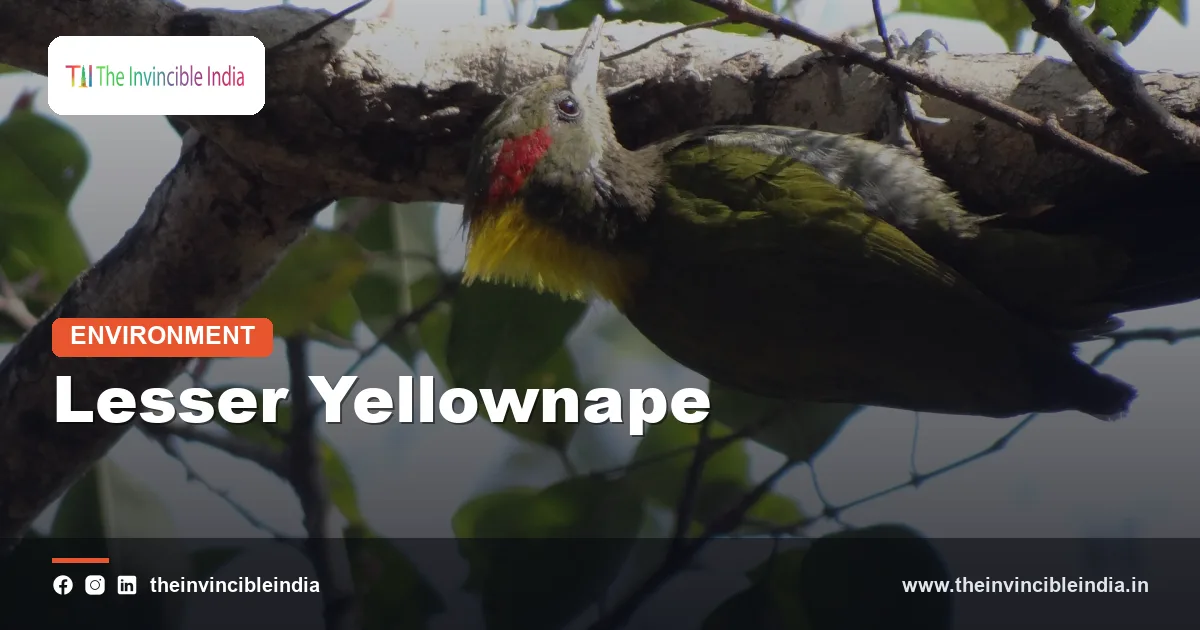
The lesser yellownape (Picus chlorolophus) is a medium-sized green woodpecker of Indian forests, recognised by its short yellow crest, pale underparts with fine barring and a bold red or whitish moustache, and it feeds mainly on ants, termites and wood-boring grubs. It lives in broadleaved woodland across the Himalayan foothills, central and eastern India, the north-east and the Western Ghats, and it is more often heard than seen as it climbs trunks in the middle layers of the forest.
The lesser yellownape is a resident, hole-nesting bird that excavates its own nest in dead or decaying wood and plays a quiet role in forest health. This article explains what the lesser yellownape is, how to recognise it, where it lives, what it eats and how it differs from similar woodpeckers.
| Attribute | Detail |
|---|---|
| Common name | Lesser yellownape |
| Scientific name | Picus chlorolophus |
| Family | Picidae (woodpeckers) |
| Size | About 25 to 27 cm long, a little larger than a myna, with a straight, chisel-like bill |
| Range and habitat in India | Moist and dry deciduous and evergreen forest across the Himalayan foothills, north-east, central India, the Eastern Ghats and the Western Ghats |
| Diet | Ants, termites, beetle grubs and other insects, with occasional fruit and nectar |
| Breeding | Excavates a nest hole in a tree trunk or branch; lays about three to four white eggs, mostly in the dry season |
| Conservation status | Least Concern on the IUCN Red List |
Key Takeaways
- The lesser yellownape is a green woodpecker with a short yellow crest, a yellow nape and a distinctive facial pattern of red, white and chestnut marks.
- The lesser yellownape feeds mainly on ants, termites and the grubs of wood-boring beetles, which it extracts from bark and rotten wood with a long, sticky tongue.
- The lesser yellownape digs its own nest hole in a tree, and abandoned holes are later reused by other cavity-nesting birds, bats and squirrels.
- The lesser yellownape lives in broadleaved forests across much of India, including the Himalayan foothills, the Western Ghats, central India and the north-east.
- The lesser yellownape is classed as Least Concern, but it relies on mature trees with dead wood, so logging and clearing of old forest reduce its habitat.
- The lesser yellownape is smaller and less heavily marked than the greater yellownape, which has a yellow throat and a larger size.
What is the lesser yellownape?
The lesser yellownape is a woodpecker of the family Picidae and the genus Picus, a group of mostly green, ground-and-trunk-feeding woodpeckers found in Europe and Asia. It is called a yellownape because of the golden-yellow crest and nape feathers that sit at the back of the head.
The word lesser separates the bird from the greater yellownape, a larger forest woodpecker that shares some of the same habitat. Both are green birds with yellow on the back of the head, but they differ in size, throat colour and call.
The lesser yellownape is widespread across South and South-East Asia and has several regional subspecies that differ slightly in colour and tone. In India, local variations are noticeable between the Himalayan foothills, the peninsula and the north-east, but the basic look of a green bird with a short yellow crest and barred underparts stays the same.
What does the lesser yellownape look like?
The lesser yellownape looks like a mostly olive-green woodpecker with a short, floppy yellow crest, a reddish or white moustache, and pale underparts finely barred with brown and white. Its flight feathers are marked with chestnut and black bars, which show clearly when the bird spreads its wings.
The main field marks are:
- Crest: a short yellow crest that points backwards and can be raised when the bird is excited.
- Crown: an olive-green to greyish crown that sits in front of the yellow crest.
- Face: a pale or whitish face with a dark eye stripe and a prominent moustache stripe below the eye.
- Underparts: whitish to pale buff and barred with greenish brown, giving a finely patterned look.
- Wings and tail: chestnut-and-black barred flight feathers, and a black, stiff tail that supports the bird against the trunk.
- Bill: a straight, chisel-like grey bill with a pale base.
The male has a red moustachial streak, while in the female the moustache is whitish rather than red, a useful marker for telling the sexes apart in good light. Young birds are duller, with paler and less distinct markings.
Where does the lesser yellownape live in India?
The lesser yellownape lives in broadleaved forests in several regions of India, including the Himalayan foothills, the north-east, parts of central and eastern India and the hill forests of the Western Ghats. It is a bird of woodland and is seldom seen in treeless or intensely farmed country.
The species uses a range of forest types, including:
- Moist deciduous forest with tall trees and plenty of dead wood.
- Semi-evergreen and evergreen forest in the hills.
- Dry deciduous forest with larger trees and ant and termite activity.
- Well-wooded plantations and old orchards that adjoin natural forest.
It is found from the plains and low hills to mid-level hills, and in the Himalayan foothills it reaches reasonable altitudes. It generally avoids the highest elevations and very dry open country.
Within these forests, the bird tends to use the middle and upper storeys, climbing the trunks of larger trees and moving from tree to tree. It often joins mixed hunting flocks of small birds that move through the forest together.
What does the lesser yellownape eat?
The lesser yellownape eats mostly ants, termites and other insects, along with the larvae of beetles that live inside wood, and it sometimes takes small fruits and nectar. Ants and termites are particularly important, which makes the bird a specialist among woodpeckers.
The bird feeds by:
- Climbing along trunks and branches while tapping and probing crevices in the bark.
- Pulling insects out of cracks with a long, barbed and sticky tongue.
- Prying away loose bark to expose insects underneath.
- Occasionally descending to the base of a trunk or onto fallen logs to feed on ants and termites.
The tongue is one of the most remarkable features of a woodpecker. It is long enough to wrap around the back of the skull and is covered with a sticky coating and tiny barbs, so the bird can extract prey from deep tunnels. In green woodpeckers like the lesser yellownape, the tongue is especially long because many of their prey live in narrow galleries.
By feeding on wood-boring beetle larvae and termites, woodpeckers help to limit pests in standing timber. They also open dead wood to fungi and other decomposers, which speeds up the recycling of nutrients in the forest.
How does the lesser yellownape drum and call?
The lesser yellownape makes sound in two ways: it taps and drums on wood, and it gives loud, plaintive calls that carry through the forest. The drumming is generally lighter than in the larger woodpeckers, and the calls are the easier clue for birdwatchers.
The voice of the lesser yellownape is a series of clear, ringing whistles and sharp notes that often fall in pitch, and listeners commonly describe them as loud and mournful. Calls are most frequent in the breeding season, when pairs advertise their territory, and in the early morning when the forest is quiet.
Drumming has two main purposes in woodpeckers. It serves as communication, announcing a territory and attracting a mate, and it sometimes signals the location of a nest hole. Woodpeckers have a thick skull, strong neck muscles and a spongy bone structure that help to absorb impact, so they can hammer repeatedly without damage.
How does the lesser yellownape breed?
The lesser yellownape breeds by excavating a nest hole in the trunk or a large branch of a tree, usually a dead or decaying one, and laying about three to four white eggs inside. Both parents take part in digging the hole, incubating the eggs and feeding the nestlings.
The key stages of the breeding cycle are:
- Pair formation: pairs call and drum more often, and chase each other through the trees at the start of the dry season.
- Excavation: the pair chisels out a round entrance hole and an internal chamber, and the work can take a week or two.
- Egg laying: three to four glossy white eggs are laid on a bed of wood chips at the bottom of the cavity.
- Incubation and feeding: both sexes share the incubation, and then bring insects to the nestlings in a regular supply.
- Fledging: the young leave the nest after several weeks and are fed by the parents for some time outside it.
The breeding season in India extends roughly through the drier months before the monsoon, although the exact timing varies by region. White eggs are typical of hole-nesters because they are hidden from view and do not need camouflage.
Old woodpecker holes have a useful afterlife. Barbets, owlets, mynas, parakeets, tits, flying squirrels and bats often move into abandoned cavities, so a single woodpecker can create housing for many other animals. Ecologists call woodpeckers keystone excavators for this reason.
How is the lesser yellownape different from similar woodpeckers?
The lesser yellownape differs from similar woodpeckers mainly in size, throat colour and the pattern of its face, with the greater yellownape being the species most easily confused with it. Observing the throat and the overall bulk of the bird gives the quickest answer.
| Feature | Lesser yellownape | Greater yellownape |
|---|---|---|
| Size | Smaller, about 25 to 27 cm | Larger, about 33 cm |
| Throat | Pale, with a moustache stripe | Yellow or yellowish throat |
| Underparts | Pale and finely barred | Plainer, olive and buffy |
| Crest | Short yellow crest | Longer yellow crest |
| Habitat | Broadleaved forest, including drier types | Moist forest, especially in hills and the north-east |
Other green woodpeckers in India include the streak-throated woodpecker, the scaly-bellied woodpecker and the grey-headed woodpecker. These differ in head colour and in the pattern of the underparts. Streak-throated woodpeckers have a streaked throat and breast, while grey-headed woodpeckers have a grey head with a red patch on the male.
Is the lesser yellownape threatened?
The lesser yellownape is not threatened at present and is listed as Least Concern on the IUCN Red List, because it has a wide range and tolerates a range of woodland types. The bird is described as fairly common in suitable habitat across much of its range.
The most important pressures include:
- Forest clearing: conversion of woodland to farmland, plantations and settlements removes nesting trees.
- Removal of dead wood: felling of dead and dying trees and collection of firewood remove nest sites and foraging substrates.
- Fragmentation: small, isolated forest patches support fewer birds and make recolonisation harder.
- Pesticides: chemical use in adjoining areas reduces insect food.
Because the bird depends on mature trees, it benefits from forest protection, careful management of fuelwood collection and the retention of standing dead trees where they pose no safety risk.
Why do woodpeckers like the lesser yellownape matter?
Woodpeckers such as the lesser yellownape matter because they control wood-boring insects, create nest cavities used by many other species, and indicate the health of mature forest. Their presence suggests that a forest has large trees, dead wood and a good supply of insects.
Birdwatchers value the species because it is a reliable find on forest walks, particularly when the bird is calling from a treetop. Its yellow crest and bold face make it a favourite subject for photography, and it gives beginners a good starting point for learning woodpecker identification.
Protecting a landscape for woodpeckers also protects a whole community. Hole-nesting owls, barbets, bats and small mammals all depend on the cavities that woodpeckers excavate, so a forest without woodpeckers often has fewer species overall.
Bottom Line
The lesser yellownape is a green, crested woodpecker of Indian broadleaved forests that eats ants and grubs and digs the nest holes that many other animals later use. It is secure as a species, and it thrives where old trees and dead wood are allowed to remain.
Frequently Asked Questions
What is a lesser yellownape?
A lesser yellownape is a green woodpecker, scientifically named Picus chlorolophus, with a short yellow crest and finely barred pale underparts. It lives in forests across India and feeds mainly on ants, termites and wood-boring grubs.
How can you identify a lesser yellownape?
You can identify a lesser yellownape by its olive-green body, short yellow crest, chestnut-barred wings and a pale face with a moustache stripe. The male has a red moustache and the female has a whitish one, and the bird is smaller than the greater yellownape.
Where does the lesser yellownape live in India?
The lesser yellownape lives in broadleaved forests of the Himalayan foothills, north-east India, central and eastern India and the Western Ghats. It prefers woodland with mature trees and avoids open, treeless country.
What does the lesser yellownape eat?
The lesser yellownape eats mostly ants, termites and the larvae of wood-boring beetles. It pulls them out of cracks and bark with a long, sticky tongue and sometimes takes small fruits and nectar.
Where does the lesser yellownape nest?
The lesser yellownape nests in a hole that it excavates in a tree trunk or large branch, usually in dead or decaying wood. The female lays about three to four white eggs, and both parents incubate and feed the young.
Is the lesser yellownape an endangered bird?
No, the lesser yellownape is not endangered and is classed as Least Concern by the IUCN. It still depends on mature forest with dead wood, so deforestation and removal of old trees can reduce local populations.
{“@context”:”https://schema.org”,”@graph”:[{“@type”:”FAQPage”,”mainEntity”:[{“@type”:”Question”,”name”:”What is a lesser yellownape?”,”acceptedAnswer”:{“@type”:”Answer”,”text”:”A lesser yellownape is a green woodpecker, scientifically named Picus chlorolophus, with a short yellow crest and finely barred pale underparts. It lives in forests across India and feeds mainly on ants, termites and wood-boring grubs.”}},{“@type”:”Question”,”name”:”How can you identify a lesser yellownape?”,”acceptedAnswer”:{“@type”:”Answer”,”text”:”You can identify a lesser yellownape by its olive-green body, short yellow crest, chestnut-barred wings and a pale face with a moustache stripe. The male has a red moustache and the female has a whitish one, and the bird is smaller than the greater yellownape.”}},{“@type”:”Question”,”name”:”Where does the lesser yellownape live in India?”,”acceptedAnswer”:{“@type”:”Answer”,”text”:”The lesser yellownape lives in broadleaved forests of the Himalayan foothills, north-east India, central and eastern India and the Western Ghats. It prefers woodland with mature trees and avoids open, treeless country.”}},{“@type”:”Question”,”name”:”What does the lesser yellownape eat?”,”acceptedAnswer”:{“@type”:”Answer”,”text”:”The lesser yellownape eats mostly ants, termites and the larvae of wood-boring beetles. It pulls them out of cracks and bark with a long, sticky tongue and sometimes takes small fruits and nectar.”}},{“@type”:”Question”,”name”:”Where does the lesser yellownape nest?”,”acceptedAnswer”:{“@type”:”Answer”,”text”:”The lesser yellownape nests in a hole that it excavates in a tree trunk or large branch, usually in dead or decaying wood. The female lays about three to four white eggs, and both parents incubate and feed the young.”}},{“@type”:”Question”,”name”:”Is the lesser yellownape an endangered bird?”,”acceptedAnswer”:{“@type”:”Answer”,”text”:”No, the lesser yellownape is not endangered and is classed as Least Concern by the IUCN. It still depends on mature forest with dead wood, so deforestation and removal of old trees can reduce local populations.”}}]}]}


