

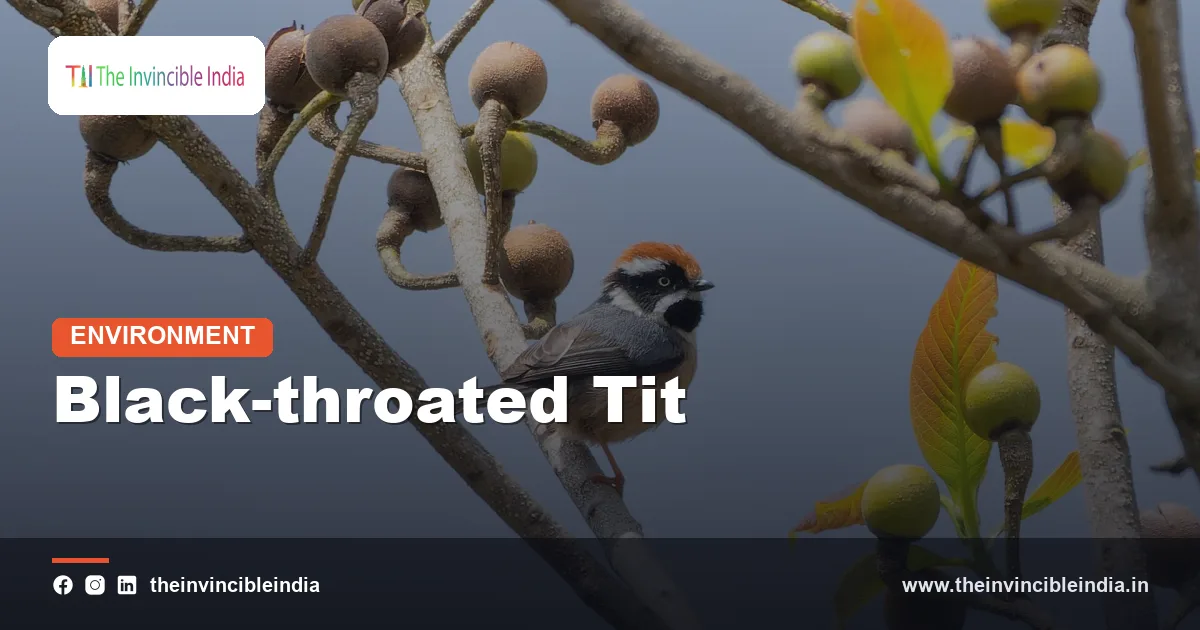
The black-throated tit (Aegithalos concinnus) is a tiny, long-tailed songbird of the Himalayan and north-eastern hill forests of India, recognised by its black throat bib, dark eye-mask, rusty breast band and restless, chattering flocks that sweep through the trees in search of insects. Weighing only a few grams, the black-throated tit is one of the smallest birds a visitor to the Indian hills is likely to meet, and one of the easiest to hear before it is seen.
Known in older field guides as the black-throated bushtit, the species belongs to the long-tailed tit family and is a year-round resident across a wide belt of mountain woodland. This article explains what the black-throated tit is, how to identify it, where it lives in India, what it eats, how it breeds and why it is a useful indicator of healthy hill forest.
| Quick Fact | Details |
|---|---|
| Common name | Black-throated tit (formerly black-throated bushtit) |
| Scientific name | Aegithalos concinnus |
| Family | Aegithalidae (long-tailed tits and bushtits) |
| Size | About 10 to 11 cm long, of which the tail is nearly half; weight only a few grams |
| Range in India | Himalayan foothills and middle hills from the western Himalaya eastwards, including Sikkim, Arunachal Pradesh and other north-eastern hill states |
| Habitat | Broadleaf, oak, rhododendron and mixed hill forest, scrub and forest edges, mostly in the mid-hills |
| Diet | Mainly small insects, their eggs and larvae, and spiders; occasionally some seeds |
| Breeding | Domed nest of moss, lichen and cobweb lined with feathers; breeds in spring to early summer |
| Conservation status | Least Concern on the IUCN Red List |
Key Takeaways
- The black-throated tit is a tiny insect-eating songbird of the family Aegithalidae that lives in Himalayan and north-eastern Indian hill forests.
- An adult black-throated tit measures roughly 10 to 11 cm from bill to tail tip, and the long tail makes up close to half of that length.
- The black-throated tit is identified by its black throat bib bordered with white, a dark mask through the eye, a rusty breast band and a long, thin tail.
- Black-throated tits live in noisy flocks, often joined by other small forest birds, and roost huddled together on cold nights.
- The black-throated tit builds an enclosed, oval nest of moss, lichen and spider silk, lined thickly with feathers for insulation.
- The black-throated tit is classified as Least Concern by the IUCN, but its mid-hill forest habitat in India depends on intact oak and broadleaf woodland.
What is the black-throated tit?
The black-throated tit is a small, long-tailed passerine bird that belongs to the family Aegithalidae, a group that also includes the long-tailed tit of Europe and Asia. Its scientific name, Aegithalos concinnus, places it in the genus Aegithalos, whose members are often called bushtits or long-tailed tits.
Despite the word “tit” in its name, the black-throated tit is not a close relative of the true tits and chickadees in the family Paridae, such as the great tit. The long-tailed tit family is a separate lineage, recognised by modern taxonomy because of differences in structure, tail length, nest design and social behaviour. Early naturalists grouped all of these small acrobatic birds together because they look and behave similarly, which is why the common name has stayed.
The species was described in the nineteenth century and has several regional races across its range, which extends from the Himalaya through southern and central China into South-East Asia and Taiwan. Differences between the races are visible mainly in the pattern of the head and the depth of the rusty colour on the underparts. For an Indian birdwatcher the key point is that the species is easy to recognise at the level of the whole bird, even when the subspecies is uncertain.
What does the black-throated tit look like?
The black-throated tit looks like a compact ball of feathers with a very long tail, a short bill and a bold face pattern. The most striking features are the black throat patch, which gives the bird its name, and the broad dark band running through the eye across the side of the head.
The main field marks are listed below.
- Throat and breast: A black bib on the throat, edged with white below, followed by a band of rusty orange or chestnut across the breast and along the flanks.
- Head: A dark mask through the eye. The colour of the crown and the extent of the dark patches differ between the Himalayan and eastern races.
- Back and wings: Bluish grey upperparts that look pale and soft in hill light.
- Belly: White or pale underparts below the rusty breast band.
- Tail: Long, narrow and graduated, often flicked and held cocked while the bird moves between twigs.
- Bill and legs: A tiny, stubby, dark bill and slender dark legs, suited to gripping thin twigs.
Males and females look very much alike, and young birds are slightly duller. In flight the black-throated tit appears as a small bundle with a trailing tail, moving in short, fluttering, undulating hops from one tree to the next. Birders often describe the impression as a “flying lollipop” because the tail seems almost out of proportion to the body.
Where is the black-throated tit found in India?
The black-throated tit is found along the Himalayan arc of India, from the hills of the western Himalaya in Himachal Pradesh and Uttarakhand eastwards through Sikkim and into Arunachal Pradesh and other north-eastern hill states. It is a resident bird, which means that it stays in the same general region through the year rather than migrating long distances.
The species is most numerous in the mid-hills rather than on the plains or at the highest elevations. As a rough guide, the black-throated tit is common between the lower hill belt of around 1,000 to 1,500 metres and the upper forest belt close to 3,000 metres, although the exact range varies with region and season. In winter, many flocks move down the slopes to escape snow and cold, and can appear in foothill forests and gardens, including areas close to the edge of the plains. In summer, the same flocks return to higher oak and rhododendron woods.
Outside India the species is found in Nepal, Bhutan and Myanmar, across much of southern China and in Taiwan, as well as in parts of Vietnam and Thailand. This broad distribution is one reason why the global population is considered secure.
Altitudinal movement in the Himalaya
The black-throated tit is a short-distance altitudinal migrant in many parts of its Indian range. Rather than flying hundreds of kilometres, flocks shift up and down mountain slopes by a few hundred metres, following the availability of insects. When insects become scarce in deep winter at higher altitude, the birds drop into warmer, lower valleys, and they return upslope when spring insect numbers rise.
What does the black-throated tit eat?
The black-throated tit feeds mainly on small insects and spiders, which it picks from leaves, twigs, bark crevices and buds. Its diet includes aphids, tiny beetles, caterpillars, moths in larval form, insect eggs and the small invertebrates that hide in lichen and moss on trunks.
Because the bird is so small, it needs to feed almost constantly, particularly in cold mountain weather where heat loss is rapid. A black-throated tit hangs upside down, hovers briefly and clings to the tips of branches to reach food that heavier birds cannot. Its short, fine bill is ideal for probing narrow gaps and plucking tiny prey. In winter, when insects are fewer, the bird may add small amounts of seeds and plant material, but animal prey remains the main food.
This diet makes the black-throated tit a natural pest controller in hill woodland and orchards. A single flock working through the canopy can remove large numbers of small insects, including pests of fruit and forest trees, over the course of a day. Ecologists refer to such birds as insectivores, and the presence of healthy insectivore populations is usually a sign that the forest still supports a rich insect community.
How does the black-throated tit behave in flocks?
The black-throated tit is a highly social bird that travels in small, noisy flocks, commonly of about ten to thirty individuals, and moves constantly through the middle and upper layers of the forest. The flock keeps in contact with thin, high-pitched, trilling calls, so an observer often hears a stream of tiny “si-si-si” notes before any bird comes into view.
Several habits make the black-throated tit distinctive.
- Continuous movement: Flocks rarely stay in one tree for more than a minute or two. The birds flow from branch to branch, following one another in a loose line.
- Mixed-species associations: Black-throated tits frequently join mixed hunting parties that include warblers, minivets, nuthatches, treecreepers and other small insect-eaters. Such parties, often called bird waves, help each species find food and watch for predators.
- Communal roosting: On cold nights the birds sit pressed together in a row on a branch or in dense foliage, sharing body heat. Huddling saves energy, which is vital for an animal with so little body mass.
- Alarm calls: The flock gives sharp alarm notes when a small hawk or shrike approaches, and the call also warns other species in the mixed party.
Because the flock is so mobile, the best way to find black-throated tits is to listen for the high trilling sound and then to look for movement in the tips of branches at eye level or above.
How does the black-throated tit breed and build its nest?
The black-throated tit builds an enclosed, oval or purse-shaped nest woven from moss, lichen and spider silk, with a small entrance hole on the side, and lines the inside with large numbers of feathers. In the Himalaya the breeding season runs broadly from spring into early summer, although the timing varies with altitude and the arrival of warm weather.
The nest is placed in a thorny bush, a low tree fork, a dense shrub or sometimes a hollow among rocks and roots, usually not far above the ground. Cobweb is used as a binding material, which allows the nest wall to stretch as the chicks grow. The feather lining provides crucial insulation against cold nights at altitude.
A typical clutch consists of several small, white eggs, and both members of a pair share the work of incubation and feeding. Members of the long-tailed tit family are known for cooperative breeding in some species, where non-breeding relatives help feed the young at the nest. After the young fledge, the family groups join together into larger flocks that remain together through the following months.
How is the black-throated tit different from similar birds?
The black-throated tit can be told apart from other small Himalayan birds by its combination of a very long tail, a black bib and a rusty breast band. Several other small forest birds share the same habitat and are sometimes confused with it, so a short comparison helps.
| Bird | Family | Key difference from the black-throated tit |
|---|---|---|
| Black-throated tit | Aegithalidae | Black bib, dark eye-mask, rusty breast band, long tail |
| Great tit | Paridae | Larger and heavier, with a short tail and a black stripe down a yellow or white breast |
| Green-backed tit | Paridae | Short tail, yellow underparts and a green back |
| Rufous-fronted tit | Aegithalidae | Close relative with a rufous forehead and a much more orange-rufous body |
| Warblers (leaf warblers) | Phylloscopidae | Slim bodies, thin bills, plain olive or green plumage and no black bib |
The simplest rule is that a very small bird with a tail nearly as long as its body, moving in a talkative flock, is almost certainly a long-tailed tit, and the black bib confirms the black-throated species.
Is the black-throated tit threatened?
The black-throated tit is not threatened at the global level and is classified as Least Concern on the International Union for Conservation of Nature (IUCN) Red List. Its wide range across the Himalaya, China and South-East Asia, together with an ability to use secondary woodland and forest edges, keeps the total population healthy.
Even so, local pressures exist in India. The main concerns are the following.
- Loss of oak and broadleaf forest: Clearing for roads, buildings, farming and fuelwood reduces the nesting cover and insect-rich canopy that the flocks depend on.
- Forest fires: Fires in dry seasons damage the understorey and the shrubs used for nest sites.
- Pesticide use: Heavy spraying in hill orchards and farmland can reduce insect prey and may poison the birds.
- Climate change: Warming may push insect populations and vegetation zones upslope, which can shift where the birds find food and nest.
Protected areas such as national parks and wildlife sanctuaries in the Himalaya support healthy populations, and the bird also survives in well-wooded villages and gardens where hedgerows and old trees remain.
Where can you see the black-throated tit in India?
The black-throated tit can be seen in hill forests across the Himalayan states, particularly in oak, rhododendron and mixed broadleaf woods in the mid-hills. It is a bird that ordinary visitors to hill stations often encounter without searching, because the flocks pass through gardens and roadside trees.
Good areas for sighting the black-throated tit include the wooded slopes around hill towns in Uttarakhand and Himachal Pradesh, forest reserves of Sikkim and Darjeeling, and the hills of Arunachal Pradesh. Some practical tips follow.
- Visit in the early morning, when flocks are most active and calls carry well.
- Listen for high, thin trilling notes and then scan the outer branches of trees at eye level.
- Look for mixed hunting parties, since black-throated tits are rarely alone.
- Use binoculars, because the birds are small and move quickly.
- Stay quiet and still near flowering shrubs and oak trees, where insects gather.
Why does the black-throated tit matter?
The black-throated tit matters because it controls small insects, serves as an indicator of healthy hill forest and is a popular species for birdwatching and education. Its constant feeding keeps down populations of caterpillars and aphids that otherwise damage trees and orchards, and its presence in a mixed flock shows that the forest still supports a diverse community of small birds.
For India, with its rich Himalayan biodiversity, the black-throated tit is also a useful entry point into bird study. Because it is common, confiding and easy to recognise, it introduces beginners to ideas such as mixed-species foraging, altitudinal movement and cooperative nesting. Citizen-science programmes that record such common birds across years help scientists track how climate and land use are changing the hill ecosystems of the country.
Bottom Line
The black-throated tit is a tiny, social, insect-eating bird of Indian hill forests, identified by its black bib, rusty breast band and long tail. It is secure as a species but depends on intact broadleaf woodland, and it rewards anyone who stops to listen for its thin, trilling flock calls.
Frequently Asked Questions
What is a black-throated tit?
A black-throated tit is a tiny, long-tailed songbird of the family Aegithalidae that lives in Himalayan and north-eastern Indian hill forests. It is about 10 to 11 cm long, has a black throat bib and a rusty breast band, and feeds on small insects and spiders. It is a resident species that moves in busy flocks.
Where does the black-throated tit live in India?
The black-throated tit lives in the Himalayan hills of India, from Himachal Pradesh and Uttarakhand eastwards to Sikkim, Arunachal Pradesh and other north-eastern hill states. It is mostly found in oak, rhododendron and mixed broadleaf forest in the mid-hills. In winter, flocks often descend to lower slopes and foothills.
What does the black-throated tit eat?
The black-throated tit eats mainly small insects, insect eggs, larvae and spiders that it picks from leaves, twigs and bark. It may take a few seeds in winter when insects are scarce. Its constant foraging helps control pests in forests and hill orchards.
How is the black-throated tit different from the great tit?
The black-throated tit differs from the great tit in size, tail length and plumage. The black-throated tit is smaller and has a very long tail, a black bib and a rusty breast band. The great tit is heavier, has a short tail and shows a black stripe down a pale or yellowish breast, and belongs to a different family called Paridae.
How does the black-throated tit build its nest?
The black-throated tit builds a domed, oval nest from moss, lichen and spider silk, with a side entrance and a thick lining of feathers. The nest is placed in a bush, a low tree fork or among dense growth, usually not far from the ground. Both parents take part in the care of the eggs and chicks.
Is the black-throated tit an endangered bird?
No, the black-throated tit is not endangered and is listed as Least Concern by the IUCN. It has a wide range across the Himalaya, China and South-East Asia and can use forest edges and secondary woodland. Local threats in India include loss of broadleaf forest, forest fires and heavy pesticide use.
{“@context”:”https://schema.org”,”@graph”:[{“@type”:”FAQPage”,”mainEntity”:[{“@type”:”Question”,”name”:”What is a black-throated tit?”,”acceptedAnswer”:{“@type”:”Answer”,”text”:”A black-throated tit is a tiny, long-tailed songbird of the family Aegithalidae that lives in Himalayan and north-eastern Indian hill forests. It is about 10 to 11 cm long, has a black throat bib and a rusty breast band, and feeds on small insects and spiders. It is a resident species that moves in busy flocks.”}},{“@type”:”Question”,”name”:”Where does the black-throated tit live in India?”,”acceptedAnswer”:{“@type”:”Answer”,”text”:”The black-throated tit lives in the Himalayan hills of India, from Himachal Pradesh and Uttarakhand eastwards to Sikkim, Arunachal Pradesh and other north-eastern hill states. It is mostly found in oak, rhododendron and mixed broadleaf forest in the mid-hills. In winter, flocks often descend to lower slopes and foothills.”}},{“@type”:”Question”,”name”:”What does the black-throated tit eat?”,”acceptedAnswer”:{“@type”:”Answer”,”text”:”The black-throated tit eats mainly small insects, insect eggs, larvae and spiders that it picks from leaves, twigs and bark. It may take a few seeds in winter when insects are scarce. Its constant foraging helps control pests in forests and hill orchards.”}},{“@type”:”Question”,”name”:”How is the black-throated tit different from the great tit?”,”acceptedAnswer”:{“@type”:”Answer”,”text”:”The black-throated tit differs from the great tit in size, tail length and plumage. The black-throated tit is smaller and has a very long tail, a black bib and a rusty breast band. The great tit is heavier, has a short tail and shows a black stripe down a pale or yellowish breast, and belongs to a different family called Paridae.”}},{“@type”:”Question”,”name”:”How does the black-throated tit build its nest?”,”acceptedAnswer”:{“@type”:”Answer”,”text”:”The black-throated tit builds a domed, oval nest from moss, lichen and spider silk, with a side entrance and a thick lining of feathers. The nest is placed in a bush, a low tree fork or among dense growth, usually not far from the ground. Both parents take part in the care of the eggs and chicks.”}},{“@type”:”Question”,”name”:”Is the black-throated tit an endangered bird?”,”acceptedAnswer”:{“@type”:”Answer”,”text”:”No, the black-throated tit is not endangered and is listed as Least Concern by the IUCN. It has a wide range across the Himalaya, China and South-East Asia and can use forest edges and secondary woodland. Local threats in India include loss of broadleaf forest, forest fires and heavy pesticide use.”}}]}]}


