

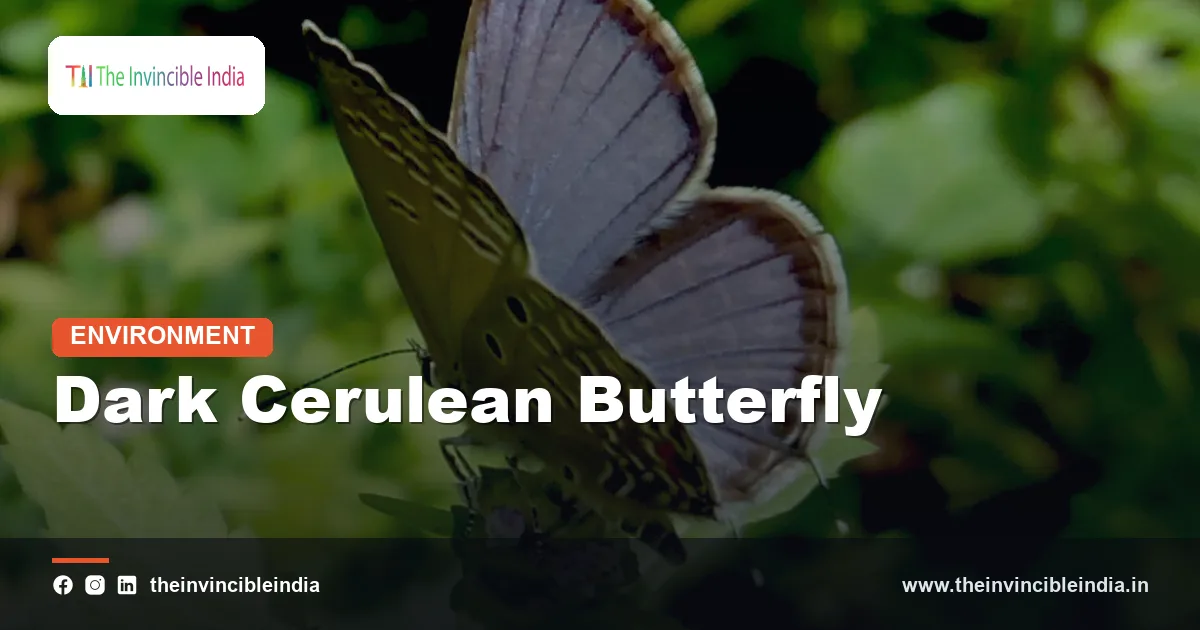
The dark cerulean (Jamides bochus) is a small, deep-blue butterfly of the family Lycaenidae that lives along forest edges, plantations and gardens across much of India and tropical Asia. The male shows a rich violet-blue upper surface, while both sexes have a finely patterned brown underside and a delicate hair-like tail on each hindwing.
The dark cerulean is easy to overlook because it flies fast and rarely sits with its wings open, yet it is one of the more frequently recorded blues in the Western Ghats, the northeast and the hill forests of the peninsula. This explainer covers how to identify the dark cerulean, where it lives, what its caterpillars and adults feed on, how its life cycle works and why this tiny insect matters.
Quick Facts
| Common name | Dark cerulean |
|---|---|
| Scientific name | Jamides bochus |
| Family | Lycaenidae (blues, coppers, hairstreaks), subfamily Polyommatinae |
| Wingspan | Roughly 3 to 4 cm; a small butterfly |
| Host plants | Flower buds and young shoots of several legumes (Fabaceae), including Pongamia and Derris, and some other woody plants |
| Range | Peninsular India, the Western Ghats, the northeast and the Himalayan foothills; also Sri Lanka and much of South-East Asia to Australasia |
| Habitat | Forest edges, plantations, scrub, wooded gardens and parks |
| Broods | Several broods a year in warm regions; breeding is continuous where conditions stay mild and flowers are available |
Key Takeaways
- The dark cerulean (Jamides bochus) is a small lycaenid butterfly with a wingspan of roughly 3 to 4 cm.
- Male dark ceruleans are deep violet-blue above, while females are paler blue with broader dark borders on the wings.
- The caterpillars of the dark cerulean feed on the flower buds and tender shoots of legumes and a few other plants.
- The dark cerulean occurs widely in India, from the Western Ghats and peninsular forests to the northeast and the Himalayan foothills.
- Adult dark ceruleans visit flowers for nectar and the males often gather at damp ground to take up salts and moisture.
- The dark cerulean is not endangered in India, but it depends on healthy forest edges, flowering plants and a pesticide-free landscape.
What is the dark cerulean butterfly?
The dark cerulean butterfly is a small blue lycaenid, scientifically named Jamides bochus, that is found across India and the wider Indo-Australian tropics. It belongs to the genus Jamides, a group commonly called ceruleans, which are known for their intense blue colour, fine tails and quick flight.
Lycaenidae is the second-largest butterfly family in the world and includes the blues, coppers, hairstreaks and harvesters. Most lycaenids are small, and many have thread-like tails on the hindwings and a dark spot near the tail, which together look like a false head. The dark cerulean follows this pattern closely.
The word “cerulean” refers to a deep sky-blue shade, and the English name “dark cerulean” was chosen to separate this species from the paler common cerulean (Jamides celeno) and the metallic cerulean (Jamides alecto), which share its habitats in many regions. Naturalists in India usually learn these species together because they look alike at a glance.
How can you identify a dark cerulean?
A dark cerulean can be identified by its deep violet-blue upper surface in the male, the brown underside crossed by fine pale lines, and a single slender tail on each hindwing. Because the butterfly usually perches with its wings closed, the underside pattern is often the feature a watcher sees first.
Upper surface
The male dark cerulean has a rich, slightly purplish blue upper surface with a narrow dark border along the wing edges. The female is paler, often a softer sky blue, with a wider dark margin on the forewing. The blue can seem to change shade as the butterfly turns in the light, because the colour comes partly from the fine structure of the wing scales and not only from pigment.
Underside
The underside of the dark cerulean is brown or greyish-brown, marked with narrow pale bands and wavy lines that run across both wings. Near the base of the hindwing there is a short row of small dark spots, and near the tail there is a black spot with a pale or bluish ring. This arrangement helps the butterfly confuse predators about which end is the head.
Tail and body
The hindwing carries a single fine tail, like a short hair, that the butterfly can move by shuffling its wings against each other. Together with the dark tail-end spot, the tail forms the false-head display that lycaenids use to draw a bird or lizard attack towards the wing edge instead of the body.
Where does the dark cerulean live in India?
The dark cerulean lives in wooded and semi-wooded country across India, with the strongest records from the Western Ghats, the evergreen and moist deciduous forests of the peninsula, the northeast and the foothills of the Himalaya. The species also extends to Sri Lanka, South-East Asia and parts of Australasia.
Within these regions the dark cerulean prefers forest edges, forest tracks, clearings, plantations and well-planted gardens. It is much less common in open, treeless farmland and in dry, thorny scrub, where its legume host plants are scarce and flowers are patchy.
The butterfly is generally more numerous during and after the monsoon, when new growth produces the flower buds on which the caterpillars depend. In regions with a cooler winter, such as the Himalayan foothills, adults become fewer between December and February, while in the humid south and the northeast they can be seen across most months.
What does the dark cerulean eat?
The caterpillars of the dark cerulean eat the flower buds, young flowers and tender shoots of legume plants and a few other woody species, while the adult butterflies drink nectar from small flowers. Adults also take moisture and minerals from damp soil, dung and the edges of streams.
Caterpillar food plants
Records from India and neighbouring regions list a range of food plants for the genus Jamides, with a strong preference for the Fabaceae family. Trees and climbers such as Pongamia and Derris are among the plants used, along with other legumes. Caterpillars usually feed inside or on the flower buds and soft young parts, which are rich in nutrients, rather than on mature leaves.
Adult food
Adult dark ceruleans sip nectar from low shrubs and herbs with small, shallow flowers, including common roadside and garden plants. Nectar supplies the sugars for flight, while salts and amino acids from mud-puddling help the males, in particular, to build reserves used in mating.
What is the life cycle of the dark cerulean?
The dark cerulean goes through complete metamorphosis in four stages: egg, caterpillar, pupa and adult butterfly. Under warm, humid conditions the whole cycle can be completed in roughly a month, although the exact time varies with temperature and food supply.
- Egg: The female lays tiny, flattened, pale eggs singly on flower buds or young shoots of a host plant, so that the newly hatched caterpillar has food immediately.
- Caterpillar: The larva is short, slightly flattened and woodlouse-shaped, often coloured to match the buds on which it feeds. It sheds its skin several times as it grows.
- Pupa: The caterpillar turns into a compact pupa, usually attached to the host plant or lying among plant litter. Inside, the body is rebuilt into the winged adult.
- Adult: The butterfly emerges, expands and dries its wings, feeds, mates and begins laying eggs. Adults live for a few weeks.
Because broods overlap in warm regions, several stages of the dark cerulean can be present on the same plant at one time. Numbers rise when flowering of the host plants peaks and fall when dry spells or cold reduce the supply of buds.
Do ants look after dark cerulean caterpillars?
Many lycaenid caterpillars, including several in the genus Jamides, are known to be attended by ants, which collect sweet secretions from a special gland on the caterpillar’s back. In return, the ants may drive off small predators and parasites, so the relationship is usually described as a mutual benefit.
Caterpillars in the family Lycaenidae often carry a honey gland, sometimes called Newcomer’s gland, along with tiny structures that appear to produce sounds or chemical signals. These tools help the caterpillar keep ants nearby. The strength of the relationship differs between species, and ant attendance has not been documented in detail for every Indian population of the dark cerulean.
The key point for gardeners and naturalists is that ants on a flowering legume branch are not necessarily a pest sign. They may be part of a small, finely balanced community, and spraying them away can also remove the butterfly’s caterpillars.
How does the dark cerulean behave and fly?
The dark cerulean has a quick, darting flight, usually at a low to medium height along forest edges, and it frequently settles on leaves or flowers with its wings closed. Males often patrol open sunny patches and visit damp ground in small groups.
Several features of the behaviour are useful to know:
- Mud-puddling: Males gather on wet sand, stream banks and animal droppings to take up water and salts.
- Wing rubbing: The butterfly often rubs its hindwings against each other, which moves the tails and the tail-end spot and may draw attacks away from the head.
- Sun-basking: Like other blues, it warms up in morning sunlight, and it is most active in the bright hours of the day.
- Resting: It tends to rest on the undersides of leaves or on twigs in shade during the hottest part of the day and in cloudy weather.
Because the dark cerulean seldom opens its wings while at rest, photographers are advised to wait quietly near flowering shrubs until the butterfly briefly flashes its blue upper surface on landing or take-off.
Which butterflies look similar to the dark cerulean?
Several small blue butterflies in India resemble the dark cerulean, especially the common cerulean, the metallic cerulean and the pea blue. They can be separated mainly by the underside pattern and the colour of the upper surface, so a careful look at the wing bands helps.
| Butterfly | Scientific name | Helpful pointers |
|---|---|---|
| Dark cerulean | Jamides bochus | Deep violet-blue male; brown underside with fine pale lines; one fine tail |
| Common cerulean | Jamides celeno | Paler blue; broader white-edged bands on the underside; also tailed |
| Metallic cerulean | Jamides alecto | Shiny, metallic-looking blue in the male; more clearly banded underside |
| Pea blue | Lampides boeticus | Often called the long-tailed blue; wavy underside lines and a prominent tail |
| Plains cupid | Chilades pandava | Tiny and tailless; lives near cycad plants in gardens and towns |
These pointers are only a guide, since wear, season and individual variation can blur the differences. Experienced observers often confirm an identification with a clear photograph of the underside, and local field guides and citizen-science platforms are helpful for checking records.
Why does the dark cerulean matter to the ecosystem?
The dark cerulean matters because it works as a small pollinator, a link in the food web and an indicator of the health of forest edges. Like other butterflies, it transfers pollen as it visits flowers, and its caterpillars and adults provide food for birds, lizards, spiders and predatory insects.
Butterflies react quickly to changes in vegetation, temperature and rainfall, so naturalists use them to track the state of a habitat. A steady presence of lycaenids such as the dark cerulean suggests that the mix of host plants, nectar flowers and sheltered resting places is intact. Falling numbers can be an early sign of loss of habitat, heavy pesticide use or the clearing of native shrubs.
The dark cerulean is not generally treated as an agricultural pest. Its caterpillars eat only a small number of buds on wild or planted trees, and the damage seldom matters economically.
How can you spot and protect the dark cerulean?
You can spot the dark cerulean by visiting a forest edge, a wooded park or a well-planted garden in the morning on a sunny day, and by watching low flowering shrubs and damp patches of ground. Protection mostly comes from keeping the habitat intact and avoiding harmful chemicals.
- Plant native nectar flowers and leave some native legume trees and climbers in place as caterpillar food.
- Avoid broad-spectrum insecticides in gardens, which kill caterpillars and adults alike.
- Keep a damp, shaded patch of soil or a shallow dish of wet sand for mud-puddling males.
- Observe without handling, since the scales on the wings are easily damaged.
- Record sightings on a citizen-science platform with a clear photograph, which helps researchers follow how butterfly ranges change.
Bottom Line
The dark cerulean is a small but striking blue butterfly that is widespread in Indian forests and gardens, valued as a pollinator and as an indicator of healthy habitat. It does not need special protection at present, but it does need flowers, host plants and an environment free of heavy pesticide use.
Frequently Asked Questions
What is the scientific name of the dark cerulean butterfly?
The scientific name of the dark cerulean butterfly is Jamides bochus. It belongs to the family Lycaenidae, the blues, and the genus Jamides, which includes the ceruleans. The species is widespread in India and across tropical Asia and Australasia.
How big is a dark cerulean butterfly?
A dark cerulean butterfly is small, with a wingspan of roughly 3 to 4 cm. The size is similar to that of other blues, which makes it easy to confuse with related ceruleans unless the underside pattern is checked.
What do dark cerulean caterpillars eat?
Dark cerulean caterpillars mainly eat flower buds, young flowers and tender shoots of legumes and a few other woody plants. The mother butterfly lays her eggs singly on these parts so that the newly hatched caterpillar has food at once.
Where is the dark cerulean found in India?
The dark cerulean is found in forest edges, plantations and wooded gardens across peninsular India, the Western Ghats, the northeast and the Himalayan foothills. It is less common in dry, treeless country where its host plants are scarce.
How can I tell a dark cerulean from a common cerulean?
A dark cerulean usually has a deeper violet-blue upper surface in the male and a finer, thinner pattern of pale lines on the brown underside. The common cerulean is paler blue with broader white-edged bands below. A clear photograph of the underside is the most reliable way to separate them.
Is the dark cerulean butterfly rare or protected?
The dark cerulean is not considered rare or endangered in India, as it is widespread and breeds on common plants. It still depends on healthy forest edges and flowering plants, so loss of habitat and heavy pesticide use are the main concerns.
{“@context”:”https://schema.org”,”@graph”:[{“@type”:”FAQPage”,”mainEntity”:[{“@type”:”Question”,”name”:”What is the scientific name of the dark cerulean butterfly?”,”acceptedAnswer”:{“@type”:”Answer”,”text”:”The scientific name of the dark cerulean butterfly is Jamides bochus. It belongs to the family Lycaenidae, the blues, and the genus Jamides, which includes the ceruleans. The species is widespread in India and across tropical Asia and Australasia.”}},{“@type”:”Question”,”name”:”How big is a dark cerulean butterfly?”,”acceptedAnswer”:{“@type”:”Answer”,”text”:”A dark cerulean butterfly is small, with a wingspan of roughly 3 to 4 cm. The size is similar to that of other blues, which makes it easy to confuse with related ceruleans unless the underside pattern is checked.”}},{“@type”:”Question”,”name”:”What do dark cerulean caterpillars eat?”,”acceptedAnswer”:{“@type”:”Answer”,”text”:”Dark cerulean caterpillars mainly eat flower buds, young flowers and tender shoots of legumes and a few other woody plants. The mother butterfly lays her eggs singly on these parts so that the newly hatched caterpillar has food at once.”}},{“@type”:”Question”,”name”:”Where is the dark cerulean found in India?”,”acceptedAnswer”:{“@type”:”Answer”,”text”:”The dark cerulean is found in forest edges, plantations and wooded gardens across peninsular India, the Western Ghats, the northeast and the Himalayan foothills. It is less common in dry, treeless country where its host plants are scarce.”}},{“@type”:”Question”,”name”:”How can I tell a dark cerulean from a common cerulean?”,”acceptedAnswer”:{“@type”:”Answer”,”text”:”A dark cerulean usually has a deeper violet-blue upper surface in the male and a finer, thinner pattern of pale lines on the brown underside. The common cerulean is paler blue with broader white-edged bands below. A clear photograph of the underside is the most reliable way to separate them.”}},{“@type”:”Question”,”name”:”Is the dark cerulean butterfly rare or protected?”,”acceptedAnswer”:{“@type”:”Answer”,”text”:”The dark cerulean is not considered rare or endangered in India, as it is widespread and breeds on common plants. It still depends on healthy forest edges and flowering plants, so loss of habitat and heavy pesticide use are the main concerns.”}}]}]}


