

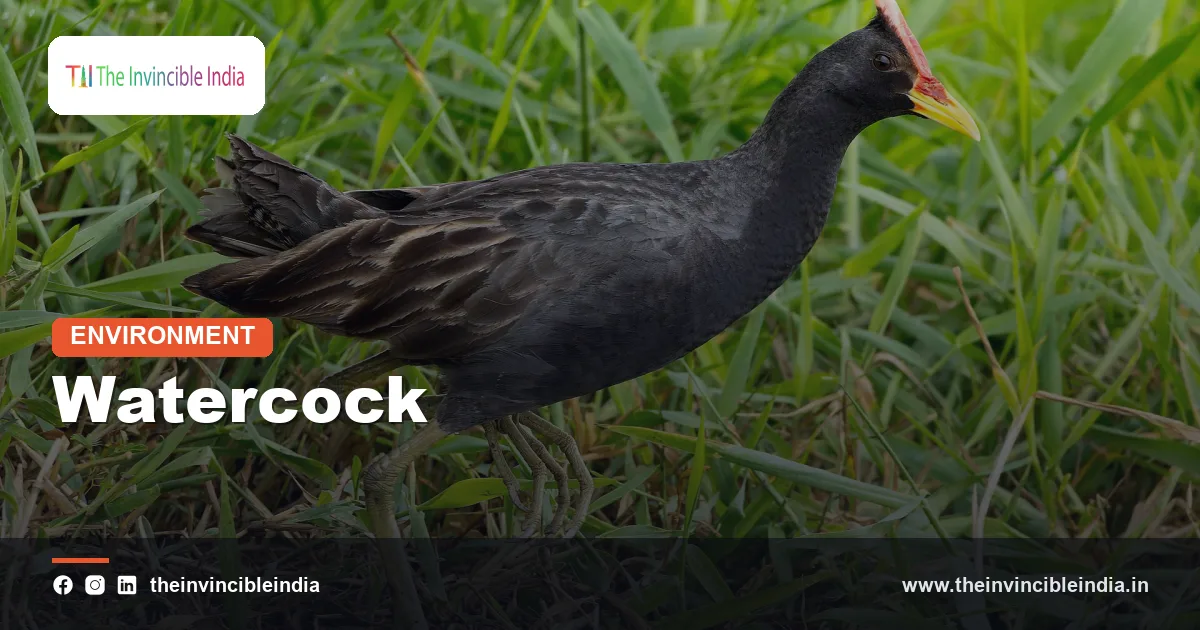
The watercock (Gallicrex cinerea) is a large, shy member of the rail family that lives in marshes, reed beds and flooded paddy fields across India and much of Asia, and the breeding male is easily recognised by its slaty-black plumage, red frontal shield and a small red horn on the forehead. Despite its size, the watercock is hard to see because it skulks in dense wet vegetation, and many people only know it from the deep, booming calls the male makes at night during the monsoon.
This article explains what the watercock is, how the male and female differ, where the watercock lives in India, what it eats, how it breeds and why its night-time call is so distinctive. It also looks at the conservation status of the species and at how paddy cultivation and wetland loss affect it.
| Common name | Watercock |
|---|---|
| Scientific name | Gallicrex cinerea (the only species in its genus) |
| Family | Rallidae (rails, crakes, gallinules and coots) |
| Size | About 40 to 43 cm; the male is noticeably larger than the female |
| Range in India | Widespread in suitable wetlands, mainly in the monsoon season, with local movements in other months |
| Habitat | Freshwater marshes, reed beds, flooded paddy fields, swampy grassland and densely vegetated pond edges |
| Diet | Omnivore: seeds, shoots, aquatic plants, insects, snails, worms and small aquatic animals |
| Breeding | Breeds mainly during the monsoon, building a nest of reeds and grasses just above the water |
| Conservation status | Least Concern on the IUCN Red List, though dependent on shallow wetlands |
Key Takeaways
- The watercock is a large rail of the species Gallicrex cinerea that lives in marshes and flooded paddy fields across India and Asia.
- A breeding male watercock is slaty-black with a red frontal shield, a small red horn above the bill and a yellow-tipped red bill.
- A female watercock and a non-breeding male are buffy-brown with dark mottling and look very different from the breeding male.
- The male watercock gives deep, repeated booming calls, often at night and in the rainy season, which are much easier to hear than the bird is to see.
- The watercock breeds mainly during the monsoon and builds a platform nest of reeds or grass in dense wet vegetation.
- The watercock is classified as Least Concern, but drainage of marshes and heavy agricultural change can reduce the habitat it depends on.
What is the watercock?
The watercock is a large, secretive bird of the rail family, Rallidae, that lives in freshwater marshes and flooded fields and walks on long toes across floating and low vegetation. It is the only member of its genus, Gallicrex, which means that no other living species is placed in the same group.
Rails are a family of mostly shy wetland birds with short wings, strong legs and a laterally narrow body that slips easily through dense reeds. Familiar relatives in India include the purple swamphen, the common moorhen, the Eurasian coot and a number of crakes. Compared with those species, the watercock is larger and heavier than a typical crake and a little more moorhen-like in shape, but it behaves like a true marsh skulker and rarely walks into the open.
The name “watercock” comes from the male’s rooster-like size and the red comb-like shield on its forehead. In Hindi and several other Indian languages the bird is called by names such as “kora”, and in rural areas it is more often heard than identified.
What does a watercock look like?
A breeding male watercock is a dark, slaty-grey to blackish bird with a bright red frontal shield, a short red horn above it and a red bill with a yellow tip, while the female and the non-breeding male are buffy-brown with darker streaking. This marked difference between the sexes and seasons is one of the main reasons the watercock is sometimes mistaken for different species.
Breeding male
The breeding male is almost uniformly dark slate-grey to black, with paler scaling on the back and a few pale feather edges. The bill is red at the base and yellow at the tip, and the forehead carries a bright red shield with a small raised horn. The legs are also red or reddish during the breeding season, and the male looks stout and slightly hunch-backed as it moves.
Female and non-breeding male
The female is smaller and sandy to buff-brown, with dark barring or streaking on the back and paler, mottled underparts. Outside the breeding season, males moult into a similar plumage, which is known as eclipse plumage, and lose the bright red shield and horn. In this state the watercock can be confused with female moorhens or other brownish rails if the observer does not notice the larger size and thick bill.
Size and build
A watercock measures about 40 to 43 centimetres, with the male clearly larger and heavier than the female. The long toes help to spread its weight across floating weed, and the tail is short and often flicked.
Where does the watercock live in India?
The watercock lives in freshwater marshes, reed beds, swampy grassland and flooded paddy fields across a large part of India, and it is most obvious in the monsoon months when the wetlands fill and the males start calling. It is widespread in parts of the plains, the eastern and north-eastern regions, the peninsula and the lower slopes of the hills, wherever suitable shallow water and dense cover occur.
The species is partly a local migrant. Movements within India follow the rains: birds appear in wetlands and paddy-growing areas when the monsoon begins and many move on or become secretive as water recedes. Elsewhere in Asia, the watercock ranges across South Asia, Southeast Asia and parts of East Asia, and some northern populations migrate south for the winter.
The habitats used by the watercock can be summarised as follows.
- Natural marshes and jheels: shallow freshwater wetlands with sedges, reeds and floating plants.
- Reed beds: tall dense stands along rivers, lakes and channels.
- Paddy fields: flooded rice fields, especially those with unharvested stems and surrounding vegetated bunds.
- Swampy grassland: wet meadows and low-lying grass with standing water.
- Pond and tank margins: edges thick with water hyacinth, lotus or similar cover.
What does the watercock eat?
The watercock is an omnivore that eats seeds, tender shoots, aquatic plants, insects, snails, worms and other small aquatic animals picked from mud, shallow water and floating vegetation. Because it feeds on both plant and animal matter, it can exploit paddy fields, marshes and weedy channels equally well.
The food it takes depends on the habitat and the season. In flooded fields it may feed on weed seeds, young shoots, grasshoppers and aquatic insect larvae. In marshes it hunts molluscs and invertebrates around the base of reeds. Feeding is mostly at dawn and dusk, when the bird steps out from cover to forage at the edge of vegetation, and it quickly retreats if disturbed.
The watercock is sometimes said to damage rice, but the evidence is limited, and by eating weeds and insects it may also bring some benefit to farmers. Like many rails, it is better described as a generalist feeder than as a crop pest.
Why does the watercock boom at night?
The male watercock booms at night mainly to advertise its territory and attract females during the breeding season, and the call is a deep, repeated sound that can carry a long distance across a marsh. Booming is most frequent in the rainy season, when the breeding males are at their most active.
Observers often describe the call as a series of low, resonant “ook” or “boom” notes, repeated in a steady rhythm, sometimes with a rising or accelerating pattern. A male may call for long periods from a hidden perch in reeds or low bushes, and neighbouring males often answer one another. Because the sound is so deep and the bird so well hidden, the booming of a watercock is easily taken for the call of a frog or even a distant animal by people who have never seen the species.
The behaviour also helps field workers. In places where the watercock is difficult to count visually, listening surveys at dusk and after dark during the monsoon can show where males are holding territory.
How does the watercock breed?
The watercock breeds mainly during the monsoon, when the male holds a territory in dense wet vegetation and the pair builds a platform nest of reeds and grass just above the water. Timing follows the rains because the flooded fields and marshes provide cover, food and nesting material at the same time.
The key points of its breeding biology are as follows.
- Season: chiefly the rainy months, from around June to September in much of India, with local variation.
- Nest: a platform or shallow pad of reeds, sedges and grasses, often built into standing vegetation or on a tussock and sometimes with a partial canopy of folded stems.
- Eggs: a clutch of several buff or pinkish eggs with reddish-brown spotting.
- Parental care: the female does most of the incubation, and the downy black chicks leave the nest soon after hatching, as in many rails.
Males are aggressive in the breeding season and may fight with rivals, which is one function of the red frontal shield and horn. Details such as exact clutch size and the degree to which the male takes part in chick care vary between reports, and the species is less thoroughly studied than larger and showier wetland birds.
How can you tell the watercock from similar birds?
The watercock can be told apart from similar marsh birds by its large size, the breeding male’s dark plumage with red shield and horn, and the female’s heavily mottled brown colour with a thick bill. It is easy to confuse with the common moorhen, the purple swamphen and some crakes at a glance, so a short comparison is helpful.
| Bird | Typical size | Key identification clues |
|---|---|---|
| Watercock (breeding male) | About 40 to 43 cm | Slaty-black body, red shield with small horn, red bill with yellow tip, deep booming call |
| Watercock (female) | Slightly smaller | Buff-brown with dark streaks, stout bill, shy and secretive |
| Common moorhen | About 32 to 35 cm | Slate body with white flank stripe, white undertail patches, red shield and yellow-tipped bill, often swims in open water |
| Purple swamphen | About 45 to 50 cm | Heavy purple-blue body, large red bill and shield, thick red legs, usually in the open |
| Ruddy-breasted crake | About 20 to 23 cm | Much smaller, rufous underparts, red legs, active at the edge of paddy and marsh |
The decisive clues are the small raised horn on the forehead of the breeding male, the lack of a white flank stripe and the bird’s habit of hiding in thick cover instead of swimming in open water.
Is the watercock threatened?
The watercock is not considered globally threatened, as it is listed as Least Concern on the IUCN Red List, but it is vulnerable to local declines wherever marshes are drained, polluted or built over. Its wide range and use of paddy fields have so far helped it to keep large populations.
The main pressures it faces include the following.
- Drainage and conversion of marshes and swamps for farming, housing or industry.
- Pollution of freshwater wetlands by chemicals and untreated waste.
- Changes in rice farming, including shifts to dry cultivation or heavy pesticide use.
- Invasive aquatic plants that choke open water and alter marsh structure.
- Hunting and trapping in some regions, although this is not well documented for India.
Conserving seasonal wetlands, retaining vegetated bunds in rice-growing landscapes and protecting village ponds are all useful steps. The watercock is a good example of a bird that links natural wetlands with working agricultural land.
How can you watch or hear a watercock?
The best way to find a watercock is to visit a well-vegetated marsh or paddy area in the monsoon, stay still at dusk and listen for the male’s deep booming call. Seeing the bird is harder, because it usually stays within thick vegetation and only steps into view for brief moments.
Some practical tips follow.
- Visit during the rains, when the males are calling and holding territory.
- Arrive before sunset and stay until dark, listening carefully.
- Scan the edges of reed beds and paddy bunds with binoculars at first and last light.
- Avoid walking into the marsh, which flushes birds and may trample nests.
- Do not use recorded calls repeatedly, as this can distract breeding males.
Bottom Line
The watercock is a large, shy marsh rail whose breeding male is unmistakable in dark plumage with a red shield and horn, and whose booming call is a sound of the Indian monsoon night. Although it is not currently threatened, its fate remains tied to shallow freshwater wetlands and traditionally managed paddy landscapes.
Frequently Asked Questions
What is a watercock?
The watercock is a large rail, Gallicrex cinerea, that lives in marshes, reed beds and flooded paddy fields in India and other parts of Asia. The breeding male is dark with a red frontal shield and a small horn, while the female is brown and mottled.
Why is the bird called a watercock?
The bird is called a watercock because the male is large for a marsh bird and carries a red comb-like shield and horn on its forehead, which resembles a rooster’s comb. It lives in water and wet vegetation.
What does the watercock sound like?
The male watercock gives deep, repeated booming notes, often at night in the breeding season. The call carries a long way over marshes, and many people hear it without ever seeing the bird that makes it.
Where can the watercock be seen in India?
The watercock can be found in freshwater marshes, reed beds and flooded paddy fields in many parts of India, especially during the monsoon. It is secretive, so listening at dusk is usually more productive than scanning for it in the open.
What does the watercock eat?
The watercock is an omnivore. It eats seeds, shoots and aquatic plants as well as insects, snails, worms and other small invertebrates, which it finds in mud, shallow water and floating vegetation.
Is the watercock endangered?
No, the watercock is listed as Least Concern by the IUCN because it is widespread and uses paddy fields as well as natural wetlands. Even so, drainage and pollution of marshes can reduce local numbers.
{“@context”:”https://schema.org”,”@graph”:[{“@type”:”FAQPage”,”mainEntity”:[{“@type”:”Question”,”name”:”What is a watercock?”,”acceptedAnswer”:{“@type”:”Answer”,”text”:”The watercock is a large rail, Gallicrex cinerea, that lives in marshes, reed beds and flooded paddy fields in India and other parts of Asia. The breeding male is dark with a red frontal shield and a small horn, while the female is brown and mottled.”}},{“@type”:”Question”,”name”:”Why is the bird called a watercock?”,”acceptedAnswer”:{“@type”:”Answer”,”text”:”The bird is called a watercock because the male is large for a marsh bird and carries a red comb-like shield and horn on its forehead, which resembles a rooster’s comb. It lives in water and wet vegetation.”}},{“@type”:”Question”,”name”:”What does the watercock sound like?”,”acceptedAnswer”:{“@type”:”Answer”,”text”:”The male watercock gives deep, repeated booming notes, often at night in the breeding season. The call carries a long way over marshes, and many people hear it without ever seeing the bird that makes it.”}},{“@type”:”Question”,”name”:”Where can the watercock be seen in India?”,”acceptedAnswer”:{“@type”:”Answer”,”text”:”The watercock can be found in freshwater marshes, reed beds and flooded paddy fields in many parts of India, especially during the monsoon. It is secretive, so listening at dusk is usually more productive than scanning for it in the open.”}},{“@type”:”Question”,”name”:”What does the watercock eat?”,”acceptedAnswer”:{“@type”:”Answer”,”text”:”The watercock is an omnivore. It eats seeds, shoots and aquatic plants as well as insects, snails, worms and other small invertebrates, which it finds in mud, shallow water and floating vegetation.”}},{“@type”:”Question”,”name”:”Is the watercock endangered?”,”acceptedAnswer”:{“@type”:”Answer”,”text”:”No, the watercock is listed as Least Concern by the IUCN because it is widespread and uses paddy fields as well as natural wetlands. Even so, drainage and pollution of marshes can reduce local numbers.”}}]}]}


