

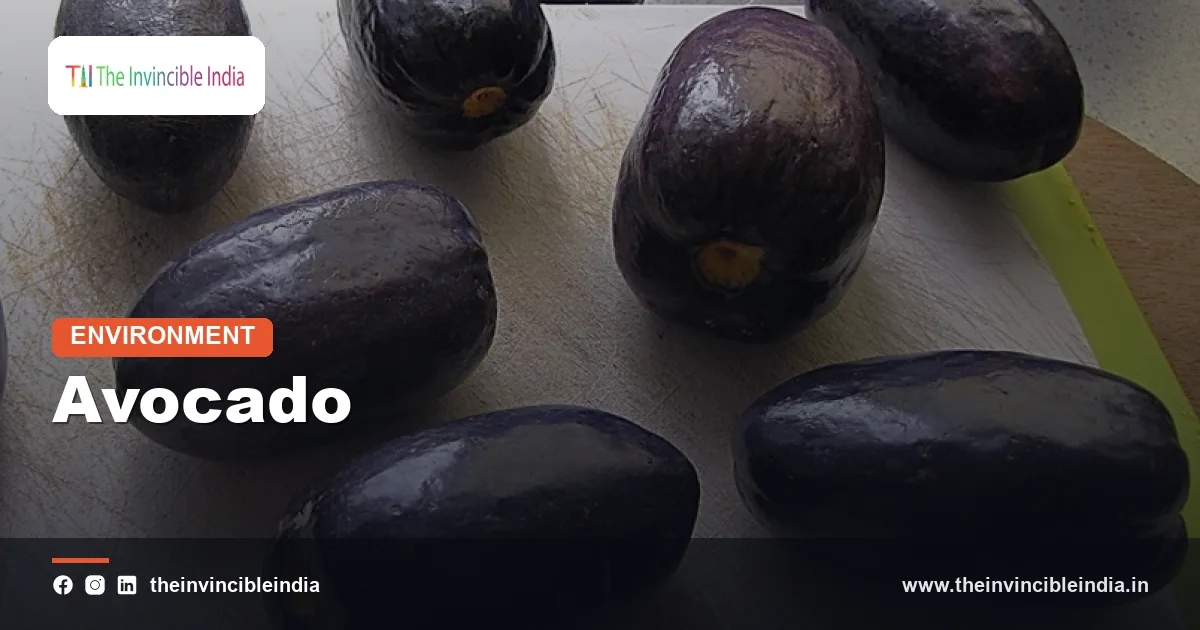
The avocado (Persea americana), known in many Indian markets as butter fruit, is a large, evergreen, subtropical tree that bears a single-seeded fruit with creamy, oil-rich green flesh. Native to the highlands of Mexico and Central America, the avocado reached India during the colonial period and is now grown mainly in the cool, humid hill districts of the south and in parts of the northeast.
Unlike most fruit sold in India, the avocado is eaten for its fat rather than its sugar, which is why its texture is often compared to butter. This article explains what the avocado tree is, where it grows in India, how the fruit ripens, what it contains and how it is used in kitchens.
| Quick Facts | Details |
|---|---|
| Common names | Avocado, butter fruit (English and Indian trade use); alligator pear in older texts |
| Scientific name | Persea americana |
| Family | Lauraceae (the laurel family, which also includes cinnamon and bay leaf) |
| Origin | Highlands of Mexico and Central America |
| Where grown in India | Nilgiris, Coorg (Kodagu), Wayanad, Idukki, the Palani and Kodaikanal hills, and parts of Sikkim and the northeast |
| Season | Flowering in the cool months of late winter; fruit harvested mostly in the monsoon and post-monsoon months, varying with cultivar and altitude |
| Part used | Fruit pulp; the seed and leaves are not eaten as food |
| Key nutrition | Monounsaturated fat, dietary fibre, potassium, folate, vitamins K and E |
| Main uses | Table fruit, salads, toasts, guacamole, shakes and desserts |
Key Takeaways
- The avocado is the fruit of Persea americana, an evergreen tree of the laurel family that is native to Mexico and Central America.
- In India the avocado is called butter fruit and is grown mainly in the cool hill districts of the Western Ghats, the Nilgiris and the northeast.
- An avocado fruit does not ripen on the tree; it softens only after it is picked, which is why growers harvest it while it is still hard.
- Most of the calories in an avocado come from monounsaturated fat, mainly oleic acid, and not from sugar or starch.
- Avocado trees are frost-sensitive and cannot tolerate waterlogged soil, so they succeed only on well-drained slopes with mild temperatures.
- Avocado flowers open in two distinct patterns, called type A and type B, and growers often plant both types together to improve fruit set.
What is an avocado?
An avocado is a fleshy, pear-shaped to round fruit produced by the evergreen tree Persea americana, and botanically it is a single-seeded berry. The skin may be green, dark purple or nearly black when ripe, while the flesh inside is pale green to yellow and the large round seed sits at the centre.
The avocado tree belongs to the family Lauraceae, so it is a distant relative of cinnamon, camphor, bay leaf and the native Indian tree tejpat. The tree can reach 15 to 20 metres in the wild, though orchard trees are pruned to a manageable height. Its leaves are glossy, leathery and oval, and they stay on the tree through the year, with old leaves dropping mostly around flowering.
The fruit is unusual in the fruit basket because of its composition. Most of the fruit’s energy comes from fat, and the sweetness is very low. This is the reason the avocado is used in savoury dishes, spreads and salads more often than as a sweet dessert fruit, although in Kerala, Karnataka and Sri Lanka it is also blended with milk and sugar.
Why is the avocado called butter fruit in India?
The avocado is called butter fruit in India because its ripe flesh is soft, smooth, pale and rich in oil, so it spreads like butter on bread. The name is common in the southern states and in fruit markets of the hill regions, and the same idea appears in the older English name “butter pear”.
The English word avocado is itself a borrowing. It comes from the Spanish word aguacate, which in turn came from ahuacatl in the Nahuatl language of central Mexico. Many Indian languages use either avocado or a local version of butter fruit, and in Kerala and Tamil Nadu the fruit is often sold under a name that translates literally as butter fruit.
For most of the twentieth century the avocado stayed a regional curiosity in India, planted in a few estates and home gardens. Interest in the fruit rose in urban markets as cafes and home cooks adopted avocado toast, salads and smoothies, and orchard planting in suitable hill districts has grown to meet that demand.
How did the avocado reach India and where does it grow?
The avocado reached India during the colonial era, and it is generally believed to have come through the botanical and plantation networks that connected the Americas with Sri Lanka and southern India. Today the avocado grows best in the hills of the Western Ghats and the Nilgiris, where mild temperatures and well-distributed rainfall suit the tree.
The main avocado-growing areas of India include the following regions.
- The Nilgiris of Tamil Nadu, including areas around Coonoor and Kotagiri.
- The Palani and Kodaikanal hills of Tamil Nadu, where avocado trees are grown at moderate elevations.
- Kodagu (Coorg) and the nearby hill districts of Karnataka, where avocado is often intercropped in coffee estates.
- Wayanad and Idukki in Kerala, where the tree is planted both in orchards and as a shade tree around homes.
- Pockets of Sikkim, Mizoram, Meghalaya and other northeastern hill states with a suitable climate.
Production in India is small compared with major producing countries such as Mexico, and national figures change from year to year. Much of the fruit is eaten locally or sold through urban retail chains, and a part of the supply in cities has traditionally been imported.
What are the types and varieties of avocado?
Avocado varieties are grouped into three horticultural races, the Mexican, the Guatemalan and the West Indian, and most commercial cultivars are either one of these or a hybrid between them. Each race differs in its tolerance of cold, the thickness of its skin and the oil content of its flesh.
| Race | Typical features | Climate preference |
|---|---|---|
| Mexican | Small fruit, thin and smooth skin, high oil content, anise-scented leaves | Most cold-tolerant of the three races |
| Guatemalan | Medium to large fruit, thick, pebbled skin, good keeping quality | Moderately cool subtropical climates |
| West Indian | Large, smooth, glossy fruit with lower oil content | Warm and humid lowlands, least cold-tolerant |
The Hass cultivar, which has a dark, pebbled skin when ripe, became the dominant type in world trade after it was selected in California in the 1920s from a seedling raised by Rudolph Hass. In India many trees are still seedlings of mixed parentage, so fruit size, skin colour and flavour can vary widely from one tree to the next. Named cultivars such as Fuerte, Pollock, Hass and Purple have been planted at research stations and in commercial orchards, and grafted plants are now preferred because they fruit earlier and give uniform quality.
What climate and soil does the avocado tree need?
The avocado tree needs a mild, frost-free subtropical climate and a deep, loose, well-drained soil, because its roots are shallow and easily damaged by standing water. In India these conditions are met on sloping land at roughly 600 to 1,500 metres above sea level, though the exact range depends on the cultivar and the latitude.
Temperature and rainfall
Avocado trees grow best between about 15 and 28 degrees Celsius. Cold snaps and frost damage young shoots and flowers, while extreme heat and dry winds cause flowers and small fruit to drop. Annual rainfall of 1,000 to 1,500 millimetres, well spread across the year, suits the tree, and dry spells are managed with irrigation.
Soil and drainage
The avocado is highly sensitive to waterlogging. Poor drainage encourages a soil fungus-like organism, Phytophthora cinnamomi, which causes root rot and is the most serious disease of the crop worldwide. Growers therefore plant on slopes or raised mounds, add organic matter and avoid heavy clay soils. A slightly acidic to neutral soil pH is preferred.
Planting and care
Grafted saplings are typically planted at wide spacing, since mature trees spread broadly. The tree usually starts bearing fruit three to five years after planting and reaches full yield in later years. Mulching, regular pruning and balanced nutrition help maintain the canopy, and windbreaks protect the brittle branches in exposed hill sites.
How does the avocado flower and set fruit?
The avocado flowers in a distinctive two-stage pattern, and the tree sets fruit more reliably when trees of two flowering types grow close together. Each small, greenish-yellow flower opens twice, once in a female phase and once in a male phase, and the two phases occur at different times of the day.
Cultivars are divided into two groups according to this timing. In type A cultivars, the flower opens as a female in the morning and closes, then reopens as a male the next afternoon. In type B cultivars, the flower opens as a female in the afternoon and as a male the next morning. When both types are planted nearby, pollen from one type is available when the other is receptive, and bees and other insects carry it across.
The avocado tree produces an enormous number of flowers, but only a tiny fraction becomes mature fruit. Heavy flowering is followed by a large natural drop of small fruit, and the final crop depends on pollinator activity, weather during flowering and the health of the tree. Cold, rainy or very dry weather at flowering reduces the harvest sharply.
When is the avocado harvested, and how does it ripen?
The avocado is harvested while it is still hard and mature, and it ripens only after it is picked, because the fruit does not soften while it hangs on the tree. In India, harvesting generally takes place in the monsoon and post-monsoon months, with the exact timing depending on the cultivar and the elevation of the orchard.
Growers judge maturity by the colour and shine of the skin, the size of the fruit and sometimes by the dry matter or oil content measured in a sample. A fruit picked too early shrivels and never ripens properly, while a fruit left on the tree can be held for weeks beyond maturity, which is a useful feature for staggering sales.
Ripening at home
Once picked, an avocado ripens in several days at room temperature. The process is driven by ethylene, a natural plant gas released by the fruit itself, so placing avocados in a paper bag alongside a banana or an apple can speed ripening. Ripe fruit yields to gentle pressure at the stalk end and should be eaten soon or kept in the refrigerator for a short time. Cut flesh browns quickly on exposure to air, and a squeeze of lime juice slows the discolouration.
What is inside an avocado: nutrition and health facts?
An avocado is a nutrient-dense fruit whose flesh is rich in monounsaturated fat, dietary fibre, potassium and several vitamins. The dominant fat is oleic acid, the same type of fatty acid that is the main component of olive oil, and the fruit contains very little sugar.
- Fats: a high proportion of monounsaturated fat, with small amounts of saturated and polyunsaturated fat.
- Fibre: a good amount of dietary fibre, both soluble and insoluble, in each fruit.
- Minerals: notable potassium, along with magnesium.
- Vitamins: folate, vitamin K, vitamin E and vitamin C, along with some B vitamins.
- Plant compounds: carotenoids such as lutein, which are better absorbed when eaten with fat, as in the avocado itself.
Because the avocado is energy-dense, portion size matters, and a typical serving is about one-third to one-half of a medium fruit. Nutrition values vary by cultivar, size and ripeness, so figures on packaging or in food tables should be treated as approximate. People with a latex allergy may also react to avocado, a recognised cross-reaction known as latex-fruit syndrome, and anyone with a medical condition should seek professional advice on diet.
How is the avocado eaten and used in Indian kitchens?
The avocado is eaten raw in India, most often mashed or sliced, and it is used in both savoury and sweet preparations. Because heat makes avocado flesh bitter and mushy, it is usually added at the end of cooking or served cold.
- Spread on bread or toast with salt, pepper and lime.
- Mashed into guacamole with onion, tomato, green chilli and coriander.
- Sliced into salads, sandwiches, wraps and rice bowls.
- Blended with milk and sugar or honey into a thick shake, a style popular in Kerala, Karnataka and Sri Lanka.
- Used as a creamy base in chilled soups, raitas and dips.
The avocado seed and leaves are not eaten as food. The tree also yields avocado oil, pressed from the pulp, which has a high smoke point and is used in cooking and cosmetics. Home gardeners often sprout the seed in a glass of water as a houseplant, but a seedling grown this way usually takes many years to fruit and does not carry the quality of the parent tree.
Is the avocado tree harmful to pets or animals?
Parts of the avocado tree contain persin, a natural fungicidal compound that is toxic to some animals, so the leaves, bark, skin and seed should be kept away from pets and livestock. Birds, horses, goats and some other animals are considered particularly sensitive, whereas the ripe flesh is eaten safely by humans.
Dogs and cats are generally less sensitive than birds, but the large seed can still cause choking or a blockage of the gut if swallowed, and the high fat content of the flesh can upset the stomach. Pet owners are advised to avoid feeding avocado and to consult a veterinarian if an animal has eaten the seed or leaves. Gardeners who keep poultry or grazing animals should plant avocado trees where the animals cannot reach the fallen leaves and fruit.
Bottom Line
The avocado is a creamy, fat-rich fruit from a subtropical laurel-family tree, and in India it is grown mainly in the cool Western Ghats and northeastern hills. Understanding that the fruit ripens only after harvest, that the tree dislikes frost and waterlogging, and that its flavour comes from oil rather than sugar explains most of what is distinctive about the crop.
Frequently Asked Questions
Is butter fruit the same as avocado?
Yes, butter fruit is the common Indian name for the avocado. The fruit earned the name because its soft, rich flesh spreads smoothly like butter. Both names refer to the fruit of the tree Persea americana.
Where is the avocado grown in India?
The avocado is grown mainly in the cool hill districts of southern India, including the Nilgiris, the Palani and Kodaikanal hills, Kodagu, Wayanad and Idukki. Smaller plantings exist in Sikkim and other northeastern hill states. The tree needs a mild, frost-free climate and well-drained soil.
Why is my avocado hard even after many days?
An avocado stays hard until it has been picked and has had time to ripen, because the fruit softens only off the tree. Ripening usually takes several days at room temperature, and it is faster if the fruit is kept in a paper bag with a banana. A fruit that was harvested too early may shrivel without ever softening properly.
Can I grow an avocado tree from a seed?
Yes, an avocado seed will sprout into a tree, but the tree is unlikely to produce fruit of the same quality as the parent. Seedling trees can take many years to bear and may never fruit well. Grafted saplings from a nursery are the reliable way to get named cultivars and earlier harvests.
Is the avocado a fruit or a vegetable?
The avocado is a fruit, and botanically it is a single-seeded berry. It is used like a vegetable in many dishes because it has very little sugar and a rich, buttery taste. This culinary use does not change its classification.
Is the avocado healthy to eat every day?
An avocado can be part of a healthy diet because it provides unsaturated fat, fibre, potassium and vitamins. It is also high in calories, so portion size matters, and a serving of about one-third to one-half of a medium fruit is common. People with a latex allergy or a medical condition should check with a doctor or dietitian.
{“@context”:”https://schema.org”,”@graph”:[{“@type”:”FAQPage”,”mainEntity”:[{“@type”:”Question”,”name”:”Is butter fruit the same as avocado?”,”acceptedAnswer”:{“@type”:”Answer”,”text”:”Yes, butter fruit is the common Indian name for the avocado. The fruit earned the name because its soft, rich flesh spreads smoothly like butter. Both names refer to the fruit of the tree Persea americana.”}},{“@type”:”Question”,”name”:”Where is the avocado grown in India?”,”acceptedAnswer”:{“@type”:”Answer”,”text”:”The avocado is grown mainly in the cool hill districts of southern India, including the Nilgiris, the Palani and Kodaikanal hills, Kodagu, Wayanad and Idukki. Smaller plantings exist in Sikkim and other northeastern hill states. The tree needs a mild, frost-free climate and well-drained soil.”}},{“@type”:”Question”,”name”:”Why is my avocado hard even after many days?”,”acceptedAnswer”:{“@type”:”Answer”,”text”:”An avocado stays hard until it has been picked and has had time to ripen, because the fruit softens only off the tree. Ripening usually takes several days at room temperature, and it is faster if the fruit is kept in a paper bag with a banana. A fruit that was harvested too early may shrivel without ever softening properly.”}},{“@type”:”Question”,”name”:”Can I grow an avocado tree from a seed?”,”acceptedAnswer”:{“@type”:”Answer”,”text”:”Yes, an avocado seed will sprout into a tree, but the tree is unlikely to produce fruit of the same quality as the parent. Seedling trees can take many years to bear and may never fruit well. Grafted saplings from a nursery are the reliable way to get named cultivars and earlier harvests.”}},{“@type”:”Question”,”name”:”Is the avocado a fruit or a vegetable?”,”acceptedAnswer”:{“@type”:”Answer”,”text”:”The avocado is a fruit, and botanically it is a single-seeded berry. It is used like a vegetable in many dishes because it has very little sugar and a rich, buttery taste. This culinary use does not change its classification.”}},{“@type”:”Question”,”name”:”Is the avocado healthy to eat every day?”,”acceptedAnswer”:{“@type”:”Answer”,”text”:”An avocado can be part of a healthy diet because it provides unsaturated fat, fibre, potassium and vitamins. It is also high in calories, so portion size matters, and a serving of about one-third to one-half of a medium fruit is common. People with a latex allergy or a medical condition should check with a doctor or dietitian.”}}]}]}


