

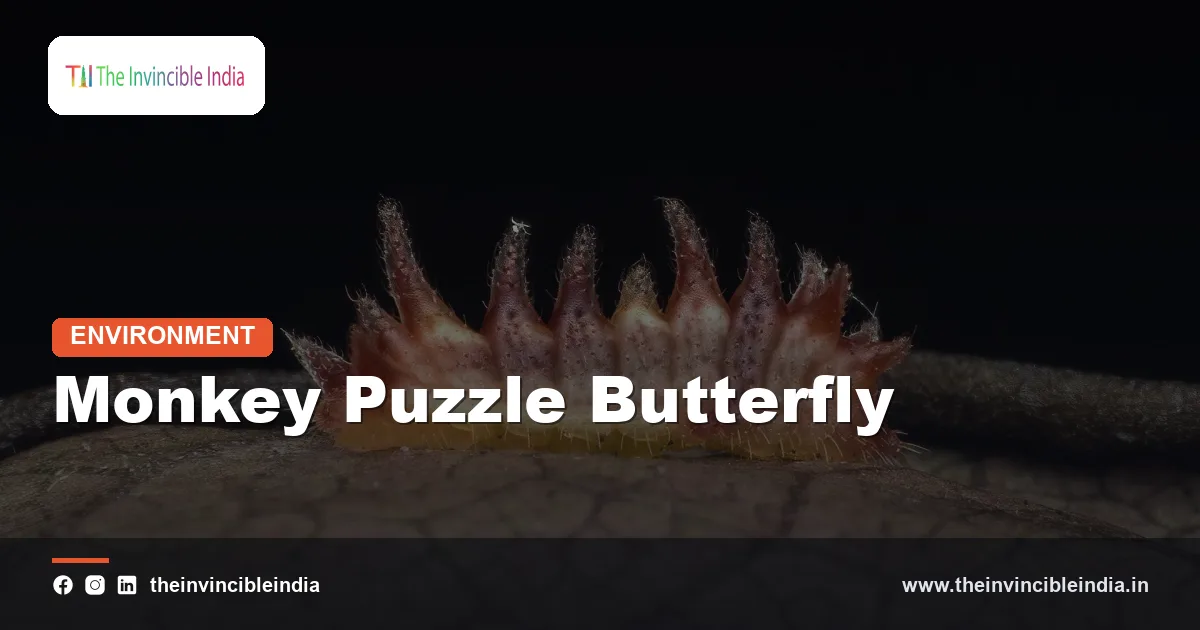
The monkey puzzle is a small white-and-black lycaenid butterfly, Rathinda amor, of Indian forests and wooded gardens, named for the maze of dark lines on its underwings and for the way it moves its tiny hindwing tails to confuse predators. It is a shade-loving species that flutters low among bushes and often settles with its wings closed, which shows the intricate pattern that gives the butterfly its common name.
Few Indian butterflies illustrate the idea of a false head so clearly. This article explains what the monkey puzzle butterfly is, how to recognise it, where it lives, what it eats, how its life cycle runs and why it is a good example of lycaenid survival tricks.
Quick Facts
| Common name | Monkey puzzle (butterfly) |
|---|---|
| Scientific name | Rathinda amor (the only species in the genus Rathinda) |
| Family | Lycaenidae (blues, hairstreaks and allies), subfamily Theclinae |
| Wingspan | Roughly 3 to 4 cm; a small butterfly |
| Host plants | Larval food plants are only partly documented; caterpillars are reported on several forest trees and shrubs |
| Range | Peninsular India and the Western Ghats, the Himalayan foothills and northeast, Sri Lanka and parts of Southeast Asia |
| Habitat | Moist and dry deciduous forest, forest edges, shaded gardens and scrub |
| Broods | Several overlapping generations a year, with more adults in the monsoon and soon after |
Key Takeaways
- The monkey puzzle (Rathinda amor) is a small lycaenid butterfly found in India, Sri Lanka and parts of Southeast Asia.
- The monkey puzzle takes its name from the maze-like pattern of fine black and brown lines on the white underside of its wings.
- Rathinda is a single-species genus, which means the monkey puzzle has no close relatives of the same genus.
- The monkey puzzle butterfly has two thread-like tails on each hindwing that, together with a spot and lines, create a false head to mislead predators.
- Monkey puzzle caterpillars belong to a family whose larvae are often attended by ants, a relationship that gives the larvae protection in return for sugary secretions.
- The butterfly is considered common and widespread in suitable forest habitat, but it depends on shaded vegetation that clearing and fragmentation can reduce.
What is the monkey puzzle butterfly?
The monkey puzzle butterfly is a small member of the family Lycaenidae, the group that also includes the blues, coppers and hairstreaks, and its scientific name is Rathinda amor. It is placed in the subfamily Theclinae, the hairstreaks, and is the only species in its genus.
The lycaenids are the second-largest butterfly family by number of species and include roughly a third of all known butterflies. Most are small, delicate and brightly or finely patterned, and many have short tails on the hindwings. The monkey puzzle follows the same pattern, but it stands out because of the very busy underside design that appears when the butterfly sits at rest.
The common name is a playful one. It likens the complicated line pattern on the wings to a puzzle that is difficult to follow with the eye, and some observers have also linked it to the monkey puzzle tree, a conifer with tangled, spiky branches, although the two have no biological connection.
How do you identify a monkey puzzle butterfly?
A monkey puzzle butterfly is identified by its white underside covered with narrow, wavy brown or black lines and by the two tails and a prominent orange-capped black spot at the rear of each hindwing. Seen from above, the wings are mostly dark brown with a bluish or greyish sheen in good light, but the butterfly rarely opens its wings while at rest.
Several features help to separate it from other small lycaenids:
- Underside pattern: pale background marked with a network of fine, interlocking lines, more complex than in most similar species.
- Tails: a long, slender tail and a shorter one near the end of each hindwing.
- Anal spot: a black spot with orange or red edging near the base of the tails.
- Size and flight: a very small body and a quick but low and fluttering flight among shrubs.
Males and females look similar to the casual observer, though females may show slightly broader wings and paler tones on the upper side. Close-up photographs help to confirm the identity because many tailed hairstreaks resemble one another at a distance.
Where is the monkey puzzle butterfly found in India?
The monkey puzzle butterfly is found across peninsular India, the Western Ghats, the Himalayan foothills and the northeastern states, as well as in Sri Lanka and parts of Southeast Asia. It lives mainly below the middle altitudes of the hills and is most often seen in humid, wooded areas.
Its typical habitats include moist deciduous forest, evergreen forest edges, shaded roadside vegetation, plantations with tree cover and well-vegetated gardens. In southern India it is commonly noted in the Western Ghats and in scrub forest near the coast. In the north it occurs in the foothills and the terai region, and in the northeast it appears in lowland forests.
The butterfly prefers shaded understorey and rarely ventures into open, sunny spaces for long. A walk along a forest path, a stream bank or the edge of a wooded park at mid-morning gives a good chance of seeing one perched on a leaf at about knee to shoulder height.
What does the monkey puzzle butterfly eat?
The adult monkey puzzle butterfly feeds on flower nectar and occasionally on moist, mineral-rich spots, while its caterpillars feed on the leaves or buds of forest trees and shrubs. As with many lycaenids, the adult has a short, coiled proboscis suited to taking small amounts of nectar from tiny flowers.
Adults visit small blossoms of shrubs and weeds near the forest floor, and like many butterflies they may sip from damp soil or animal droppings to gain salts. Because they fly in shade, they are often found where flowering shrubs grow along forest margins.
The larval host plants of the monkey puzzle are less thoroughly documented than those of many showy Indian butterflies. Records from different parts of its range mention several kinds of woody plants, and observers continue to add information. For this reason the species is of interest to citizen scientists who photograph females laying eggs and note the plants they choose.
How does the false head of the monkey puzzle work?
The false head works by making the back of the hindwing look like the front of the butterfly, so a bird or lizard may strike at the tails and spot rather than at the real head. The tails resemble antennae, the dark spot resembles an eye and the converging lines point towards the rear, so the insect appears to face the opposite direction.
Many lycaenids add movement to this illusion. The monkey puzzle often rubs its hind wings against each other in a slow alternating motion, which makes the tails wave like antennae. A predator that snatches at the moving tails is likely to tear away a small piece of wing, and the butterfly can fly off with minor damage. Butterflies found with symmetrical notches in their hindwings are often evidence of such attacks.
This trick is called deflection. It is one of several defences seen in Indian butterflies, and the table below compares it with others.
| Defence | How it works | Example |
|---|---|---|
| False head (deflection) | Draws attacks to the wing edge away from vital parts | Monkey puzzle and other tailed lycaenids |
| Camouflage | Wing underside resembles a dead leaf | Blue oakleaf |
| Warning colours | Bright colour advertises toxicity | Common crow, Plain tiger |
| Mimicry | Edible species imitate a toxic one | Common mime |
What is the life cycle of the monkey puzzle butterfly?
The life cycle of the monkey puzzle butterfly has four stages, egg, caterpillar, pupa and adult, and the whole sequence may take a few weeks in warm weather. Like all butterflies, it undergoes complete metamorphosis, which means each stage looks very different from the next.
- Egg: the female lays tiny, flattened eggs singly on the tender parts of the host plant.
- Caterpillar: the larva has a short, slug-like shape typical of lycaenids, which helps it to hide and to be handled by ants.
- Pupa: the chrysalis is small and compact and attached to a leaf, stem or a sheltered surface.
- Adult: the butterfly emerges, expands its wings and begins feeding and mating within a day or so.
Because the tropics lack a strong winter break in many forest areas, the monkey puzzle does not have a single fixed breeding season. Generations overlap, and adults can be seen in most months, with greater numbers during and just after the monsoon when new leaves and flowers are abundant.
Why do ants matter to monkey puzzle caterpillars?
Ants matter because the caterpillars of many lycaenids, which probably includes the monkey puzzle, are guarded by ants in exchange for sweet liquid secretions. The larvae often have a honey gland on the back and small organs that release chemical signals which calm or attract ants.
Ant attendance helps to protect the soft, slow caterpillar from parasitic wasps and other predators. The relationship, which biologists call myrmecophily, ranges from mild association to dependency, and in a few lycaenids it becomes parasitic, with larvae living inside ant nests. For most species, including those in the hairstreak group, the ants are simply bodyguards that collect a reward.
How closely the monkey puzzle depends on ants in different parts of India is still being documented, and amateur field notes on caterpillars with ants are welcome contributions to butterfly databases.
Is the monkey puzzle butterfly rare or threatened?
No, the monkey puzzle butterfly is not regarded as a rare species and is generally described as common in suitable forest and wooded habitats across much of its range. Collecting or trading wild butterflies is restricted under India’s Wildlife (Protection) Act, 1972, and collecting inside protected areas such as national parks is banned.
The butterfly does depend on shaded woodland, so large-scale clearing of forest, conversion of woodland to open farmland and heavy use of pesticides can reduce its numbers locally. Because it is small and often overlooked, trends in its population are poorly measured.
Anyone who wants to help can plant native flowering shrubs, leave leaf litter and undergrowth in wooded gardens, avoid pesticides and report sightings to community platforms such as India Biodiversity Portal or eButterfly, where records strengthen knowledge of range and season.
How can you watch and photograph the monkey puzzle?
The best way to watch a monkey puzzle butterfly is to walk slowly along shaded forest paths or wooded garden edges in the morning, scan leaves at knee to head height and approach perched butterflies gently from the side. The butterfly often returns to the same leaf after a short flight, so patience pays.
A macro lens or a phone with a close-up mode is enough to record the underwing pattern. Photographers should shoot the underside, where the maze of lines is visible, and include the hindwing tails and spot. A second shot showing the host plant or the surrounding habitat adds useful information. Avoid touching the wings, which are covered in tiny scales that rub off easily.
How does the monkey puzzle behave in the wild?
The monkey puzzle behaves as a quiet, low-flying forest-edge butterfly that spends much of the day perched on leaves and flying in short, jerky flights between them. It seldom basks with open wings, so most sightings show the white underside and the slowly moving hindwings.
Males often claim a perch on a leaf in a patch of dappled light and make brief sorties to chase intruders or look for females. Females are more secretive and spend time near the plants where they lay eggs. On overcast days the butterfly may be almost still, which makes it easier to photograph but harder to spot in the first place.
Because the species lives under tree cover, it is sensitive to the loss of shade. Gardens and plantations that keep native trees, shrubs and leaf litter can hold small populations even close to towns.
Bottom Line
The monkey puzzle is a tiny forest butterfly with a big idea: a maze-patterned underside and a convincing false head. It is common but easy to miss, and slow, careful observation of shaded woodland reveals it.
Frequently Asked Questions
What is the monkey puzzle butterfly?
The monkey puzzle butterfly is a small lycaenid, Rathinda amor, found in the forests and wooded gardens of India, Sri Lanka and parts of Southeast Asia. It is named for the maze of lines on its white underside and has tiny tails that act as a false head.
Why is it called the monkey puzzle?
It is called the monkey puzzle because the dense network of black and brown lines on its underwings looks like a puzzle that is hard to follow. The name is descriptive and has no biological link with the monkey puzzle tree, which is an unrelated conifer.
How big is a monkey puzzle butterfly?
A monkey puzzle butterfly is small, with a wingspan of roughly 3 to 4 centimetres. Its size and tendency to keep its wings closed mean it is easy to overlook against leaves and forest shadows.
Where can I see a monkey puzzle butterfly in India?
You can see a monkey puzzle butterfly in shaded forests, forest edges and wooded gardens in peninsular India, the Western Ghats, the Himalayan foothills and the northeast. Morning walks along damp, shady paths give the best chance.
What does the false head of a monkey puzzle do?
The false head diverts predator attacks away from the real head and body. The hindwing tails look like antennae, the dark spot looks like an eye, and the butterfly rubs its hind wings to make the tails move, so a bird or lizard may strike a harmless wing edge instead.
Is the monkey puzzle butterfly protected?
The monkey puzzle butterfly is not regarded as a threatened species, but it benefits from general protection in reserves and national parks, where collecting wildlife is banned. Its long-term survival depends on keeping shaded forest and wooded habitat, and on avoiding pesticides.
{“@context”:”https://schema.org”,”@graph”:[{“@type”:”FAQPage”,”mainEntity”:[{“@type”:”Question”,”name”:”What is the monkey puzzle butterfly?”,”acceptedAnswer”:{“@type”:”Answer”,”text”:”The monkey puzzle butterfly is a small lycaenid, Rathinda amor, found in the forests and wooded gardens of India, Sri Lanka and parts of Southeast Asia. It is named for the maze of lines on its white underside and has tiny tails that act as a false head.”}},{“@type”:”Question”,”name”:”Why is it called the monkey puzzle?”,”acceptedAnswer”:{“@type”:”Answer”,”text”:”It is called the monkey puzzle because the dense network of black and brown lines on its underwings looks like a puzzle that is hard to follow. The name is descriptive and has no biological link with the monkey puzzle tree, which is an unrelated conifer.”}},{“@type”:”Question”,”name”:”How big is a monkey puzzle butterfly?”,”acceptedAnswer”:{“@type”:”Answer”,”text”:”A monkey puzzle butterfly is small, with a wingspan of roughly 3 to 4 centimetres. Its size and tendency to keep its wings closed mean it is easy to overlook against leaves and forest shadows.”}},{“@type”:”Question”,”name”:”Where can I see a monkey puzzle butterfly in India?”,”acceptedAnswer”:{“@type”:”Answer”,”text”:”You can see a monkey puzzle butterfly in shaded forests, forest edges and wooded gardens in peninsular India, the Western Ghats, the Himalayan foothills and the northeast. Morning walks along damp, shady paths give the best chance.”}},{“@type”:”Question”,”name”:”What does the false head of a monkey puzzle do?”,”acceptedAnswer”:{“@type”:”Answer”,”text”:”The false head diverts predator attacks away from the real head and body. The hindwing tails look like antennae, the dark spot looks like an eye, and the butterfly rubs its hind wings to make the tails move, so a bird or lizard may strike a harmless wing edge instead.”}},{“@type”:”Question”,”name”:”Is the monkey puzzle butterfly protected?”,”acceptedAnswer”:{“@type”:”Answer”,”text”:”The monkey puzzle butterfly is not regarded as a threatened species, but it benefits from general protection in reserves and national parks, where collecting wildlife is banned. Its long-term survival depends on keeping shaded forest and wooded habitat, and on avoiding pesticides.”}}]}]}


