

The pale grass blue (Pseudozizeeria maha) is a tiny pale-blue butterfly of the family Lycaenidae that flutters low over lawns, road verges, fallow fields and other grassy ground across India. It is one of the commonest of the small blues, and most people who have walked across a damp garden lawn have seen it without noticing it, because the butterfly is smaller than a one-rupee coin and rarely rises above knee height.
The pale grass blue is also one of the easiest wild butterflies to study, since its caterpillars feed on a familiar weed, creeping wood sorrel, that grows almost everywhere in the country. This article explains how to recognise the species, what it eats, where and when it flies, how it differs from its look-alikes, and why such an ordinary insect is worth a second look.
| Common name | Pale grass blue |
|---|---|
| Scientific name | Pseudozizeeria maha (Kollar, 1844); formerly placed in the genus Zizeeria |
| Family and subfamily | Lycaenidae (blues and coppers), subfamily Polyommatinae |
| Wingspan | About 20 to 30 mm, among the smallest butterflies of the Indian plains |
| Larval host plants | Chiefly creeping wood sorrel (Oxalis corniculata) and related Oxalis species |
| Range and habitat in India | Widespread across the plains and lower hills; lawns, gardens, wasteland, roadsides, paddy bunds and damp grassy clearings |
| Flight season and broods | Flies for most of the year, with several overlapping generations; most numerous in and after the monsoon |
| Notable features | Pale violet-blue male with a dark border; browner female; underside grey-brown with small dark spots ringed in white |
Key Takeaways
- The pale grass blue (Pseudozizeeria maha) is a small lycaenid butterfly with a wingspan of roughly 20 to 30 mm, found across most of India.
- Caterpillars of the pale grass blue feed mainly on creeping wood sorrel (Oxalis corniculata), a common lawn and garden weed.
- Male pale grass blues are pale violet-blue above with a broad dark margin, while females are darker brown with a dusting of blue near the wing bases.
- The pale grass blue flies low over short grass and basks with its wings open in sunshine, but closes them quickly when clouds pass or when disturbed.
- The species breeds in several overlapping generations a year and is seen in almost every month in warm parts of India, most abundantly during and after the rains.
- The pale grass blue is easily confused with the dark grass blue (Zizeeria karsandra), the lesser grass blue (Zizina otis) and the tiny grass blue (Zizula hylax), but differs in shade, size and spot pattern.
What is the pale grass blue butterfly?
The pale grass blue is a small day-flying butterfly in the family Lycaenidae, the large group that also contains the blues, coppers, hairstreaks and royals. The species was described by the Austrian entomologist Vincenz Kollar in 1844 as Pseudozizeeria maha, and it ranges well beyond India, through Sri Lanka and Southeast Asia towards East Asia.
In India the pale grass blue belongs to a small cluster of “grass blues”, butterflies whose names refer to the grassy places where they live rather than to any grass they eat. Field guides group them together because they share a compact body, short rounded wings and a habit of keeping close to the ground. Among these, the pale grass blue is the one with the lightest and most delicate colouring.
The scientific name has changed over time. Older books call the butterfly Zizeeria maha, and some Indian field guides still use that name. The common name “pale grass blue” has stayed the same, which is why it is the more reliable label for everyday use.
How can you identify a pale grass blue?
A pale grass blue can be identified by its very small size, its pale violet-blue upper wings in the male, and the grey-brown underside covered with tiny black spots edged in white. Because the butterfly usually perches with its wings closed, the underside pattern is what most observers actually see.
Upper side
The male has a soft, pale violet-blue upper surface with a clear dark band running along the outer edge of each wing. The shade is lighter and slightly greyer than that of most other grass blues. The female is browner overall, with the blue confined to a dusting near the base of the wings, and her dark border is broader.
Under side
The underside is pale grey-brown to greyish-fawn. A series of small, black, white-ringed spots crosses both wings, with a short row near the base of the forewing and a curved row further out. The spots are smaller and less bold than those of the dark grass blue, which gives the whole underside a cleaner, paler look.
Behaviour as a clue
The pale grass blue has a weak, bobbing, close-to-the-ground flight and settles often on flowers, damp soil and blades of grass. In bright sunshine it may bask with its wings half open or fully open, which is the best moment to see the blue of the male. When clouds cover the sun, it closes its wings at once.
Which plants do pale grass blue caterpillars eat?
Pale grass blue caterpillars feed mainly on creeping wood sorrel (Oxalis corniculata), a low, clover-like weed with yellow flowers that is common in lawns, flower beds, pots and damp waste ground. The caterpillars are also recorded on related Oxalis species, which is why the butterfly follows these plants wherever they grow.
The female lays her tiny eggs singly on the young leaves, buds or tender stems of the plant. The eggs are pale, flattened and finely sculptured, and they are hard to see without a hand lens. Each caterpillar eats the soft leaf tissue and grows quickly in warm weather.
Adult butterflies do not depend on Oxalis. They sip nectar from small, low-growing flowers, including many common weeds, and the males also settle on damp ground to drink minerals. For gardeners, the practical lesson is simple: a patch of wood sorrel left alone in a corner of the lawn is often enough to keep a local colony going.
How does the pale grass blue grow from egg to adult?
The pale grass blue completes a full metamorphosis in four stages: egg, caterpillar, pupa and adult. In warm weather the whole cycle can be finished in a few weeks, which allows several generations in a single year.
- Egg: A single small, flattened egg is laid on the host plant and hatches within a few days.
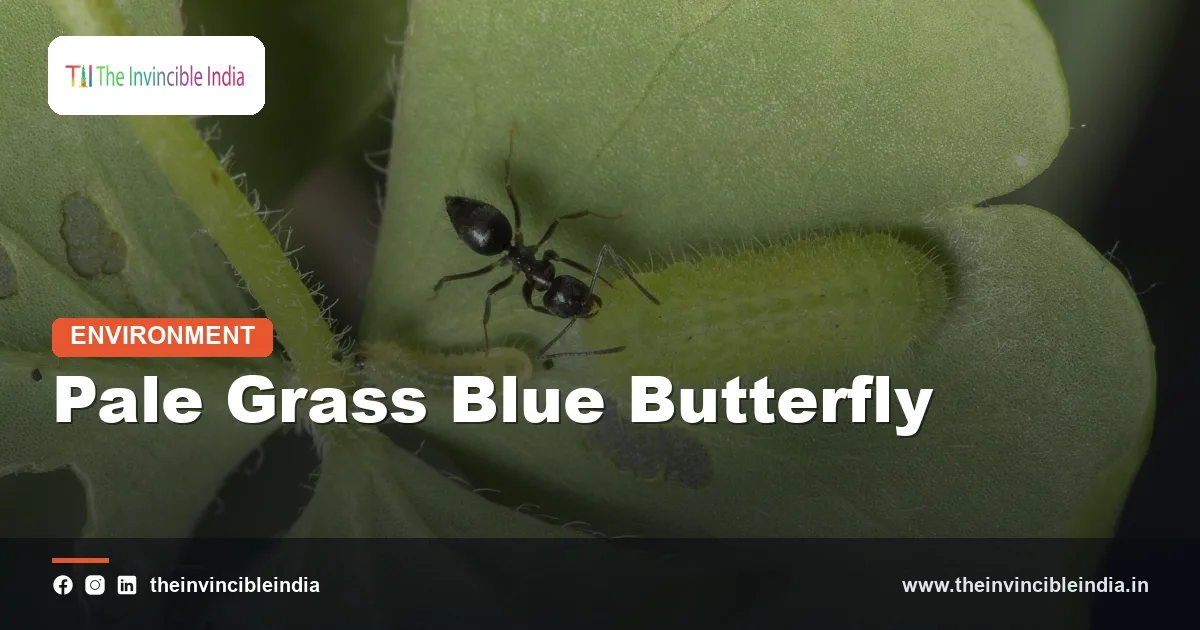
- Caterpillar: The larva is green, slug-shaped and covered with fine short hairs, which helps it blend into the Oxalis leaves. It moults several times as it grows.
- Pupa: The caterpillar changes into a compact, pale pupa attached to a leaf, stem or nearby debris. Like many lycaenids, it is small and inconspicuous.
- Adult: The butterfly emerges, dries its wings and begins feeding and mating within hours or a day.
Many lycaenid caterpillars are known to be visited by ants, which gather sugary secretions from special glands. Whether a particular colony of pale grass blues attracts ants depends on the place and the season, so it is best treated as something to look for rather than an assured sight.
Where in India is the pale grass blue found?
The pale grass blue is found across most of India, from the plains to the lower hills, wherever short grass, weeds and open ground occur together. It is a butterfly of disturbed, human-modified land rather than deep forest, and it does well in cities and villages.
Typical places to find the species include:
- Lawns and garden edges, especially where the grass is kept short and damp
- Roadsides, railway embankments and canal banks
- Paddy bunds, fallow fields and the margins of cultivated land
- Open clearings within scrub and light woodland
- School grounds, parks and temple compounds
Beyond India, the species occurs in Sri Lanka, Bangladesh, Nepal, Myanmar and much of Southeast Asia, and a related population extends into East Asia. Its wide distribution reflects how well it copes with ordinary farmland and urban green spaces.
When is the best time to see the pale grass blue?
The best time to see the pale grass blue is during and just after the monsoon, when Oxalis grows thickly and the butterflies are most numerous, though the species can be seen in almost every month in the warmer parts of India. Numbers fall in cold winters in the north and in very hot, dry spells, when host plants wither.
Within a day, the butterflies are most active in the morning and late morning, when the grass has dried but the sun is not yet harsh. A short walk over a lawn will often make small blue shapes lift from the grass and settle again a few metres away. Watching quietly, without chasing, is the best method; a pale grass blue will usually return to the same patch.
How is the pale grass blue different from other grass blues?
The pale grass blue differs from other grass blues mainly in its lighter colouring, its cleaner underside with small spots, and its slightly different habitat. Four small blues are often mixed up on Indian lawns, and the table below summarises the usual distinguishing features.
| Butterfly | Scientific name | Size | Distinguishing features |
|---|---|---|---|
| Pale grass blue | Pseudozizeeria maha | About 20-30 mm | Pale violet-blue male; pale grey-brown underside with small, neat spots |
| Dark grass blue | Zizeeria karsandra | About 20-30 mm | Darker upper side; underside greyer with bolder spots |
| Lesser grass blue | Zizina otis | About 20-28 mm | Brighter blue male; underside with fewer spots and no basal spots on the hindwing |
| Tiny grass blue | Zizula hylax | About 15-22 mm | Even smaller; brownish upper side in the female; fine black-and-white banding on the underside |
Even experts sometimes need a close photograph to separate the pale and dark grass blues, since the two overlap in range and habitat. Looking at the shade of the underside, the size of the spots and the ground colour usually settles the question.
How can you watch pale grass blues at home?
The simplest way to watch pale grass blues at home is to sit or crouch beside a damp patch of lawn or garden bed in the morning and look for tiny blue-grey shapes moving between the grass blades. A lawn that has been left slightly untidy, with wood sorrel and small flowering weeds, attracts far more butterflies than one trimmed bare.
A few habits help beginners:
- Move slowly and avoid casting a shadow over the butterfly, which will otherwise close its wings and fly off.
- Look at the wood sorrel leaves for tiny green caterpillars and pale, flattened eggs, using a magnifying glass if you have one.
- Photograph the underside of a perched butterfly, because the spot pattern is the best guide to species.
- Keep notes on the date and weather to see how numbers change with the seasons.
Over a few weeks, a single patch of lawn can show every stage of the life cycle, from egg to adult, which makes the pale grass blue an excellent subject for school projects and for family nature walks.
Why does the pale grass blue matter?
The pale grass blue matters because it is a reliable indicator of healthy, unsprayed green spaces and because it serves as a food source and a pollinator in small habitats that larger butterflies avoid. A thriving colony in a garden or school ground shows that the soil, weeds and low flowers are supporting a full life cycle.
The butterfly also has value as a teaching subject. Because it lives in public places and its host plant is familiar, children and beginners can follow the whole life cycle in a single patch of lawn. Naturalist groups across India often use common small blues as the first step in learning to identify butterflies.
Small lycaenids also serve as food for spiders, lizards, mantises and birds. Removing every weed from a lawn, or spraying it with herbicides and insecticides, can quietly eliminate this link in the local food chain.
What threats does the pale grass blue face, and how can people help?
The pale grass blue is not regarded as a threatened species in India, because it breeds on common weeds and tolerates disturbed land. The main local pressures are heavy use of weedkillers, constant mowing and paving over of open ground.
People can help in simple ways:
- Leave a small patch of wood sorrel and other low weeds unmown in a corner of the lawn.
- Avoid broad-spectrum herbicides and insecticides on lawns and garden edges.
- Plant small-flowered, low-growing nectar plants beside open grass.
- Keep a patch of bare, damp soil or a shallow, pebbled water dish for mineral-seeking males.
- Record sightings in a citizen-science platform so that long-term data on common species are collected.
Bottom Line
The pale grass blue is a tiny, pale, ground-hugging lycaenid whose caterpillars eat a common garden weed. It is easy to overlook, easy to confuse with other grass blues, and easy to support, which makes it an ideal first butterfly for beginners in India.
Frequently Asked Questions
What is the scientific name of the pale grass blue?
The scientific name of the pale grass blue is Pseudozizeeria maha, described by Vincenz Kollar in 1844. Older books place the species in the genus Zizeeria, so it may also appear as Zizeeria maha. It belongs to the family Lycaenidae.
How big is a pale grass blue butterfly?
A pale grass blue has a wingspan of roughly 20 to 30 mm, which makes it one of the smallest butterflies seen on Indian lawns. The female is generally similar in size to the male. Because of its size and low flight, it is often mistaken for a small moth or overlooked altogether.
What do pale grass blue caterpillars eat?
Pale grass blue caterpillars eat mainly creeping wood sorrel (Oxalis corniculata) and related Oxalis species. The female lays eggs singly on the young leaves and buds. This common weed explains why the butterfly is so widespread in lawns and gardens.
Is the pale grass blue found all over India?
The pale grass blue is found across most of India, from the plains to the lower hills, wherever short grass, weeds and open ground occur. It is most often seen in lawns, roadsides, fallow fields and paddy margins. It is less common in dense forest and in very high mountains.
How can I tell a pale grass blue from a dark grass blue?
The pale grass blue is lighter in colour, with a paler grey-brown underside and smaller spots, while the dark grass blue (Zizeeria karsandra) is darker with bolder underside markings. The two overlap in range and habitat. A clear close-up photograph of the underside is the most reliable way to separate them.
Is the pale grass blue an endangered butterfly?
The pale grass blue is not considered endangered in India, because it is common and breeds on widespread weeds. Local populations can still decline where lawns are heavily sprayed, constantly mown or paved over. Leaving a small patch of wood sorrel unmown helps to sustain it.
{“@context”:”https://schema.org”,”@graph”:[{“@type”:”FAQPage”,”mainEntity”:[{“@type”:”Question”,”name”:”What is the scientific name of the pale grass blue?”,”acceptedAnswer”:{“@type”:”Answer”,”text”:”The scientific name of the pale grass blue is Pseudozizeeria maha, described by Vincenz Kollar in 1844. Older books place the species in the genus Zizeeria, so it may also appear as Zizeeria maha. It belongs to the family Lycaenidae.”}},{“@type”:”Question”,”name”:”How big is a pale grass blue butterfly?”,”acceptedAnswer”:{“@type”:”Answer”,”text”:”A pale grass blue has a wingspan of roughly 20 to 30 mm, which makes it one of the smallest butterflies seen on Indian lawns. The female is generally similar in size to the male. Because of its size and low flight, it is often mistaken for a small moth or overlooked altogether.”}},{“@type”:”Question”,”name”:”What do pale grass blue caterpillars eat?”,”acceptedAnswer”:{“@type”:”Answer”,”text”:”Pale grass blue caterpillars eat mainly creeping wood sorrel (Oxalis corniculata) and related Oxalis species. The female lays eggs singly on the young leaves and buds. This common weed explains why the butterfly is so widespread in lawns and gardens.”}},{“@type”:”Question”,”name”:”Is the pale grass blue found all over India?”,”acceptedAnswer”:{“@type”:”Answer”,”text”:”The pale grass blue is found across most of India, from the plains to the lower hills, wherever short grass, weeds and open ground occur. It is most often seen in lawns, roadsides, fallow fields and paddy margins. It is less common in dense forest and in very high mountains.”}},{“@type”:”Question”,”name”:”How can I tell a pale grass blue from a dark grass blue?”,”acceptedAnswer”:{“@type”:”Answer”,”text”:”The pale grass blue is lighter in colour, with a paler grey-brown underside and smaller spots, while the dark grass blue (Zizeeria karsandra) is darker with bolder underside markings. The two overlap in range and habitat. A clear close-up photograph of the underside is the most reliable way to separate them.”}},{“@type”:”Question”,”name”:”Is the pale grass blue an endangered butterfly?”,”acceptedAnswer”:{“@type”:”Answer”,”text”:”The pale grass blue is not considered endangered in India, because it is common and breeds on widespread weeds. Local populations can still decline where lawns are heavily sprayed, constantly mown or paved over. Leaving a small patch of wood sorrel unmown helps to sustain it.”}}]}]}


