

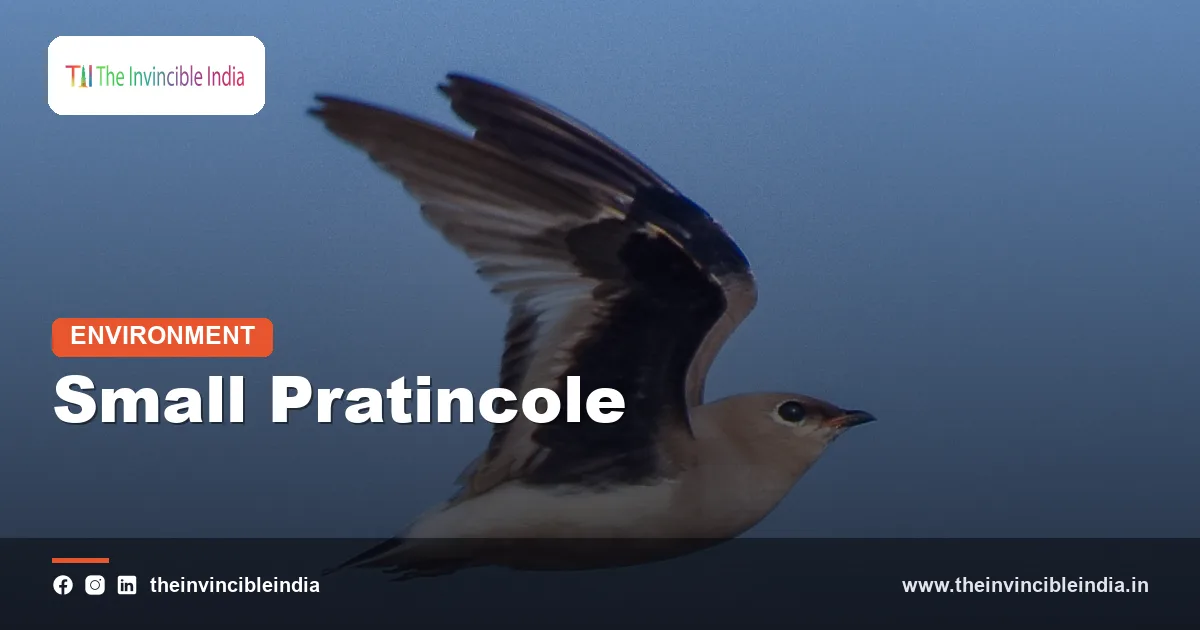
The small pratincole (Glareola lactea) is a swift-like, sandy-grey waterbird of the Indian subcontinent that lives along large rivers, hunts flying insects over open water and nests in colonies on bare sandbars. Despite being a wader by family, it behaves more like a swallow or a tern, spending much of its time in the air with fast, twisting flight.
The small pratincole is one of the most distinctive birds of Indian riverbanks, especially on the great northern rivers, where flocks gather at dusk to feed over the water. This article explains what the bird is, how to recognise it, where it lives, what it eats, how it nests on open sand and why river-bar habitat is so important to its survival.
| Quick Facts | Small Pratincole |
|---|---|
| Common name | Small pratincole, also called little pratincole or small Indian pratincole |
| Scientific name | Glareola lactea |
| Family | Glareolidae (pratincoles and coursers), order Charadriiformes |
| Size | About 17 cm long, with long pointed wings and a shallowly forked tail |
| Range and habitat in India | Large rivers with sandbars and shingle banks, also lakes, reservoirs and coasts; found across much of the Indian subcontinent |
| Diet | Flying insects caught on the wing, mostly at dawn and dusk |
| Breeding | Colonial; lays two or three eggs in a shallow scrape on bare sand, mostly in the dry season before the monsoon floods |
| Migration | Largely resident with local movements that follow river levels and the monsoon |
| Conservation status | Least Concern on the IUCN Red List |
Key Takeaways
- The small pratincole is a sandy-grey bird in the family Glareolidae that catches insects in flight and is often compared to a swallow or a swift.
- Small pratincoles nest in colonies on bare river sandbars, laying eggs directly on the sand without building a proper nest.
- The small pratincole has a white band across its dark wings, a black underwing in flight and a short tail with a shallow fork.
- Small pratincoles feed mostly at dawn and dusk, hawking insects above rivers, lakes and wetlands.
- Riverbed sand and shingle bars are the key breeding habitat of the small pratincole, so dams, sand mining and altered river flow can reduce nesting success.
- The IUCN Red List classifies the small pratincole as a species of Least Concern because of its wide range across South and Southeast Asia.
What is the small pratincole?
The small pratincole is a medium-small, long-winged bird in the family Glareolidae, which also contains the other pratincoles and the coursers. Its scientific name is Glareola lactea, and the species lives in South Asia and parts of mainland Southeast Asia.
Pratincoles are an unusual group. They belong to the order Charadriiformes, which includes plovers, sandpipers, gulls and terns, yet they hunt like swallows. Their short bills open to a very wide gape, which lets them snap up insects in the air. Their legs are short but they can run on the ground, and they are often seen standing or resting on sandbars between hunting flights.
The English word pratincole comes from Latin roots meaning meadow dweller, a name given to a related species in Europe. The small pratincole, by contrast, is more closely tied to water and sand than to meadows. In the Indian context it is a river bird, and a flock circling over a sandbar at sunset is among the most characteristic sights of north Indian rivers.
The species is the smallest of the pratincoles. Its soft sandy-grey and brown plumage helps it blend with sand, and the pale colour of the body explains the second half of the scientific name, since the Latin word lacteus means milky.
How do you identify a small pratincole?
A small pratincole is identified by its pale sandy-grey body, black-tipped wings with a white band, black underwing, short shallowly forked tail and white rump. In flight it looks like a long-winged tern or a large swallow, with agile, darting movements.
On the ground
Perched birds look compact and rather plain. The upperparts are pale grey-brown, the throat is whitish, and the breast is a soft sandy tone. A thin dark line runs from the bill to the eye, and the legs are short and dark. The bill is short, black and slightly curved, with a reddish base in some birds. When they stand on sandbars they blend so well that a resting flock can be missed until it takes off.
In flight
Flight is where the species shows its best features. The wings are long, narrow and pointed. The flight feathers are dark, with a pale patch or band on the inner wing. The underwing is dark and contrasts with the pale body. The rump and tail base are white, and the tail has only a shallow fork, shorter than that of other pratincoles. The flight is buoyant and erratic, with sudden turns and glides, like that of a swallow or a nightjar.
Voice
Small pratincoles call frequently in flight, giving sharp, high, tern-like notes that carry across water. Colonies are noisy, and the calls alert birds to danger.
Key identification points include the following.
- Pale sandy-grey body, smaller than a mynah.
- Dark wings with a white band and a dark underwing.
- White rump and a shallowly forked tail.
- Rapid, tern-like or swallow-like flight over water and sandbars.
- Gregarious habit, with flocks of a few birds to many dozens.
Where is the small pratincole found in India?
The small pratincole is found across much of India, mostly along large rivers, and also around lakes, reservoirs and some coastal areas. It is widespread in the Indian subcontinent and ranges beyond into Pakistan, Nepal, Bangladesh, Sri Lanka and parts of Myanmar and Southeast Asia.
The bird is most strongly associated with broad, braided rivers that have wide sandbars. The Ganga, Yamuna, Chambal, Brahmaputra, Indus system and other large rivers provide ideal habitat. Birdwatchers on the Chambal river, for example, often find pratincoles together with skimmers, terns and lapwings on the same sandbars. The species also occurs along peninsular rivers, though it is generally less abundant where sandbars are small or flow is controlled.
Numbers and local distribution change with the season. During and after the monsoon, when rivers are in spate and sandbars are submerged, birds move to lakes, reservoirs, flooded fields and estuaries. As the water falls in the cooler months, they return to the exposed banks.
Because it feeds on the wing, the small pratincole is often seen at wetlands far from its nesting sandbars, as it covers wide areas in search of insects. This mobility is one reason the species appears in so many checklists across the country.
What habitat does the small pratincole need?
The small pratincole needs open, sandy or shingle riverbanks for nesting and open water or wetland for feeding. It avoids dense vegetation and is rarely found far from water.
A good sandbar for pratincoles is flat, bare, dry and surrounded by flowing water. The surrounding water gives some protection from ground predators such as jackals and dogs, and the open view lets the birds watch for danger. The sand colour matches the plumage and the eggs, reducing the risk of detection.
- Nesting habitat: bare sand or shingle bars and islands in large rivers.
- Feeding habitat: the air space above rivers, lakes, ponds, marshes and reservoirs, where insects swarm.
- Roosting habitat: sandbars, mudflats, dry lake margins and sometimes ploughed fields.
This dependence on a specific, dynamic habitat is what makes the bird sensitive to river management. Sandbars shift with floods and are created and removed by natural river processes. When flow is regulated by dams and barrages, or when sand is extracted for construction, the pattern of bars changes and nesting areas can disappear.
What does the small pratincole eat?
The small pratincole eats flying insects, which it catches in mid-air. Beetles, flying ants, termites, grasshoppers and other winged insects form its diet, together with the insects that swarm over water.
Feeding is concentrated around dawn and dusk. At these times the air above rivers fills with insects, and flocks of pratincoles circle low or high, snapping at prey. The wide gape of the bill and the agile flight make them efficient aerial hunters. In the middle of the day, birds often rest on sandbars, standing quietly in the heat.
Birds may also pick insects from the ground or the water surface, and in some places they gather around grass fires or ploughing, where insects are flushed. Large winged termite emergences, which occur after rain, draw flocks of pratincoles along with swifts, swallows and bee-eaters.
Because the species depends on insect swarms, it is influenced by pesticide use and by the health of wetland insect communities. Rivers with plentiful insect life support larger numbers of pratincoles.
How does the small pratincole breed?
The small pratincole breeds in colonies on bare sandbars, laying its eggs in a shallow scrape on the sand rather than building a proper nest. Breeding mostly takes place in the dry season, before monsoon floods cover the sandbars.
The clutch is small, usually two or three eggs. The eggs are pale and marked with dark blotches and streaks, which make them very hard to see against sand and pebbles. Both parents share incubation and, when the sun is hot, they may stand over the eggs to shade them. The chicks hatch covered in down, are active within hours and leave the scrape soon after hatching. They crouch and stay still when danger approaches, relying on camouflage.
Colony living has advantages. Many birds watching at once can detect predators sooner, and the group can mob intruders. Pratincole colonies sometimes sit alongside colonies of terns, lapwings and other sandbar nesters, and the combined alarm calls offer extra warning.
Nesting in the open also carries a heavy risk. Rising water, sudden rain, grazing animals, dogs, people walking along the banks and crows can all destroy a colony. The birds respond by renesting if eggs are lost early in the season, but late floods can end a breeding attempt entirely.
Is the small pratincole a migratory bird?
The small pratincole is largely resident in India, but it makes local movements that follow river levels, monsoon rains and food supply. It is not a long-distance migrant in the way of many ducks and waders.
In the cold and dry months, birds gather along rivers with exposed sandbars. After breeding, flocks may wander widely, and the number of birds at a given site can change from week to week. During the monsoon, many birds leave the river channels for stable water bodies or for floodplain areas where insects are abundant.
Some populations in the northern part of the range may move further, and birds can appear in places where they are not normally recorded. Such records are valuable because they show how mobile the species is. A yearly cycle for a typical Indian river population looks like this.
| Period | Typical activity | Main habitat |
|---|---|---|
| Cool, dry months | Flocks forage and roost; pairs begin to form towards the end of the period | Large rivers, lakes and reservoirs |
| Hot, dry months | Colonies form, eggs are laid and chicks are raised | Bare sand and shingle bars |
| Monsoon | Birds disperse as rivers rise and sandbars vanish | Wetlands, floodplains, estuaries and flooded fields |
| Post-monsoon | Birds return to rivers as water falls and bars reappear | Exposed sandbars and riverbanks |
How is the small pratincole different from other pratincoles?
The small pratincole differs from the other pratincoles that occur in India mainly in its smaller size, shorter and shallower tail fork, and the pale patch on its wing. Two other pratincoles are of interest to Indian birdwatchers, and the three can be confused in poor light.
- Oriental pratincole (Glareola maldivarum): larger, with a longer, deeper-forked tail and a chestnut underwing; it is a passage and seasonal visitor in parts of India, particularly in coastal areas.
- Collared pratincole (Glareola pratincola): also larger, with a more deeply forked tail and a chestnut underwing; it is a scarcer visitor in the north-west.
- Small pratincole: smallest, black underwing, shallow tail fork, strongly tied to rivers and sandbars.
The black underwing of the small pratincole is the best simple clue. When a flock wheels overhead, dark undersides with a pale body are a feature of this species, while the larger pratincoles flash a chestnut underwing.
The bird also differs from true terns, with which it shares flight style. Terns have long pointed bills, dive for fish, and have different head patterns, while pratincoles have short bills and catch insects.
Is the small pratincole threatened?
No, the small pratincole is not considered globally threatened, and the IUCN Red List lists it as Least Concern because of its large range and large overall population. Local populations, however, can be affected by changes to rivers.
The main concerns for riverine birds include the following.
- Sand and gravel mining, which removes or disturbs the sandbars where colonies form.
- Dams, barrages and changes in water release that flood nests during the breeding season.
- Disturbance from people, vehicles, livestock and dogs near colonies.
- Pollution and pesticide use, which reduce insect prey.
- Loss of free-flowing river stretches through embankments and channel engineering.
Protected stretches of river, such as sanctuaries along the Chambal, give pratincoles and other sandbar birds safer nesting sites. Careful management of release schedules during the nesting season and controls on sand mining are the main tools for helping the species at the local level.
Why does the small pratincole matter?
The small pratincole matters because it is an indicator of healthy river systems with natural sandbars and rich insect life. The presence of colonies shows that the river still has intact bars, reasonable water quality and enough undisturbed space.
The bird also controls insect populations, including pests of agriculture and species that breed in water, such as midges and mosquitoes, which it takes in large numbers on the wing. It forms part of a community of sandbar birds that includes terns, skimmers, lapwings, plovers and the endangered Indian skimmer, and measures that benefit one species usually benefit the others.
Tips for watching small pratincoles
- Visit a large river or reservoir with exposed sandbars, especially in the hour before sunset.
- Observe colonies from a distance, because approaching nests can cause desertion and exposes eggs to the sun and predators.
- Use binoculars to check the underwing colour of birds overhead.
- Scan sand carefully; resting birds and eggs are well camouflaged.
- Record numbers and the date to contribute to community bird counts.
Bottom Line
The small pratincole is a sandy-grey, swallow-like bird that nests on bare river sandbars and feeds on flying insects over water. It is common enough to be rated Least Concern, but its fortunes remain tied to the health and natural flow of Indian rivers.
Frequently Asked Questions
What is a small pratincole?
A small pratincole is a sandy-grey, long-winged bird of the family Glareolidae, with the scientific name Glareola lactea. It lives along rivers and wetlands in South and Southeast Asia and catches insects in flight. It nests in colonies on bare sandbars.
Is the small pratincole a wader or a swallow?
The small pratincole is a wader by classification, since it belongs to the order Charadriiformes. It looks and behaves like a swallow or tern in the air because it hunts flying insects. Its short bill and wide gape suit this aerial feeding style.
Where does the small pratincole nest?
The small pratincole nests on bare sand or shingle bars in large rivers. It lays two or three well-camouflaged eggs in a shallow scrape rather than building a nest. Colonies usually form in the dry season, before monsoon floods cover the bars.
What does the small pratincole eat?
The small pratincole eats flying insects such as beetles, termites, flying ants and grasshoppers. It catches most of them in the air at dawn and dusk. It occasionally picks prey from the ground or the surface of the water.
How can I tell a small pratincole from a tern?
You can tell a small pratincole from a tern by its short, dark bill, darker underwing and sandy-grey body. Terns have longer, pointed bills and dive for fish. The pratincole has a white rump and a shallowly forked tail and catches insects in the air.
Is the small pratincole endangered?
No, the small pratincole is not endangered. The IUCN Red List classifies it as Least Concern because it has a large range and population. Sand mining, dams and disturbance can still harm local colonies.
{“@context”:”https://schema.org”,”@graph”:[{“@type”:”FAQPage”,”mainEntity”:[{“@type”:”Question”,”name”:”What is a small pratincole?”,”acceptedAnswer”:{“@type”:”Answer”,”text”:”A small pratincole is a sandy-grey, long-winged bird of the family Glareolidae, with the scientific name Glareola lactea. It lives along rivers and wetlands in South and Southeast Asia and catches insects in flight. It nests in colonies on bare sandbars.”}},{“@type”:”Question”,”name”:”Is the small pratincole a wader or a swallow?”,”acceptedAnswer”:{“@type”:”Answer”,”text”:”The small pratincole is a wader by classification, since it belongs to the order Charadriiformes. It looks and behaves like a swallow or tern in the air because it hunts flying insects. Its short bill and wide gape suit this aerial feeding style.”}},{“@type”:”Question”,”name”:”Where does the small pratincole nest?”,”acceptedAnswer”:{“@type”:”Answer”,”text”:”The small pratincole nests on bare sand or shingle bars in large rivers. It lays two or three well-camouflaged eggs in a shallow scrape rather than building a nest. Colonies usually form in the dry season, before monsoon floods cover the bars.”}},{“@type”:”Question”,”name”:”What does the small pratincole eat?”,”acceptedAnswer”:{“@type”:”Answer”,”text”:”The small pratincole eats flying insects such as beetles, termites, flying ants and grasshoppers. It catches most of them in the air at dawn and dusk. It occasionally picks prey from the ground or the surface of the water.”}},{“@type”:”Question”,”name”:”How can I tell a small pratincole from a tern?”,”acceptedAnswer”:{“@type”:”Answer”,”text”:”You can tell a small pratincole from a tern by its short, dark bill, darker underwing and sandy-grey body. Terns have longer, pointed bills and dive for fish. The pratincole has a white rump and a shallowly forked tail and catches insects in the air.”}},{“@type”:”Question”,”name”:”Is the small pratincole endangered?”,”acceptedAnswer”:{“@type”:”Answer”,”text”:”No, the small pratincole is not endangered. The IUCN Red List classifies it as Least Concern because it has a large range and population. Sand mining, dams and disturbance can still harm local colonies.”}}]}]}


