

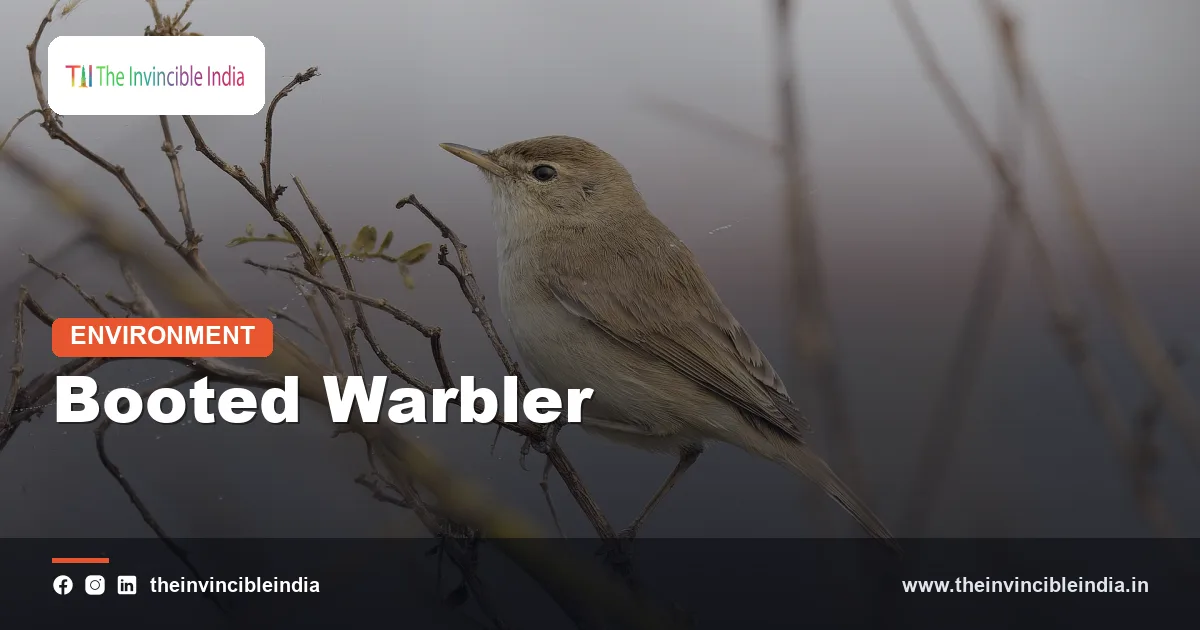
The booted warbler (Iduna caligata) is a tiny, plain, pale-brown warbler that breeds in Central Asia and western Siberia and spends the winter across much of India, where it hunts insects low in scrub, hedges, crop edges and gardens. Few birds are easier to overlook: it has no bright colours, no striking pattern and a thin, unremarkable voice. For that very reason, the booted warbler is a favourite puzzle for Indian birdwatchers during the cooler months.
This guide explains what the booted warbler is, how to recognise it, where and when it appears in India, what it eats, how it differs from look-alike species such as Sykes’s warbler, and why a bird this small still matters to the health of Indian scrub and farmland habitats. It is a winter migrant, which means the bird seen in an Indian hedge in January has travelled thousands of kilometres from its breeding grounds.
Quick Facts
| Attribute | Detail |
|---|---|
| Common name | Booted warbler |
| Scientific name | Iduna caligata (earlier placed in the genus Hippolais) |
| Family | Acrocephalidae (reed and tree warblers) |
| Length | About 11 to 12 cm |
| Breeding range | Western Siberia, Kazakhstan, Central Asia and parts of Mongolia |
| Wintering range | Mainly the Indian subcontinent, including most of India |
| Time in India | Roughly September to April |
| Habitat in India | Dry scrub, thorn forest, hedgerows, gardens and field edges |
| Diet | Small insects and other invertebrates |
| IUCN status | Least Concern |
Key Takeaways
- The booted warbler (Iduna caligata) is a small, plain brownish warbler that breeds in Central Asia and western Siberia and winters mainly in the Indian subcontinent.
- In India the booted warbler is a winter visitor, present from roughly September to April, and it is found in dry scrub, hedges, gardens and farmland rather than in dense forest.
- The booted warbler is distinguished from the closely related Sykes’s warbler by its shorter bill, rounder head and generally more contrasting face pattern, though the two are genuinely hard to separate.
- The booted warbler feeds almost entirely on small insects, which it gleans from low foliage and twigs while flicking its tail and wings.
- The booted warbler is a small songbird and is unrelated to the booted eagle, a raptor whose English name shares only the word “booted”.
- The IUCN classifies the booted warbler as Least Concern because its breeding range is vast and its population is large, but it still depends on healthy scrub and farmland along its migration route.
What is the booted warbler?
The booted warbler is a small insect-eating songbird of the genus Iduna, a group of warblers that are sometimes called “tree warblers” and sit within the family Acrocephalidae. The scientific species name caligata is Latin for “booted”, and the English name echoes it. The bird was formerly placed in the genus Hippolais with the better-known icterine and olive-tree warblers, but modern genetic work moved it and its relatives into Iduna.
An adult booted warbler measures only about 11 to 12 centimetres from bill tip to tail tip and weighs roughly as much as a few coins. It is a plain bird in every sense: brownish-grey above, buffy-white below, with a faint pale stripe over the eye. Nothing about its plumage announces it, which is why experienced birders rely on behaviour, proportions and voice more than on colour.
The booted warbler should not be confused with the booted eagle (Hieraaetus pennatus), a medium-sized bird of prey. The two share only the word “booted”, which in both cases refers to feathered or scaled legs. The warbler is a songbird small enough to sit in a person’s palm, and it eats insects rather than hunting vertebrate prey.
How can you identify a booted warbler?
The booted warbler is identified by its small size, short and fine bill, dull brownish upperparts, pale buffy underparts and a pale eyebrow stripe that is clearer behind the eye than in front of it. The head is usually rounded, the body is compact, and the tail is relatively short for a warbler of this group. In good light, a dark line runs through the eye and gives the face a slightly sharper look than the plainer olive warblers around it.
Behaviour helps just as much as appearance. The booted warbler moves restlessly through low bushes, often flicking its tail and sometimes its wings, and it frequently drops to the ground or the base of a shrub to pick up prey. It rarely sits still for long, and it tends to skulk rather than perch in the open.
Key field marks
- Small, compact warbler with a short, fine, pointed bill.
- Brownish-grey or sandy-brown upperparts with a faint olive tinge in fresh plumage.
- Whitish to buffy underparts, usually without any streaking.
- Pale supercilium (eyebrow) with a darker line through the eye.
- Constant tail-flicking and wing-flicking while foraging low in bushes.
- A short, hard “tchk” or “chek” call note, heard often in winter.
How is the booted warbler different from Sykes’s warbler?
The booted warbler differs from Sykes’s warbler (Iduna rama) mainly in bill length, head shape and overall tone, but the two are very similar and were treated as a single species until fairly recently. Modern authorities now recognise them as separate species with different breeding ranges, although both winter in India and often share the same habitat. Even experienced observers sometimes leave a bird as “booted or Sykes’s” when the views are poor.
| Feature | Booted warbler | Sykes’s warbler |
|---|---|---|
| Bill | Shorter and finer | Longer and heavier |
| Head shape | Rounder | More sloping, often with a flatter forehead |
| Overall tone | Warmer or darker brown | Paler, greyer and sandier |
| Face pattern | Eyebrow and eye-line usually more distinct | Face plainer, less contrast |
| Breeding range | Siberia and northern Central Asia | Central Asia, further south |
These differences are tendencies rather than absolute rules, and individual birds vary with wear, light and age. Observers also use the call, the posture and the general feel of the bird to reach a decision. When a good photograph is available, careful measurement of bill proportions often settles the question.
Where does the booted warbler live and breed?
The booted warbler breeds across a broad belt of northern and Central Asia, from western Siberia and Kazakhstan through the Central Asian steppe and into parts of Mongolia. There it nests in low scrub, willow thickets, river valleys and the edges of cultivated land, usually close to the ground. The nest is a small cup built in a low bush or among rank vegetation, and the female lays a small clutch of pale eggs.
After breeding, the birds move south and south-east to winter in warmer, drier country. The Indian subcontinent is the heartland of the winter range, so India hosts a very large share of the world’s booted warblers each year. Smaller numbers appear in neighbouring countries such as Pakistan, Nepal and Bangladesh, and a few reach Sri Lanka. A scattering of lost birds turns up as rare vagrants in western Europe in autumn, far from their usual route.
When and where can you see the booted warbler in India?
In India the booted warbler is present from about September to April, and it can be found across most of the country in suitable dry habitat. Early arrivals appear in the north-west from late summer, and numbers build as autumn progresses. By March and April the birds start to leave, and some individuals may offer snatches of song before they depart for the breeding grounds.
The booted warbler prefers open, semi-arid and lightly wooded country over dense, humid forest. Good places to look include the following.
- Thorn scrub and acacia woodland in Rajasthan, Gujarat and the Deccan plateau.
- Hedgerows and field margins around farmland in the plains.
- Gardens, orchards and wasteland patches in towns and on city outskirts.
- Scrubby edges of wetlands, riverbeds and irrigation channels.
Because the bird is so inconspicuous, it is frequently under-recorded. Citizen-science platforms and long-running bird monitoring programmes have helped reveal that the booted warbler is more widespread in Indian winters than older field guides suggested.
What does the booted warbler eat?
The booted warbler eats small insects and other tiny invertebrates, which it picks from leaves, twigs, bark and the ground. Typical prey includes beetles, small flies, caterpillars, bugs and spiders. The bird uses its slender bill like forceps, gleaning items from foliage rather than catching them in long aerial chases.
During the Indian winter the booted warbler forages low, usually within a couple of metres of the ground, working methodically through a bush before flitting to the next one. It is solitary or found in loose association with other small insectivores. Birds in drier regions also take advantage of insects attracted to flowering shrubs and to irrigated crops.
Why the diet matters
Every insectivorous winter migrant, including the booted warbler, removes large numbers of small insects over the season. This natural pest control has real value in farmland, hedges and gardens, even though no single warbler makes a measurable difference on its own. Collectively, wintering insectivorous birds contribute to the balance of invertebrate populations in Indian scrub and agricultural landscapes.
How does the booted warbler migrate to India?
The booted warbler migrates to India by flying south from its Central Asian and Siberian breeding grounds in autumn, crossing mountain ranges and arid plains in a journey of several thousand kilometres. Like most small warblers, it migrates mainly at night and rests and feeds by day in whatever cover it can find. Individuals use stopover habitats along the way to rebuild fat reserves before the next stage.
Researchers studying migratory songbirds often use ringing (banding) to track such journeys. A tiny numbered ring is placed on the leg, and later recoveries show where individuals travelled. Programmes run by organisations such as the Bombay Natural History Society (BNHS), founded in 1883, have long contributed to Indian bird-ringing and migration studies.
| Stage | Approximate timing | What happens |
|---|---|---|
| Breeding | May to July | Nesting in low scrub across Central Asia and Siberia |
| Autumn migration | August to October | Southward movement, mostly at night |
| Wintering in India | September to March | Foraging in scrub, hedges and gardens |
| Spring migration | March to April | Return to the northern breeding range |
What does the booted warbler sound like?
The booted warbler gives a short, dry, hard call, usually written as “tchk” or “chek”, which is the sound most often heard in India during winter. The call is repeated at intervals while the bird moves through cover, and it is one of the best clues to the bird’s presence when it stays hidden. The sound is sharp but not loud, and it can be easy to miss in a noisy garden.
On the breeding grounds the male sings a rapid, jumbled, slightly scratchy warble delivered from a low perch. This song is rarely heard in India, although a bird preparing to leave in spring may try out a few notes. Learning the call is a practical skill, since it allows birders to confirm a warbler that refuses to show itself in thick scrub.
Is the booted warbler threatened?
The booted warbler is not considered threatened, and the International Union for Conservation of Nature (IUCN) lists it as Least Concern. Its breeding range is very large, its population is believed to be big, and the species adapts to a variety of dry, scrubby and farmland habitats. There is no evidence of the steep declines seen in some other long-distance migrants.
This reassuring status does not mean the bird is free from pressure. Several concerns are worth noting.
- Conversion of scrub and wasteland to construction or intensive agriculture reduces winter foraging habitat.
- Heavy pesticide use can cut the supply of insect food in farmland.
- Removal of hedgerows and thorny field boundaries eliminates low cover.
- Changing climate may shift the timing of migration and the availability of insects at stopover sites.
Protecting small patches of native scrub, keeping hedges and leaving some wild corners in gardens help not only the booted warbler but also many other resident and migratory birds.
Why does the booted warbler matter to Indian birdwatching?
The booted warbler matters because it shows how much of India’s winter birdlife lives in ordinary, unprotected places such as hedges, wasteland and gardens rather than in famous sanctuaries. It also rewards patient observation, since separating it from Sykes’s warbler and other pale warblers sharpens identification skills. Many birders regard a confidently identified booted warbler as a small milestone.
The bird also illustrates the connection between India and distant breeding grounds. A warbler that nests in the steppes of Kazakhstan or the willow thickets of Siberia depends on both ends of its route, which means Indian conservation choices matter to ecosystems thousands of kilometres away. Recording sightings with date and place on open citizen-science platforms adds valuable data on arrival and departure dates, and it helps scientists track changes over time.
Bottom Line
The booted warbler is a small, plain, tail-flicking insectivore that winters across India after breeding in Central Asia and Siberia. It is secure as a species but depends on scrub, hedges and farmland that are easy to lose. Learning to spot it, and to tell it from Sykes’s warbler, is a rewarding exercise in careful birdwatching.
Frequently Asked Questions
Is the booted warbler the same as the booted eagle?
No, the booted warbler and the booted eagle are completely different birds. The booted warbler (Iduna caligata) is a tiny insect-eating songbird of about 11 to 12 cm, while the booted eagle is a medium-sized bird of prey. They share only the word “booted” in their English names.
When does the booted warbler arrive in India?
The booted warbler begins arriving in India from late summer and is present from about September to April. Numbers build through autumn, and the birds depart northwards in March and April to breed in Central Asia and Siberia.
What does a booted warbler look like?
A booted warbler is a small, plain, brownish-grey warbler with paler buffy underparts, a short fine bill and a faint pale eyebrow stripe. It lacks bright colours or streaks, and it is best recognised by its compact shape and constant tail-flicking behaviour.
How can you tell a booted warbler from Sykes’s warbler?
A booted warbler generally has a shorter, finer bill, a rounder head and a more contrasting face than Sykes’s warbler, which tends to be paler, greyer and longer-billed. The differences are subtle, so many sightings are recorded as “booted or Sykes’s” unless the views are very good.
What does the booted warbler eat in India?
The booted warbler eats small insects and other tiny invertebrates such as beetles, flies, caterpillars and spiders. It gleans them from leaves, twigs and the ground while foraging low in scrub, hedges and gardens.
Is the booted warbler an endangered bird?
No, the booted warbler is not endangered, and the IUCN lists it as Least Concern. Its breeding range is vast and its population is large, although loss of scrub and hedgerow habitat and heavy pesticide use remain long-term concerns.
{“@context”:”https://schema.org”,”@graph”:[{“@type”:”FAQPage”,”mainEntity”:[{“@type”:”Question”,”name”:”Is the booted warbler the same as the booted eagle?”,”acceptedAnswer”:{“@type”:”Answer”,”text”:”No, the booted warbler and the booted eagle are completely different birds. The booted warbler (Iduna caligata) is a tiny insect-eating songbird of about 11 to 12 cm, while the booted eagle is a medium-sized bird of prey. They share only the word “booted” in their English names.”}},{“@type”:”Question”,”name”:”When does the booted warbler arrive in India?”,”acceptedAnswer”:{“@type”:”Answer”,”text”:”The booted warbler begins arriving in India from late summer and is present from about September to April. Numbers build through autumn, and the birds depart northwards in March and April to breed in Central Asia and Siberia.”}},{“@type”:”Question”,”name”:”What does a booted warbler look like?”,”acceptedAnswer”:{“@type”:”Answer”,”text”:”A booted warbler is a small, plain, brownish-grey warbler with paler buffy underparts, a short fine bill and a faint pale eyebrow stripe. It lacks bright colours or streaks, and it is best recognised by its compact shape and constant tail-flicking behaviour.”}},{“@type”:”Question”,”name”:”How can you tell a booted warbler from Sykes’s warbler?”,”acceptedAnswer”:{“@type”:”Answer”,”text”:”A booted warbler generally has a shorter, finer bill, a rounder head and a more contrasting face than Sykes’s warbler, which tends to be paler, greyer and longer-billed. The differences are subtle, so many sightings are recorded as “booted or Sykes’s” unless the views are very good.”}},{“@type”:”Question”,”name”:”What does the booted warbler eat in India?”,”acceptedAnswer”:{“@type”:”Answer”,”text”:”The booted warbler eats small insects and other tiny invertebrates such as beetles, flies, caterpillars and spiders. It gleans them from leaves, twigs and the ground while foraging low in scrub, hedges and gardens.”}},{“@type”:”Question”,”name”:”Is the booted warbler an endangered bird?”,”acceptedAnswer”:{“@type”:”Answer”,”text”:”No, the booted warbler is not endangered, and the IUCN lists it as Least Concern. Its breeding range is vast and its population is large, although loss of scrub and hedgerow habitat and heavy pesticide use remain long-term concerns.”}}]}]}


