

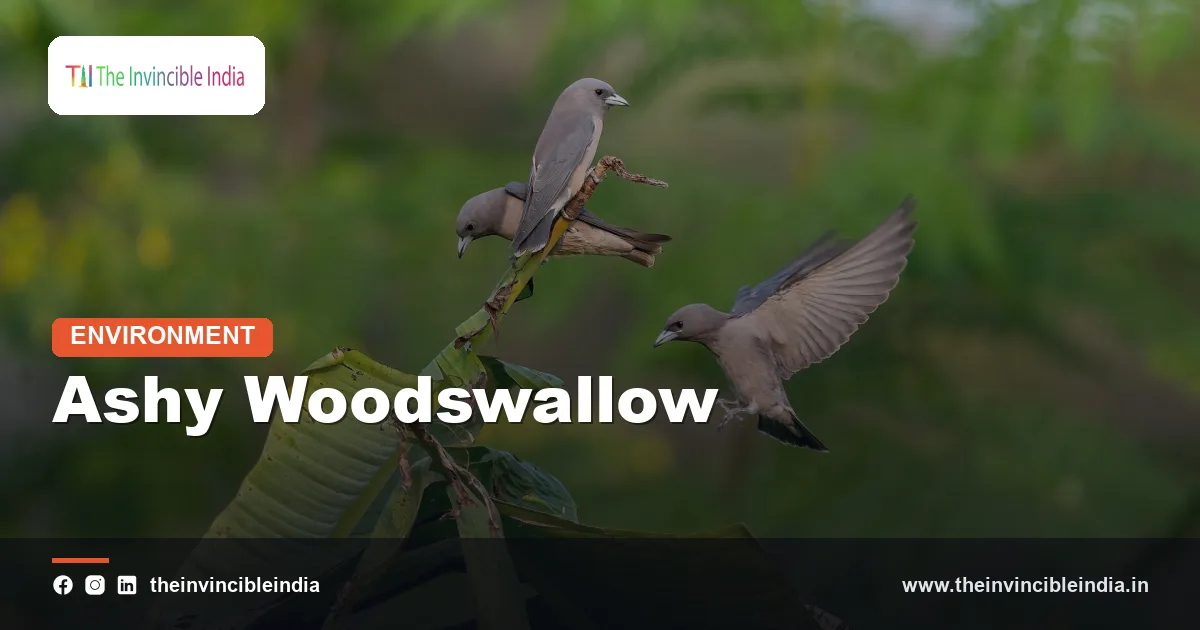
The ashy woodswallow (Artamus fuscus) is a stocky, dove-grey and brownish songbird of Indian open country that perches in tight rows on wires and palm fronds and sallies out to catch flying insects on broad, triangular wings. Despite its name and swallow-like flight, the ashy woodswallow is not a true swallow; it belongs to a separate family, the woodswallows (Artamidae), which are related to Australasian butcherbirds and currawongs.
The ashy woodswallow is the most widespread woodswallow of the Indian subcontinent and a familiar sight over palm groves, roadside avenues and farmland. This explainer covers how to identify the ashy woodswallow, where it lives, what it eats, how it nests, why it huddles in groups and how secure its population is.
Quick Facts
| Common name | Ashy woodswallow |
|---|---|
| Scientific name | Artamus fuscus |
| Family | Artamidae (woodswallows) |
| Size | About 17 to 19 cm in length |
| Habitat | Open country with palms and trees, farmland, roadsides, village edges |
| Diet | Flying insects caught in the air; also some nectar |
| Nest | Small cup of twigs and fibre in a palm crown, tree fork or crevice |
| Behaviour | Social; perches in tight huddled rows and roosts in groups |
| IUCN status | Least Concern |
Key Takeaways
- The ashy woodswallow (Artamus fuscus) is a small grey-brown insect-eating bird of the woodswallow family that is common in open country across much of India.
- Ashy woodswallows are highly social and perch pressed shoulder to shoulder in tight rows on electric wires, branches and dead twigs.
- An ashy woodswallow catches flying insects on the wing and often glides and soars on triangular wings like a small swift or swallow, although it is not related to true swallows.
- The ashy woodswallow commonly nests in the crown of a palm such as a palmyra or coconut, building a small cup of fine twigs, roots and fibre.
- Woodswallows have a brush-tipped tongue that lets them take some nectar and pollen in addition to their main diet of insects.
- The ashy woodswallow is listed as Least Concern by the IUCN because it is widespread and adaptable in human-modified landscapes.
What is the ashy woodswallow?
The ashy woodswallow is a small passerine bird, a perching songbird, found in South and Southeast Asia, and it is the only widespread woodswallow of mainland India. The scientific name Artamus fuscus was given by the French ornithologist Louis Pierre Vieillot in the early nineteenth century.
Woodswallows (genus Artamus) number only about eleven species, centred on Australia, New Guinea and nearby islands, with just a few species reaching Asia. The family is named for the superficial resemblance of its members to swallows, in their long wings and aerial feeding, together with their habit of perching on wood. DNA studies place woodswallows among the Australasian group of songbirds that includes butcherbirds, magpies and currawongs, not among true swallows (Hirundinidae).
In India a second woodswallow, the white-breasted woodswallow (Artamus leucorynchus), occurs in the Andaman and Nicobar Islands. On the mainland the ashy woodswallow is the species most people will encounter.
How can you identify an ashy woodswallow?
An ashy woodswallow can be identified as a plump, short-tailed, sooty-grey bird with a darker head and throat, a stout pale blue-grey bill with a black tip, a pale grey to whitish rump and white undertail feathers. The bird is about the size of a bulbul, but its short tail and broad pointed wings give it a distinctive silhouette.
Plumage
The upperparts of the ashy woodswallow are slate or brownish grey, with a darker head, throat and upper breast that can look almost blackish in some light. The rump is paler, and the undertail coverts are white or very pale. The underparts are a softer greyish pink or buff-grey. Male and female look alike, and young birds are browner with buff spots and streaks.
Bill and silhouette
The bill is relatively thick, bluish at the base and dark at the tip, and the legs are short. In flight the wings are broad at the base and sharply pointed, and the tail is short and square. When gliding, an ashy woodswallow can look like a miniature kite or swift, a resemblance that helps distinguish it from slim-winged swallows and bee-eaters.
Quick field checks
- Several birds perched in a tight row on a wire or dead branch.
- Short, stubby shape with a thick bluish bill.
- Frequent glides and circles with fluttering wingbeats in open air.
- Sideways tail wagging when perched.
Where is the ashy woodswallow found in India?
The ashy woodswallow is found across most of peninsular and eastern India, the Gangetic plains, the Western Ghats foothills and the Himalayan foothills, being generally absent from true deserts and from high mountain zones. Outside India the species ranges through Sri Lanka, Bangladesh, Nepal, Myanmar and parts of Southeast Asia.
The ashy woodswallow prefers open or semi-open country with scattered tall trees, and it is closely linked to palms. Palmyra palm groves, coconut plantations, date palms and roadside avenue trees are all favoured. Farmland edges, river banks, lightly wooded hill slopes and village outskirts also suit the species, because these places provide both open air for insect hunting and tall perches for resting.
Most ashy woodswallows are resident, though local movements follow rainfall and food. Flocks may move to areas where insects emerge after the first rains. During cold weather in northern India, small groups may shift to lower and warmer sites. Because the bird is so common, it rarely draws attention until a row on a wire is noticed.
What does the ashy woodswallow eat?
The ashy woodswallow eats mainly flying insects, which it catches in mid-air in short sallies from a perch or in sustained aerial pursuit. Typical prey includes flying ants, termites, beetles, grasshoppers, flies, bees, wasps and dragonflies.
The bird often hunts in groups at dusk and just after rain, when swarms of winged termites and ants emerge. It circles high in the air with a few quick wingbeats followed by long glides, then returns to a perch to eat its catch. Like swifts and swallows, woodswallows are agile aerial feeders, but they spend far more time perched, and they return to the same posts repeatedly.
A notable feature of woodswallows is the brush-tipped tongue, an adaptation shared with nectar-feeding birds. This allows woodswallows to lick nectar and pollen from flowers such as those of coral trees (Erythrina), silk-cotton (Bombax) and palms, and so the ashy woodswallow may play a minor role in pollination, although this role is not well studied.
- Main diet: flying insects, especially termite and ant swarms.
- Supplementary food: flower nectar and pollen.
- Feeding style: sallies from perches, plus aerial soaring.
- Benefit to people: removes many crop and household insects.
Why do ashy woodswallows huddle together?
Ashy woodswallows huddle together because they are strongly social birds that perch and roost in close contact, which helps them conserve warmth, stay alert to predators and maintain group bonds. A row of ashy woodswallows pressed shoulder to shoulder on an electric wire is one of the easiest ways to recognise the species.
Huddling is especially visible at dusk and on cool mornings. Groups settle for the night in the crowns of palms, under leaf bases or in dense foliage, sometimes in clusters of a dozen or more birds. At the roost, birds nestle against each other, and the group occasionally calls with soft, chattering notes.
The group also acts as a defence team. Woodswallows are known to mob birds of prey such as shikras and kestrels with noisy, aerial dives, and they will chase crows and kites away from nest sites. The social behaviour continues through the breeding season, where several adults may share feeding and guarding duties in some woodswallow species.
How does the ashy woodswallow breed?
The ashy woodswallow breeds by building a small, loose cup nest of fine twigs, rootlets, grass and fibre, usually wedged in the crown or leaf bases of a palm, in a tree fork or in a crevice of a building or pole. The breeding season in India generally falls between about March and August, varying by region and the monsoon.
A clutch normally has two to four eggs, which are pale with brown and grey spots. Both parents take part in incubating the eggs and feeding the chicks with insects. The young leave the nest after a few weeks but often return to the nest or roost with the family group for some time.
Because the nest is usually placed high in a palm crown or an exposed tree, it faces threats from crows, squirrels, snakes and from tree-trimming or palm-harvesting by people. Toddy tapping and pruning of palm fronds during the breeding season can destroy active nests without anyone noticing.
How is the ashy woodswallow different from swallows and swifts?
The ashy woodswallow differs from swallows and swifts in being a perching songbird of a different family, with a stout bill, broad triangular wings, a short square tail and a habit of sitting in tight rows rather than skimming continuously. The resemblance in flight is an example of convergent evolution among aerial insect feeders.
| Feature | Ashy woodswallow | Barn swallow | Swifts |
|---|---|---|---|
| Family | Artamidae | Hirundinidae | Apodidae |
| Body shape | Stocky, short tail | Slim, forked tail | Slender, scythe-like wings |
| Bill | Thick, blue-grey with dark tip | Tiny and dark | Tiny, wide gape |
| Perching | Often, in huddled rows | On wires, loosely spaced | Rarely perches |
| Flight | Glides, soars, circles | Swooping, low flights | Fast, sustained |
The comparison helps birdwatchers separate the ashy woodswallow from bee-eaters, drongos and flycatchers that also sit on wires. The ashy woodswallow’s chunky body, blue-grey bill and huddled behaviour are the most dependable clues.
What sounds does the ashy woodswallow make?
The ashy woodswallow produces a series of short, nasal, chirping and chattering notes, often written as “chek, chek” or “kip, kip”, together with a soft warbling song from perched or soaring birds. The calls are not loud but are constant in flocks, so a perched group is often heard before it is seen.
Birds in flight call to keep contact with the flock, and they give sharper alarm notes when a bird of prey approaches. During the breeding season, courting birds give a more musical, twittering song. Recordings of woodswallow calls are useful to distinguish the ashy woodswallow from other open-country birds in dusk surveys.
Is the ashy woodswallow threatened?
The ashy woodswallow is not threatened, and the International Union for Conservation of Nature (IUCN) lists the species as Least Concern because it is widespread, numerous and tolerant of modified habitats. Like most Indian wild birds, it is protected under the Wildlife (Protection) Act, 1972.
Population pressures are mostly local. Loss of mature palms and avenue trees, intensive pesticide use that removes insect prey, and trimming of nest palms are the main concerns. Electric wires, though a favoured perch, occasionally cause electrocution or collision injuries.
Simple actions help the ashy woodswallow and its insect-eating neighbours. Retaining old palms and roadside trees, delaying palm pruning until after the nesting season and reducing broad-spectrum insecticide use all preserve food and nest sites. Birdwatchers can contribute by logging sightings and nesting observations on community platforms such as eBird.
What role does the ashy woodswallow play in the Indian countryside?
The ashy woodswallow acts as a natural insect controller in farmland, palm groves and villages, because a flock can remove very large numbers of flying insects in a single evening. Its feeding is concentrated on the swarms that appear at dusk, when termites, ants, moths and beetles take flight.
The bird also serves as a convenient indicator of open, tree-dotted habitats with plenty of aerial insects. When woodswallows disappear from a stretch of road or palm grove, the cause is often loss of old trees, intensive spraying of insecticides or the removal of palms used for nesting. Because the species is conspicuous and easy to recognise, it is a good starting point for beginners learning to watch birds, and its group perching makes counting straightforward.
In rural India, woodswallows share the sky with swifts, bee-eaters, drongos and kites. Each of these birds hunts at a different height and in a different way, and together they form an overlapping aerial community that keeps insect numbers in balance. Observers who watch a palm grove at sunset can often see all of these species in a single sweep, with the woodswallows circling highest and gliding longest.
Bottom Line
The ashy woodswallow is a sociable, palm-loving insect hunter whose huddled rows on wires and graceful glides are a familiar part of the Indian countryside. It is common and Least Concern globally, though it benefits from the protection of old palms and trees and from careful use of pesticides.
Frequently Asked Questions
What is an ashy woodswallow?
An ashy woodswallow is a small, stocky, grey-brown insect-eating songbird of the woodswallow family (Artamidae) found in open country across India and South and Southeast Asia. It is often seen perched in tight rows on wires and branches.
Is the ashy woodswallow a type of swallow?
No, the ashy woodswallow is not a true swallow. It belongs to the separate family Artamidae, which is related to Australasian butcherbirds, and only resembles swallows in its aerial feeding and wing shape.
Why do ashy woodswallows sit so close together?
Ashy woodswallows sit close together because they are highly social birds, and huddling conserves warmth, keeps the group alert to predators and strengthens group bonds. The behaviour is most obvious at dusk and on cool mornings.
What does the ashy woodswallow eat?
The ashy woodswallow eats mainly flying insects such as termites, ants, beetles and flies, which it catches in mid-air. It also takes some nectar and pollen using its brush-tipped tongue.
Where does the ashy woodswallow nest?
The ashy woodswallow typically nests in the crown of a palm, in a tree fork or in a crevice, building a small cup of twigs, roots and fibre. It usually lays two to four eggs, and both parents feed the chicks.
Is the ashy woodswallow endangered?
No, the ashy woodswallow is not endangered. The IUCN lists it as Least Concern because it is widespread and adaptable, and it is also protected in India under the Wildlife (Protection) Act, 1972.
{“@context”:”https://schema.org”,”@graph”:[{“@type”:”FAQPage”,”mainEntity”:[{“@type”:”Question”,”name”:”What is an ashy woodswallow?”,”acceptedAnswer”:{“@type”:”Answer”,”text”:”An ashy woodswallow is a small, stocky, grey-brown insect-eating songbird of the woodswallow family (Artamidae) found in open country across India and South and Southeast Asia. It is often seen perched in tight rows on wires and branches.”}},{“@type”:”Question”,”name”:”Is the ashy woodswallow a type of swallow?”,”acceptedAnswer”:{“@type”:”Answer”,”text”:”No, the ashy woodswallow is not a true swallow. It belongs to the separate family Artamidae, which is related to Australasian butcherbirds, and only resembles swallows in its aerial feeding and wing shape.”}},{“@type”:”Question”,”name”:”Why do ashy woodswallows sit so close together?”,”acceptedAnswer”:{“@type”:”Answer”,”text”:”Ashy woodswallows sit close together because they are highly social birds, and huddling conserves warmth, keeps the group alert to predators and strengthens group bonds. The behaviour is most obvious at dusk and on cool mornings.”}},{“@type”:”Question”,”name”:”What does the ashy woodswallow eat?”,”acceptedAnswer”:{“@type”:”Answer”,”text”:”The ashy woodswallow eats mainly flying insects such as termites, ants, beetles and flies, which it catches in mid-air. It also takes some nectar and pollen using its brush-tipped tongue.”}},{“@type”:”Question”,”name”:”Where does the ashy woodswallow nest?”,”acceptedAnswer”:{“@type”:”Answer”,”text”:”The ashy woodswallow typically nests in the crown of a palm, in a tree fork or in a crevice, building a small cup of twigs, roots and fibre. It usually lays two to four eggs, and both parents feed the chicks.”}},{“@type”:”Question”,”name”:”Is the ashy woodswallow endangered?”,”acceptedAnswer”:{“@type”:”Answer”,”text”:”No, the ashy woodswallow is not endangered. The IUCN lists it as Least Concern because it is widespread and adaptable, and it is also protected in India under the Wildlife (Protection) Act, 1972.”}}]}]}


