

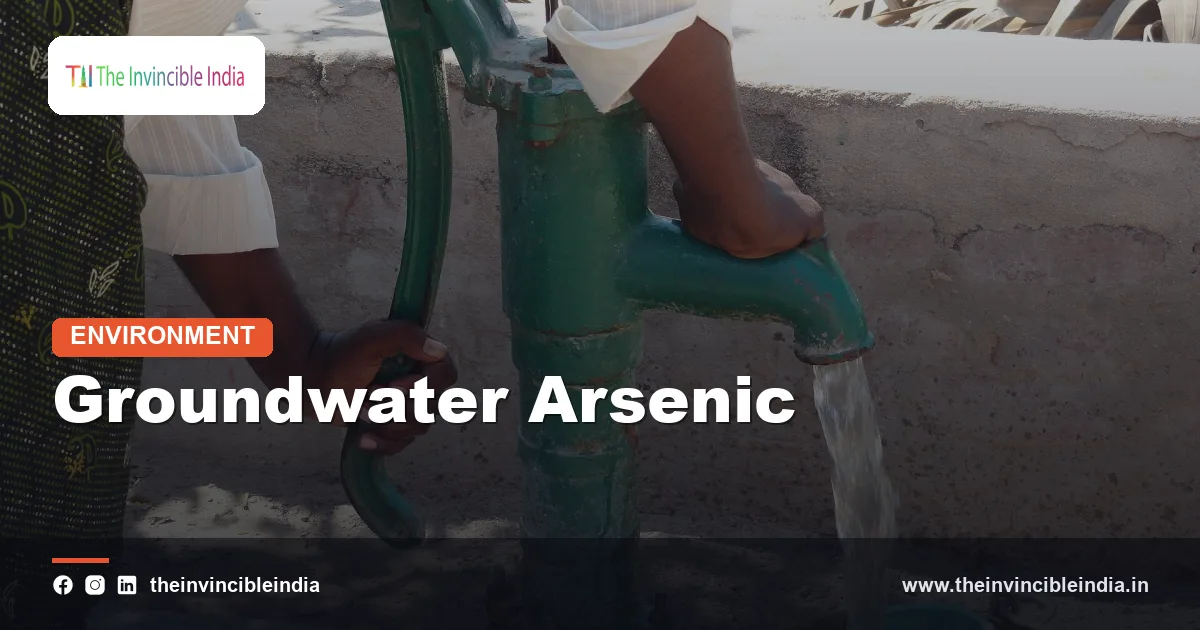
Groundwater arsenic is the natural contamination of well water by the toxic element arsenic, and in India it affects the shallow aquifers of the Ganga-Brahmaputra-Meghna plains, where millions of people drink from hand pumps and tube wells that deliver water above the safe limit. Arsenic has no colour, smell or taste in water, so people can drink it for years without knowing, and the slow harm it causes shows up only after long exposure.
This explainer covers where arsenic in groundwater comes from, which Indian states are affected, the safe limit of 10 micrograms per litre, how arsenic damages the body, how it can enter the food chain through rice, and what can be done about it. It was last reviewed on 2 November 2026.
| Attribute | Detail |
|---|---|
| What it is | Presence of dissolved arsenic in groundwater above the safe drinking-water limit |
| Main origin | Geogenic (natural): released from sediments eroded from the Himalaya and deposited in river plains |
| Safe limit | 10 micrograms per litre (µg/L, or 0.01 mg/L) under WHO guidelines and the Bureau of Indian Standards (BIS) |
| Most affected states | West Bengal, Bihar, Uttar Pradesh, Assam and Jharkhand, with pockets in Punjab, Haryana, Manipur, Chhattisgarh and other states |
| First major detection in India | West Bengal, in the early 1980s |
| Main health effect | Arsenicosis, including skin lesions and cancers of the skin, bladder, lung and other organs |
| Exposure routes | Drinking water, and food such as rice grown with arsenic-rich irrigation water |
| Measuring agency | Central Ground Water Board (CGWB) and state public health departments |
Key Takeaways
- Arsenic in Indian groundwater is mostly natural, released from iron-rich sediments in the shallow alluvial aquifers of the Ganga-Brahmaputra-Meghna basin, not from industrial pollution in most places.
- The safe limit set by the World Health Organization and by the Bureau of Indian Standards is 10 micrograms per litre, and many wells in West Bengal, Bihar, Uttar Pradesh and Assam exceed it.
- Long-term drinking of arsenic-rich water causes arsenicosis, with skin changes appearing first and cancers of the skin, bladder and lung developing after years of exposure.
- Arsenic cannot be seen, smelled or tasted, so only laboratory or field-kit testing can tell whether a well is safe.
- Rice and other crops irrigated with contaminated groundwater can take up arsenic, adding to the exposure of people who never drink the water directly.
- The most reliable fixes are switching to safe sources, such as treated surface water or deeper tested aquifers, together with testing, arsenic-removal systems and piped supply under the Jal Jeevan Mission.
What Is Groundwater Arsenic and Why Is It Dangerous?
Groundwater arsenic is dissolved arsenic in underground water, and it is dangerous because it is a poison and a proven human carcinogen even at low concentrations. Arsenic occurs naturally in rocks and soil, and under certain chemical conditions it dissolves into the water that fills the gaps in an aquifer.
The danger lies in its quiet, cumulative nature. A person who drinks arsenic-rich water does not fall ill at once. Instead, small daily doses build up over years. Skin patches appear first, and later the risks of cancer, heart disease, diabetes and damage to the nervous system and lungs rise. Children, malnourished people and those who rely on the same well for a lifetime face the greatest risk.
The International Agency for Research on Cancer classifies inorganic arsenic as carcinogenic to humans. Because the contamination comes from the ground itself, it is not cleaned by boiling, and boiling can actually concentrate the arsenic by evaporating water.
Where Does Arsenic in Indian Groundwater Come From?
Arsenic in Indian groundwater comes mostly from natural sources: arsenic-bearing minerals in sediments that rivers carried down from the Himalaya and spread across the plains over thousands of years. This is called geogenic contamination, in contrast to man-made pollution.
The process runs in several steps. Rivers such as the Ganga, Brahmaputra and Meghna carry silt, sand and clay from the young, eroding mountains. The sediments contain arsenic bound to iron oxide minerals, which coat the sand grains. Over time these sediments are buried and surrounded by water, and the layers become rich in organic matter such as buried plant material and peat.
In the oxygen-poor environment of such an aquifer, bacteria feed on the organic matter and, in doing so, break down the iron minerals. This process, known as reductive dissolution, frees the arsenic into the water. The result is that arsenic levels are highest in shallow, young, oxygen-poor aquifers, typically at depths of around 20 to 100 metres, and are often much lower in older, deeper aquifers where the sediments have been flushed or are chemically different.
Human activity can change the picture. Heavy pumping for irrigation can alter groundwater flow and draw arsenic-rich water into previously safe zones or deeper layers. In a few places, mining, smelting, coal burning and some pesticides add arsenic, but in the Gangetic plains these are minor compared with the natural source.
Which Indian States Have Arsenic in Groundwater?
The Indian states with the most arsenic in groundwater are West Bengal, Bihar, Uttar Pradesh and Assam, all of which lie on the Ganga and Brahmaputra floodplains. Arsenic was first widely recognised in India in West Bengal in the early 1980s, when doctors found cases of skin disease among villagers in the districts south of Kolkata. The problem has since been mapped well beyond that area.
| State or region | Where it occurs | Notes |
|---|---|---|
| West Bengal | Districts such as Murshidabad, Nadia, Malda, North and South 24 Parganas and Hooghly, mostly in the Bhagirathi-Hooghly delta | Among the earliest and best documented cases; many districts have wells above the limit |
| Bihar | Districts along the Ganga, including Bhojpur, Buxar, Patna, Bhagalpur, Vaishali and Saran | Reported in a long belt on both banks of the river |
| Uttar Pradesh | Eastern districts such as Ballia, Ghazipur and Gorakhpur, and parts of the Ganga and Ghaghra basins | Large areas of the eastern plains are affected |
| Assam | Brahmaputra valley districts such as Jorhat, Dhemaji, Lakhimpur and Golaghat | Reported in upper Assam floodplains |
| Jharkhand | Sahibganj and nearby Ganga-side districts | Along the river plains |
| Other states | Pockets in Punjab, Haryana, Manipur, Chhattisgarh and Karnataka | Smaller or local, some linked to geology or mining |
The same belt continues across the border into Bangladesh, where arsenic in tube wells has been described as one of the largest mass poisonings in history. India and Bangladesh share the same river system and the same geology, so the problem does not stop at the border.
Estimates of the number of people exposed vary with the survey and the threshold used, but studies and government reports generally place the number at tens of millions of people living in areas where groundwater exceeds the safe limit. These are broad figures, and the real exposure depends on which wells people actually drink from.
What Is the Safe Limit for Arsenic in Drinking Water?
The safe limit for arsenic in drinking water is 10 micrograms per litre, as set by the World Health Organization and adopted by the Bureau of Indian Standards in its drinking water specification, IS 10500. A microgram per litre is the same as a part per billion, so 10 micrograms per litre equals 0.01 milligrams per litre.
India’s older standard was 50 micrograms per litre, five times higher, which was also the earlier national standard in Bangladesh. The tightening to 10 micrograms per litre followed growing evidence that health risks persist well below 50. Under the BIS standard, 0.01 mg/L is the acceptable limit and there is no relaxation for a higher value in the absence of an alternative source, which is a stricter position than for some other contaminants.
Even the WHO treats 10 micrograms per litre as a provisional guideline, because it is close to what is practically measurable and treatable, and not because it is risk-free. Lifetime exposure at that level still carries some cancer risk. The practical goal is therefore to bring levels as far below the limit as feasible.
How Does Arsenic Affect Human Health?
Arsenic affects human health by damaging the skin, blood vessels, lungs, liver, bladder and nerves, and by causing cancer, after months or years of exposure. The condition caused by long-term arsenic poisoning is called arsenicosis, or chronic arsenic toxicity.
- Skin changes: The earliest visible signs are dark patches called melanosis and hardened, rough spots on the palms and soles called keratosis. They typically appear after several years of exposure.
- Cancer: Long-term exposure raises the risk of cancers of the skin, bladder, lung and, in some studies, kidney and liver. These cancers may develop decades after exposure begins.
- Blood vessel disease: Arsenic is linked to high blood pressure, heart disease and a gangrene-like condition of the feet and hands called blackfoot disease, which is better known from Taiwan.
- Diabetes and other disorders: Studies have associated chronic exposure with diabetes, lung disease, liver damage and nerve damage.
- Effects on children and pregnancy: Exposure in the womb and in childhood has been linked to poorer birth outcomes and impaired child development.
Because skin lesions can take years to appear, many people are unaware of the risk until damage is advanced. Doctors in affected areas often use skin lesions as a marker, but internal damage can occur before any mark is visible. There is no cure for arsenicosis. Treatment mainly means stopping further exposure by switching to safe water, along with good nutrition and medical care for the lesions and any cancers.
Can Arsenic Enter the Food Chain Through Rice and Crops?
Arsenic can enter the food chain through crops, especially rice, because farmers in affected regions irrigate their fields with the same contaminated groundwater. Rice is particularly prone to taking up arsenic because it is grown in flooded paddies, where the chemistry of the soil makes arsenic more soluble and easily absorbed by the plant.
Studies in West Bengal and Bangladesh have shown that irrigating with arsenic-rich water can raise the arsenic content of paddy soils and of rice grain, and can also affect vegetables, cattle fodder and milk to a lesser degree. For people whose diet is built around rice, this adds a significant second route of exposure, so switching drinking water alone may not remove the whole risk.
Several approaches can help. Growing rice with intermittent rather than continuous flooding, choosing lower-uptake varieties, mixing cleaner water sources for irrigation, and washing and cooking rice in plenty of safe water can reduce the intake. Research on these methods is ongoing, and food-safety standards for arsenic in rice are still being developed in many countries.
How Do You Test Water for Arsenic?
You can test water for arsenic with a field test kit for a quick indication or with laboratory analysis for an accurate figure. Because arsenic cannot be detected by sight, taste or smell, testing is the only way to know whether a well is safe.
Field kits use chemical reactions that change colour in proportion to the arsenic present, and they are used by health workers to screen thousands of wells. They are useful for screening but less precise at low levels near the limit, so wells that test close to or above the limit should be confirmed in a laboratory using methods such as atomic absorption spectrometry or ICP-MS. Government laboratories under the public health engineering departments, and under the Jal Jeevan Mission, increasingly offer testing, including training of village women to use field kits.
Concentrations can vary sharply between neighbouring wells, even those only a few metres apart, because of local differences in the sediment. A safe well next door is not proof that a household’s own well is safe. Hand pumps found to be contaminated are commonly marked with red paint and safe ones with green, although these labels depend on the quality of the testing behind them.
What Are the Ways to Remove or Avoid Arsenic?
The ways to remove or avoid arsenic are to switch to a safe source, to treat water at the household or community level, and to treat water at a large scale before piped supply. The choice depends on the location, cost and what is available locally.
Switch to safer sources
- Surface water supply: Treating river or reservoir water in a plant and delivering it by pipes avoids groundwater altogether and is the long-term approach in many districts.
- Deep tube wells: Wells that tap deeper, older aquifers, often beyond 150 metres, can be much lower in arsenic. They must be tested regularly and carefully sealed so that shallow contaminated water cannot leak down, and heavy pumping from the deep aquifer could one day draw arsenic downward.
- Rainwater harvesting and dug wells: In some areas, protected dug wells and rainwater storage give arsenic-free water for drinking and cooking, provided they are kept hygienic.
Remove arsenic from the water
- Community arsenic removal plants: Plants using adsorption on activated alumina or iron-based media, coagulation, or reverse osmosis can serve a village, though they need reliable maintenance and safe disposal of the arsenic-laden sludge.
- Household filters: Domestic filters using iron-based media or membranes can work if maintained, but poor upkeep has led many to fail.
- Oxidation and settling: Where groundwater also contains iron, letting water stand and oxidise can remove part of the arsenic, though not always enough to reach the safe limit.
Experience shows that the biggest barrier is not technology but sustained operation. Many arsenic-removal plants installed in India have fallen out of use for lack of funds, spare parts and local ownership. Programmes that combine safe supply with community training and regular testing last longer.
What Is India Doing About Groundwater Arsenic?
India is addressing groundwater arsenic mainly through its drinking water programmes, which prioritise arsenic- and fluoride-affected habitations for safe supply. The Jal Jeevan Mission, launched in 2019 to provide tap water to every rural household, has made quality-affected areas a priority and has emphasised surface-water-based schemes where groundwater is poor.
Earlier schemes, including the National Rural Drinking Water Programme, financed arsenic mitigation, and states such as West Bengal and Bihar have built piped schemes and arsenic removal plants in the worst districts. The Central Ground Water Board monitors groundwater quality and publishes maps of contaminated areas, and the Bureau of Indian Standards sets the legal limits. The National Water Quality Sub-Mission in earlier years was meant to supply safe water to affected habitations as a priority.
Gaps remain. Testing coverage is incomplete, many contaminated hand pumps are still in use because residents have no alternative, and monitoring of removal plants is weak. Public awareness also lags, and the stigma attached to skin lesions can discourage people from seeking help. Experts recommend that mitigation be paired with regular health screening, nutrition support and access to treatment for people already affected.
Bottom Line
Groundwater arsenic is a natural but largely preventable public-health crisis in the Ganga-Brahmaputra plains. The contamination is concentrated in shallow aquifers, it cannot be seen or tasted, and it harms health through skin disease and cancer after years of exposure, as well as through rice. The remedy is a combination of testing every source, supplying safe water through surface or tested deep sources, and keeping removal plants working long enough to protect a whole generation.
Frequently Asked Questions
Is arsenic in Indian groundwater natural or man-made?
Arsenic in Indian groundwater is mostly natural. It is released from arsenic-bearing sediments eroded from the Himalaya and deposited across the Ganga-Brahmaputra plains, when bacteria in oxygen-poor aquifers break down iron minerals. Industrial, mining and agrochemical sources exist, but are minor in the main affected belt.
What is the safe limit of arsenic in drinking water in India?
The safe limit of arsenic in drinking water is 10 micrograms per litre, or 0.01 mg/L, under both the World Health Organization guideline and the Bureau of Indian Standards specification IS 10500. India’s older limit was 50 micrograms per litre, which has since been tightened.
Which states in India are worst affected by arsenic in groundwater?
West Bengal, Bihar, Uttar Pradesh and Assam are the worst affected, with Jharkhand also reporting contamination along the Ganga. All lie on the Ganga or Brahmaputra floodplains. Smaller pockets have been found in Punjab, Haryana, Manipur, Chhattisgarh and a few other states.
What diseases does arsenic in water cause?
Arsenic in water causes arsenicosis, which shows first as dark skin patches and hardened palms and soles. Long-term exposure also raises the risk of cancers of the skin, bladder and lung, as well as heart disease, diabetes and nerve damage. Symptoms often take years to appear.
Does boiling remove arsenic from water?
Boiling does not remove arsenic from water. Because some water evaporates, boiling can actually make the arsenic more concentrated. Safe options are to switch to a tested low-arsenic source or to use a properly maintained arsenic-removal filter or plant.
Can arsenic get into rice?
Arsenic can get into rice when paddy fields are irrigated with contaminated groundwater. Rice is flooded for much of its growth, which makes arsenic in the soil easier for the plant to absorb. Intermittent flooding, safer irrigation water and cooking rice in plenty of clean water can reduce exposure.
{“@context”:”https://schema.org”,”@graph”:[{“@type”:”FAQPage”,”mainEntity”:[{“@type”:”Question”,”name”:”Is arsenic in Indian groundwater natural or man-made?”,”acceptedAnswer”:{“@type”:”Answer”,”text”:”Arsenic in Indian groundwater is mostly natural. It is released from arsenic-bearing sediments eroded from the Himalaya and deposited across the Ganga-Brahmaputra plains, when bacteria in oxygen-poor aquifers break down iron minerals. Industrial, mining and agrochemical sources exist, but are minor in the main affected belt.”}},{“@type”:”Question”,”name”:”What is the safe limit of arsenic in drinking water in India?”,”acceptedAnswer”:{“@type”:”Answer”,”text”:”The safe limit of arsenic in drinking water is 10 micrograms per litre, or 0.01 mg/L, under both the World Health Organization guideline and the Bureau of Indian Standards specification IS 10500. India’s older limit was 50 micrograms per litre, which has since been tightened.”}},{“@type”:”Question”,”name”:”Which states in India are worst affected by arsenic in groundwater?”,”acceptedAnswer”:{“@type”:”Answer”,”text”:”West Bengal, Bihar, Uttar Pradesh and Assam are the worst affected, with Jharkhand also reporting contamination along the Ganga. All lie on the Ganga or Brahmaputra floodplains. Smaller pockets have been found in Punjab, Haryana, Manipur, Chhattisgarh and a few other states.”}},{“@type”:”Question”,”name”:”What diseases does arsenic in water cause?”,”acceptedAnswer”:{“@type”:”Answer”,”text”:”Arsenic in water causes arsenicosis, which shows first as dark skin patches and hardened palms and soles. Long-term exposure also raises the risk of cancers of the skin, bladder and lung, as well as heart disease, diabetes and nerve damage. Symptoms often take years to appear.”}},{“@type”:”Question”,”name”:”Does boiling remove arsenic from water?”,”acceptedAnswer”:{“@type”:”Answer”,”text”:”Boiling does not remove arsenic from water. Because some water evaporates, boiling can actually make the arsenic more concentrated. Safe options are to switch to a tested low-arsenic source or to use a properly maintained arsenic-removal filter or plant.”}},{“@type”:”Question”,”name”:”Can arsenic get into rice?”,”acceptedAnswer”:{“@type”:”Answer”,”text”:”Arsenic can get into rice when paddy fields are irrigated with contaminated groundwater. Rice is flooded for much of its growth, which makes arsenic in the soil easier for the plant to absorb. Intermittent flooding, safer irrigation water and cooking rice in plenty of clean water can reduce exposure.”}}]}]}


