

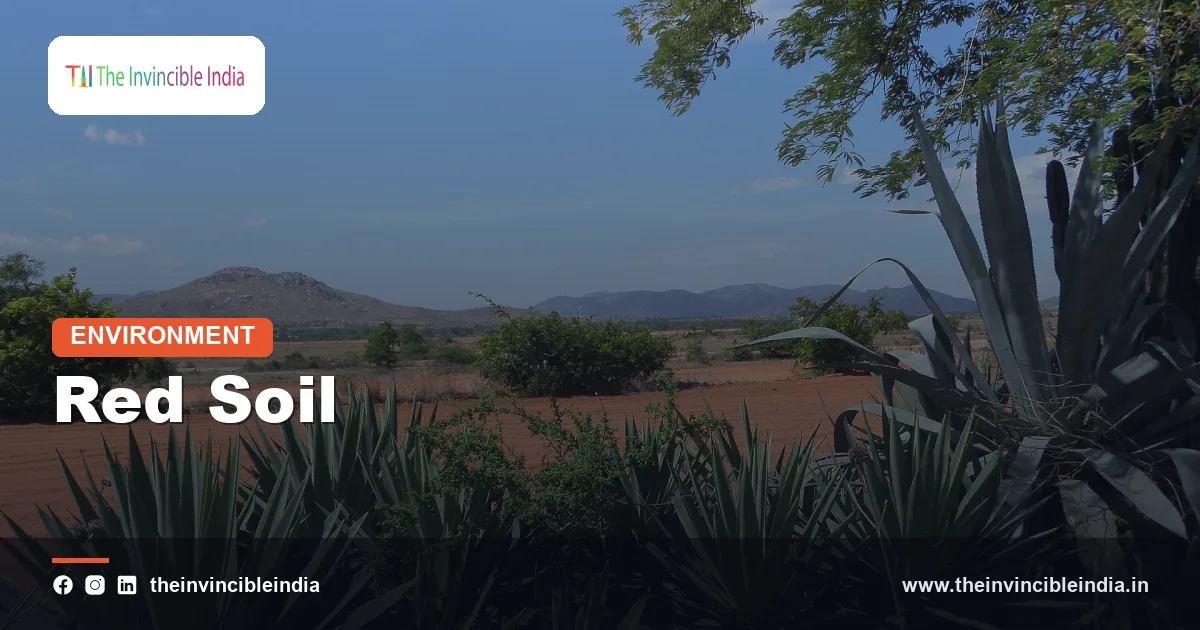
Red soil is the reddish, iron-stained soil that covers much of peninsular India, formed from the weathering of ancient granites, gneisses and other crystalline rocks, and it is typically light, porous and low in nutrients but productive when it is irrigated and fertilised with care. Its colour comes from iron oxides coating the soil particles, and it supports millets, pulses, oilseeds, cotton and fruit across the southern and eastern parts of the Deccan.
Red soil occupies roughly a tenth of India’s land and is one of the country’s major soil groups, alongside alluvial and black soil. Understanding why it is red, where it occurs, why it is hungry for nutrients and how farmers have learned to work with it explains a great deal about dryland farming in Tamil Nadu, Karnataka, Andhra Pradesh, Telangana and Odisha.
| Attribute | Detail |
|---|---|
| Source of colour | Iron oxides, mainly hematite, coating soil particles; yellow where the iron is hydrated |
| Parent rock | Old crystalline and metamorphic rocks such as granite, gneiss and schist |
| Share of India’s land | Roughly one-tenth of the country |
| Main regions | Tamil Nadu, Karnataka, Andhra Pradesh, Telangana, Odisha, Chhattisgarh, Jharkhand (Chota Nagpur), parts of Maharashtra and the north-east hills |
| Texture | Sandy to loamy on uplands; clayey and deeper in valleys and lowlands |
| Reaction (pH) | Neutral to mildly acidic |
| Typically low in | Nitrogen, phosphorus, lime and organic matter |
| Typical crops | Ragi, jowar, bajra, groundnut, pulses, cotton, tobacco, castor, fruit orchards |
Key Takeaways
- Red soil is a reddish soil formed on ancient crystalline and metamorphic rocks, and it covers roughly one-tenth of India, mostly across the peninsular plateau and its eastern fringe.
- The red colour comes from iron oxides, and the soil turns yellow or brown where the iron is hydrated, for example in wetter areas or low-lying fields.
- Red soil is porous, light and well drained but poor in nitrogen, phosphorus, lime and humus, so it responds strongly to manure, fertiliser and irrigation.
- Millets, groundnut, pulses and cotton dominate red soil farming, much of it rain-fed, with rice, sugarcane and orchards where water is available.
- Upland red soils are prone to erosion, crusting and moisture stress, so soil and water conservation is the main route to better yields.
- Red soil is distinct from laterite soil, which forms under heavier rainfall and is more intensely leached, and from black soil, which is clay-rich and moisture-retentive.
What is red soil?
Red soil is a soil group defined by its reddish colour, light texture and origin in ancient crystalline and metamorphic rocks. It forms in place from the rock beneath it, rather than being carried in by rivers, so its character reflects both the parent rock and the climate.
The soil is not a single uniform material. In soil science, most Indian red soils fall into the orders known as Alfisols, with some Ultisols, Oxisols and Inceptisols, depending on how far weathering has progressed. Indian agricultural scientists commonly describe red soils as those with a reddish surface layer over a lighter or more clayey subsoil, with kaolinite as the dominant clay mineral.
Because kaolinite clay holds few nutrients and little water, red soil has a low capacity to retain fertiliser and a modest capacity to store moisture. This single mineral fact explains much of the soil’s reputation for being easy to work but hard to make rich.
Why is red soil red?
Red soil is red because iron compounds in the weathered rock oxidise and form a thin film of iron oxide, chiefly hematite, around the soil particles. The same process that rusts an iron nail colours the soil.
The parent rocks, such as granite and gneiss, contain iron-bearing minerals. Over long periods of warm, seasonally wet and dry weather, these minerals break down. Silica and many bases are washed away, while iron is left behind and oxidised in the presence of air. Where the soil is well aerated and dries out regularly, the iron stays in its dark red form.
Where the iron is hydrated, as in wetter or more poorly drained conditions, the colour shifts towards yellow or brownish tones. This is why a single hillside can show red soil on the ridge and yellowish soil in the hollow. The colour is therefore a clue to drainage and moisture history, not a direct measure of fertility.
Where is red soil found in India?
Red soil is found chiefly across the southern and eastern parts of the Deccan plateau, covering large areas of Tamil Nadu, Karnataka, Andhra Pradesh, Telangana and Odisha, and extending into Chhattisgarh, Jharkhand and the north-east. It runs in a broad belt on the older rocks of peninsular India.
- Tamil Nadu: red soils cover a very large share of the state, including the interior districts away from the coast and the river deltas.
- Karnataka: the southern and eastern plateau, including much of the old Mysuru region and the districts around Bengaluru and Tumakuru.
- Andhra Pradesh and Telangana: Rayalaseema, the Telangana plateau and the uplands bordering the Eastern Ghats.
- Odisha, Chhattisgarh and Jharkhand: the Chota Nagpur plateau and the Chhattisgarh basin, where red and yellow soils are widespread.
- Elsewhere: patches in Maharashtra, Goa, Bundelkhand, the Aravalli fringe in Rajasthan, and hill areas of Meghalaya, Nagaland and Manipur.
In the north-east and parts of the Western Ghats edge, similar reddish soils develop under much heavier rainfall and are more acidic. They overlap in character with laterite soils, and the boundary between the two is often blurred in the field.
How does red soil form?
Red soil forms when granite, gneiss, schist and similar rocks weather under a tropical climate with a warm, seasonally wet and dry pattern, leaving a residue rich in iron and clay. The process takes thousands to millions of years.
The peninsular shield is among the oldest land on Earth, made of rocks that are hundreds of millions to billions of years old. Because this land has stood relatively stable for so long, weathering has had ample time to work. Moderate rainfall dissolves and removes some minerals, a process called leaching, while iron and aluminium remain behind.
On slopes, erosion removes the finer particles faster than they form, so uplands tend to carry shallow, gravelly, coarse-textured soil. In valleys and low plains, the eroded material collects, giving deeper, finer and more fertile red soils. This is the reason farmers often distinguish upland red soil from lowland red soil on the same farm.
What are the properties of red soil?
Red soil is a light-textured, porous, well-drained soil with low natural fertility, low water-holding capacity and a neutral to slightly acidic reaction. It is easy to plough but quick to dry out.
Its nutrient profile is the key to managing it. Nitrogen and phosphorus are generally low, organic matter is poor because high temperatures break it down quickly, and lime is scarce. Potash is often moderate. Deficiencies of zinc, boron and sulphur are reported in many areas, and iron toxicity is not a concern since the iron is locked in oxides.
- Texture: sandy loam to clay loam, with gravel in upland positions.
- Structure: weak; surface crusting after rain can seal the top layer and hinder seedling emergence.
- Drainage: good to excessive, so waterlogging is uncommon but moisture stress is.
- Organic matter: low, often below one per cent in cultivated upland fields.
- Response to inputs: strong, since a small addition of manure, fertiliser or water produces a visible yield gain.
Which crops grow best in red soil?
Millets, groundnut, pulses and cotton are the leading crops grown on red soil, along with tobacco, castor, sunflower, potatoes and fruit trees. The soil suits crops that tolerate dry spells and do not need heavy, waterlogged conditions.
Under rain-fed conditions, farmers grow finger millet (ragi), sorghum (jowar), pearl millet (bajra), horse gram, pigeon pea and groundnut, often in mixed or inter-cropped systems that spread risk. Where irrigation is available, red soils support rice, sugarcane, banana, vegetables, cotton and fruit orchards including mango, citrus, cashew and coconut. Tamil Nadu and Andhra Pradesh use red soil heavily for groundnut and cotton, while Karnataka’s red soils are famous for ragi.
The deeper, clay-rich red soils of the lowlands can also grow rice and sugarcane well when irrigated. As a general rule, crop choice on red soil follows water availability far more than any fixed soil rule.
How can red soil be made more productive?
Red soil is made more productive by adding organic matter, balancing nutrients, conserving rainwater and controlling erosion. Because the soil responds strongly to inputs, modest improvements often bring large gains.
- Organic matter: farmyard manure, compost, green manures and crop residues raise water retention and feed soil life.
- Balanced fertiliser: split doses of nitrogen, with phosphorus and micronutrients such as zinc, guided by soil tests under the Soil Health Card scheme.
- Liming: in acidic red soils, lime or similar amendments correct acidity and improve phosphorus availability.
- Water conservation: contour bunding, farm ponds, mulching and watershed development hold rain where it falls.
- Erosion control: field bunds, grass strips, tree planting and contour cultivation on sloping land.
- Efficient irrigation: drip and sprinkler systems fit the soil’s fast drainage and save water.
Watershed development programmes across the peninsular states have been among the most visible responses, turning degraded red soil hillsides into more reliable farmland through bunds, check dams and tree cover.
How does red soil compare with black and laterite soil?
Red soil differs from black soil and laterite soil mainly in parent rock, clay type and degree of leaching: it forms on crystalline rock, is lighter than black soil and less intensely leached than laterite. The three often occur side by side across the peninsula.
| Feature | Red soil | Black soil | Laterite soil |
|---|---|---|---|
| Parent material | Granite, gneiss, schist | Deccan lava (basalt) | Rocks weathered under heavy seasonal rain |
| Colour | Red to yellowish-red | Dark grey to black | Red to brick-red |
| Texture | Light, porous | Heavy, clayey | Gravelly, coarse |
| Water retention | Low to moderate | High; cracks when dry | Low |
| Fertility | Low to moderate | Moderate to high | Low |
| Acidity | Neutral to mildly acidic | Neutral to alkaline | Acidic |
| Typical crops | Millets, groundnut, pulses | Cotton, soybean, sorghum | Cashew, tea, coffee, rubber |
Laterite forms where heavy rain leaches away silica and bases so thoroughly that iron and aluminium oxides dominate, which can harden into a brick-like rock on drying. Red soil is less extreme, and the two grade into each other where rainfall rises, for example along the Western Ghats and Eastern Ghats.
What are the main threats to red soil?
The main threats to red soil are erosion, loss of organic matter, nutrient depletion and the pressure of dryland farming under erratic rainfall. Because the soil is thin and structureless on slopes, it loses its topsoil quickly.
Heavy monsoon downpours strike unprotected, crust-prone soil and carry away fine particles and nutrients. Over time, gullies can develop on bare slopes, and the exposed subsoil is less fertile. Continuous cropping without manure further drains organic matter, while shifting rainfall patterns raise the risk of dry spells at critical growth stages.
Land use change adds to the pressure. Quarrying, brick-making and conversion of farmland to buildings consume red soil near growing towns, and overgrazing degrades pasture on uplands. Because much of the red soil region is rain-fed and semi-arid, the combination of poor soil and uncertain water makes farmers there among the most climate-exposed in the country.
Bottom Line
Red soil is a modest soil with a strong response to care. It is easy to cultivate, quick to drain and short of nutrients, yet with organic matter, balanced fertiliser, water conservation and sensible crop choice it sustains millions of dryland farms across peninsular India. Protecting its thin topsoil is the surest way to keep that productivity.
Frequently Asked Questions
What is red soil in India?
Red soil in India is a reddish, light-textured soil formed from the weathering of ancient crystalline and metamorphic rocks such as granite and gneiss. It covers roughly one-tenth of the country, mainly across peninsular India. It is low in nitrogen, phosphorus and organic matter but responds well to fertiliser and irrigation.
Why is red soil red in colour?
Red soil is red because of iron oxides, mainly hematite, that coat the soil particles as iron-bearing minerals in the parent rock weather and oxidise. Where the iron is hydrated, as in wetter or poorly drained spots, the soil appears yellowish or brownish. The colour reflects drainage and weathering, not fertility.
Which crops are grown in red soil?
Millets such as ragi, jowar and bajra, along with groundnut, pulses, cotton, tobacco and castor, are the main crops grown in red soil. With irrigation it also supports rice, sugarcane, vegetables and fruit orchards such as mango, citrus and cashew. Much of the farming is rain-fed.
Which states have red soil?
Red soil is widespread in Tamil Nadu, Karnataka, Andhra Pradesh, Telangana and Odisha, and also occurs in Chhattisgarh, Jharkhand, parts of Maharashtra and the hills of the north-east. It forms a broad belt over the older rocks of the Deccan plateau and its eastern margin.
Is red soil fertile?
Red soil is naturally low to moderate in fertility because it lacks nitrogen, phosphorus, lime and humus and holds little water. However, it responds strongly to manure, fertiliser and irrigation, and deeper lowland red soils can be quite productive. Good management makes it a dependable farming soil.
What is the difference between red soil and laterite soil?
Red soil forms mostly on crystalline rock under moderate rainfall and is mildly acidic and lightly leached, while laterite soil forms under heavy seasonal rain and is intensely leached, acidic and often gravelly or hard. Laterite suits plantation crops like cashew, tea and rubber, whereas red soil suits millets and groundnut.
{“@context”:”https://schema.org”,”@graph”:[{“@type”:”FAQPage”,”mainEntity”:[{“@type”:”Question”,”name”:”What is red soil in India?”,”acceptedAnswer”:{“@type”:”Answer”,”text”:”Red soil in India is a reddish, light-textured soil formed from the weathering of ancient crystalline and metamorphic rocks such as granite and gneiss. It covers roughly one-tenth of the country, mainly across peninsular India. It is low in nitrogen, phosphorus and organic matter but responds well to fertiliser and irrigation.”}},{“@type”:”Question”,”name”:”Why is red soil red in colour?”,”acceptedAnswer”:{“@type”:”Answer”,”text”:”Red soil is red because of iron oxides, mainly hematite, that coat the soil particles as iron-bearing minerals in the parent rock weather and oxidise. Where the iron is hydrated, as in wetter or poorly drained spots, the soil appears yellowish or brownish. The colour reflects drainage and weathering, not fertility.”}},{“@type”:”Question”,”name”:”Which crops are grown in red soil?”,”acceptedAnswer”:{“@type”:”Answer”,”text”:”Millets such as ragi, jowar and bajra, along with groundnut, pulses, cotton, tobacco and castor, are the main crops grown in red soil. With irrigation it also supports rice, sugarcane, vegetables and fruit orchards such as mango, citrus and cashew. Much of the farming is rain-fed.”}},{“@type”:”Question”,”name”:”Which states have red soil?”,”acceptedAnswer”:{“@type”:”Answer”,”text”:”Red soil is widespread in Tamil Nadu, Karnataka, Andhra Pradesh, Telangana and Odisha, and also occurs in Chhattisgarh, Jharkhand, parts of Maharashtra and the hills of the north-east. It forms a broad belt over the older rocks of the Deccan plateau and its eastern margin.”}},{“@type”:”Question”,”name”:”Is red soil fertile?”,”acceptedAnswer”:{“@type”:”Answer”,”text”:”Red soil is naturally low to moderate in fertility because it lacks nitrogen, phosphorus, lime and humus and holds little water. However, it responds strongly to manure, fertiliser and irrigation, and deeper lowland red soils can be quite productive. Good management makes it a dependable farming soil.”}},{“@type”:”Question”,”name”:”What is the difference between red soil and laterite soil?”,”acceptedAnswer”:{“@type”:”Answer”,”text”:”Red soil forms mostly on crystalline rock under moderate rainfall and is mildly acidic and lightly leached, while laterite soil forms under heavy seasonal rain and is intensely leached, acidic and often gravelly or hard. Laterite suits plantation crops like cashew, tea and rubber, whereas red soil suits millets and groundnut.”}}]}]}


