

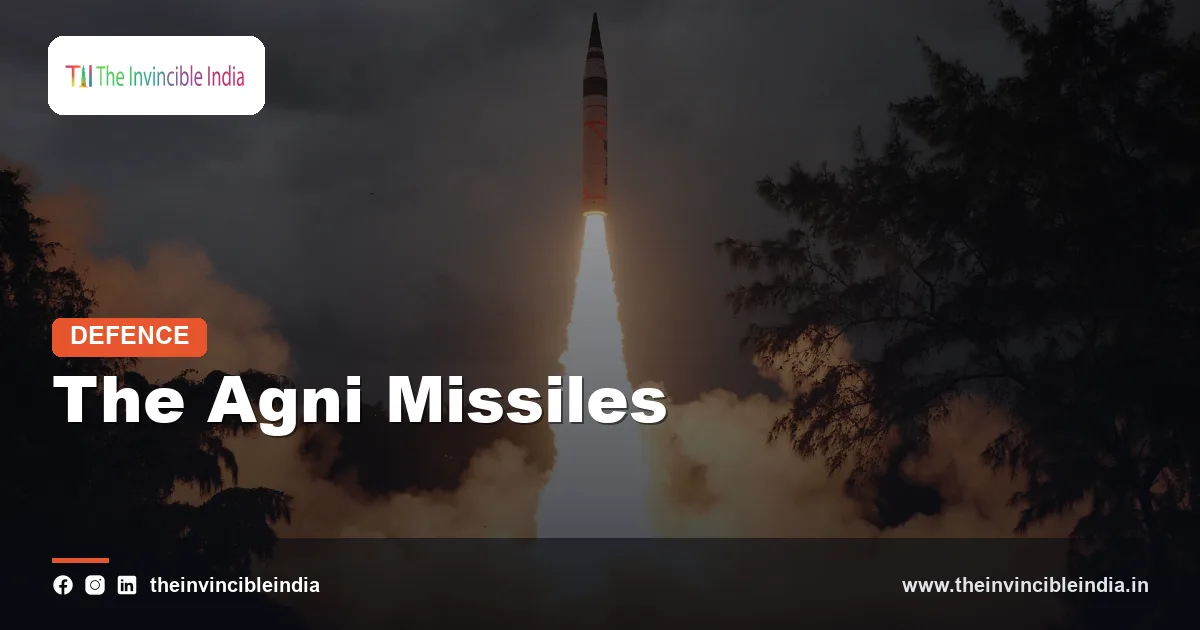
The Agni missile series is India’s family of surface-to-surface ballistic missiles, designed to carry nuclear and conventional warheads over distances ranging from a few hundred kilometres to well beyond five thousand kilometres. Developed by the Defence Research and Development Organisation (DRDO) under the Integrated Guided Missile Development Programme (IGMDP), the Agni missiles form the land-based backbone of India’s strategic deterrent. The name comes from the Sanskrit word for fire.
From a technology demonstrator tested in 1989 to the canisterised, intercontinental-class Agni-V and the newer Agni-Prime, the series shows how India built a long-range missile capability step by step. This explainer describes the origins of the programme, the different variants, the shift to solid-fuel propulsion, how the missiles fit into the doctrine of credible minimum deterrence and the nuclear triad, and what distinguishes one Agni from another. Ranges are given in approximate terms, since official figures are limited and performance depends on payload.
Quick Facts
| Feature | Details |
|---|---|
| Type | Surface-to-surface ballistic missiles, nuclear-capable |
| Developer | Defence Research and Development Organisation (DRDO) |
| Parent programme | Integrated Guided Missile Development Programme (IGMDP), begun in 1983 |
| Technology demonstrator | First flight in May 1989 |
| Propulsion | Solid-fuel rocket motors in operational variants |
| Operator | Strategic Forces Command (SFC), established in 2003 |
| Variants | Agni-I, Agni-II, Agni-III, Agni-IV, Agni-V and Agni-Prime |
| Range class | From short and medium range to intercontinental-class |
| Doctrine | Credible minimum deterrence with no first use |
Origins: The Integrated Guided Missile Development Programme
India’s missile programme took organised shape in the early 1980s, when the government approved the Integrated Guided Missile Development Programme in 1983. The programme was led by Dr A. P. J. Abdul Kalam and aimed to achieve self-reliance in missile technology rather than depending on imports, which were increasingly restricted. It had four principal strands: the Prithvi surface-to-surface missile, the Akash surface-to-air missile, the Trishul short-range surface-to-air missile and the Nag anti-tank missile. The Agni was added as a long-range programme.
The Defence Research and Development Laboratory in Hyderabad was the lead laboratory, and a network of DRDO labs, the Indian Space Research Organisation, public sector units and private industry contributed. The experience gained in satellite launch vehicles, especially the SLV-3, provided valuable know-how in rocket motors, guidance and re-entry technology.
The 1989 technology demonstrator
The first Agni flight, in May 1989, was a technology demonstrator intended to prove critical technologies, above all a re-entry vehicle that could survive the intense heat of coming back into the atmosphere. It combined a solid first stage derived from the SLV-3 with a liquid-fuelled second stage derived from Prithvi. The demonstrator was flown a few more times in the early 1990s and gave the team confidence to design operational missiles.
What Makes a Ballistic Missile Different
A ballistic missile is powered during the initial phase of flight, called the boost phase, after which it follows a free-falling trajectory under gravity, much like a thrown stone but on a vast scale. Long-range missiles travel outside the dense atmosphere for much of their path, then re-enter at very high speed. Unlike cruise missiles, which fly within the atmosphere like small aircraft, ballistic missiles are extremely fast and hard to intercept.
Range categories commonly used
| Category | Approximate range | Agni examples |
|---|---|---|
| Short range | Up to about 1,000 km | Prithvi series; low end of Agni-Prime |
| Medium range | About 1,000 to 3,000 km | Agni-I, Agni-II, Agni-Prime |
| Intermediate range | About 3,000 to 5,500 km | Agni-III, Agni-IV, Agni-V |
| Intercontinental | Above about 5,500 km | Agni-V is often described as at or near this threshold |
Official statements on Agni ranges are limited and sometimes deliberately cautious, so descriptions in open sources vary with payload and trajectory. The table should be read as a general guide, not a specification.
Agni-I: The Short-to-Medium Range Workhorse
Agni-I is a single-stage, solid-fuelled missile with a range of several hundred kilometres, commonly reported at the lower end of the medium-range class. It was developed to meet the need for a missile that could cover key regional targets while being quicker to handle than liquid-fuelled systems. Agni-I is road-mobile, launched from a transporter erector launcher, and can carry a nuclear or conventional warhead.
Its development benefited from the earlier technology demonstrator and from work on Prithvi. After successful tests in the early 2000s, it entered service with the Strategic Forces Command and has been tested again over the years in user trials, which are launches by the armed forces to confirm readiness and crew proficiency.
Why a shorter-range Agni?
Different targets and scenarios require different tools. A missile that can reach regional objectives, with a comparatively small and mobile launcher, gives planners flexibility. Agni-I fills this gap and also serves as a stepping stone in the technology ladder to longer-range systems.
Agni-II and Agni-III: Extending the Reach
Agni-II, first flown in 1999, is a two-stage solid-fuel missile with a range in the low thousands of kilometres, roughly in the two to three thousand kilometre band. It was an important step because it was fully solid-fuelled and road- and rail-mobile, which enhanced survivability and reaction time. It uses a heavier re-entry vehicle than the demonstrator and an improved guidance package.
Agni-III, tested from the mid-2000s, extended the reach to around three thousand kilometres or more. It is also a two-stage solid-fuel missile but with a larger diameter and greater thrust, and it uses more advanced navigation and a more sophisticated re-entry vehicle. Early tests had mixed results, but subsequent launches were successful and the missile was inducted.
Technology advances
- Higher-performance composite rocket motor casings that reduce weight.
- Improved inertial navigation, including ring laser gyroscopes.
- Better thermal protection for the re-entry vehicle.
- Mobile launch options that make the missile harder to track and destroy.
Agni-IV: A Lighter, More Advanced Missile
Agni-IV, first tested in 2011, is a two-stage solid-fuel missile with a range of roughly three and a half to four thousand kilometres. It is notable for its relatively light weight, achieved through advanced composite materials, and for its modern avionics, including a ring laser gyro-based inertial navigation system and a micro-navigation system. It also features an advanced re-entry vehicle with improved thermal protection and accuracy.
Agni-IV is launched from a road-mobile transporter and was tested several times from Abdul Kalam Island, formerly Wheeler Island, off the Odisha coast, including user trials by the Strategic Forces Command. The missile also served as a technology base for the development of the longer-range Agni-V, since it validated lightweight composites, electronics and mobile launch systems.
The testing range
Most Agni tests take place at the Integrated Test Range at Chandipur and at the island launch complex in Odisha, where the Bay of Bengal offers a clear downrange area for impact. NOTAMs and maritime warnings are issued before each test to keep ships and aircraft away from the flight path.
Agni-V: The Longest-Range Agni
Agni-V is the longest-range missile in the series and the centrepiece of India’s strategic land-based deterrent. First tested in April 2012, it is a three-stage, solid-fuelled missile with a range commonly reported as more than five thousand kilometres, which places it at or close to the intercontinental threshold. It marked the entry of India into a small group of countries with missiles of this class.
Agni-V introduced a number of notable innovations. It is designed to be canisterised, that is, stored and launched from a sealed canister that can be carried on a road vehicle. The canister protects the missile, allows quick deployment from many locations and shortens the time needed to prepare for launch. Canisterised launches were successfully conducted from the mid-2010s onwards, and user trials followed.
MIRV capability
In March 2024, India announced a successful test of Agni-V with multiple independently targetable re-entry vehicle (MIRV) technology, under a mission named Divyastra. A MIRV missile carries several warheads that can be aimed at different targets, which increases the effectiveness of a single missile and complicates missile defence. The announcement was widely seen as a significant technological milestone.
Agni-Prime: The Next-Generation Missile
Agni-Prime, also called Agni-P, is a newer-generation, two-stage, solid-fuel missile in the medium-range class, with a range generally reported in the region of a thousand to two thousand kilometres. It is intended to replace older systems such as Agni-I and Agni-II. Compared with them, it is lighter and uses composite materials, advanced guidance, manoeuvring re-entry vehicles and dual redundant navigation and guidance systems for higher accuracy.
The missile is canisterised, so it can be moved and launched from different platforms. After its first flight in 2021, further tests included launches by the Strategic Forces Command and, later, demonstrations from rail-based mobile launchers, which would allow the missile to be moved across the rail network and fired from many points, making detection difficult.
Why it matters
- It modernises the shorter and medium range end of the Agni family.
- Its canister and mobile launch options improve survivability.
- It applies lessons from Agni-IV and Agni-V to a smaller, more flexible system.
Reports of a further Agni-VI have appeared from time to time in the media, but no such missile has been officially confirmed as an operational programme, and these remain speculative.
Solid-Fuel Propulsion and Canisterisation
One of the defining engineering choices in the Agni programme is the move from liquid to solid propellants. Liquid-fuelled missiles, such as the early Prithvi, need to be fuelled shortly before launch, which takes time and exposes them to risk. Solid-fuelled missiles are loaded with propellant at the factory and can be stored ready for years, enabling rapid launch.
| Aspect | Solid fuel | Liquid fuel |
|---|---|---|
| Readiness | Very quick, always loaded | Slower, fuelling needed |
| Storage | Simple and long-lasting | Complex, hazardous handling |
| Control of thrust | Limited once ignited | Better, can be throttled |
| Mobility | Easier to move and hide | More difficult |
Canisterisation adds another layer: the missile is stored in a sealed tube, usually with a controlled environment, that serves as both transport container and launch tube. The result is a weapon that can be moved discreetly, protected from the environment and launched with a short preparation time. This is important for survivability and for ensuring that a second-strike capability remains credible.
Role in Credible Minimum Deterrence
India conducted nuclear tests at Pokhran in 1974 and again in May 1998, after which it declared itself a nuclear weapon state. The draft nuclear doctrine of 1999 and the official doctrine adopted in January 2003 set out the principles: credible minimum deterrence, a posture of no first use against nuclear-armed states and non-nuclear weapon states, massive retaliation in the event of a nuclear attack on India or its forces, and strict civilian political control over nuclear weapons.
Within this framework, the Agni missiles provide the means of delivery that make deterrence credible. The Strategic Forces Command, created in 2003, manages the nuclear forces and operates under the Nuclear Command Authority, which is chaired by the Prime Minister and includes a Political Council and an Executive Council. Credible minimum deterrence does not mean matching rivals warhead for warhead; it means having a survivable force capable of inflicting unacceptable damage in response to an attack.
Survivability and assured retaliation
A deterrent works only if it can survive a first strike. This is why India emphasises mobility, canisterisation, dispersal and a sea-based leg. Road and rail mobility makes it hard for an adversary to locate every missile, while solid fuel allows quick launch.
The Nuclear Triad and Agni’s Place in It
A nuclear triad consists of three delivery legs: land-based missiles, air-delivered weapons and sea-based missiles. India declared its triad operational in November 2018 with the first deterrence patrol of the nuclear-powered ballistic missile submarine INS Arihant.
- Land: the Agni and Prithvi series of ballistic missiles, mobile and dispersed.
- Air: nuclear-capable strike aircraft able to deliver gravity bombs and air-launched missiles.
- Sea: ballistic missile submarines of the Arihant class armed with submarine-launched ballistic missiles of the K series.
The Agni missiles dominate the land leg, which offers high readiness and flexible range options. The sea leg gives assured second-strike capability because submarines are very hard to detect. Together, the legs complement one another, giving planners resilience against failures or surprise attacks.
Challenges, Missile Defence and Arms Control Context
Developing and maintaining a missile force involves significant technical and diplomatic challenges. Re-entry vehicles must survive extreme heat, guidance systems must be accurate over long distances, and motors need to work reliably after long storage. Each new variant requires repeated flight tests to build confidence, which is why launches are conducted periodically even for older versions.
The development of ballistic missile defence by various countries, and the spread of advanced technologies like hypersonic glide vehicles, shape the strategic environment. India has also developed its own missile defence programme, which is separate from the Agni series. India is not a member of the Nuclear Non-Proliferation Treaty and has maintained a voluntary moratorium on nuclear testing since 1998, while following export-control norms and joining the Missile Technology Control Regime in 2016.
Conclusion
The Agni missile series illustrates how India turned a research project into a mature strategic capability. From the 1989 demonstrator to Agni-I, Agni-II, Agni-III, Agni-IV, Agni-V and Agni-Prime, the family has grown in range, accuracy and survivability, with solid propulsion and canisterisation as key features. Embedded in a doctrine of credible minimum deterrence and a nuclear triad, the missiles are intended to prevent conflict rather than to fight it. Last reviewed: 3 October 2026.
Frequently Asked Questions
Who developed the Agni missiles?
The Agni missiles were developed by the Defence Research and Development Organisation under the Integrated Guided Missile Development Programme, which began in 1983 and was led by Dr A. P. J. Abdul Kalam. The Defence Research and Development Laboratory in Hyderabad was the lead laboratory.
What are the different Agni missile variants?
The series includes Agni-I, Agni-II, Agni-III, Agni-IV, Agni-V and the newer Agni-Prime. They range from short-to-medium range systems of several hundred to a couple of thousand kilometres up to Agni-V, which has a reported range of more than five thousand kilometres.
Why are Agni missiles solid-fuelled?
Solid propellant is loaded at the factory, so the missile can be stored for long periods and launched quickly, without time-consuming fuelling. This makes the missile easier to move and hide, which improves survivability and supports a credible second-strike capability.
What is special about Agni-V?
Agni-V is the longest-range Agni, a three-stage solid-fuel missile with a canisterised launch system for rapid, flexible deployment. In 2024, India announced a successful test with MIRV technology, which allows one missile to carry multiple warheads aimed at different targets.
Who operates the Agni missiles?
The missiles are operated by the Strategic Forces Command, created in 2003, which functions under the Nuclear Command Authority chaired by the Prime Minister. Civilian political leadership retains control over any decision on the use of nuclear weapons.
How do the Agni missiles fit into India’s nuclear triad?
The Agni missiles form the land-based leg of the triad, alongside air-delivered weapons and submarine-launched ballistic missiles on the Arihant class. Together, the three legs provide a survivable force that supports credible minimum deterrence and a no first use policy.


