

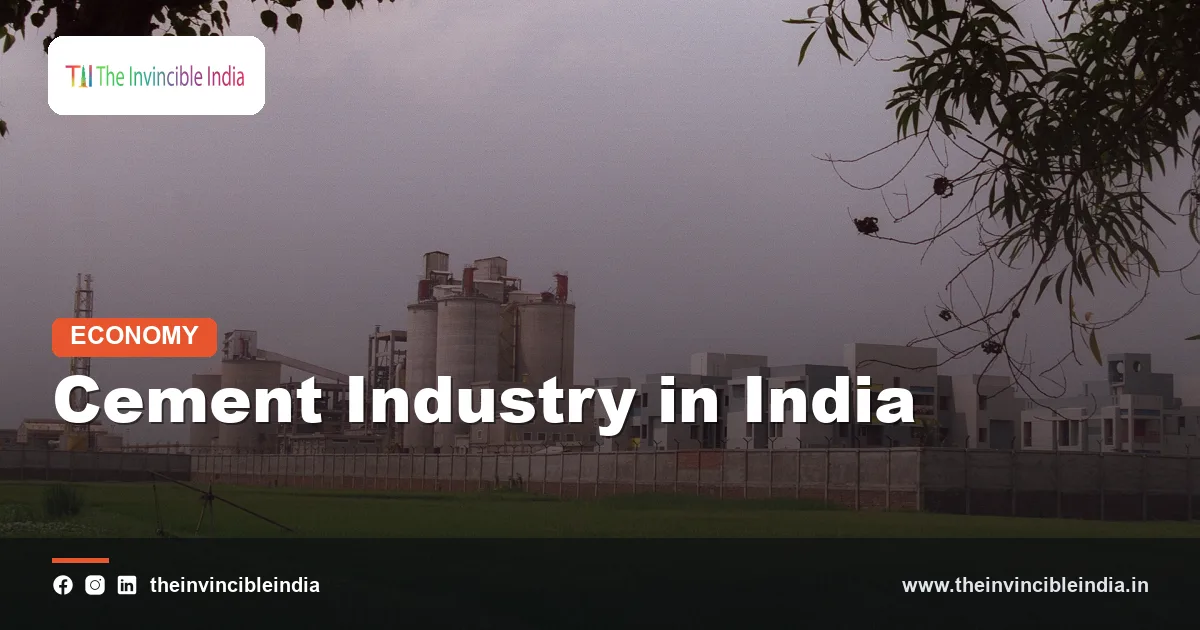
Every highway, metro pillar, dam, apartment block and village school road in India rests on cement. The cement industry in India is among the country’s oldest core industries and one of its most reliable barometers of construction activity. India is the second-largest producer of cement in the world, behind China, and the sector sits at the meeting point of mining, energy, transport and real estate.
Cement is a bulk commodity with a distinctive economic character: it is cheap relative to its weight, expensive to move over long distances, and made from raw materials that are found only in particular regions. That is why its geography, ownership and pricing look so different from those of other industries. This article explains how cement is made, where it is produced, who the major players are, what drives demand, and how the industry is trying to cut its large carbon footprint.
Quick Facts
| Aspect | Details |
|---|---|
| Global rank | Second-largest cement producer in the world, after China |
| First successful plant | Chennai (then Madras), 1904 |
| Key raw material | Limestone, together with clay, gypsum and fuel |
| Main product types | Ordinary Portland Cement, Portland Pozzolana Cement, Portland Slag Cement |
| Decontrol | Partial in 1982, full price and distribution decontrol in 1989 |
| Major groups | UltraTech, Ambuja and ACC, Shree Cement, Dalmia Bharat, among others |
| Main demand drivers | Housing, infrastructure, commercial construction |
| Principal challenge | High energy use and carbon dioxide emissions |
A Short History of Cement in India
Cement has a curious early story in India. Early attempts at manufacture in the nineteenth century, including an effort near Calcutta in 1889, used limited technology and did not last. The first commercially successful plant was set up at Madras in 1904 by the South India Industrial Company. A few years later, plants began operating at Porbandar in Gujarat, Katni in what is now Madhya Pradesh, and Lakheri in Rajasthan.
The Indian cement industry took an organised shape in 1936, when ten companies merged to form the Associated Cement Companies, later known as ACC, and a sister company marketed products under a single banner. The Second World War, the planned development era after independence and the demands of big projects such as dams and steel plants raised demand steadily. The government controlled prices and distribution for decades, which led to shortages and queues of builders waiting for supplies.
Reform came in stages. The government partially decontrolled the industry in 1982, allowing producers to sell a share of output at market prices, and removed price and distribution controls in 1989. Further liberalisation in the early 1990s, including delicensing, encouraged new capacity, modern technology and foreign participation. Over the following decades, large groups expanded through greenfield plants and acquisitions, leading to a more consolidated industry.
How Cement Is Made
Cement making is essentially the controlled cooking of finely ground rocks into a hard material called clinker, which is then ground with a small amount of gypsum to create the grey powder used on construction sites.
Step 1: Quarrying and crushing
Limestone, the main raw material, is blasted or cut from open-cast mines near the plant and fed through crushers. Roughly one and a half tonnes of limestone are needed for each tonne of clinker. Smaller quantities of clay, shale, iron ore and bauxite are added to adjust the chemical composition.
Step 2: Raw meal grinding and blending
The crushed materials are ground to a fine powder, called raw meal, in a raw mill and blended so that the chemistry is uniform. Modern plants use the dry process, in which the meal is fed in a dry state, because it uses much less fuel than the older wet process in which a slurry was used.
Step 3: Burning in the kiln
The raw meal is heated in a preheater tower and then in a rotary kiln, where temperatures reach about 1,450 degrees Celsius. Limestone breaks down into lime and carbon dioxide, and the lime reacts with silica, alumina and iron to form clinker nodules.
Step 4: Cooling, grinding and packing
The clinker is cooled rapidly and stored, then ground with a few per cent of gypsum, which controls the setting time, and in some products with fly ash or slag. The finished cement is dispatched in bags, usually of fifty kilograms, or in bulk by road and rail.
Types of Cement
The Bureau of Indian Standards prescribes specifications for each type, and the choice depends on the application.
| Type | Composition | Typical use |
|---|---|---|
| Ordinary Portland Cement (OPC) | Mostly clinker with gypsum, sold in different strength grades | High-strength structural work, precast and specialist applications |
| Portland Pozzolana Cement (PPC) | Clinker and gypsum blended with fly ash or other pozzolanic material | General construction, masonry, plaster, mass concrete |
| Portland Slag Cement (PSC) | Clinker blended with granulated blast furnace slag | Marine, sewage and other aggressive environments |
| White cement | Low-iron raw materials | Decorative finishes, tiles and wall putty |
| Oil well and sulphate-resisting cements | Special formulations | Oil wells, foundations in sulphate-rich soil |
Blended cements such as PPC and PSC now account for a majority of Indian sales, helped by the availability of fly ash from thermal power stations and slag from steel plants. They use less clinker per tonne, which is good for emissions.
Where Cement Is Made: Regional Clusters
Since limestone cannot be economically moved over long distances, cement plants cluster around limestone belts. Over time, regional hubs have emerged, and each serves a market within a certain economic radius, because transport costs rise quickly with distance.
- Rajasthan: limestone-rich districts around Chittorgarh, Nimbahera, Beawar and Jaisalmer support several large plants that serve the northern and western markets.
- Madhya Pradesh: the Satna belt, historically one of the densest clusters in Asia, along with Katni, Maihar and nearby areas.
- Gujarat: the Saurashtra and Kutch coast, with plants such as those at Kodinar, Ambuja Nagar and Sikka, which also have access to ports for export and coastal movement.
- Andhra Pradesh and Telangana: Nalgonda, Kurnool, Kadapa and Guntur regions, known for large capacities serving the south and east.
- Karnataka: the Kalaburagi district around Sedam and Chittapur.
- Chhattisgarh and Odisha: limestone deposits and nearby coal and steel plants make this a major hub for the east.
- Tamil Nadu: districts such as Ariyalur and the Coimbatore region.
- Himachal Pradesh and Punjab belt: plants in the foothills, including around Baddi and Darlaghat.
Coastal grinding units and bulk terminals have also come up near major cities, where clinker from the limestone belts is ground and distributed, a model known as split location. This reduces the transport of bagged cement over long distances.
Major Producers
The industry is concentrated at the top, although a long tail of regional companies remains. The big players have grown by building capacity and by acquisitions.
UltraTech Cement
Part of the Aditya Birla Group, UltraTech began in the 1980s, and it grew through acquisition of the cement business of Larsen and Toubro in 2004 and several later purchases. It is the largest cement company in India by capacity and has plants in many States.
Ambuja Cements and ACC
Ambuja started in 1983 in Gujarat and was known for its coastal location and for efficiency. ACC, India’s oldest cement company, dates from 1936. After Holcim entered both companies, the Adani Group acquired the Indian cement holdings of Holcim in 2022, bringing the two under a common group that has since expanded further.
Shree Cement
Founded in 1979 in Beawar, Rajasthan, Shree Cement built a reputation for low operating costs, strong use of waste heat recovery and a push into new regions.
Dalmia Bharat
Dalmia Bharat has deep roots in the south and east, and it has been vocal about climate targets and low-carbon products.
Others
Other well-known producers include JK Cement, JK Lakshmi, Ramco Cements, The India Cements, Birla Corporation, Nuvoco, Heidelberg, Orient and a number of regional firms. Public sector units such as the Cement Corporation of India also exist, though with a small share.
Demand Drivers
Cement demand follows construction, and construction in India follows a mix of household, public and corporate spending.
- Housing: the largest single segment, especially individual home construction in rural and semi-urban areas, along with urban apartments and affordable housing programmes.
- Infrastructure: roads, railways, metro systems, ports, airports, irrigation and power projects, which depend heavily on public capital expenditure.
- Commercial and industrial building: offices, warehouses, logistics parks, factories and malls.
- Government schemes: rural housing, urban missions and rural road programmes support steady local demand.
The sector is strongly seasonal. Demand dips during the monsoon, when construction slows, and recovers in the post-monsoon months and in the last quarter of the financial year, when public spending speeds up. Prices also vary regionally, with the south historically being more volatile because of surplus capacity.
Per-capita consumption in India remains well below that of many developed and some emerging economies, which suggests a long runway for growth as urbanisation and infrastructure building continue. Capacity utilisation across the industry is typically moderate, since the industry has added capacity ahead of demand.
Economics: Costs, Logistics and Pricing
Cement making is capital intensive and cost conscious. The main cost heads are power and fuel, raw materials, freight, and packing and selling expenses.
- Power and fuel: a major cost, met through coal, petroleum coke, grid electricity, captive power plants and increasingly renewable energy and alternative fuels.
- Freight: a large fraction of the delivered cost because of the weight of the product, so proximity to markets and rail connectivity are important.
- Raw materials: limestone mine leases are scarce and valuable, and mining rights are regulated under mineral laws, with royalty and auction rules.
- Distribution: a network of dealers and retailers sells to individual home builders, while institutional sales go directly to large projects.
Prices are set regionally, and the competition between producers is fierce. The Competition Commission of India has examined concerns about price coordination in the sector in the past, so the industry is closely watched. Cement is a goods item under the Goods and Services Tax, and any change in the tax rate affects consumer prices and demand.
Energy Intensity and Environmental Footprint
Cement is one of the most energy-intensive and carbon-intensive industrial products. Emissions come from two main sources. The larger share arises from the chemical reaction in the kiln, called calcination, in which limestone releases carbon dioxide. The rest comes from burning fuel to heat the kiln and from electricity use in grinding.
Since a significant fraction of emissions is built into the chemistry, cutting them requires more than just efficiency. Environmental issues also include dust from quarrying and crushing, the use of land and water, and the impact on local communities, so plants are expected to follow pollution control norms, restore mined areas and invest in local development.
India’s cement plants are, however, among the more energy efficient in the world on average, with a large share of modern dry-process kilns, waste heat recovery systems and a high use of blended cement. Improving on this further is the goal of the next phase.
Decarbonisation and the Blended Cement Challenge
The industry has committed to reduce emissions through several levers, and many companies have announced long-term net-zero goals.
Levers for lowering emissions
- More blended cement: replacing part of the clinker with fly ash, slag or calcined clay reduces process emissions directly.
- Alternative fuels and raw materials: using municipal and industrial waste, biomass and refuse-derived fuel in kilns, a practice also called co-processing.
- Waste heat recovery: capturing heat from kiln exhaust to produce electricity.
- Renewable energy: solar, wind and hybrid power to supply plants, reducing grid dependence.
- New technologies: carbon capture, utilisation and storage, low-carbon clinker and novel binders, which are still at early stages.
The blended cement challenge
Blended cement is already widely used, but there are limits to how far it can go. Supplies of fly ash will decline as coal-based power generation stabilises or falls, and slag availability depends on steel production in particular regions. Calcined clay, combined with limestone, offers a promising alternative. Builders and engineers must also be comfortable with the strength gain and curing behaviour of blended cements, so codes, training and awareness play a role as much as technology.
Conclusion
The cement industry in India has moved from shortage and control to scale and competition, and it now stands as the world’s second-largest producer. Its future is tied to the country’s building boom, which will need large amounts of cement for housing and infrastructure, and to its ability to manage the emissions that come with it. If producers can expand capacity close to markets, secure limestone and raw materials responsibly, and move steadily towards blended cements, alternative fuels and renewable power, cement can continue to support growth without overwhelming the climate. For readers, the sector is a good example of how geology, logistics and policy shape a basic industrial product.
Frequently Asked Questions
Where does India rank in cement production?
India is the second-largest producer of cement in the world, after China. The industry has grown steadily alongside housing and infrastructure construction, and it supplies almost all of the country’s domestic requirement.
What are the raw materials for cement?
The main raw material is limestone, supplemented by clay, shale, iron ore or bauxite for adjusting chemistry, and gypsum added at the grinding stage. Fly ash and slag are also used in blended cements.
Which are the major cement companies in India?
The leading groups include UltraTech Cement, Ambuja Cements and ACC, Shree Cement and Dalmia Bharat. Other significant players include JK Cement, Ramco Cements, The India Cements and Birla Corporation, along with many regional producers.
Why are cement plants located near limestone deposits?
Limestone is needed in large quantities, roughly one and a half tonnes for every tonne of clinker, and it is heavy and cheap to carry only over short distances. For that reason, plants are built near limestone belts in States such as Rajasthan, Madhya Pradesh, Gujarat, Andhra Pradesh and Telangana.
What is blended cement and why does it matter?
Blended cement, such as Portland Pozzolana Cement or Portland Slag Cement, replaces part of the clinker with materials like fly ash or slag. Because clinker making causes most of the emissions, blended cement lowers the carbon footprint of each tonne of cement.
Why is the cement industry considered carbon intensive?
Producing clinker requires heating limestone in a kiln at very high temperatures, which both consumes a lot of fuel and releases carbon dioxide from the limestone itself. A large part of the emissions comes from this chemical reaction, so reducing them needs changes in materials and technology as well as energy efficiency.
{“@context”:”https://schema.org”,”@graph”:[{“@type”:”FAQPage”,”mainEntity”:[{“@type”:”Question”,”name”:”Where does India rank in cement production?”,”acceptedAnswer”:{“@type”:”Answer”,”text”:”India is the second-largest producer of cement in the world, after China. The industry has grown steadily alongside housing and infrastructure construction, and it supplies almost all of the country’s domestic requirement.”}},{“@type”:”Question”,”name”:”What are the raw materials for cement?”,”acceptedAnswer”:{“@type”:”Answer”,”text”:”The main raw material is limestone, supplemented by clay, shale, iron ore or bauxite for adjusting chemistry, and gypsum added at the grinding stage. Fly ash and slag are also used in blended cements.”}},{“@type”:”Question”,”name”:”Which are the major cement companies in India?”,”acceptedAnswer”:{“@type”:”Answer”,”text”:”The leading groups include UltraTech Cement, Ambuja Cements and ACC, Shree Cement and Dalmia Bharat. Other significant players include JK Cement, Ramco Cements, The India Cements and Birla Corporation, along with many regional producers.”}},{“@type”:”Question”,”name”:”Why are cement plants located near limestone deposits?”,”acceptedAnswer”:{“@type”:”Answer”,”text”:”Limestone is needed in large quantities, roughly one and a half tonnes for every tonne of clinker, and it is heavy and cheap to carry only over short distances. For that reason, plants are built near limestone belts in States such as Rajasthan, Madhya Pradesh, Gujarat, Andhra Pradesh and Telangana.”}},{“@type”:”Question”,”name”:”What is blended cement and why does it matter?”,”acceptedAnswer”:{“@type”:”Answer”,”text”:”Blended cement, such as Portland Pozzolana Cement or Portland Slag Cement, replaces part of the clinker with materials like fly ash or slag. Because clinker making causes most of the emissions, blended cement lowers the carbon footprint of each tonne of cement.”}},{“@type”:”Question”,”name”:”Why is the cement industry considered carbon intensive?”,”acceptedAnswer”:{“@type”:”Answer”,”text”:”Producing clinker requires heating limestone in a kiln at very high temperatures, which both consumes a lot of fuel and releases carbon dioxide from the limestone itself. A large part of the emissions comes from this chemical reaction, so reducing them needs changes in materials and technology as well as energy efficiency.”}}]}]}


