

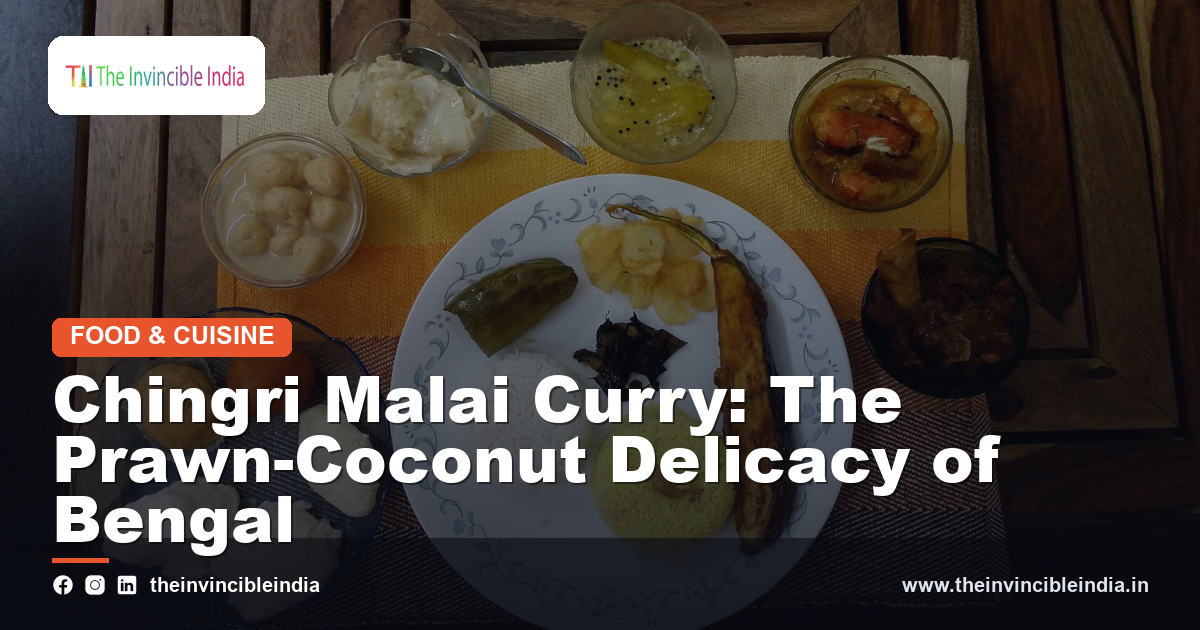
Chingri malai curry, also spelled chingri malaikari and often called prawn malai curry or Bengali prawn coconut curry, is a mildly spiced, creamy dish of Bengal in which large prawns are simmered in a gravy of coconut milk, ghee and fragrant whole spices. The word chingri means prawn in Bengali, and malai suggests the cream-like richness of the sauce, which in the classic version comes from coconut rather than dairy cream. It is a dish of celebration, served at weddings, festive lunches and special Sunday meals, and a prized example of the seafood tradition described in the guide to Bengali cuisine. This guide explains what the dish is, how it is made and why it holds such esteem in Bengali food culture.
Quick answer: Chingri malai curry is a Bengali dish of prawns cooked in a mild, creamy gravy of coconut milk, onion, ginger, ghee and whole spices such as cardamom, cinnamon and clove. It is also called chingri malaikari and is traditionally made with large freshwater prawns known as golda chingri. Served with steamed rice or pulao, it is one of the most celebrated festive seafood dishes of Bengal.
Key Takeaways
- Chingri malai curry is a classic seafood dish of Bengal, eastern India, and is also spelled chingri malaikari.
- Chingri means prawn in Bengali, and malai refers to the creamy richness of the coconut milk gravy.
- The traditional choice is golda chingri, the large freshwater prawn valued in Bengali cooking.
- Whole spices such as cardamom, cinnamon, clove and bay leaf scent the gravy, which is mild rather than fiery.
- Mustard oil and ghee are commonly used, giving the dish a distinctive Bengali aroma and richness.
- A related presentation, daab chingri, cooks the prawns inside a green coconut and is served at festive meals.
Read on for the ingredients, method, serving customs, and cultural role in detail.
Quick Facts
| Detail | Information |
|---|---|
| Dish | Chingri malai curry (chingri malaikari, Bengali prawn coconut curry) |
| Region | Bengal, eastern India and Bangladesh |
| Type | Seafood curry, festive main dish |
| Main ingredients | Prawns (golda chingri), coconut milk, onion, ginger |
| Fats used | Mustard oil and ghee |
| Whole spices | Cardamom, cinnamon, clove, bay leaf |
| Taste | Mild, creamy, lightly sweet and aromatic |
| Usually served with | Steamed rice, pulao or luchi |
What is chingri malai curry?
Chingri malai curry is a Bengali prawn curry in which large prawns are gently cooked in a smooth, pale gold gravy of coconut milk and mild spices. It is considered a dish for special meals, and its refined, creamy character sets it apart from the more pungent mustard-based prawn preparations of Bengal. The gravy is lightly seasoned with ginger, green chilli, onion paste and whole spices, and finished with ghee for aroma. The prawns remain the focus, cooked just long enough to stay tender and sweet. In Bengali homes the curry usually appears alongside plain rice and a few simple accompaniments rather than a heavy array of dishes. Chingri malai curry thus offers a delicate, rich and fragrant example of Bengal’s love for seafood and coconut.
What are the other names of chingri malai curry?
Chingri malai curry is also called chingri malaikari, prawn malai curry, malai chingri and Bengali prawn coconut curry. The word malaikari combines malai, meaning cream or richness, with kari, the Bengali form of curry, and it is used for several creamy Bengali preparations in which fish or prawns are cooked in coconut milk. In some regions of Bengal and in Bangladesh the same dish is simply described as chingri macher malaikari, where macher means of fish and the prawn is treated as a type of seafood. Restaurants outside Bengal often shorten the name to prawn malai curry. Knowing these different names helps readers recognise the same creamy coconut prawn dish across menus, cookbooks and family recipes. The names all point to a single, treasured preparation.
Where does chingri malai curry come from?
Chingri malai curry comes from Bengal, the Bengali-speaking region of eastern India and present-day Bangladesh, a land of rivers and wetlands where freshwater prawns and coconut are both widely used. The dish belongs to the broader tradition of malaikari, a class of coconut-based preparations that are popular in the region’s celebratory cooking. Its exact origin and date are not firmly documented, and any claim of a specific inventor should be treated with caution. What is evident is that the dish became a symbol of festive Bengali dining, particularly in households that prize seafood. Bengal’s long coastline in the south and its network of rivers supplied prawns, while coastal trade provided coconut. The dish reflects this meeting of land, water and kitchen craft.
Why are prawns so important in Bengali cuisine?
Prawns are important in Bengali cuisine because the region’s rivers, delta and coast supply abundant fish and shellfish, and seafood is central to everyday and festive eating. Bengali meals commonly feature fish curries, fried fish and prawn dishes served with rice, and the language has specific names for many kinds of fish. Prawns, called chingri, are treasured for their sweetness and are cooked in mustard paste, coconut, poppy seed and many other styles. Large freshwater prawns in particular are associated with feasts and special occasions. The cultural importance of seafood is also reflected in customs around weddings and festivals, where fish and prawn dishes are considered auspicious. Chingri malai curry therefore draws on a deep culinary relationship between Bengalis and the waters around them.
What is golda chingri?
Golda chingri is the large freshwater prawn, often called giant river prawn or scampi in English, that is the traditional choice for chingri malai curry. It is recognised by its long, strong claws and sweet, firm flesh, and it is found in the rivers and ponds of Bengal and neighbouring regions. The head of the golda chingri is rich in flavour, and many cooks keep it on during cooking so that the fat enriches the gravy. When golda chingri is unavailable, large saltwater prawns or tiger prawns are often used as substitutes, though the flavour is slightly different. Choosing fresh, well-sized prawns is considered the first step to a good malaikari. The prized status of golda chingri explains much of the dish’s reputation as a luxury meal.
What ingredients go into chingri malai curry?
Chingri malai curry is made from prawns, coconut milk, onion, ginger, green chillies, mustard oil, ghee, sugar, salt and whole spices. The whole spices usually include cardamom, cinnamon, cloves and bay leaf, and a little ground cumin and turmeric are common. Grated onion and ginger paste form the base of the gravy, while coconut milk supplies the cream-like body that gives the dish its name. A pinch of sugar rounds out the flavour and brings out the natural sweetness of the prawns. A final spoonful of ghee adds richness and fragrance. Garam masala is sometimes added at the end for aroma. The ingredient list is restrained, and the quality of the prawns and coconut milk largely determines how good the dish tastes.
The Role of Coconut Milk
Coconut milk is the soul of chingri malai curry, providing its creamy texture, gentle sweetness and the malai character of the sauce. Traditional cooks extract coconut milk from freshly grated coconut, pressing out a thick first milk and a thinner second milk, and they often add the thinner milk first and the thick milk at the end to keep the gravy glossy and smooth. Packaged coconut milk is widely used in modern kitchens and works well when handled gently. Coconut milk can split if boiled too hard, so the curry is simmered over low heat. The mild sweetness of coconut also softens the flavour of the whole spices and the heat of the green chillies. Coconut milk therefore gives the curry both its body and its soothing, rounded flavour.
How is chingri malai curry cooked?
Chingri malai curry is cooked by lightly frying the marinated prawns, preparing a spiced onion and ginger base, adding coconut milk and simmering until the gravy is creamy. The cleaned prawns are first marinated with salt and turmeric and fried briefly in mustard oil so that they stay tender and take on a gentle colour. In the same pan, whole spices and bay leaf are tempered, onion and ginger paste are cooked until fragrant, and a little sugar is added. Coconut milk is poured in and the mixture is simmered gently, then the prawns return to the pan to finish cooking. A spoonful of ghee and a slit green chilli complete the dish. Gentle heat and careful timing keep the prawns succulent and the gravy smooth.
Mustard Oil, Ghee and the Bengali Aroma
Mustard oil and ghee give chingri malai curry its distinctive Bengali aroma, with mustard oil supplying a sharp, nutty note and ghee adding smooth richness. Mustard oil is the traditional cooking medium of Bengal and is usually heated until it loses its raw pungency before the prawns are fried. Its slight bite contrasts pleasantly with the sweet coconut milk and prevents the curry from tasting flat. The finishing ghee mellows these flavours and perfumes the gravy. Some modern cooks use refined oil to lessen the pungency, but many Bengalis feel that the characteristic taste of the dish depends on mustard oil. The careful pairing of oil and ghee demonstrates how Bengali cooks layer fats to create depth within an otherwise mild and delicate curry.
What is daab chingri?
Daab chingri is a related Bengali preparation in which prawns are cooked in a tender green coconut, called daab, with coconut flesh, mustard and spices. The coconut is cut open at the top, filled with the marinated prawns and sauce, and then steamed or baked until cooked, so that the shell itself acts as a serving vessel. The coconut water and soft flesh add a natural sweetness and aroma. Daab chingri is often served at celebrations and in restaurants as a showpiece version of Bengali prawn cooking. While it shares prawns and coconut with chingri malai curry, its sauce is usually mustard-led rather than creamy. The two dishes together show the creative range of Bengal’s coconut and seafood traditions.
What is chingri malai curry served with?
Chingri malai curry is usually served with plain steamed rice, and on festive occasions it may accompany pulao, fried rice or luchi. Plain rice is preferred because it lets the delicate flavours of coconut and prawn stand out without competition. A traditional Bengali lunch may begin with bitter vegetables and dal, followed by fish and prawn dishes, and end with chutney and sweets, with the malaikari taking its place as a highlight in the middle. Simple sides such as fried vegetables or a light salad balance the richness of the curry. When served with luchi, the soft, puffed Bengali bread, it forms a particularly indulgent combination. The pairing reflects a preference for mild accompaniments that frame the curry.
Chingri Malai Curry at Weddings and Festive Meals
Chingri malai curry is a favourite at Bengali weddings, Sunday family lunches and festive gatherings, where it stands as a mark of generous hospitality. Prawn and fish dishes are considered auspicious in Bengali culture, and a special prawn curry on the table signals the importance of the occasion. In many families a particular cook is known for a signature version, and the recipe may be passed down through generations. Caterers and community feasts often include it in the menu for guests who enjoy seafood. The dish is also commonly cooked for guests visiting from far away, as a gesture of welcome. Through such customs, chingri malai curry joins taste with tradition in the social and celebratory life of Bengal.
How does chingri malai curry compare with other Indian prawn curries?
Chingri malai curry differs from most other Indian prawn curries in being mild, creamy and gently sweet rather than fiery, sour or heavily spiced. The Goan prawn preparations are built on vinegar and chillies, as in Goan prawn balchao, while Kerala and Mangalore curries commonly rely on tamarind and coconut with stronger heat. Bengal’s own prawn dishes include mustard-based preparations that are sharper in flavour. Malaikari is distinctive for its use of whole spices, ghee and coconut milk in a restrained manner that highlights the prawn. The comparison shows how a single ingredient, prawn, can be treated very differently across regions. Chingri malai curry represents the Bengali preference for subtle, aromatic and creamy seafood cooking.
Tips for a Smooth and Fragrant Malaikari
A smooth and fragrant chingri malai curry depends on fresh prawns, gentle heat and careful handling of the coconut milk. Cooks recommend not overcooking the prawns, since they turn rubbery after a few minutes beyond doneness, and adding them toward the end of the simmering. Coconut milk should be warmed rather than boiled hard, to avoid splitting. Tempering the whole spices lightly in oil brings out their aroma without burning them. Tasting for sweetness and salt before finishing with ghee helps balance the dish, and slitting rather than chopping the green chillies gives gentle heat without overpowering the cream. Serving the curry fresh gives the best texture. These practical points reflect the patient, aroma-focused approach that Bengali cooks bring to this celebrated dish.
Chingri Malai Curry Today
Chingri malai curry today remains one of the most admired dishes of Bengali cuisine, served in family kitchens, Bengali restaurants and festive buffets in India and around the world. Many diners outside Bengal first encounter it as prawn malai curry on restaurant menus, often as a recommended speciality. Home cooks continue to prepare it for celebrations, while chefs experiment with presentation, using coconut shells or modern plating. Frozen prawns and packaged coconut milk have made the dish easier to prepare far from the Bengal delta. Food writers frequently cite it as a prime example of the elegance of Bengali seafood cooking. Chingri malai curry endures as a symbol of festive Bengali dining, linking prawns, coconut and generous hospitality.
Sources & Further Reading
- Ministry of Culture, Government of India (indiaculture.gov.in).
- Ministry of Tourism, Government of India (tourism.gov.in).
Frequently Asked Questions
What is chingri malai curry?
Chingri malai curry is a Bengali dish of prawns cooked in a mild, creamy gravy of coconut milk, onion, ginger, ghee and whole spices. It is also called chingri malaikari and is traditionally made with large freshwater prawns.
What does chingri mean in Bengali?
Chingri means prawn or shrimp in Bengali. In the name chingri malai curry, it identifies the main ingredient, while malai refers to the creamy coconut milk gravy.
Is chingri malai curry made with cream?
Chingri malai curry is traditionally made with coconut milk rather than dairy cream. The word malai suggests richness, and the creamy texture comes mainly from coconut milk with a finishing spoonful of ghee.
Which prawns are best for chingri malai curry?
Large freshwater prawns known as golda chingri are the traditional and preferred choice. Large saltwater or tiger prawns are common substitutes when golda chingri is not available.
What is chingri malai curry served with?
Chingri malai curry is usually served with plain steamed rice, and on festive occasions with pulao or luchi. Mild accompaniments let the coconut and prawn flavours stand out.
What is the difference between chingri malai curry and daab chingri?
Chingri malai curry is a coconut milk prawn gravy cooked in a pan, while daab chingri is a related dish in which prawns are cooked inside a green coconut with mustard and spices. Daab chingri is usually sharper and more mustard-led, whereas malai curry is mild and creamy.


