

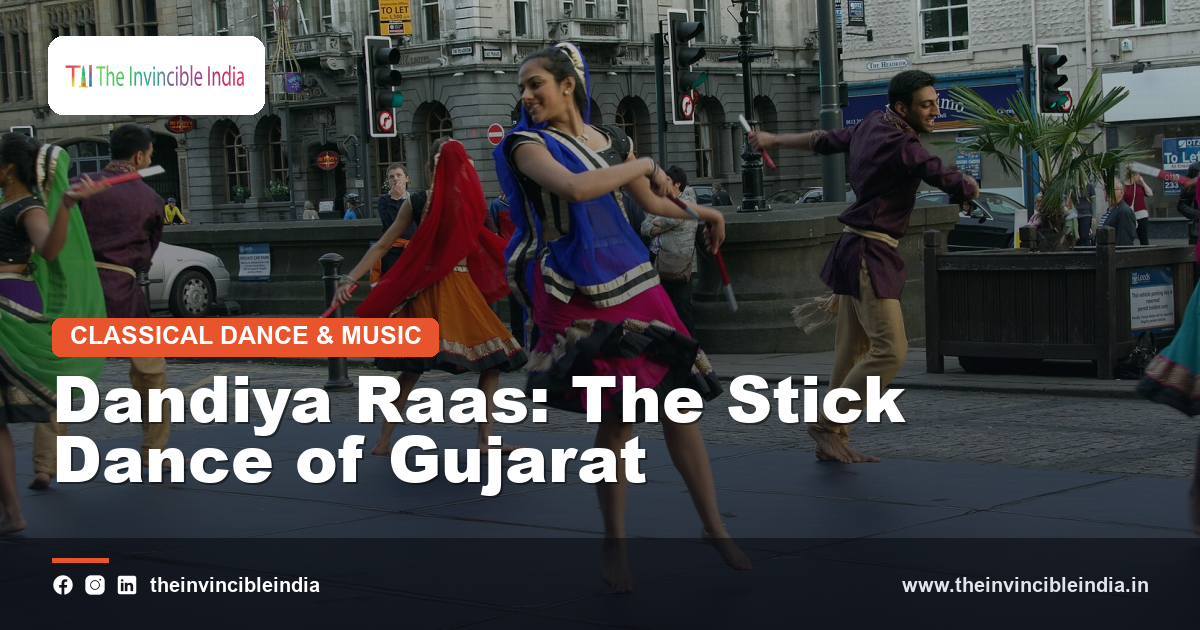
Few festival dances are as instantly recognisable as Dandiya Raas, the energetic stick dance of Gujarat performed each year during Navratri. Danced in rotating circles to the steady clack of paired wooden sticks, it shares its festival season and much of its spirit with Garba, though the two forms move to distinct rhythms and gestures. What began as a community tradition tied to seasonal and devotional celebration has grown into one of the most widely recognised expressions of Gujarati culture, performed in courtyards, temple grounds and large public gatherings alike. This guide traces the dance’s steps, music, costume and continuing popularity, both within Gujarat and among Gujarati communities far beyond the state.
Quick Facts
| Detail | Information |
|---|---|
| Type | Folk stick dance |
| Region | Gujarat, especially Saurashtra and Kutch |
| Season | Performed chiefly during Navratri |
| Props | A pair of decorated wooden sticks (dandiya) |
| Formation | Dancers move in rotating circles |
| Related Dance | Garba, often performed alongside it |
Origins and Historical Roots
Dandiya Raas traces its roots to the rural folk traditions of Gujarat, where seasonal and devotional gatherings brought communities together for song, rhythm and movement around the time of the autumn harvest and the Navratri festival. As with many Indian folk dances, its early development is remembered chiefly through continuous community practice rather than precise historical record, passed down through generations of villagers who performed it as part of festive and religious life. Over time the dance moved from largely rural courtyards into wider public celebration, eventually becoming one of the most recognisable folk traditions associated with the state of Gujarat as a whole.
Meaning of the Name
The term Dandiya Raas combines two elements, dandiya referring to the short decorated sticks used in the dance and raas describing a broader category of circular group dance found within Gujarati and wider Indian folk tradition. Together the name identifies the dance precisely as a stick-based form of raas, distinguishing it from other circular dances performed without props. This naming convention reflects a broader pattern in Indian folk dance terminology, where the central prop or gesture of a dance often becomes part of its very name, helping communities and audiences distinguish between closely related regional forms.
The Sticks and Their Symbolism
Each dancer in Dandiya Raas carries a pair of short, decorated wooden sticks, struck rhythmically against a partner’s sticks as the dance progresses through its rotating formation. Beyond their obvious percussive function, the sticks are often spoken of in connection with the broader themes of Navratri, a festival widely associated with the triumph of good over evil, though communities and performers may describe the sticks’ symbolic meaning in varied, general terms rather than a single fixed interpretation. Brightly painted or decorated with small bells and ribbons, the sticks also serve a visual role, catching light and colour as dancers move.
Basic Steps and Rhythmic Pattern
The basic movement of Dandiya Raas involves a repeating sequence of steps performed in time with the sticks’ rhythmic clashing, typically striking one’s own sticks together before turning to strike a neighbouring dancer’s sticks as the circle rotates. This creates a continuous, flowing pattern of movement and sound that can be sustained for extended periods as the tempo of the accompanying music gradually increases. Beginners typically learn a simple core step before progressing to more elaborate variations, and the dance’s structure allows dancers of considerably different skill levels to participate together within the same circle.
Formation and Circular Movement
Dandiya Raas is danced in one or more concentric circles, with dancers moving steadily in a coordinated rotational direction while striking sticks with partners who shift continuously as the circle turns. This circular, ever-changing formation is central to the dance’s social character, since it ensures that participants interact briefly with many different partners over the course of a single session rather than remaining paired with one person throughout. Larger public celebrations may feature several concentric circles moving simultaneously, creating a striking visual spectacle of coordinated, rotating movement across an open courtyard or ground.
Costume and Adornment
Traditional dress for Dandiya Raas draws on the vivid, richly decorated clothing associated with Gujarati festive culture, with women commonly wearing colourful mirrored skirts, cholis and dupattas, and men wearing kediyu tops paired with dhoti or churidar and turbans. Ornamentation with mirrors, embroidery and beadwork reflects light attractively under festival lighting, adding visual energy to the dance’s already lively rhythm. While contemporary participants sometimes wear simplified or modern versions of these garments, traditional festive dress remains closely associated with Dandiya Raas and is widely favoured at larger community and cultural events during Navratri.
Music and Accompaniment
Dandiya Raas is performed to lively folk music built around a strong, driving rhythmic pulse, traditionally provided by drums alongside melodic accompaniment from instruments common to Gujarati folk performance. Songs performed during Dandiya Raas often carry themes connected to devotion, seasonal celebration and community festivity, sung by a lead vocalist or group to which dancers respond with coordinated movement. As with many participatory folk dances, the tempo of the music often increases gradually over the course of a performance, encouraging dancers to match its rising energy with faster, more spirited stick work as the session builds toward its peak.
Relationship to Garba
Dandiya Raas is frequently performed alongside Garba, another circular Gujarati folk dance associated with Navratri, and the two are often presented together during the same evening of festivities. Garba is typically danced without sticks, relying instead on clapping and graceful hand and body movements performed around a central lamp or image, while Dandiya Raas introduces the paired sticks and a somewhat more vigorous rhythmic character. Many festival programmes begin with an extended period of Garba before transitioning into Dandiya Raas later in the evening, allowing participants to experience both related but distinct forms within a single celebration.
Navratri and Ritual Context
Navratri, the nine-night festival during which Dandiya Raas is most widely performed, is a major devotional occasion in Gujarat and across much of India, centred on the worship of the goddess in her various forms. Dance during Navratri is understood by many participants as a form of devotional celebration in itself, performed communally rather than as pure entertainment, often held in courtyards adjoining temples or around a central shrine. This ritual dimension gives Dandiya Raas a significance that extends beyond recreation, linking physical movement and rhythm to the festival’s broader themes of devotion, community and seasonal renewal.
Regional Variations Within Gujarat
While Dandiya Raas is recognised as a broadly unified tradition across Gujarat, distinct regional styles can be found across areas such as Saurashtra and Kutch, each shaped by local musical preferences, costume traditions and stepping patterns. Some regional forms favour slower, more measured stick work, while others emphasise faster, more acrobatic movement, reflecting the diversity of folk performance traditions found within the state. These regional distinctions, while sometimes subtle to outside observers, are a source of local pride and identity, and community festivals often showcase the specific style associated with their particular area of Gujarat.
Community and Social Role
Beyond its performance value, Dandiya Raas has long served an important social function within Gujarati communities, bringing neighbours and extended family together for an extended period of shared festivity each year during Navratri. Its participatory, rotating structure encourages interaction across generations and among people who might not otherwise dance together, reinforcing community bonds during a season already centred on collective celebration. This social dimension has helped the dance remain vibrant and widely practised, since its appeal rests as much on shared community experience as on any individual dancer’s technical skill.
Gender and Participation Patterns
Dandiya Raas is traditionally participatory and broadly open to men and women alike, who often dance in paired or mixed circular formations rather than strictly separated groups, distinguishing it from some other regional folk forms with more defined gender roles. Contemporary public celebrations, particularly larger organised events, typically welcome dancers of all ages, backgrounds and skill levels, reflecting the dance’s inclusive, community-oriented character. This openness has contributed significantly to Dandiya Raas’s continuing popularity, allowing new participants to join in with relative ease even without extensive prior training in the dance’s specific steps.
Spread Beyond Gujarat
Communities with Gujarati heritage organise Dandiya Raas events during Navratri in cities across India and in parts of the Indian diaspora worldwide, carrying the dance well beyond its regional origins. Large urban celebrations, often held in halls, grounds or community centres, can draw participants from far beyond the local Gujarati population, reflecting the dance’s broad and growing popular appeal. This geographic spread has helped Dandiya Raas become one of the more widely recognised Indian folk dances internationally, frequently associated in popular imagination with Navratri festivities even among audiences unfamiliar with its specific Gujarati origins.
Modern Stage and Competitive Dandiya
In recent decades, Dandiya Raas has increasingly appeared in organised stage performances and competitive events, where choreographed groups perform elaborate routines set to amplified music and coordinated lighting for large public audiences. Such events, while distinct in scale and presentation from traditional community gatherings, have helped popularise the dance further and introduced it to audiences who might never encounter its more intimate village or courtyard form. Competitive Dandiya events, judged on synchronisation, costume and energy, have become a notable feature of urban Navratri celebrations in many Indian cities during the festival season.
Teaching and Continuity
Dandiya Raas is typically learned informally within families and communities, with children picking up basic steps by observing and joining adults during festival celebrations from a young age. In more urban settings, dedicated dance schools and cultural organisations now also offer structured classes ahead of the Navratri season, helping newcomers learn the dance’s steps, formations and stick technique in a more formal setting. This combination of informal community transmission and increasingly organised instruction has helped ensure that Dandiya Raas continues to be actively learned and performed by new generations of dancers each year.
Dandiya Raas Today
Today Dandiya Raas remains one of the most vibrant and widely celebrated folk dances in India, performed each Navratri in settings ranging from small village courtyards to large organised urban events and diaspora celebrations abroad. Its distinctive rhythmic stick work, colourful costume and inclusive, participatory character continue to draw dancers of all ages and backgrounds into its rotating circles year after year. As Navratri continues to be celebrated widely across India and beyond, Dandiya Raas stands as one of Gujarat’s most recognisable and enduring contributions to the country’s living folk dance heritage.
Sources & Further Reading
- Sangeet Natak Akademi, national academy for music, dance and drama (sangeetnatak.gov.in).
- Ministry of Culture, Government of India (indiaculture.gov.in).
Frequently Asked Questions
What is Dandiya Raas?
Dandiya Raas is a folk dance from Gujarat in which performers strike short decorated sticks together in rhythm while moving through a rotating circular formation, most commonly during the Navratri festival.
How is Dandiya Raas different from Garba?
Garba is typically performed without sticks, using clapping and circular movements around a central lamp or image, while Dandiya Raas involves paired sticks struck together, and the two are often performed on the same evening in sequence.
What do the sticks in Dandiya Raas represent?
The sticks are often associated in general terms with Navratri’s broader themes of the triumph of good over evil, though communities and performers may describe their significance in varied ways rather than a single fixed meaning.
Who can participate in Dandiya Raas?
The dance is broadly participatory, traditionally open to men and women dancing in paired or mixed formations, and modern public events welcome dancers of all backgrounds and skill levels.
Is Dandiya Raas performed outside Gujarat?
Yes, communities with Gujarati heritage organise Dandiya Raas events during Navratri in cities across India and in parts of the Indian diaspora worldwide, often alongside Garba.


