

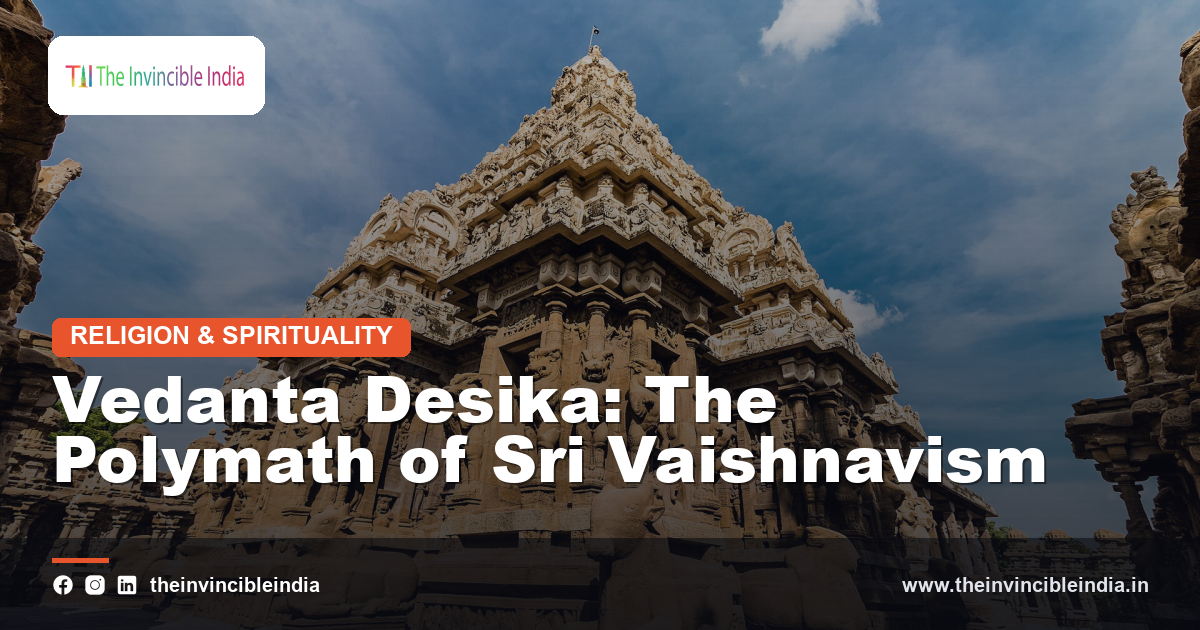
Vedanta Desika, also called Venkatanatha, Thoopul Desikan, Vedantacharya and Nigamanta Maha Desika, is revered as one of the most learned teachers of Sri Vaishnavism. Traditionally placed in the thirteenth and fourteenth centuries, he is remembered as a philosopher, poet, devotional composer and defender of Vishishtadvaita Vedanta, the school of thought that teaches the qualified oneness of the soul with God. His writings in Sanskrit, Tamil and the mixed Manipravalam style still shape worship and study in the Vaishnava temples of the south. This guide explains his life and works in general terms and notes where details rest on tradition. It also places him within the wider Vaishnava tradition.
Quick answer: Vedanta Desika is a medieval Sri Vaishnava acharya, philosopher and poet of the Vishishtadvaita school, traditionally associated with Kanchipuram and Srirangam in Tamil Nadu. He is remembered for scholarly works such as the Rahasyatrayasara, devotional poems such as the Paduka Sahasram, and for defending and refining the philosophy of Ramanuja. His legacy is especially strong in the Vadakalai stream of Sri Vaishnavism, though many Vaishnavas honour him.
Key Takeaways
- Vedanta Desika, born Venkatanatha, is among the most respected acharyas of Sri Vaishnavism after Ramanuja.
- Tradition places him in the thirteenth and fourteenth centuries, with his birthplace at Thoopul near Kanchipuram.
- He composed in Sanskrit, Tamil and Manipravalam, covering philosophy, hymns, poetry and drama.
- The Paduka Sahasram, in praise of the sandals of Lord Ranganatha, and the Rahasyatrayasara are among his best-known works.
- He is honoured as the leading teacher of the Vadakalai tradition, while Sri Vaishnavas of every stream respect his scholarship.
- The title Kavitarkika Simha, meaning lion among poets and logicians, reflects his skill in both literature and debate.
The sections below set out his life, works, philosophy and present-day legacy in more detail.
Quick Facts
| Detail | Information |
|---|---|
| Also known as | Venkatanatha, Thoopul Desikan, Vedantacharya, Nigamanta Maha Desika |
| Tradition | Sri Vaishnavism (Vishishtadvaita Vedanta) |
| Era | Traditionally the thirteenth and fourteenth centuries |
| Associated places | Thoopul, Kanchipuram, Srirangam, Thiruvahindrapuram |
| Languages | Sanskrit, Tamil and Manipravalam |
| Best-known works | Paduka Sahasram, Rahasyatrayasara, Yatiraja Saptati |
Who Was Vedanta Desika?
Vedanta Desika was a Sri Vaishnava teacher, scholar and poet who is regarded as one of the greatest acharyas to follow Ramanuja. He lived, according to tradition, in the thirteenth and fourteenth centuries in the Tamil country, a period when the Sri Vaishnava community was consolidating its teachings and temple life. His birth name was Venkatanatha, and the honorific Vedanta Desika, meaning teacher of Vedanta, came to be his best-known title.
He is celebrated for combining qualities that are rarely found together: deep philosophical rigour, a gift for poetry, and a sincere devotional temperament. Much of what is known about him comes from the devotional biographies of his community, so careful writers describe his life in general terms. Seen this way, he stands as a figure who gave the Sri Vaishnava tradition both intellectual strength and literary beauty.
Why Is He Called a Polymath?
Vedanta Desika is called a polymath because his surviving works span philosophy, theology, poetry, drama, hymnody and practical guidance for religious life. Few authors in the Indian tradition wrote with equal command in such a range of forms. His treatises argue points of Vedanta with precision, while his poems display the ornamented beauty of classical Sanskrit and the sweetness of Tamil devotion.
Tradition credits him with a very large body of writing, and the community remembers him with titles that point to this breadth. Among them is Kavitarkika Simha, understood as a lion among poets and logicians, and Sarvatantra Svatantra, understood as one who was master of every system of thought. These honorifics are devotional in character, yet they accurately describe the unusual range that his works display.
Where Was Vedanta Desika Born?
Vedanta Desika is traditionally said to have been born at Thoopul, a locality near Kanchipuram in present-day Tamil Nadu. Kanchipuram is one of the great temple cities of the south, long known as a centre of learning and of Vaishnava devotion, and the region shaped his early world. Alternative forms of his name, such as Thoopul Desikan and Thoopul Pillai, preserve the memory of this birthplace.
Details such as the exact year of birth are given in traditional biographies, but in this guide they are treated as tradition rather than as settled history. What matters for understanding him is the setting: a cultured temple town in which Sanskrit learning, Tamil devotional song and ritual worship lived side by side. This environment helps explain the breadth that later marked his writing.
Early Education and Teachers
Tradition describes Vedanta Desika as a precocious student who received a thorough grounding in the Vedas, the Sanskrit sciences and the Sri Vaishnava texts. His maternal uncle, remembered as Atreya Ramanuja or Kidambi Appullar, is traditionally named as his principal teacher and as a link to the line of teachers going back to Ramanuja. Stories of a bright and disciplined young scholar are told with affection in the community.
The importance of the teacher is a recurring theme in Sri Vaishnavism, where knowledge is understood to pass through a lineage rather than through books alone. Vedanta Desika is therefore presented as a faithful inheritor of an established tradition, who then enriched it through his own reflection. His education explains why his works rest on a firm foundation of scripture, commentary and living practice.
The Vishishtadvaita Background
Vishishtadvaita, the philosophy that Vedanta Desika defended, teaches that God, souls and the world are real, and that souls and matter form the body of the Supreme Being. The word means qualified non-duality: reality is one, yet it is qualified by distinct but dependent elements. This view was systematised by Ramanuja and became the intellectual backbone of Sri Vaishnavism.
In this system, the Supreme Being is Vishnu, also called Narayana, and liberation comes through knowledge, devotion and surrender to the divine. Vedanta Desika took up these ideas, clarified them, and answered objections raised by rival schools. His work shows how a living philosophy is kept alive: by restating its central claims in each generation with fresh arguments and fresh poetry, while remaining faithful to its source.
Life at Kanchipuram and Srirangam
Kanchipuram and Srirangam are the two places most strongly linked with Vedanta Desika. Kanchipuram was the home of his youth and of the Varadaraja temple, a major Vaishnava shrine, while Srirangam, on an island in the Kaveri, houses the great temple of Lord Ranganatha. Tradition places much of his mature teaching and writing at Srirangam, the foremost centre of the Sri Vaishnava community.
Accounts speak of a time of political turmoil in the region during his lifetime, and the community remembers his efforts to protect its sacred traditions and to keep teaching alive. These stories are told with devotional colouring, and their precise historical details are best treated cautiously. They nevertheless show how closely his name is tied to the great temple towns of the Tamil country.
Thiruvahindrapuram and the Hayagriva Tradition
Thiruvahindrapuram, near Cuddalore, is a temple site that tradition associates with a period of Vedanta Desika’s life, especially his devotion to Hayagriva, the horse-headed form of Vishnu worshipped as the giver of learning. Local tradition holds that he received guidance in a Hayagriva mantra on the nearby hill known as Oushadhagiri, and a shrine there honours the connection.
These accounts are part of devotional memory rather than documented history, but they explain why Hayagriva is so closely linked with Vedanta Desika. Students and scholars in the tradition still pray to Hayagriva for clarity of mind, and the hymn composed in his honour is widely recited. The association illustrates how learning and devotion were understood in Sri Vaishnavism as parts of one spiritual path.
What Is the Paduka Sahasram?
The Paduka Sahasram is a Sanskrit devotional poem of about a thousand verses in praise of the sandals, or paduka, of Lord Ranganatha at Srirangam. In the Indian devotional imagination, the sandals symbolise the Lord’s grace, which a devotee can approach with humility. The poem is admired for its rich imagery, its varied metres, and its skilful play with sound and meaning.
Tradition says that Vedanta Desika composed it in a single night, in response to a challenge from scholars, though this is a devotional account rather than a documented fact. Whatever its origin, the work is regarded as a masterpiece of Sanskrit poetry and a high point of Sri Vaishnava literature. It remains a text that is studied for its language as much as it is recited for its devotion.
What Is the Rahasyatrayasara?
The Rahasyatrayasara is Vedanta Desika’s major prose treatise explaining the three secrets, or rahasyas, of Sri Vaishnava teaching. These are the three sacred formulas on which the community’s spiritual practice rests, namely the Ashtakshara, Dvaya and Charama Shloka. The work sets out their meaning, their place in the life of a devotee, and the doctrine of surrender, known as prapatti.
It is written in the mixed Manipravalam style, blending Tamil and Sanskrit, which made it accessible to a wider community than purely Sanskrit writing would have reached. Many regard it as the most important summary of Sri Vaishnava doctrine after the foundational works of Ramanuja. For students, it serves as an authoritative guide to how philosophy and devotional practice come together in daily life.
Philosophical Treatises and Debate
Vedanta Desika wrote a number of Sanskrit philosophical works that defend Vishishtadvaita and engage with rival schools. The Tattvamuktakalapa and its commentary survey fundamental categories of thought, the Nyaya Siddhanjana develops the logic of the system, and the Shata Dushani raises a hundred objections against the Advaita position. Together they show a mind trained in argument and committed to careful reasoning.
Such works belong to a long Indian tradition of philosophical debate, in which each school states its case and answers its critics in a spirit of serious inquiry. Vedanta Desika’s role in that debate earned him wide respect, and his arguments are still studied by students of Vedanta. His treatises demonstrate that Sri Vaishnavism possessed intellectual resources equal to its devotional depth.
Poetry and Drama
Beyond philosophy, Vedanta Desika wrote poetry and drama that rank among the finest Sanskrit literature of his age. The Yadavabhyudaya is a poem on the life of Krishna, the Hamsa Sandesha is a messenger poem in which a swan carries a message from Rama to Sita, and the Sankalpa Suryodaya is an allegorical play in which the human soul is guided toward wisdom.
These works show that he was a literary artist as well as a theologian. The messenger poem follows a classical form familiar from earlier Sanskrit literature, while the play uses characters representing ideas such as mind and discernment to teach a Vedantic lesson. In this way, his creative writing carried philosophy into forms that could be enjoyed by cultivated readers and audiences.
Stotras and Devotional Hymns
Vedanta Desika composed many short hymns, called stotras, that are still sung in Vaishnava homes and temples. Among the best known are the Raghuvira Gadya, a rhythmic prose hymn in praise of Rama, the Dayashataka, a hundred verses on divine compassion addressed to Lord Venkateshwara of Tirumala, and the Gopalavimshati, a set of twenty verses on Krishna as the cowherd.
Other hymns honour Garuda, Hayagriva, the avatars of Vishnu and the Lord of Srirangam. Their language is elegant yet direct, and their emotional range runs from joyful praise to humble surrender. Because they are short and melodious, these stotras have travelled far beyond scholarly circles, giving ordinary devotees a way to share in the spiritual vision of a great teacher through daily recitation.
Why Did He Also Write in Tamil?
Vedanta Desika wrote in Tamil and in Manipravalam because he wished Sri Vaishnava teaching to reach beyond Sanskrit scholars. Tamil was the language of the Alvars, the early devotional poets whose hymns the community cherishes, and he held their work in great honour. His Tamil and Manipravalam compositions include works such as the Amritaranjani, the Adhikarasaram and the Paramapadasopanam.
He also composed a Tamil devotional work that mirrors the structure of the Alvars’ poetry, linking his own writing to their inheritance. By moving comfortably between languages, he built a bridge between the learned Sanskrit tradition and the popular Tamil devotional stream. This bilingual outlook is one of the features that makes his legacy so wide and so enduring.
What Is the Difference Between Vadakalai and Tenkalai?
Vadakalai and Tenkalai are two streams within Sri Vaishnavism that share the same core beliefs but differ in emphasis on certain theological questions. Vedanta Desika is honoured as the principal teacher of the Vadakalai, or northern, tradition, while the Tenkalai, or southern, tradition looks especially to teachers such as Pillai Lokacharya and Manavala Mamunigal. Both revere Ramanuja and the Alvars.
The differences are often explained in terms of the relation between human effort and divine grace, and the community uses well-known analogies to illustrate them. Respectful writers stress that the two streams belong to one family and worship the same Lord. For a reader, the key point is that Vedanta Desika is central to one stream and widely respected across the whole Sri Vaishnava world.
The Ideal of Surrender
Prapatti, or loving surrender to God, is the central spiritual ideal that Vedanta Desika explained and defended. In Sri Vaishnava teaching, a devotee who feels unable to attain liberation through effort alone places full trust in the divine, who then guides the soul to its goal. This path is open to all, regardless of learning or status, which gave the teaching a strongly inclusive spirit.
His writings describe surrender with careful attention to its inner attitude: confidence in divine mercy, humility, and a resolve to live in accordance with the Lord’s will. The theme runs through his philosophical, devotional and practical works alike. It explains why a scholar of such high learning could also write with simple, heartfelt feeling, since in his view the highest wisdom leads naturally to surrender.
How Should Traditional Accounts Be Read?
Traditional accounts of Vedanta Desika should be read as devotional biography, valuable for what they reveal about how the community sees him. Many stories, such as the composition of a great poem in one night or his special relationship with Hayagriva, are told in a devotional register that does not claim to meet the standards of modern historical records. Details of dates and events vary between traditions.
A respectful approach keeps two things in view. On one hand, his surviving writings are real and can be studied directly, giving firm evidence of his thought and style. On the other hand, the stories surrounding his life express reverence and carry meaning of their own. Holding both together allows a reader to honour the tradition while remaining careful about historical claims.
Vedanta Desika Today
Vedanta Desika remains a living presence in Sri Vaishnava worship and learning. His hymns are recited in temples and homes, his treatises are studied in traditional schools of Vedanta, and his birth anniversary is observed by the community with reverence, traditionally around the Shravana star in the autumn season. Shrines at Kanchipuram, Thiruvahindrapuram and Srirangam keep his memory alive.
For students of Indian culture, he offers a model of how scholarship, poetry and devotion can strengthen one another. His example shows that philosophy in India has often been practised as a way of life rather than as an abstract exercise. Readers who wish to learn more can explore his works in translation and visit the temple towns that shaped his journey.
Sources & Further Reading
- Ministry of Culture, Government of India (indiaculture.gov.in).
- Archaeological Survey of India (asi.nic.in).
Frequently Asked Questions
Who was Vedanta Desika?
Vedanta Desika was a Sri Vaishnava acharya, philosopher and poet traditionally placed in the thirteenth and fourteenth centuries. He defended the Vishishtadvaita philosophy of Ramanuja and composed works in Sanskrit, Tamil and Manipravalam.
When did Vedanta Desika live?
Tradition places Vedanta Desika in the thirteenth and fourteenth centuries. Exact dates are given in devotional biographies, so they are best treated as traditional rather than as firmly documented history.
What is Vedanta Desika best known for?
Vedanta Desika is best known for the Paduka Sahasram, the Rahasyatrayasara and his many hymns and philosophical treatises. He is also remembered for his devotion to Hayagriva and for the breadth of his learning.
What does the title Kavitarkika Simha mean?
Kavitarkika Simha means a lion among poets and logicians. The title honours his skill in both literary composition and philosophical debate.
Is Vedanta Desika associated with Vadakalai or Tenkalai?
Vedanta Desika is honoured as the foremost teacher of the Vadakalai tradition. Members of the Tenkalai stream also respect his learning, since both streams belong to the wider Sri Vaishnava community.
Which places are associated with Vedanta Desika?
The places most associated with him are Thoopul and Kanchipuram, where he was born and educated, Srirangam, where he taught, and Thiruvahindrapuram, linked with his Hayagriva devotion. Each has shrines and traditions that preserve his memory.


