

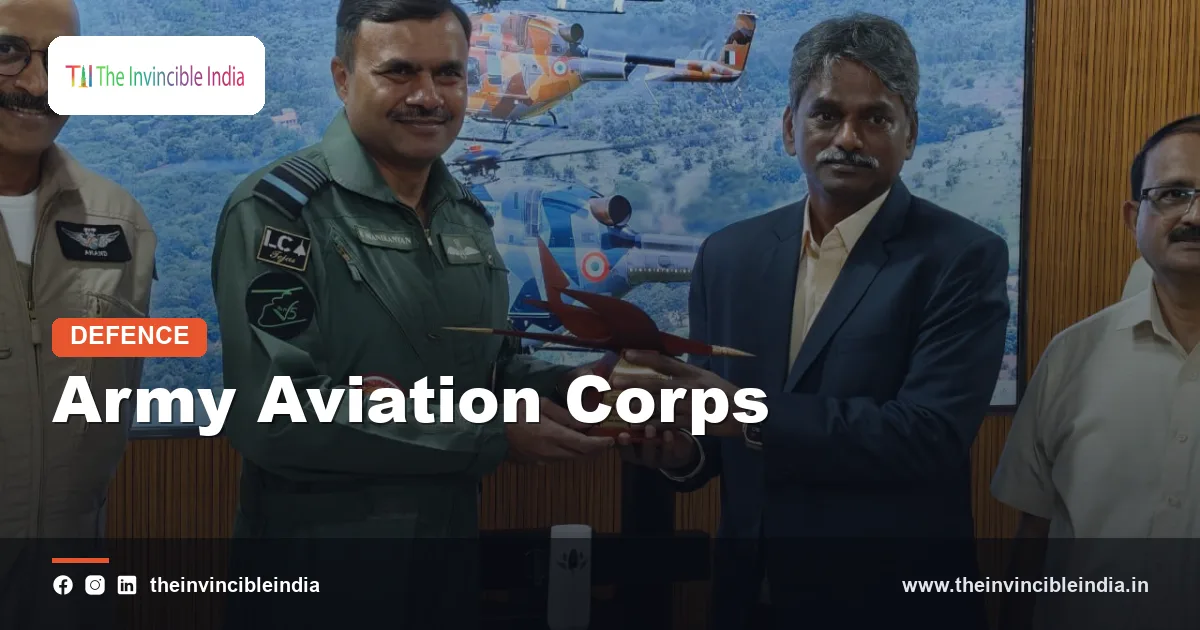
The Army Aviation Corps is the youngest arm of the Indian Army, raised on 1 November 1986 to give ground commanders their own aerial eyes, ears and lift. Flying light helicopters and unmanned systems over some of the most difficult terrain in the world, from the glaciers of Siachen to the deserts of Rajasthan and the jungles of the north-east, the Corps performs reconnaissance, observation, casualty evacuation and logistic tasks in the forward areas where fixed-wing aircraft and ground transport cannot easily reach.
Although the Army had used aircraft for decades before 1986, they were flown mainly by Air Force crews under Air Observation Post arrangements. The creation of a dedicated Corps changed this and led, over time, to the induction of indigenous helicopters such as the Dhruv, the Rudra and the Prachand Light Combat Helicopter. This explainer covers the history, roles, aircraft, organisation, training and ongoing debates about the Army’s aviation arm, using only established public information.
Quick Facts
| Item | Detail |
|---|---|
| Raised | 1 November 1986 |
| Status | Youngest combat support arm of the Indian Army |
| Predecessor | Air Observation Post (AOP) squadrons of the Indian Air Force, manned by Army officers |
| Principal roles | Reconnaissance, observation, casualty evacuation, logistics, command support and, increasingly, attack |
| Key aircraft | Chetak, Cheetah, Dhruv (Advanced Light Helicopter), Rudra, Prachand LCH |
| Training establishment | Combat Army Aviation Training School, Nashik |
| Corps Day | 1 November |
| Chief at Army HQ | Director General, Army Aviation |
Origins: From Air Observation Posts to an Independent Corps
The Army’s association with aviation began soon after Independence. In the late 1940s, Air Observation Post flights were created within the Indian Air Force, flying light fixed-wing aircraft to spot enemy positions and direct artillery fire. The pilots were Army artillery officers who trained as flyers, a unique arrangement that tied the Army’s gunners to the air.
Wars and the need for dedicated air support
These AOP units served in the wars of 1962, 1965 and 1971, and their helicopters and light aircraft carried out reconnaissance, communication and casualty evacuation missions. As the Army’s operations became more mobile and mechanised, commanders sought greater control over such assets. Helicopters were also becoming central to operations in mountains and on the high-altitude border.
The decision of 1986
In 1986 the government approved the formation of an Army Aviation Corps. On 1 November 1986, the AOP squadrons were transferred to the Army along with their aircraft and personnel, and the new Corps was born. The decision gave the Army its own aviation arm for the first time, while continuing to rely on the Air Force for heavy-lift and offensive air support. Since then, 1 November has been observed as Corps Day.
Roles and Missions of the Army Aviation Corps
The mission of the Corps is to enhance the mobility, firepower and situational awareness of ground forces. Its aircraft usually operate at low altitude, close to the battle area and in cooperation with infantry, armour and artillery.
- Reconnaissance and observation: Locating enemy positions, tracking movement and providing real-time information to commanders.
- Casualty evacuation: Moving wounded soldiers from forward posts to hospitals, often in the “golden hour” after injury.
- Logistic support: Supplying remote posts with ammunition, rations, equipment and mail, especially in snowbound areas.
- Command and communication: Carrying commanders and staff to forward locations and acting as airborne command posts.
- Insertion and extraction: Moving small teams or specialist elements into or out of difficult terrain.
- Fire support and anti-armour: Using armed helicopters to engage targets in support of ground forces.
- Disaster relief: Rescue and relief during floods, earthquakes, cyclones and landslides.
Operating in Extreme Terrain
The Army’s helicopters work in places where weather and altitude push machines and crew to the limit. The Himalayas, the Karakoram and the Siachen glacier are particularly demanding, with thin air reducing engine power and lift, and sudden storms limiting visibility. Pilots therefore require special training in high-altitude flying.
Siachen and the high Himalayas
On the Siachen glacier, the world’s highest battlefield, helicopters are the lifeline of troops who live on posts at extreme altitude. Light helicopters such as the Cheetah have been used to land on tiny helipads at great heights, delivering supplies and bringing back casualties. Flights in this region have earned the Corps a reputation for exceptional skill and courage.
Deserts, jungles and islands
In the western deserts, heat and dust affect engines and visibility, while in the north-east dense forests, heavy rains and mountainous terrain complicate flying. Army Aviation also operates in support of formations along the coast and in island territories. Operating across such varied environments requires versatile aircraft and highly adaptable crews.
Aircraft of the Army Aviation Corps
The fleet has traditionally been built around light helicopters, many of them developed or manufactured in India by Hindustan Aeronautics Limited.
| Helicopter | Type | Notable features |
|---|---|---|
| Chetak | Light utility helicopter | Licence-built Alouette III; long-serving workhorse for liaison, evacuation and supply |
| Cheetah | Light utility helicopter | Licence-built Lama; famed for high-altitude operations at Siachen |
| Dhruv (ALH) | Advanced light helicopter | Indigenously designed twin-engine helicopter by HAL; inducted in the early 2000s |
| Rudra | Armed version of the Dhruv | Weapons-capable helicopter for escort, reconnaissance and fire support |
| Prachand (LCH) | Light combat helicopter | Indigenous attack helicopter designed for high-altitude warfare |
| Unmanned aerial vehicles | Drones | Used for surveillance and target acquisition with the aviation arm |
An ageing light-helicopter fleet
The Chetak and Cheetah, based on 1960s and 1970s designs, have served for decades and are now being replaced. Hindustan Aeronautics Limited developed the Light Utility Helicopter to succeed them, a single-engine design optimised for high-altitude work. The programme is part of the broader push for indigenous defence manufacturing.
The Dhruv and Rudra: Indigenous Capability
The Advanced Light Helicopter Dhruv was the first major helicopter designed and built in India. Developed by HAL, it first flew in the early 1990s and entered service with the Army and the Air Force in the early 2000s. Its twin-engine design, glass cockpit and capability in hot-and-high conditions made it a versatile platform for transport, rescue and utility work.
Weapon systems integration
The Rudra is the armed version of the Dhruv, fitted with guns, rockets and air-to-air or anti-tank missiles, depending on the configuration. Inducted into the Army in 2013, it gave the Corps its first armed helicopter and allowed Army pilots to provide fire support, escort and reconnaissance with a weapons-capable platform. The Rudra also served as a stepping stone to the larger attack helicopter role.
Coastguard and civil variants
Beyond the Army, versions of the Dhruv serve the Navy, the Air Force, the Coast Guard and civil operators. The helicopter has also been exported in small numbers to a few foreign countries, underlining the progress of India’s aerospace industry.
Prachand LCH and the Attack Helicopter Role
The Light Combat Helicopter, named Prachand, is a twin-engine attack helicopter designed and built by HAL specifically for operations at high altitude and in hot conditions. It first flew in 2010 and, after years of development and trials, was formally inducted into service in October 2022 at a ceremony at Jodhpur. The government approved a first batch of 15 helicopters, divided between the Air Force and the Army.
Key characteristics
- Narrow, tandem-seat fuselage with a low radar and visual signature.
- Armour and crash-worthy structures for crew survivability.
- Gun turret, rockets and air-to-air and anti-tank missiles.
- Ability to operate at very high altitude, including from forward bases in Ladakh and Siachen.
- Role in anti-tank, counter-insurgency, escort and support of ground operations.
Strategic significance
The Prachand is a symbol of self-reliance. It allows the armed forces to use an indigenous helicopter in the exact conditions they confront on the northern borders, where foreign designs have often been limited by altitude and temperature.
Attack Helicopters and the Role Debate
For many years, a doctrinal question divided the Army and the Air Force: who should operate attack helicopters. The Air Force held that they were an element of air power and should be under its control, as is the case with its Mi-35 and Apache fleets. The Army argued that attack helicopters are essentially flying artillery and anti-tank weapons that must be tightly integrated with ground operations, and so should belong to the Corps.
The move towards the Army
In recent years, the Army has gained attack helicopters of its own. It operates the armed Rudra, has received a share of the Prachand order, and has been allotted the American-made AH-64E Apache for its aviation arm under an agreement signed in 2020. The Army’s Apache and Prachand helicopters are intended to strengthen its hitting power in support of strike corps and mountain formations, while the Air Force keeps its own attack and transport fleets.
A joint approach
The debate is increasingly framed in terms of integration rather than ownership. Planning for integrated theatre commands envisages that air and army aviation assets will work together under joint command arrangements, with the details still evolving.
Organisation, Training and Personnel
The Army Aviation Corps is headed at Army Headquarters by the Director General, Army Aviation, who is responsible for policy, training and operations. Flying units are organised into squadrons and flights, grouped under Army Aviation Brigades and attached to Corps and Commands, where they support formations on the ground.
Training
The Combat Army Aviation Training School at Nashik Road is the main training institution of the Corps. Pilots, technicians and other personnel learn the skills needed for helicopter operations, from basic flying to tactical aviation. Volunteers are drawn from other arms of the Army, such as infantry, armoured corps and artillery, which ensures that pilots know the ground battle intimately.
Personnel
- Officers: Pilots, air traffic controllers, engineers and administrative staff.
- Technical staff: Aircraft engineers and technicians who maintain helicopters in demanding conditions.
- Women in aviation: In recent years women officers have been selected for flying duties in the Corps, marking a milestone.
The Corps also works closely with the Air Force on training and maintenance, and with HAL for repair and overhaul.
Unmanned Systems and Future Technologies
Alongside helicopters, the Army Aviation arm and related units operate unmanned aerial vehicles for reconnaissance, surveillance and target acquisition. These drones extend the reach of ground commanders without risking pilots, and they are increasingly joined by small loitering munitions and tactical systems.
Directions of development
- Induction of the Light Utility Helicopter to replace the Chetak and Cheetah.
- Greater use of manned-unmanned teaming, where helicopters work together with drones.
- Improved night-vision, sensors and protection against missiles.
- Better integration with Army networks, so that aviation assets share data in real time.
- Indigenous engines and subsystems to reduce reliance on imports.
The Corps’s progress reflects the larger transformation of the Indian military from a force largely dependent on imports to one with a growing domestic defence industry.
Humanitarian Missions and Public Service
Besides combat support, the Corps has an extensive record of humanitarian work. During floods in Kashmir, Uttarakhand, Assam and elsewhere, Army helicopters rescue stranded civilians, drop relief supplies and move medical teams. In earthquakes and landslides they reach isolated villages when roads are cut. These missions are carried out in coordination with the National Disaster Response Force and state authorities.
Why it matters
Such operations strengthen the bond between the armed forces and civil society, and they also provide valuable flying experience in difficult conditions. Many of the Corps’s most memorable rescue operations have been in remote mountain regions, where the ability to land on narrow ledges and ridges can mean the difference between life and death.
Conclusion
From the small Air Observation Post flights of the late 1940s to a full Corps with armed helicopters, the Army Aviation Corps has grown into a vital component of the Indian Army. Raised on 1 November 1986, it combines reconnaissance, logistics, evacuation and increasingly offensive roles, and it is a leading user of indigenous aircraft such as the Dhruv, Rudra and Prachand. As technology, joint operations and self-reliance shape the future, the Corps is certain to remain at the forefront of the Army’s mobility and firepower.
Frequently Asked Questions
When was the Army Aviation Corps raised?
The Army Aviation Corps was raised on 1 November 1986, which is observed as its Corps Day. It was formed by taking over the Air Observation Post squadrons that had earlier been part of the Indian Air Force.
What does the Army Aviation Corps do?
It flies helicopters and unmanned systems for reconnaissance, observation, casualty evacuation, logistics and command support in forward areas. It also uses armed helicopters for fire support and takes part in disaster relief.
Which helicopters does the Army Aviation Corps use?
Its fleet includes the Chetak and Cheetah light helicopters, the indigenous Dhruv Advanced Light Helicopter, the armed Rudra and the Prachand Light Combat Helicopter. It has also been allotted Apache attack helicopters.
Where are Army Aviation pilots trained?
Pilots and technical personnel are trained at the Combat Army Aviation Training School at Nashik Road. Many pilots are volunteers from other arms of the Army, such as infantry and artillery.
Who designed the Prachand helicopter?
The Prachand Light Combat Helicopter was designed and built by Hindustan Aeronautics Limited. It was formally inducted in October 2022 and is meant for operations at high altitude in support of the Army and the Air Force.
Why is the Army Aviation Corps important at Siachen?
Helicopters are the primary means of supplying troops and evacuating casualties on the Siachen glacier, where ground routes are extremely difficult. Army Aviation pilots are known for landing on very high and small helipads in harsh weather.
{“@context”:”https://schema.org”,”@graph”:[{“@type”:”FAQPage”,”mainEntity”:[{“@type”:”Question”,”name”:”When was the Army Aviation Corps raised?”,”acceptedAnswer”:{“@type”:”Answer”,”text”:”The Army Aviation Corps was raised on 1 November 1986, which is observed as its Corps Day. It was formed by taking over the Air Observation Post squadrons that had earlier been part of the Indian Air Force.”}},{“@type”:”Question”,”name”:”What does the Army Aviation Corps do?”,”acceptedAnswer”:{“@type”:”Answer”,”text”:”It flies helicopters and unmanned systems for reconnaissance, observation, casualty evacuation, logistics and command support in forward areas. It also uses armed helicopters for fire support and takes part in disaster relief.”}},{“@type”:”Question”,”name”:”Which helicopters does the Army Aviation Corps use?”,”acceptedAnswer”:{“@type”:”Answer”,”text”:”Its fleet includes the Chetak and Cheetah light helicopters, the indigenous Dhruv Advanced Light Helicopter, the armed Rudra and the Prachand Light Combat Helicopter. It has also been allotted Apache attack helicopters.”}},{“@type”:”Question”,”name”:”Where are Army Aviation pilots trained?”,”acceptedAnswer”:{“@type”:”Answer”,”text”:”Pilots and technical personnel are trained at the Combat Army Aviation Training School at Nashik Road. Many pilots are volunteers from other arms of the Army, such as infantry and artillery.”}},{“@type”:”Question”,”name”:”Who designed the Prachand helicopter?”,”acceptedAnswer”:{“@type”:”Answer”,”text”:”The Prachand Light Combat Helicopter was designed and built by Hindustan Aeronautics Limited. It was formally inducted in October 2022 and is meant for operations at high altitude in support of the Army and the Air Force.”}},{“@type”:”Question”,”name”:”Why is the Army Aviation Corps important at Siachen?”,”acceptedAnswer”:{“@type”:”Answer”,”text”:”Helicopters are the primary means of supplying troops and evacuating casualties on the Siachen glacier, where ground routes are extremely difficult. Army Aviation pilots are known for landing on very high and small helipads in harsh weather.”}}]}]}


