

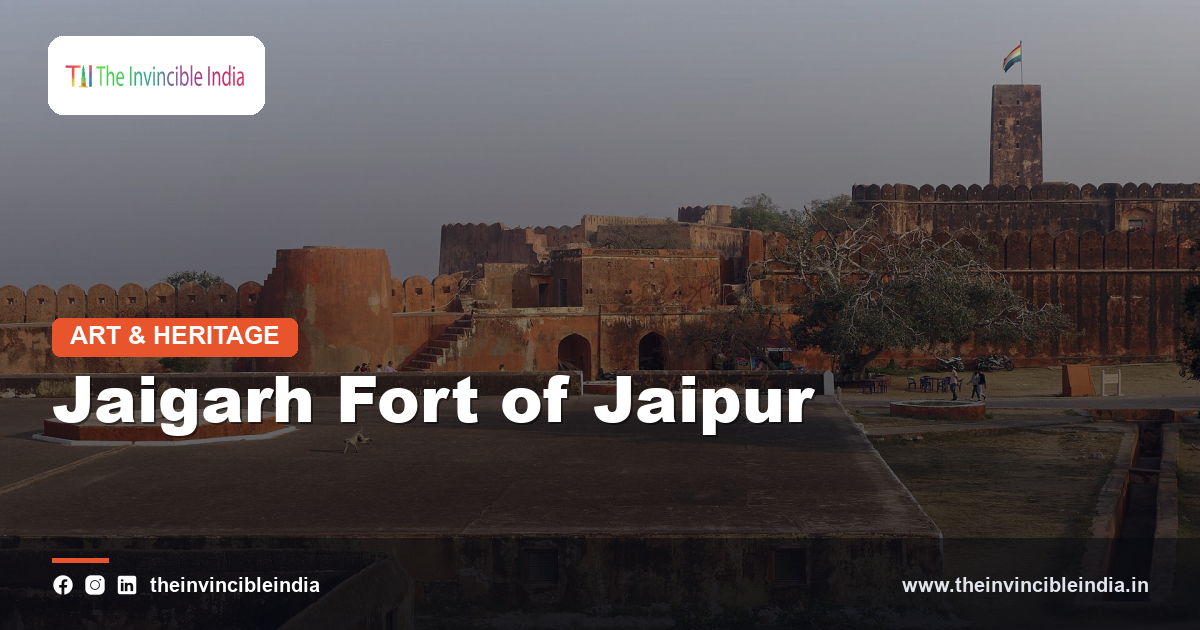
Crowning a ridge of the Aravalli hills above the old capital of Amber, Jaigarh Fort is one of the great military strongholds of Rajasthan. Its long sandstone ramparts follow the contours of the hill, enclosing palaces, temples, reservoirs, an armoury and the workshop where massive guns were cast. Built to guard the Kachhwaha rulers and their royal seat, it is closely tied to the story of the neighbouring Amber Fort and to the later rise of Jaipur. The fort is especially famous for its enormous Jaivana cannon and for the ingenious water systems that allowed a hilltop garrison to survive long periods of siege. This guide explores its history, architecture, defences and continuing importance as a heritage landmark.
Quick Facts
| Detail | Information |
|---|---|
| Location | Aravalli ridge above Amber, near Jaipur, Rajasthan |
| Type | Hill fort and garrison stronghold |
| Associated Dynasty | Kachhwaha rulers of Amber and Jaipur |
| Famous For | Jaivana cannon and water-harvesting tanks |
| Companion Fort | Amber Fort |
| Material | Local sandstone |
An Overview of Jaigarh Fort
Jaigarh Fort stands on a high ridge of the Aravalli range, commanding the valley in which the old capital of Amber lies and the routes that approach it. The name is often understood to honour Jai Singh, the ruler associated with its strengthening, and the fort reflects the military confidence of the Kachhwaha dynasty at the height of its power. Its thick walls, bastions and gateways run for a considerable distance along the crest, enclosing a compact town of barracks, storehouses, temples and palaces. Unlike the ceremonial splendour of the royal palace below, the fort was designed first and foremost for defence, and its character is sober, strong and practical. This functional purpose gives Jaigarh a distinct identity among the forts of the region. It remains one of the clearest examples of how Rajput rulers planned for security in a difficult landscape.
Location on the Aravalli Ridge
The Aravalli hills, among the oldest mountain ranges in the world, form a natural barrier across much of Rajasthan, and Rajput rulers made frequent use of their ridges for fortification. Jaigarh occupies a summit from which the approaches to Amber can be observed at a great distance, and the steep slopes below made assault extremely difficult. The fort is often linked with the prominent hill sometimes described in tradition as the hill of eagles, a name that suggests its lofty and commanding position. From the ramparts, the lakes, valleys and town below are visible, and in clear weather the view extends toward the growing city of Jaipur. The choice of site shows how closely Rajput military architecture responded to topography. The ridge gave the fort its strength, and the fort in turn gave the ridge its lasting importance.
Origins and Historical Background
Fortifications on the ridge above Amber are older than the fort seen today, but the present structure is generally credited to the period of Sawai Jai Singh II, the celebrated ruler who also founded the city of Jaipur in the early eighteenth century. Earlier Kachhwaha rulers had already recognised the value of the height, and successive generations strengthened the defences as the dynasty grew in power and influence. The fort was built to protect the royal capital and its treasury, and to serve as a secure refuge in times of threat. Its history is therefore bound up with the political fortunes of the Kachhwaha state, from its service within the wider empire of its time to its later independent development. Jaigarh is best read as the product of several generations of builders rather than a single moment of construction.
Sawai Jai Singh II and His Vision
Sawai Jai Singh II is remembered as a ruler of wide interests, combining statecraft with a deep commitment to astronomy, planning and learning. He founded the planned city of Jaipur and built astronomical observatories in several cities, and his practical, scientific outlook is visible in the organisation of Jaigarh as well. The fort was equipped not only with defences but also with systems for water, storage and manufacture, making it a self-sufficient stronghold. This combination of military and technical planning reflects the broader character of his reign, in which engineering and learning were valued alongside arms. His association with Jaigarh therefore adds an intellectual dimension to what might otherwise seem a purely military monument. The fort stands as a reminder that Rajput rulers could be patrons of science as well as defenders of their realms.
The Link with Amber Fort
Jaigarh and Amber Fort are best understood as two parts of a single defensive system. Amber, at the foot of the hill, served as the royal residence and ceremonial centre, while Jaigarh above it guarded the palace and the valley. The two were connected by fortified walls and passages that allowed movement between the palace and the fort without exposure to attackers. In times of danger the royal household and its resources could be moved upward to the safety of the ridge. This relationship shows the careful logic of Rajput planning, in which beauty and security were provided by separate but linked structures. Visitors who see both sites gain a fuller picture of how a royal capital was protected and governed. The bond between Jaigarh and Amber remains central to understanding the region’s heritage.
Ramparts, Bastions and Gateways
The defensive works of Jaigarh are among its most impressive features. High sandstone walls run along the ridge, rising and falling with the terrain and punctuated by bastions and watchtowers from which defenders could survey the approaches. The gateways are built with sturdy arches and are arranged so that an attacker would have to advance through narrow and exposed passages under fire. Crenellated parapets and loopholes provided cover for archers and, later, for gunners, and the thickness of the masonry was designed to withstand sustained assault. The walls are not decorative, yet their long lines have a stark beauty, especially when seen against the dry hills at sunrise or sunset. The ramparts demonstrate the skill of Rajput military engineers and the importance of layered defence in the design of hill fortresses.
The Jaivana Cannon
The most famous object at Jaigarh is the Jaivana cannon, a colossal gun mounted on wheels and housed beneath a covered structure near one of the watchtowers. It is widely regarded as among the largest cannons of its kind ever cast, and its sheer size conveys the ambition and technical capacity of the ruler who commissioned it. The barrel is long and thick, decorated with bands and ornament, and its carriage is built to bear its enormous weight. Popular accounts say that it was fired only as a test, and its main purpose was probably to project the strength of the state as much as to fight battles. The cannon remains the fort’s most photographed object and a powerful symbol of early modern military technology in India. The Jaivana cannon gives Jaigarh much of its popular fame.
The Cannon Foundry
Jaigarh was not merely a place where guns were stored but one where they were made. The fort contained a foundry in which cannon were cast, and the remains of the workshop give valuable insight into the metalworking and engineering skills available to the rulers of the period. Casting a large gun required careful preparation of moulds, control of high temperatures and a coordinated team of skilled workers, and the surviving installations show how these processes were organised. The presence of a foundry inside a hill fort emphasised the self-sufficiency of the stronghold, since its garrison could produce and repair weapons without depending on outside supply. The facility is also a reminder that Indian rulers of the time actively developed artillery as part of their military strategy. The foundry ranks among the most technically interesting elements of the fort.
Water Harvesting and Reservoirs
A hilltop fort in a dry region depends on water, and Jaigarh is admired for its sophisticated systems for collecting and storing it. Channels cut into the slopes directed monsoon runoff into large reservoirs, and tanks within the fort held supplies that could sustain the garrison through long periods without rain. Some of the storage was covered or underground to reduce evaporation, and the planning shows a close understanding of the local climate. This tradition of water management is a hallmark of Rajasthan’s heritage, seen also in the stepped reservoirs described in the guide to the stepwells of India. The tanks at Jaigarh also supplied gardens and buildings within the walls. The water works are as vital to the story of the fort as its guns and walls, and they illustrate the practical wisdom of traditional engineering.
Palaces, Halls and Courtyards
Although Jaigarh was built for defence, it also contains residential and ceremonial buildings that served the royal household and the officials who lived within the walls. Halls and courtyards are arranged around open spaces, with arched openings, balconies and modest decorative details that recall the style of Rajput palace architecture on a simpler scale. Structures associated with royal residence, audience and leisure show that the fort was intended for use in times of peace as well as war. Their restrained ornament contrasts with the richer decoration of the palace at Amber below, yet they share the same architectural vocabulary of arches, pillars and sandstone walls. Wandering through these courtyards, visitors sense the daily life of a garrison and court. The palaces of Jaigarh add a human dimension to its military character and complement the broader account in the guide to royal palaces of India.
Temples and Religious Life
Like most Rajput strongholds, Jaigarh contained shrines where the garrison and the royal family could worship. Small temples within the walls served the everyday religious needs of those who lived there, and their presence reflects the close relationship between kingship and devotion in the tradition of the Kachhwaha rulers. The shrines are modest in scale but carefully built, with sandstone construction and simple ornament that match the surrounding fortifications. Religious observance formed part of the rhythm of fort life, marking festivals and the seasons, and it gave the garrison a sense of protection and purpose. The temples also demonstrate that a military site could be a place of quiet spiritual practice. Their survival alongside the ramparts and guns reveals the combination of strength and faith that shaped Rajput culture.
The Armoury and Museum
Today part of the fort is devoted to displays that illustrate its history and the military heritage of the region. The collections include arms and armour, cannon balls and other items associated with the life of the garrison, as well as objects that shed light on royal administration and daily living. These displays help visitors interpret the architecture around them by linking buildings to the tools and weapons used within them. A number of old maps, photographs and documents are also exhibited, providing context for the growth of the Kachhwaha state and the development of Jaipur. The museum functions as a useful introduction to the fort before visitors explore its ramparts and courtyards. Such displays turn the fort from a silent ruin into a readable record of the past, and they strengthen its role as an educational heritage site.
Views Across Jaipur and Amber
One of the great rewards of a visit to Jaigarh is the panorama from its ramparts and watchtowers. To one side lie the palace, lake and old streets of Amber, framed by ridges crowned with walls and bastions, and to the other the valleys open toward the modern sprawl of Jaipur. From the highest points, the long line of the fortifications can be seen snaking across the hills, giving a clear sense of the scale of the defensive system. The views explain why the ridge was chosen, since every approach to the capital could be observed from above. They are also among the most photographed in Rajasthan, especially in the warm light of early morning and late afternoon. The outlook from Jaigarh connects the fort to the wider landscape it was built to protect.
Visiting Jaigarh Fort
Jaigarh is reached by a road that climbs from the Amber area, and the visit usually takes a couple of hours when combined with the walk along the ramparts. The cooler months from autumn to early spring are the most comfortable, as summer heat on the exposed ridge can be intense. Visitors should wear sturdy shoes and carry water, since the paths are uneven and shade is limited in places. Early morning is especially rewarding because the light is soft and the crowds are smaller. Many travellers pair the fort with a visit to Amber Fort below, which provides a fuller understanding of the royal complex. Respect for the monument, including staying on marked paths and avoiding damage to old masonry, helps preserve it for others. A careful visit to Jaigarh is both an easy and rewarding excursion.
Jaigarh Fort Today
Today Jaigarh Fort is one of the most important heritage sites around Jaipur and a leading example of Rajput military architecture. Its sandstone ramparts, the great Jaivana cannon, the foundry and the ingenious water systems together present a coherent picture of a self-sufficient hill stronghold. Joined to Amber Fort by its walls and its history, it completes the story of a royal capital and its defences. The fort also speaks to the wider heritage of the region, including the great strongholds described in the guide to the Jaisalmer Fort and other Rajasthan citadels. For visitors and students alike, Jaigarh offers a vivid understanding of how rulers, engineers and craftsmen worked together to shape a fortress in the hills. It continues to stand watch over the landscape of Amber and Jaipur.
Sources & Further Reading
- Archaeological Survey of India (asi.nic.in).
- Ministry of Culture, Government of India (indiaculture.gov.in).
Frequently Asked Questions
Where is Jaigarh Fort located?
Jaigarh Fort stands on a ridge of the Aravalli hills above Amber, a short distance from the city of Jaipur in Rajasthan. It overlooks Amber Fort and the valley below, and is connected to it by fortified walls.
What is Jaigarh Fort famous for?
It is best known for the Jaivana cannon, a very large wheeled gun regarded as one of the biggest of its kind. The fort is also admired for its ramparts, its cannon foundry and its water-harvesting systems.
Who built Jaigarh Fort?
The present fort is generally attributed to the period of Sawai Jai Singh II of the Kachhwaha dynasty, although earlier rulers had fortified the ridge. It was built to protect the royal capital at Amber and its treasury.
How is Jaigarh Fort connected to Amber Fort?
The two form a single defensive system, with Amber serving as the royal palace and Jaigarh guarding it from the ridge above. Fortified passages and walls link the two, allowing safe movement between them in times of danger.
When is the best time to visit Jaigarh Fort?
The cooler months from autumn to early spring are the most pleasant, especially in the morning when the light is soft and the crowds are smaller. Visitors should wear comfortable shoes and carry water, as the ridge is exposed.


