

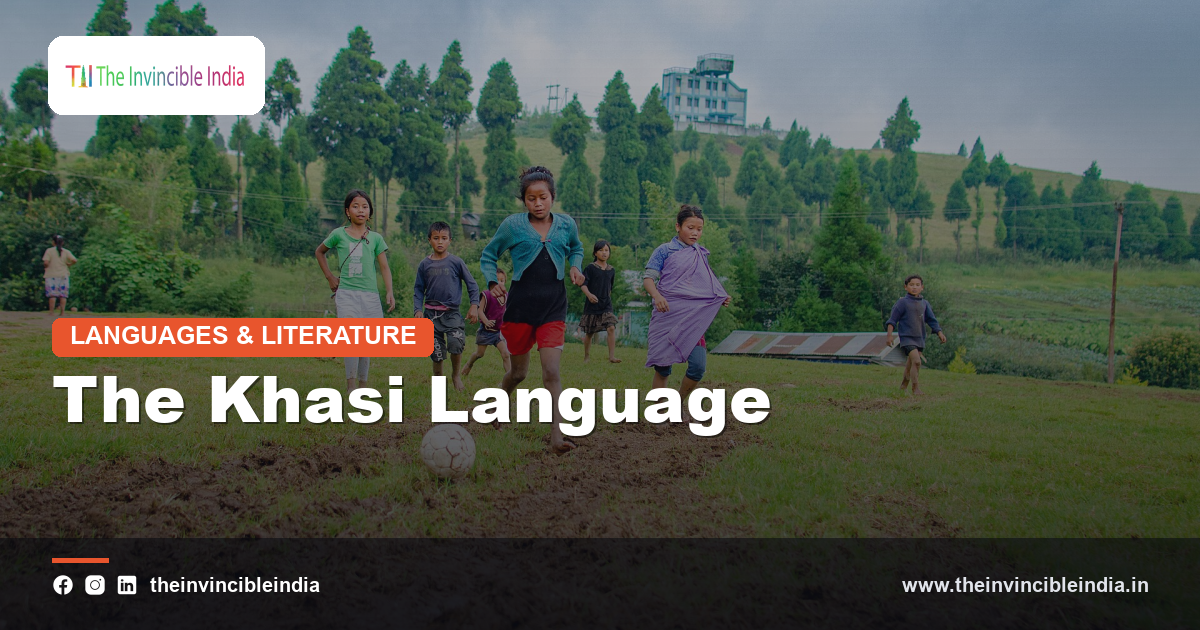
The Khasi language is the principal voice of the hills of Meghalaya and one of the most distinctive members of India’s linguistic family. Unlike most languages of the subcontinent, which descend from Indo-Aryan, Dravidian or Tibeto-Burman stock, Khasi belongs to the Austroasiatic family, linking the hills of the Northeast with a wide arc of languages across mainland Southeast Asia. Spoken in the Khasi and Jaintia Hills and written in a Roman-based script, it carries a rich body of oral tradition, a growing literature and the identity of a matrilineal people. Readers exploring the broader landscape of tongues across the country may begin with the languages of India before turning to this guide.
Quick Facts
| Detail | Information |
|---|---|
| Language family | Austroasiatic (Khasic branch) |
| Home region | Khasi and Jaintia Hills, Meghalaya |
| Script | Roman script with added letters |
| Main dialects | Standard Khasi, Pnar, War, Bhoi, Lyngngam |
| Word order | Subject-verb-object |
| Status | Associate official language in Meghalaya |
An Austroasiatic Language in the Hills
Khasi stands apart in the linguistic map of India because it belongs to the Austroasiatic family, a group whose members are found mostly in mainland Southeast Asia. In the subcontinent this family is represented by only a few communities, and Khasi is the best known of them in the Northeast. Its relatives include languages spoken in distant lands, which suggests a very old connection between the hill peoples of Meghalaya and the wider Austroasiatic world.
Linguists place Khasi in its own Khasic branch of the family, and scholars of the region have long treated it as a reminder of how varied the languages of India are. Its presence among the Tibeto-Burman neighbours of the Northeast shows that the hills of Meghalaya hold a linguistic inheritance different from the surrounding plains and ranges.
Where Khasi Is Spoken
The heartland of Khasi is the group of hills in the central and eastern parts of Meghalaya, commonly called the Khasi and Jaintia Hills. The city of Shillong, the state capital, is the main urban centre where the language is heard in markets, schools, offices and homes. Communities also live in neighbouring parts of Assam, and related speech forms are found across the border in Bangladesh.
In the villages of the plateau, Khasi remains the everyday language of family life, farming, trade and ceremony. In towns it shares space with English, Hindi, Bengali and other tongues, making Shillong a genuinely multilingual city. The geography of the hills, with their steep valleys and scattered settlements, has shaped both the spread and the variety of the language.
Dialects and Regional Varieties
Khasi is not a single uniform speech but a family of closely related varieties shaped by the terrain of the hills. The form spoken around Sohra and the central plateau has long served as the standard, and it is the variety most often used in schools, newspapers and books. Other well-known varieties include Pnar or Jaintia, spoken in the Jaintia Hills, and the speech of the War, Bhoi and Lyngngam communities.
These varieties are broadly understood by one another, though differences in sound and vocabulary are noticeable to speakers. Some, such as Lyngngam, show features that set them somewhat apart from the central standard. The presence of such regional forms is a sign of the long, local history of the people and the way language adapts to the land.
Sounds and Structure
Khasi follows a subject-verb-object order, which will feel familiar to speakers of English, and it is not a tonal language in the way that many of its Southeast Asian relatives are. Its sound system includes a range of vowels and consonants that give it a distinctive rhythm, and many words carry stress patterns that learners must absorb by listening.
The grammar relies heavily on small particles placed before nouns and verbs rather than on long chains of endings. Words are built from short roots, and meaning is often shaped by the particles that accompany them. This design gives the language a compact, flexible character that is quite different from the heavily inflected tongues of the Indo-Aryan family.
Gender Markers and the Role of Particles
One of the most recognisable features of Khasi grammar is the use of small markers before nouns that indicate gender and number. The particle u signals a masculine noun, ka a feminine one, and ki a plural, while i can add a sense of smallness or affection. These markers appear constantly in speech and writing and give the language its characteristic sound.
Because the markers accompany names and common nouns alike, a listener can often tell at once whether a person or thing is treated as male, female or plural. The system is regular and elegant, and it reflects a worldview in which many things, including places and natural features, are spoken of in gendered terms. It remains one of the first things learners notice.
The Roman Script and Its Adaptation
Khasi is written in the Roman script, which is unusual among the major languages of India, most of which use scripts descended from Brahmi or Perso-Arabic traditions. The adoption of the Roman alphabet is associated with the work of Christian missionaries in the nineteenth century, who set down the language in writing and produced the first printed texts for the community.
The alphabet was adapted to the sounds of Khasi by adding marked letters and conventions for sounds not found in English. Today this Roman-based writing is used in schools, newspapers, official documents and digital media. It has made the language easy to type and share, though some scholars have also explored earlier and alternative ways of recording it.
Missionaries, Printing and the Rise of Written Khasi
The written history of Khasi is closely tied to the arrival of Christian missions in the hills during the nineteenth century. Missionaries, among them Welsh Presbyterians, studied the language, standardised a spelling system and produced primers, hymns and translations of religious texts. These works turned a language that had lived mostly in speech into one that could be read and taught.
Printing presses and mission schools spread literacy across the hills, and the community soon took up writing for itself. The result was a language that moved from oral custom to the printed page within a relatively short period. This legacy continues to shape education, church life and publishing in Meghalaya, and it remains an important chapter in the story of the language.
Oral Traditions and Folk Narrative
Long before the printed page, Khasi culture preserved its knowledge through song, proverb, story and ritual speech. Elders passed down accounts of the origins of the clans, the sacred groves, the rivers and the hills, and these tales were told in the language of the home and the village. Folk narrative gave moral guidance and explained the landscape in imaginative terms.
Among the best-known tales is the story of Ka Likai, linked in popular memory with a famous waterfall near Sohra. Such narratives show how language, landscape and memory are interwoven in Khasi life. Even today, storytellers, teachers and writers draw on these traditions, keeping the oral heritage alive within a modern setting.
Proverbs, Songs and Poetry
Khasi speech is rich in proverbs and sayings that express social values such as respect, honesty, hospitality and care for kin. These short, memorable lines are used in conversation, in public speeches and in the advice given to the young. They show how the language packs shared wisdom into compact and often poetic forms.
Song has always been a major vehicle for the language, from folk melodies sung at festivals to hymns and modern compositions. Poets have written about the hills, the clouds, the rivers and the bonds of family, using the particular rhythms of Khasi. The tradition of verse and song continues to connect each generation with the sounds and imagery of their mother tongue.
Literature and Pioneering Writers
Modern Khasi literature began to take shape in the nineteenth and early twentieth centuries, as educated members of the community wrote poetry, essays, plays, histories and religious works. Early figures such as Jeebon Roy are remembered for helping to establish the habit of writing in the language, while the poet Soso Tham is widely honoured for verse that celebrated Khasi land and heritage.
Later writers expanded the range of the literature to include novels, short stories, drama and translation. Writers, publishers and literary societies in Shillong and the hills have kept this tradition going. Khasi literature, though smaller than that of the major Indian languages, has a distinct voice that reflects the history and outlook of its people.
Language, Clan and Matrilineal Society
The Khasi language cannot be separated from the social order in which it is used. Khasi society is matrilineal, with descent traced through the mother and the youngest daughter traditionally holding a special place in the care of the family home. Clan names and kinship terms are central to how people introduce themselves and relate to others.
The vocabulary of kinship, clan and household reflects these customs with great precision. Words for mother, maternal uncle and clan carry meanings that go beyond simple family relations, expressing duties and ties of respect. In this way the language serves as a living record of one of the best-known matrilineal traditions in the world.
Festivals and Ritual Speech
Khasi festivals bring the language into public life through dance, music and ceremonial words. Celebrations such as the Nongkrem dance in the Khasi Hills and the Behdienkhlam festival of the Jaintia Hills involve prayers, songs and formal speeches delivered in the traditional idiom. The Shad Suk Mynsiem, often called the dance of the joyful heart, is another occasion on which the culture is celebrated.
At these gatherings, elders and priests use a ritual register of the language that differs from everyday talk, and young people hear and learn it by participation. The festivals therefore act as classrooms for the language as much as showcases for dress and dance, helping to hand on vocabulary and customs across generations.
Khasi in Education and Administration
Khasi is taught in schools across Meghalaya and studied at the university level, including at institutions in Shillong. Textbooks, examinations and teacher training in the language support its continued use among the young. English, however, also plays a major role in education and official work, and children in the hills commonly grow up using both languages.
In the administrative sphere, English is the principal official language of Meghalaya, while Khasi and Garo hold the status of associate official languages. Khasi is not listed in the Eighth Schedule of the Constitution, and demands for its inclusion have been a recurring theme in public discussion. Such recognition is seen by many speakers as a matter of cultural dignity.
Khasi in Media, Cinema and Music
The language has a lively presence in newspapers, radio, television and, increasingly, online platforms. Khasi-language publications report on local affairs, culture and sport, while radio programmes bring news, songs and discussions into homes across the hills. These media help standardise usage and give the language a visible, modern role.
Khasi cinema and popular music have also grown, with films, albums and stage productions made by local artists. Traditional instruments such as the duitara, a stringed instrument, are heard alongside modern bands. Young musicians often write songs in Khasi, showing that the language remains a creative medium for each new generation and is not confined to the past.
Challenges of a Multilingual Setting
Like many regional languages, Khasi faces the pressures of a multilingual and increasingly connected world. English is the language of higher education and many careers, Hindi and Bengali are heard widely in towns, and migration and urban life bring constant contact with other tongues. Some families worry that children may grow more comfortable in other languages than in their own.
Writers, teachers and community groups have responded by promoting reading, publishing and cultural events in Khasi. They stress that bilingualism need not mean loss, provided that the mother tongue is used with pride in the home and the public sphere. Sustained effort of this kind is widely seen as essential to keeping the language vibrant.
Digital Life and the Future of Khasi
Because Khasi uses the Roman script, it adapted quickly to computers, mobile phones and social media. Speakers write messages, share poems and post videos in the language, and online communities discuss grammar, vocabulary and literature. Digital tools such as keyboards and dictionaries make learning easier for those who live far from the hills.
Educators and enthusiasts have also explored ways of building digital libraries and teaching resources in the language. These efforts point to a future in which technology supports rather than replaces the mother tongue. The ease of writing Khasi in the digital world is one of the practical advantages the community has carried forward.
The Khasi Language Today
Today the Khasi language remains a living and cherished part of the cultural identity of Meghalaya. It is spoken at home, heard in church and festival, taught in classrooms and printed in books and newspapers. As an Austroasiatic language in a land of many language families, it adds a rare and valuable thread to the linguistic fabric of India.
Its survival and growth depend on the pride and practice of its speakers, supported by schools, writers and institutions. For students of Indian culture, Khasi offers a window into a matrilineal society, a rich oral heritage and a literature still in the making. Understanding it enriches any appreciation of the diversity of the Indian nation.
Sources & Further Reading
- Ministry of Culture, Government of India (indiaculture.gov.in).
- Sahitya Akademi, India’s national academy of letters (sahitya-akademi.gov.in).
Frequently Asked Questions
To which language family does Khasi belong?
Khasi belongs to the Austroasiatic family, which is found mainly in mainland Southeast Asia. In India it is the best-known Austroasiatic language of the Northeast, set apart from the Tibeto-Burman languages around it.
Where is the Khasi language spoken?
It is spoken mainly in the Khasi and Jaintia Hills of Meghalaya, with Shillong as its chief urban centre. Communities also live in neighbouring parts of Assam, and related speech is found across the border in Bangladesh.
Which script is used to write Khasi?
Khasi is written in the Roman script, adapted with added marked letters to suit its sounds. The use of this script is associated with missionary work in the nineteenth century and is now standard in schools and publishing.
Is Khasi an official language?
English is the main official language of Meghalaya, while Khasi and Garo are recognised as associate official languages in the state. Khasi is not part of the Eighth Schedule of the Constitution, and its inclusion has been widely discussed.
What are the main dialects of Khasi?
The central standard form is based on the speech of the plateau around Sohra, and other varieties include Pnar or Jaintia, War, Bhoi and Lyngngam. These forms are broadly related but differ in sound and vocabulary.


