

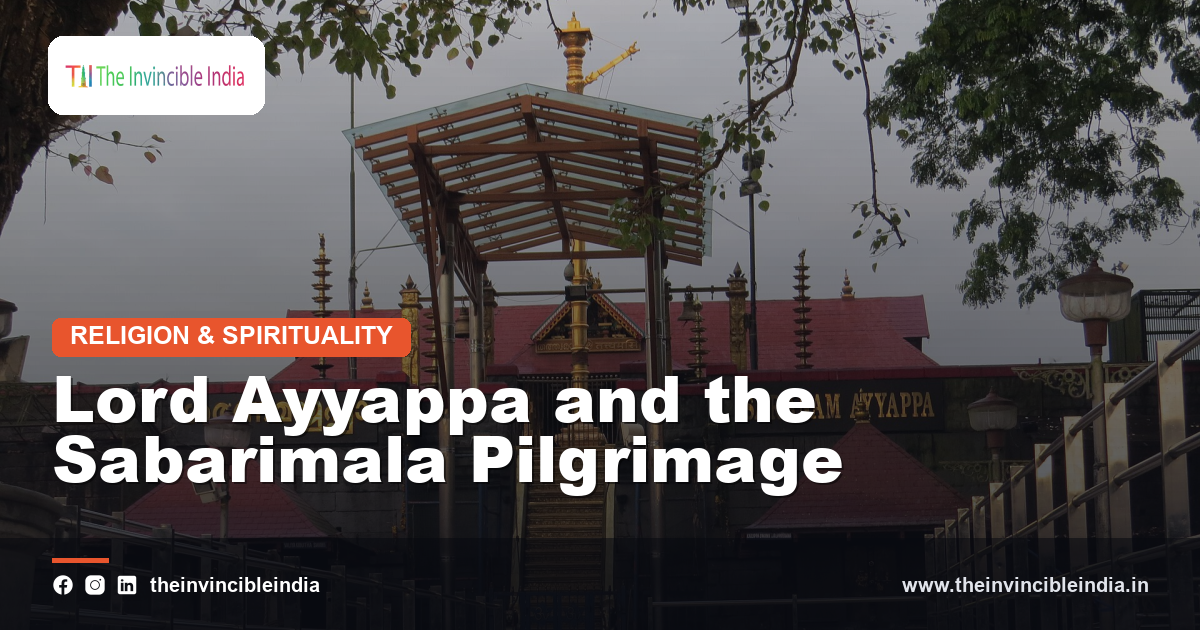
Lord Ayyappa is among the most widely worshipped deities of southern India, and the hill shrine of Sabarimala in Kerala draws one of the largest annual gatherings of pilgrims in the country. Devotees prepare for the journey through weeks of disciplined living, simple dress, and shared prayer, arriving at the forest sanctuary as members of a single devotional community. Rooted in the broader landscape of pilgrimage in India, the Sabarimala tradition blends legend, ritual austerity, music, and a strong ethic of equality among those who undertake the climb. This guide explores the story of Ayyappa, the older Sastha tradition behind him, the vows and rites of the pilgrimage, and the enduring place of Sabarimala in India’s living religious culture.
Quick Facts
| Detail | Information |
|---|---|
| Deity | Lord Ayyappa (Dharma Sastha) |
| Location | Western Ghats, Pathanamthitta district, Kerala |
| Pilgrim Greeting | Swamiye Saranam Ayyappa |
| Key Observance | Forty-one-day vratam |
| Pilgrim Bundle | Irumudi kettu |
| Peak Season | Mandala and Makaravilakku period |
Who Is Lord Ayyappa
Lord Ayyappa is a Hindu deity venerated especially in Kerala, Tamil Nadu, Karnataka, and Andhra Pradesh, and increasingly by devotees across the whole country and the wider diaspora. He is known by many names, including Manikandan, Sastha, and Hariharaputra, a title that points to a divine parentage linking two great streams of Hindu devotion. Devotees picture him as a youthful, meditative figure seated in a yogic posture, a form that expresses both discipline and compassion. He is regarded as a protector of dharma, a guardian of the forest, and a patient listener to the prayers of ordinary people. His worship is notable for its emphasis on personal restraint, simple living, and the dissolving of social distinctions among his followers. Understanding who Ayyappa is therefore means appreciating both a figure of legend and a living devotional culture built around his example.
The Legend of Ayyappa's Birth
According to the traditional narrative, Ayyappa is born from the union of Shiva and Vishnu, the latter appearing in the enchanting form of Mohini. This origin, which gives him the epithet Hariharaputra, is often understood as a symbol of harmony between the Shaiva and Vaishnava traditions that have sometimes been presented as separate paths. The story continues with the divine child being found on the banks of a river, wearing a small bell or jewel at his neck, which accounts for the name Manikandan. He is taken in and raised with affection, and the account unfolds with episodes of courage and wisdom. Different regions and storytellers tell the legend with variations in detail and emphasis, and devotees generally accept this diversity as part of a living oral tradition. Whatever the telling, the central message remains one of unity between traditions and of divine grace appearing in humble circumstances.
The Pandalam Connection
In the traditional account, the child Manikandan is brought up in the household of a ruler associated with Pandalam, a place in the central part of present-day Kerala. The narrative describes a loving upbringing, a youth marked by learning and martial skill, and a growing recognition that the young prince was no ordinary person. Devotional memory preserves this link with Pandalam in practical ways, since a ceremonial procession carrying sacred ornaments for the deity begins from that region each year and travels toward the hill shrine. The association gives the Sabarimala tradition a tangible connection to the cultural life of Kerala, joining mythic narrative with a recurring ritual calendar. Villages along the route take part in welcoming and honoring the procession. In this way the Pandalam connection shows how legend and living custom reinforce one another across generations of devotees.
Dharma Sastha and the Older Tradition
Alongside the popular narrative of Ayyappa, scholars and devotees recognize an older and wider tradition of worshipping Sastha, a deity regarded as a guardian of dharma and of villages and forests. Temples of Sastha exist in many parts of southern India, and in Tamil-speaking regions a closely related protective deity is often worshipped under the name Aiyanar. Over time, devotional practice appears to have gathered these related strands together, so that Ayyappa is commonly regarded as a form of Dharma Sastha. This layering of identities is typical of the way Indian religious life absorbs and reinterprets earlier traditions without erasing them. Devotees at Sabarimala generally do not feel a tension between the names, treating Ayyappa and Sastha as expressions of one divine presence. The convergence illustrates how local guardian worship and pan-Indian theology can meet and enrich each other within a single living tradition.
The Sabarimala Temple and Its Setting
The shrine of Sabarimala stands on a hilltop in the forested Western Ghats of Kerala, within a landscape of dense vegetation, streams, and wildlife. Its remote setting is central to its meaning, because reaching the temple traditionally requires effort, patience, and a willingness to leave ordinary comforts behind. The sanctum is modest in scale compared with the great temple complexes of the plains, and its power for devotees lies in simplicity and atmosphere rather than in monumental architecture. The sacred precinct is often referred to as the Sannidhanam, the place of the deity’s presence. Administration of the temple and the arrangements for visitors have long involved public bodies working together with local communities and volunteers. The setting of the shrine, quiet forest hills drawing crowds who walk and chant together, forms an inseparable part of the Sabarimala experience.
The Forty-One-Day Vratam
The heart of the Sabarimala tradition is the vratam, a period of disciplined preparation lasting around forty-one days before the pilgrimage. During this time devotees traditionally follow a strict code of conduct that includes simple vegetarian food, abstinence from intoxicants, restraint in speech and temper, and regular prayer, often with a daily bath at dawn. Many sleep on simple bedding and avoid personal luxuries such as elaborate grooming. The discipline is understood as a way of purifying body and mind so that the pilgrim arrives ready to see the divine in every companion. Families often support the observance by adjusting household routines. The vratam turns the journey from a simple trip into a spiritual undertaking, and for many participants the weeks of preparation are as meaningful as the climb itself, shaping habits of humility and self-control that they hope to retain afterward.
The Mala and the Dark Clothing
A visible sign of the vratam is the mala, a garland of beads, often made from tulasi or rudraksha, which the devotee receives and wears throughout the period of observance. It is commonly placed on the pilgrim by a guide known as a guru swami, or by a temple priest, and carries a pledge to live by the rules of the pilgrimage. Many devotees also wear black, dark blue, or saffron clothing, and walk without footwear on pilgrimage days. The uniform appearance is deliberate, since it softens differences of wealth, profession, and status. A banker and a farm laborer may stand side by side in the same simple cloth. During the vratam, devotees traditionally address one another as Swami, extending to every fellow pilgrim the respect due to the deity. Dress and address together create a visible language of equality and devotion.
The Irumudi Kettu
The irumudi kettu is the sacred two-compartment bundle that pilgrims carry on their heads on the way to the temple. One compartment holds items for the deity, most notably ghee placed in a coconut, which is later used in a ritual offering. The other holds provisions and offerings for the journey itself, such as rice and other simple items. The bundle is prepared with prayer, often at the home or a local temple, and its tying is treated as a ritual moment. Carrying it on the head signifies that the pilgrim has placed the divine at the highest point of the self, and that all burdens of the journey are offered up. Traditionally, those carrying the irumudi are given special access to the sacred steps at the sanctum. The bundle thus functions as both a practical load and a powerful symbol of surrender.
The Journey Through Pamba and the Forest Trail
For many pilgrims the journey begins at the river Pamba, where it is customary to bathe and offer prayers before ascending toward the shrine. From there the path rises through forest, and devotees move in groups, chanting the name of Ayyappa and the familiar call of Swamiye Saranam Ayyappa, which means that the deity is the refuge. Traditionally pilgrims walked long distances through the forest to reach the hilltop, and some continue to follow the older trekking routes as an act of devotion. Modern facilities, including paths, rest areas, and medical help, have been developed to support the large numbers of visitors. Volunteers and local organizations play a visible role in offering water, food, and guidance. The trail is therefore both a physical ascent and a shared spiritual experience, in which fatigue and chanting merge into a sense of common purpose.
The Eighteen Sacred Steps
At the entrance to the sanctum, pilgrims climb a flight of eighteen sacred steps known as the Pathinettam Padi. These steps are held in deep reverence, and only those who have completed the vratam and carry the irumudi are traditionally permitted to ascend them. Devotees often touch the steps with respect and climb them with folded hands and focused concentration. Various interpretations of the number eighteen are given by teachers and devotees, linking it to spiritual qualities, senses, or stages of inner purification, and these explanations differ from one community to another. What is widely shared is the sense that the steps mark the threshold between ordinary life and the presence of the deity. The ascent is often the emotional high point of the pilgrimage, a moment when weeks of preparation and days of travel are gathered into a single, deeply felt act of devotion.
Tat Tvam Asi and the Message of Equality
Near the sanctum, pilgrims encounter the Sanskrit phrase Tat Tvam Asi, meaning that thou art that, a statement drawn from the Upanishadic tradition and associated with the idea that the individual self and the ultimate reality are not separate. At Sabarimala this teaching is felt in practice as well as theory, since the pilgrimage encourages devotees to see the divine in one another. The shared dress, the common form of address, and the collective discipline all support a social atmosphere in which distinctions of caste, community, and wealth are set aside for the duration of the pilgrimage. Devotees frequently describe this experience of fellowship as one of the most valued parts of the journey. The message of equality is therefore not an added theme but an organizing principle of the tradition, expressed through actions and appearance as much as through words.
Vavar and the Spirit of Harmony
Within the Ayyappa tradition there is a well-known association with a figure called Vavar, who is remembered in the narrative as a companion of Ayyappa. Devotional practice includes paying respects at a place associated with Vavar, commonly at a mosque in the town of Erumely, which many pilgrims visit as part of their journey. This custom is widely cited as an example of religious harmony in Kerala, where communities of different faiths have lived alongside one another for many centuries. Accounts of the relationship are part of oral tradition and vary in detail, so they are best understood as expressions of a cultural ideal rather than as a fixed historical record. For many devotees, however, the gesture of respect is sincere and deeply meaningful. It shows how a Hindu pilgrimage can embrace an inclusive spirit, honoring friendship across religious boundaries as part of its own devotional identity.
Makaravilakku and Makara Sankranti
One of the best-known moments of the Sabarimala year is the Makaravilakku, observed around the time of Makara Sankranti, the festival marking the sun’s northward journey in mid-January. On this occasion, devotees gather in the hills to witness sacred ornaments for the deity being carried in procession to the shrine and offered in worship. The appearance of a sacred light on a distant hill is a central focus of devotion for the assembled pilgrims, who regard it as a sign of divine presence. Interpretations of the light differ among individuals, and the tradition itself places its emphasis on faith, awe, and the shared experience of waiting together in the forest. The event concludes the main pilgrimage season and is remembered as a culminating moment. Makaravilakku thus links the Ayyappa tradition to the larger Hindu festival calendar and to the rhythms of the solar year.
The Pilgrimage Season and Temple Offerings
The principal pilgrimage period runs through the winter months, beginning with the Mandala season and continuing to the time of Makaravilakku, during which the temple is open for extended hours. Outside this period the shrine opens only for shorter monthly observances. At the sanctum, one of the most characteristic rites is the ghee abhishekam, in which the ghee carried in the irumudi is offered for ritual pouring over the deity. Pilgrims also receive prasadam, including a sweet preparation made from rice, jaggery, and ghee, which is carried home and shared with family and friends. Offerings of coconut, camphor, and simple flowers are also common. These customs give structure to the visit and connect the hilltop worship to household devotion. Through such offerings, the experience of the shrine travels back into the daily lives of devotees long after the pilgrimage has ended.
Other Sastha Temples of Kerala
Although Sabarimala is the most famous shrine, the Sastha tradition includes other important temples in Kerala and neighboring regions. A group of five well-known Sastha temples in the southern part of Kerala is often mentioned in devotional literature, each associated with a particular aspect or stage of the deity’s story, such as childhood, youth, or married life. These shrines, including those at Kulathupuzha, Aryankavu, and Achankovil, preserve distinct local rituals and festivals, and many have long histories of community worship. Pilgrims sometimes visit them as part of a wider devotional circuit. Their existence shows that the Ayyappa tradition is not centered on a single place but is part of a regional network of Sastha worship. Together these temples reveal the depth and variety of the tradition, and they offer quieter alternatives for devotees seeking worship outside the main pilgrimage season.
Music, Devotional Song, and Collective Prayer
Devotional music is at the center of Ayyappa worship, and the pilgrim season is filled with songs in Malayalam, Tamil, Kannada, and Telugu. Gatherings known as bhajans and group sessions of singing, often led by experienced devotees, take place in homes, temples, and community halls during the weeks of the vratam. Among the most beloved pieces is the lullaby-like hymn Harivarasanam, which is sung at the close of the temple’s daily worship and is widely recognized by devotees across the country. Folk traditions, including rhythmic drumming and call-and-response chanting, add further variety and energy to the devotional atmosphere. Music serves as both prayer and social glue, allowing people with different languages and backgrounds to join in a single voice. The singing that echoes through the forest on pilgrimage days is one of the most memorable features of the tradition.
Pilgrimage Ethics and Care of the Forest
The tradition of Sabarimala has always emphasized restraint, humility, and respect toward fellow pilgrims, and in recent times it has also been linked with concern for the natural environment of the sacred hills. Because the temple is set within a sensitive forest ecosystem, teachers, volunteers, and administrators have encouraged devotees to avoid littering, to reduce the use of plastics, and to behave with care toward the forest and its wildlife. These appeals are consistent with the older idea of Ayyappa as a guardian of the forest and a protector of living beings. Voluntary cleanliness drives, in which pilgrims and local residents take part, have become a familiar feature of the season. Linking devotion with ecological responsibility gives the pilgrimage a contemporary relevance. It also shows how traditional religious values can support practical efforts to preserve sacred landscapes for future generations of visitors.
Ayyappa and Sabarimala Today
Today the Ayyappa tradition continues to attract millions of devotees from across India and from communities abroad, and the pilgrimage remains a powerful symbol of disciplined devotion and social fellowship. Ayyappa temples have been built in many cities, and local groups organize vratam observances, devotional singing, and community service in the weeks before each season. Modern transport and organized services have made the journey more accessible, while many pilgrims still seek to keep alive the older spirit of simplicity and effort. Public conversations about the customs and administration of the shrine have taken place from time to time, and the tradition continues to evolve within the framework of its core values. Through all these changes, the essential character of Sabarimala endures: a forest shrine, a shared vow, and a call that unites people in devotion to a deity who stands for restraint, harmony, and protection.
Sources & Further Reading
- Ministry of Culture, Government of India (indiaculture.gov.in).
- Kerala Tourism, Government of Kerala (keralatourism.org).
Frequently Asked Questions
Who is Lord Ayyappa?
Lord Ayyappa, also called Sastha, Manikandan, and Hariharaputra, is a Hindu deity widely worshipped in southern India. Tradition describes him as the son of Shiva and Vishnu in the form of Mohini, and devotees honor him as a protector of dharma and the forest.
Where is the Sabarimala temple located?
The Sabarimala temple stands on a hill in the Western Ghats in the Pathanamthitta district of Kerala. It is reached through forested terrain, with many pilgrims beginning the final stage of the journey from the river Pamba.
What is the vratam observed by Sabarimala pilgrims?
The vratam is a period of about forty-one days of disciplined preparation before the pilgrimage. It generally involves simple vegetarian food, abstinence from intoxicants, regular prayer, plain living, and wearing a mala of sacred beads.
What is the irumudi kettu?
The irumudi kettu is a two-compartment bundle carried on the head by pilgrims. One part holds offerings for the deity, including ghee in a coconut, and the other holds provisions for the journey.
What does Swamiye Saranam Ayyappa mean?
It is the traditional pilgrim chant, meaning that the deity is the refuge of the devotee. Pilgrims call it out together during the vratam and on the trail, and it expresses surrender, unity, and faith.


