

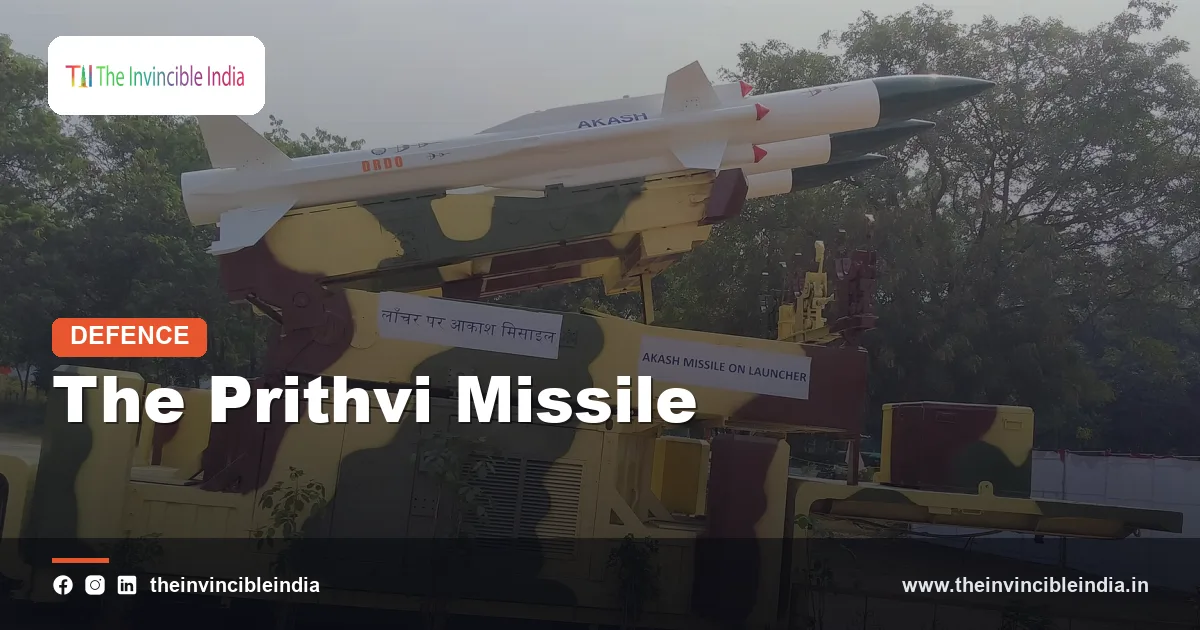
The Prithvi missile is India’s first indigenously developed surface-to-surface ballistic missile and the one that began the country’s modern journey in missile technology. Named after the Sanskrit word for Earth, it was the first system to emerge from the Integrated Guided Missile Development Programme (IGMDP) and it paved the way for the longer-range Agni series and for a family of newer short-range tactical weapons.
This explainer looks at the origins of Prithvi, its three variants, the liquid and solid propulsion technologies involved, the naval version known as Dhanush, and the newer Prahaar and Pralay missiles that carry the tactical missile story forward. Ranges and technical details are described in approximate, publicly known terms rather than as precise specifications.
Quick Facts
| Item | Detail |
|---|---|
| Type | Short-range surface-to-surface ballistic missile (SRBM) |
| Developer | Defence Research and Development Organisation (DRDO), led by the Defence Research and Development Laboratory (DRDL), Hyderabad |
| Programme | Integrated Guided Missile Development Programme (IGMDP), sanctioned in 1983 |
| First flight test | 25 February 1988, from Sriharikota |
| Variants | Prithvi-I (Army), Prithvi-II (Air Force), Prithvi-III and naval Dhanush |
| Propulsion | Liquid-fuelled in the original variants; solid propulsion in later and successor systems |
| Production agency | Bharat Dynamics Limited (BDL) |
| Successor tactical missiles | Prahaar and Pralay, both solid-propellant systems |
| Mission programme leader | Dr A. P. J. Abdul Kalam headed the IGMDP |
Origins: Why India Needed Its Own Missiles
By the early 1980s, India depended heavily on imported weapon systems, and access to advanced military technology was uncertain. Policy makers and scientists concluded that a self-reliant missile capability was essential for national security. The result was a decision in 1983 to launch the Integrated Guided Missile Development Programme, an ambitious plan to develop a family of missiles in parallel instead of one at a time.
The programme was driven by DRDO scientists under the leadership of Dr A. P. J. Abdul Kalam, who had earlier worked at ISRO on the SLV-3 launch vehicle and brought valuable experience in rocket propulsion and guidance. The reasoning behind building different missile types together was that the nation would develop common sub-systems, including propulsion, guidance and control, and a broad industrial base for them.
The five IGMDP missiles
- Prithvi: surface-to-surface tactical ballistic missile.
- Agni: longer-range ballistic missile series, initially a technology demonstrator.
- Trishul: short-range surface-to-air missile.
- Akash: medium-range surface-to-air missile.
- Nag: third-generation anti-tank guided missile.
The IGMDP was formally declared complete in the first decade of the 2000s, though the families of missiles it started have continued to evolve.
Understanding Tactical and Ballistic Missiles
To appreciate Prithvi, it helps to understand some basic terms. A ballistic missile is powered by a rocket motor in the early part of its flight, after which it follows a curved, largely unpowered trajectory under gravity to its target. Cruise missiles, in contrast, fly within the atmosphere under continuous power, much like a small pilotless aircraft. Missiles are commonly grouped by range into short-range, medium-range, intermediate-range and intercontinental classes.
What does tactical mean?
The word tactical refers to missiles meant for battlefield or theatre-level use against targets such as command posts, airfields, logistic nodes and troop concentrations, rather than the deep strategic targets associated with long-range systems. Prithvi belongs to this tactical category. Its role was to give commanders the ability to hit important targets behind enemy lines quickly, without risking aircraft and pilots in contested airspace.
- Short-range ballistic missiles typically cover from a few tens to several hundred kilometres.
- They are valued for speed, short reaction time and the difficulty of intercepting them.
- Accuracy, expressed through a measure called circular error probable, is a critical performance factor.
Prithvi-I: The First Variant
The first flight test of Prithvi took place on 25 February 1988 from the Sriharikota range on the east coast, and development trials continued for several years. The version meant for the Indian Army, called Prithvi-I, was inducted into service in the early 1990s and is generally associated with the 1994 induction. It is a single-stage, road-mobile missile that can carry a heavy conventional warhead over a range commonly given as around 150 kilometres.
Key characteristics
- Single-stage design using storable liquid propellants.
- Mounted on a mobile launcher so that it can be moved and fired from prepared or unprepared sites.
- Designed to carry a relatively heavy payload at shorter range, which suited the Army’s battlefield requirements.
- Guided by an inertial navigation system, with a degree of corrective guidance during flight.
Prithvi-I was a technological milestone because it showed that India could build, test and field a ballistic missile entirely on its own. It also served as a learning platform for guidance, control and launcher technology that was used in later systems.
Prithvi-II: The Air Force Variant
Prithvi-II was developed mainly for the Indian Air Force, which wanted a missile that could be used against airfields, radars and other high-value targets. It has a longer range than the first model, commonly quoted in the region of 250 to 350 kilometres, with a smaller warhead mass. It was first flight-tested in the mid-1990s and entered service in the early 2000s.
Like the earlier version, it uses liquid propulsion, but with refinements in guidance and an improved flight profile. Over the years it has been test-fired repeatedly, including user trials from the Integrated Test Range at Chandipur in Odisha. These trials demonstrate readiness and consistency of the system rather than any new capability.
Why liquid propulsion mattered
- Liquid engines give good control over thrust and are well understood by Indian rocket engineers from space programme experience.
- Their main drawback is a longer preparation time, since fuelling and handling are more complex than with solid motors.
- Storable liquids allow the missile to remain fuelled for some period, which partly offsets this limitation.
Prithvi-III and the Naval Dhanush
The third variant in the family is usually described as Prithvi-III, associated with the Navy and with a longer range than earlier models. In practice it is often discussed together with the ship-launched Dhanush system, which is a naval adaptation of Prithvi. Dhanush, meaning bow in Sanskrit, was designed to be launched from a surface ship and was first tested from a naval vessel in the early 2000s.
What Dhanush showed
Launching a liquid-fuelled ballistic missile from a moving ship at sea is technically demanding, because the platform is unstable and storage and handling of the missile on board need special arrangements. Its successful test demonstrated India’s ability to put a ballistic missile on a naval platform, an important step towards the later submarine-launched missiles that are part of the country’s strategic programme.
- Intended to give the Navy a capability to strike land targets from the sea.
- Range is generally given as being of the order of a few hundred kilometres.
- Offers flexibility because a ship can position itself in a chosen area of the sea.
The naming of variants has sometimes been inconsistent in public sources, and readers should treat the Prithvi-III and Dhanush labels as closely related members of the same family.
Propulsion: From Liquid to Solid
The original Prithvi variants are powered by liquid-fuel rocket engines. Solid propellant technology, however, has several operational advantages: the missile can be stored ready to fire, it needs less support equipment, and it has a short preparation time. Subsequent Indian missile development, from the Agni series onwards, has progressively favoured solid motors, along with canisterised launch for road and rail mobility.
| Feature | Liquid propulsion | Solid propulsion |
|---|---|---|
| Preparation before launch | Longer, due to fuelling and checks | Short, since propellant is stored in the motor |
| Thrust control | Better control of burn | Fixed once ignited, mostly |
| Logistics | More support vehicles | Simpler logistics |
| Typical use | Early Prithvi variants | Prahaar, Pralay, later Agni missiles |
This shift in propulsion explains why Prithvi is gradually being complemented, and in some roles replaced, by newer tactical systems that are quicker to deploy.
Prahaar: A Quick-Reaction Tactical Missile
Prahaar, meaning strike or blow, is a short-range, solid-propellant, surface-to-surface missile developed by DRDO. It was first flight-tested in July 2011 from the Chandipur range. The missile is intended to cover a range of the order of 150 kilometres and is characterised by high manoeuvrability, quick reaction and the ability to be launched from a mobile platform.
Distinctive features
- Solid-propellant motor, avoiding liquid fuelling procedures.
- Road-mobile canister-based launchers carrying multiple missiles, which allows salvo fire.
- Designed for high accuracy with modern navigation and control.
- Meant to fill a gap between unguided rockets and longer-range ballistic missiles.
Its development reflects an evolving doctrine in which commanders seek a precise, rapid response capability against time-sensitive targets close to the front.
Pralay: Quasi-Ballistic Tactical Missile
Pralay, meaning cataclysm, is a more recent solid-fuelled, quasi-ballistic missile intended for the Army and the Air Force. A quasi-ballistic missile flies a lower, flatter and more manoeuvrable path than a classical ballistic one, which makes it harder to intercept. Its first flight test took place in December 2022 from an island range off the Odisha coast, and further trials followed in subsequent years.
Features reported publicly
- Range described in the broad band between roughly 150 and 500 kilometres.
- Solid propellant, advanced guidance with navigation aids and the ability to change course in flight.
- Capability to carry different types of conventional warheads.
- Road-mobile launcher based on a wheeled vehicle.
Pralay is regarded as the natural successor to Prithvi-class missiles in the conventional tactical role, and it is part of a broader modernisation of India’s conventional strike capability alongside systems such as the BrahMos cruise missile and the Pinaka multi-barrel rocket launcher.
Role in India’s Defence Posture
India’s declared nuclear doctrine rests on credible minimum deterrence and a policy of no first use, and the long-range Agni family and submarine-launched missiles form the core of the strategic arsenal. Prithvi, by contrast, is used by the conventional forces as a tactical system. At the same time, Prithvi-II has been test-fired by the Strategic Forces Command in the past, which has led to its association with a dual-capable role. Details of any warheads are not part of public record and are best left outside discussion.
Wider contributions
- Conventional deterrence: the ability to hit targets at depth supports deterrence below the nuclear threshold.
- Technology base: guidance, propulsion, materials and testing infrastructure built for Prithvi were reused in other programmes.
- Missile defence: variants of Prithvi have served as target missiles in tests of India’s ballistic missile defence interceptors, which are separately named Prithvi Air Defence and Advanced Air Defence in their early development.
- Industry: Bharat Dynamics Limited and private suppliers built a production ecosystem.
Testing, Infrastructure and Export Control
Missile development needs extensive test facilities. India uses the Integrated Test Range at Chandipur and the island test facility off the Odisha coast, which were set up to support the IGMDP and later programmes. Telemetry, radar tracking and ship-based monitoring help engineers evaluate each flight. Users from the armed forces conduct periodic trials to ensure that missiles from the production line meet their standards.
On the international side, India became a member of the Missile Technology Control Regime (MTCR) in 2016, which sets guidelines for the transfer of rocket and missile technology. Membership brought India into a major export control arrangement and has helped it in trade with other member states in high technology areas.
Conclusion
The Prithvi missile marks the start of India’s indigenous ballistic missile story. From its first test in 1988 to its induction into the Army, Air Force and, in modified form, the Navy, it created the knowledge and infrastructure on which later achievements were built. Today, solid-fuelled tactical systems such as Prahaar and Pralay are taking the baton, offering faster response and better mobility. Understanding Prithvi therefore gives an essential starting point for studying the entire family of Indian missiles.
Frequently Asked Questions
What is the Prithvi missile?
Prithvi is India’s first indigenously developed short-range surface-to-surface ballistic missile. It was developed by DRDO under the Integrated Guided Missile Development Programme and first tested in 1988. It exists in Army, Air Force and Navy-related variants.
What are the differences between Prithvi-I, II and III?
Prithvi-I was designed for the Army with a range of around 150 km and a heavier payload. Prithvi-II, for the Air Force, has a longer range of a few hundred kilometres with a lighter payload. Prithvi-III is associated with the Navy and a still longer range, and is closely linked with the ship-launched Dhanush.
What is the Dhanush missile?
Dhanush is the naval version of Prithvi, designed to be fired from a ship at land or sea targets. It showed that a ballistic missile could be launched from a naval platform.
How are Prahaar and Pralay different from Prithvi?
Both use solid propellant, which allows faster launch preparation than Prithvi’s liquid engines. Prahaar is a shorter-range quick-reaction missile, while Pralay is a quasi-ballistic missile with a longer reach and greater manoeuvrability.
What is the IGMDP?
The Integrated Guided Missile Development Programme was launched in 1983 to develop a family of missiles at the same time. It produced Prithvi, Agni, Trishul, Akash and Nag, and helped build India’s missile industry and test infrastructure.
Is Prithvi a nuclear missile?
Prithvi is mainly a conventional tactical missile, though Prithvi-II is considered dual-capable and has been test-fired by the Strategic Forces Command. Specific details of warheads are not made public.
{“@context”:”https://schema.org”,”@graph”:[{“@type”:”FAQPage”,”mainEntity”:[{“@type”:”Question”,”name”:”What is the Prithvi missile?”,”acceptedAnswer”:{“@type”:”Answer”,”text”:”Prithvi is India’s first indigenously developed short-range surface-to-surface ballistic missile. It was developed by DRDO under the Integrated Guided Missile Development Programme and first tested in 1988. It exists in Army, Air Force and Navy-related variants.”}},{“@type”:”Question”,”name”:”What are the differences between Prithvi-I, II and III?”,”acceptedAnswer”:{“@type”:”Answer”,”text”:”Prithvi-I was designed for the Army with a range of around 150 km and a heavier payload. Prithvi-II, for the Air Force, has a longer range of a few hundred kilometres with a lighter payload. Prithvi-III is associated with the Navy and a still longer range, and is closely linked with the ship-launched Dhanush.”}},{“@type”:”Question”,”name”:”What is the Dhanush missile?”,”acceptedAnswer”:{“@type”:”Answer”,”text”:”Dhanush is the naval version of Prithvi, designed to be fired from a ship at land or sea targets. It showed that a ballistic missile could be launched from a naval platform.”}},{“@type”:”Question”,”name”:”How are Prahaar and Pralay different from Prithvi?”,”acceptedAnswer”:{“@type”:”Answer”,”text”:”Both use solid propellant, which allows faster launch preparation than Prithvi’s liquid engines. Prahaar is a shorter-range quick-reaction missile, while Pralay is a quasi-ballistic missile with a longer reach and greater manoeuvrability.”}},{“@type”:”Question”,”name”:”What is the IGMDP?”,”acceptedAnswer”:{“@type”:”Answer”,”text”:”The Integrated Guided Missile Development Programme was launched in 1983 to develop a family of missiles at the same time. It produced Prithvi, Agni, Trishul, Akash and Nag, and helped build India’s missile industry and test infrastructure.”}},{“@type”:”Question”,”name”:”Is Prithvi a nuclear missile?”,”acceptedAnswer”:{“@type”:”Answer”,”text”:”Prithvi is mainly a conventional tactical missile, though Prithvi-II is considered dual-capable and has been test-fired by the Strategic Forces Command. Specific details of warheads are not made public.”}}]}]}


