

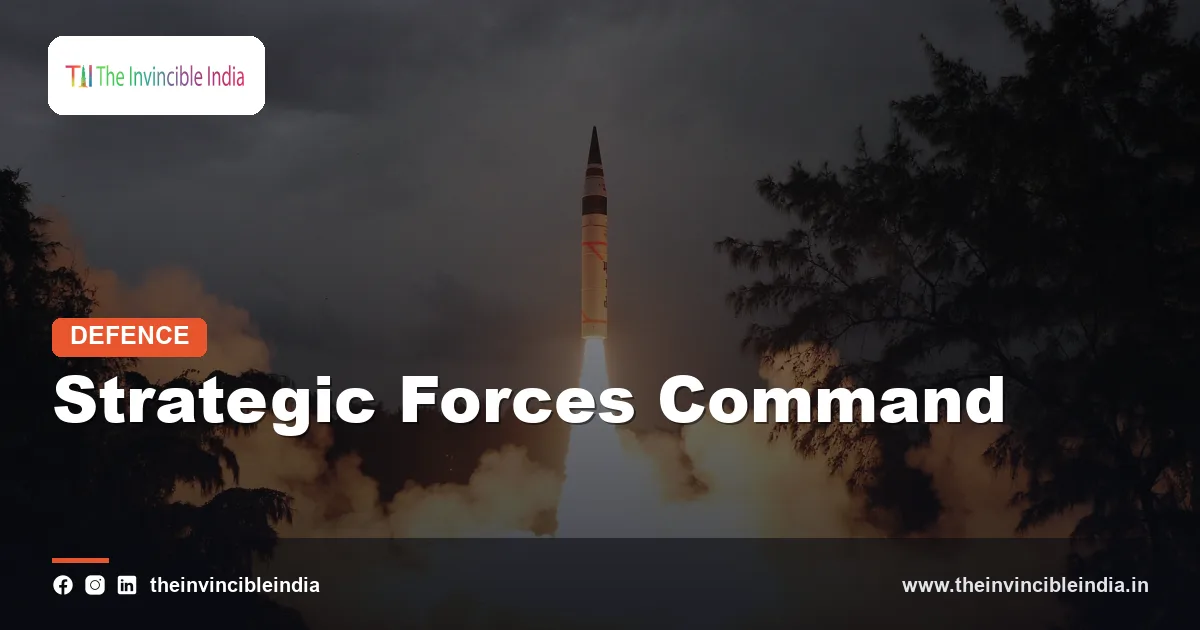
The Strategic Forces Command (SFC) is the tri-service military formation that manages and administers India’s nuclear forces. Created in 2003 as part of a new nuclear command and control structure, it sits within the Nuclear Command Authority and works under strict civilian political control. It is the organisation that turns the country’s declared nuclear doctrine of credible minimum deterrence and no first use into a real, structured and disciplined capability.
This explainer covers how the command came about, where it fits in the chain of authority, the three legs of the delivery triad, how the chain of command works, and why civilian control is central to the system. Only well-established, publicly stated facts are used; operational details of any nuclear force are rightly secret and are not discussed here.
Quick Facts
| Item | Detail |
|---|---|
| Established | Announced on 4 January 2003, along with the Nuclear Command Authority |
| Nature | Tri-service command, with personnel drawn from the Army, Navy and Air Force |
| Head | Commander-in-Chief SFC, a three-star officer drawn in rotation from the three services |
| Headquarters | New Delhi |
| Parent structure | Nuclear Command Authority (Political Council and Executive Council) |
| Doctrine | Credible minimum deterrence and no first use |
| Delivery triad | Land-based missiles, aircraft and nuclear-powered ballistic missile submarines |
| Authority to order use | Only the civilian political leadership, headed by the Prime Minister |
The Road to a Nuclear Command Structure
India conducted its first nuclear test, described officially as a peaceful nuclear explosion, at Pokhran in May 1974. For more than two decades after this, the country retained a policy of ambiguity, keeping the option open but not declaring itself a nuclear weapon state. This changed in May 1998, when India carried out a series of tests at Pokhran on 11 and 13 May and announced itself as a nuclear weapon state. A voluntary moratorium on further testing was declared soon afterwards.
Why a command was needed
Possessing nuclear weapons is one thing; having a stable, secure and accountable system to control them is another. After 1998, India needed to define who would own the weapons, who would decide on their use, and how that decision would be passed down safely. Two steps followed:
- In August 1999 the National Security Advisory Board released a draft nuclear doctrine for public discussion.
- On 4 January 2003 the Cabinet Committee on Security reviewed operationalisation of the doctrine, approved the structure of the Nuclear Command Authority and announced the setting up of the Strategic Forces Command.
The aim was to establish clear political ownership and professional military management under a single roof.
What the Strategic Forces Command Does
The SFC is responsible for the management and administration of the strategic forces, meaning the nuclear-capable units and assets assigned to it. It handles training, readiness, maintenance, logistics, communications and security for these forces. In effect, it is the custodian of the delivery systems and the operational arm which would carry out a political decision, if one were ever taken.
Core responsibilities
- Maintaining and operating nuclear-capable delivery systems across land, air and sea.
- Ensuring that the forces remain survivable, secure and always ready to meet the requirement of credible deterrence.
- Conducting training, exercises and user trials of missiles in coordination with scientific agencies.
- Integrating the three services into a coherent structure with shared procedures.
- Following the directions that flow down from the political leadership through the Nuclear Command Authority.
It is important to stress that the SFC does not decide policy on nuclear use. It is an instrument of civilian decisions, not an independent decision-maker.
The Nuclear Command Authority
The Nuclear Command Authority (NCA) is the apex body that controls India’s nuclear arsenal. It has two parts, and between them they separate the roles of political decision and technical or executive implementation. This two-tier design is a deliberate safeguard.
The Political Council
The Political Council is chaired by the Prime Minister. It is the only body that can authorise the use of nuclear weapons. Its members include senior Cabinet ministers who deal with national security. The concentration of decision-making power at the highest political level reflects the principle that decisions of such grave consequence belong to the elected leadership.
The Executive Council
The Executive Council is chaired by the National Security Adviser. It provides inputs for decision-making by the Political Council and executes the directives given to it by the Political Council. The Commander-in-Chief of the Strategic Forces Command, along with other senior officials, is part of the apparatus that interacts with this council.
| Body | Chair | Main role |
|---|---|---|
| Political Council | Prime Minister | Sole authority to order nuclear use |
| Executive Council | National Security Adviser | Advises the Political Council and carries out its directives |
| Strategic Forces Command | Commander-in-Chief SFC | Manages and operates the nuclear forces |
The Doctrine Behind the Command
The Strategic Forces Command exists to serve a declared doctrine, whose main elements were formally released in January 2003. It is relatively restrained and defensive in character.
- Credible minimum deterrence: India will maintain a nuclear force sufficient to deter an adversary, but not to engage in an arms race.
- No first use: nuclear weapons will be used only in retaliation against a nuclear attack on Indian territory or on Indian forces anywhere.
- Massive retaliation: any first strike will be met with a response intended to inflict unacceptable damage.
- Non-use against non-nuclear states: nuclear weapons will not be used against states that do not have nuclear weapons, subject to certain stated provisions regarding major attacks with biological or chemical weapons.
- Civilian control: retaliatory attacks can be authorised only by the civilian political leadership through the NCA.
The doctrine also commits India to a continued moratorium on nuclear testing, to strict export controls and to a stance in favour of a global, non-discriminatory move towards nuclear disarmament. It has been reviewed in public debate from time to time, but the core pillars have remained in place.
The Nuclear Triad Explained
A nuclear triad means having the ability to deliver nuclear weapons from three different kinds of platform: land, air and sea. The idea is to ensure survivability. If an adversary could not destroy all three legs in a first strike, deterrence remains credible. India has developed all three legs over time, with the SFC handling the delivery systems.
Land: the missile leg
The land-based leg rests on ballistic missiles, notably the Agni series, developed by DRDO. These range from shorter-range to intermediate-range and longer-range systems, with newer models featuring solid fuel, canister launch and road or rail mobility to improve survivability and quick response. The Prithvi series has also been associated with this role in its dual-capable variants.
Air: the aircraft leg
The air leg is based on nuclear-capable combat aircraft of the Indian Air Force, which provide flexibility and the possibility of recall. The specific aircraft types and arrangements are not officially detailed, and it is widely understood that this was the earliest means of delivery for the country.
Sea: the submarine leg
The sea leg is considered the most survivable because submarines can hide in the depths of the ocean. India’s indigenously built nuclear-powered ballistic missile submarine, INS Arihant, was commissioned in 2016, and a sister vessel followed in later years. These carry submarine-launched ballistic missiles such as the K-series. The sea leg completed the triad and supports the posture of assured retaliation after a first strike.
Chain of Command and Civilian Control
The chain of command is built around political ownership. At the top, the Political Council headed by the Prime Minister alone can authorise the use of nuclear weapons. The Executive Council turns that authorisation into directives. These flow to the Commander-in-Chief of the Strategic Forces Command, who is responsible for the forces that would carry them out.
Safeguards built into the system
- Authority to order use is held only at the political level and cannot be exercised by any military commander on his own.
- The Nuclear Command Authority is stated to have an established succession of alternates, so that the retaliatory chain remains unbroken even if the leadership is disrupted.
- Scientific and civilian establishments have a role in the development and stewardship of weapons and missiles, creating a separation between military operators and the technical custodians.
- The system emphasises robust command, control, communications and intelligence arrangements and strong physical and procedural security.
This combination of civilian primacy and professional military management reflects the broader tradition of civil-military relations in India, where the armed forces operate under the direction of the elected government.
Leadership and Tri-Service Character
The SFC is a joint command, so its personnel come from all three services. Its Commander-in-Chief is an officer of three-star rank, who holds the appointment on a rotational basis, which has been held at different times by officers of the Air Force, Army and Navy. The headquarters in New Delhi coordinates the units and sub-formations located in different regions.
The tri-service model is significant for another reason. It was one of the earliest examples of an integrated, joint military structure in India, long before debates on theatre commands gained momentum. Because it integrates the services, each of which fields its own nuclear-capable platforms, the command offers a kind of working template for jointness in the Indian armed forces.
Relationship with higher defence management
The post of the Chief of Defence Staff, created in December 2019, and the Department of Military Affairs added another layer to the higher defence organisation. The nuclear chain, however, continues to flow through the Nuclear Command Authority, and the SFC remains answerable to it.
Testing and Readiness
Credible deterrence requires confidence that the systems work as intended. India periodically tests its nuclear-capable missiles, often described as user trials, conducted from test ranges on the east coast, with the SFC taking part alongside the developers at DRDO. These flights are pre-notified to ensure safety in air and sea areas and are generally publicly announced. They serve to validate performance, train operators and signal technical credibility without any actual nuclear use.
- The test ranges include sites off the coast of Odisha, with tracking stations along the coast.
- Different missile classes are tested to different distances to confirm performance.
- Submarine-launched missile tests are conducted at sea and need specialised recovery and tracking arrangements.
International Context and Responsible Posture
India is not a party to the Nuclear Non-Proliferation Treaty, which it has regarded as discriminatory, but it has stressed its record as a responsible nuclear state. It has maintained its testing moratorium and, in 2008, secured a waiver from the Nuclear Suppliers Group that allowed civil nuclear cooperation with other countries. It has also supported efforts to prevent proliferation of nuclear material and technology.
The SFC and the NCA structure are often cited in India’s explanations of its responsible posture. They show that command and control, with civilian leadership and clear lines of accountability, is institutionalised rather than ad hoc.
Conclusion
The Strategic Forces Command is a quiet but vital part of India’s security architecture. Since its creation in 2003 it has given the country a professionally managed, tri-service force structure operating under the Nuclear Command Authority and the civilian Political Council. With a delivery triad covering land, air and sea, and a doctrine built on no first use and credible minimum deterrence, it represents a posture meant to prevent war rather than fight one. Public understanding of this system, even at a general level, is important for informed debate on national security.
Frequently Asked Questions
What is the Strategic Forces Command?
It is the tri-service command that manages and administers India’s nuclear forces. It was announced in January 2003 together with the Nuclear Command Authority and is headquartered in New Delhi. It follows directions given through the civilian political leadership.
Who can order the use of nuclear weapons in India?
Only the civilian political leadership can do so, through the Political Council of the Nuclear Command Authority, which is chaired by the Prime Minister. No military commander has independent authority to order use.
What are the Political Council and Executive Council?
The Political Council, chaired by the Prime Minister, is the sole body authorised to approve nuclear use. The Executive Council, chaired by the National Security Adviser, provides inputs to the Political Council and carries out its directives.
What is India’s nuclear triad?
It refers to the capability to deliver nuclear weapons from land-based missiles such as the Agni series, from aircraft and from nuclear-powered ballistic missile submarines such as INS Arihant. Having all three legs improves survivability and the credibility of deterrence.
What is India’s nuclear doctrine?
India follows a policy of credible minimum deterrence and no first use. It promises a massive retaliation if attacked with nuclear weapons, and does not use them against non-nuclear weapon states, subject to stated provisions.
Who heads the Strategic Forces Command?
It is headed by a Commander-in-Chief, an officer of three-star rank who is drawn from the Army, Navy or Air Force in rotation. The appointment is held on a tri-service basis.
{“@context”:”https://schema.org”,”@graph”:[{“@type”:”FAQPage”,”mainEntity”:[{“@type”:”Question”,”name”:”What is the Strategic Forces Command?”,”acceptedAnswer”:{“@type”:”Answer”,”text”:”It is the tri-service command that manages and administers India’s nuclear forces. It was announced in January 2003 together with the Nuclear Command Authority and is headquartered in New Delhi. It follows directions given through the civilian political leadership.”}},{“@type”:”Question”,”name”:”Who can order the use of nuclear weapons in India?”,”acceptedAnswer”:{“@type”:”Answer”,”text”:”Only the civilian political leadership can do so, through the Political Council of the Nuclear Command Authority, which is chaired by the Prime Minister. No military commander has independent authority to order use.”}},{“@type”:”Question”,”name”:”What are the Political Council and Executive Council?”,”acceptedAnswer”:{“@type”:”Answer”,”text”:”The Political Council, chaired by the Prime Minister, is the sole body authorised to approve nuclear use. The Executive Council, chaired by the National Security Adviser, provides inputs to the Political Council and carries out its directives.”}},{“@type”:”Question”,”name”:”What is India’s nuclear triad?”,”acceptedAnswer”:{“@type”:”Answer”,”text”:”It refers to the capability to deliver nuclear weapons from land-based missiles such as the Agni series, from aircraft and from nuclear-powered ballistic missile submarines such as INS Arihant. Having all three legs improves survivability and the credibility of deterrence.”}},{“@type”:”Question”,”name”:”What is India’s nuclear doctrine?”,”acceptedAnswer”:{“@type”:”Answer”,”text”:”India follows a policy of credible minimum deterrence and no first use. It promises a massive retaliation if attacked with nuclear weapons, and does not use them against non-nuclear weapon states, subject to stated provisions.”}},{“@type”:”Question”,”name”:”Who heads the Strategic Forces Command?”,”acceptedAnswer”:{“@type”:”Answer”,”text”:”It is headed by a Commander-in-Chief, an officer of three-star rank who is drawn from the Army, Navy or Air Force in rotation. The appointment is held on a tri-service basis.”}}]}]}


