

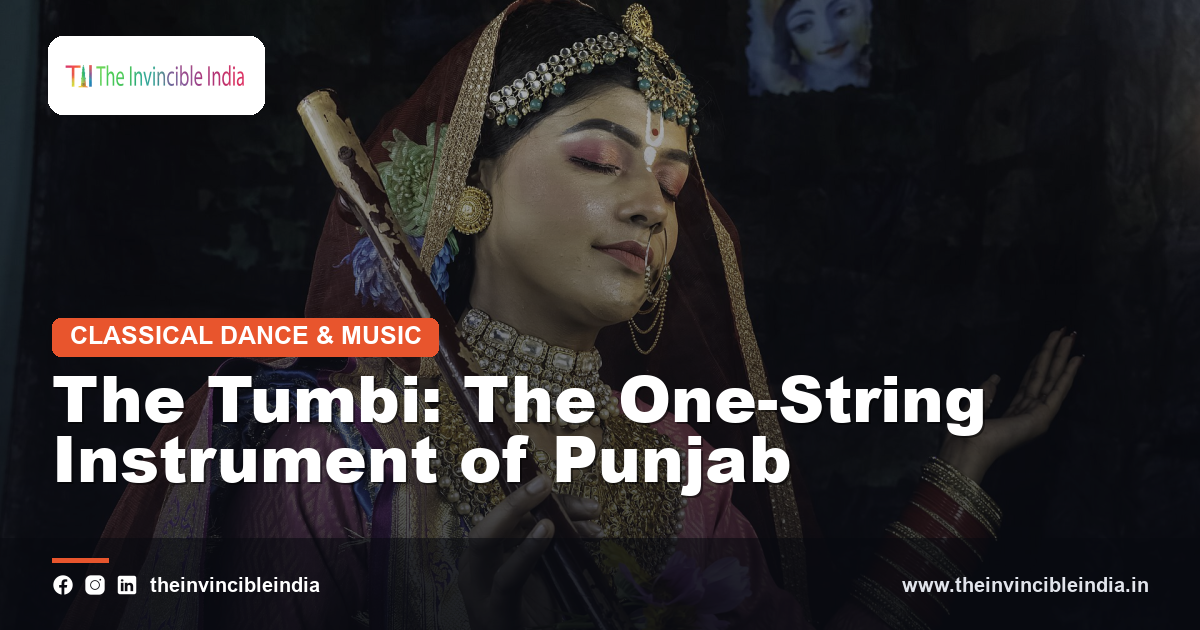
Few sounds say Punjab as quickly as the sharp, joyful twang of the tumbi, a one-string plucked instrument whose bright voice cuts through the beat of the drum and the chorus of singers. Built from simple materials and played with a single finger, it has accompanied village songs, wedding celebrations and harvest festivities for generations, and it became one of the signature sounds of bhangra. Its single string is often compared with that of the ektara, yet the tumbi has a distinct character, a higher pitch and a rhythmic, almost percussive attack of its own. This guide explores the tumbi’s construction, its sound, its playing technique and its enduring place in the folk and popular music of Punjab.
Quick Facts
| Detail | Information |
|---|---|
| Type | Plucked string instrument (chordophone) |
| Origin | Punjab region, North India |
| Strings | A single metal string |
| Body | Hollow resonator with a long, slender neck |
| Played with | A single finger, usually the index finger |
| Traditions | Punjabi folk music, folk songs and bhangra |
What Is the Tumbi
The tumbi is a plucked string instrument from the Punjab region, distinguished by the fact that it carries only a single string stretched over a hollow resonating body and a long, slender neck. Because it has just one string, it is not a melodic instrument in the way of a sitar or a violin; instead, it supplies a bright, repeating figure that works as both a rhythmic pulse and a melodic hook. Its sound is high, piercing and cheerful, qualities that made it ideal for open-air performance among large gatherings of people. The word tumbi is associated with the gourd-like resonator from which early versions were traditionally made. In essence, the tumbi is a small instrument with an outsized presence, and its identity as the voice of Punjabi folk celebration rests on the clarity and energy of that single plucked string.
Roots in Punjabi Folk Tradition
The tumbi belongs to the rural musical culture of Punjab, where songs, instruments and dances grew together around the rhythms of agricultural life, marriage rites and seasonal festivals. In village settings, a singer might be accompanied by little more than a drum and a plucked string instrument, and the tumbi was among the most popular of the latter because it was easy to carry and easy to hear. Its precise origins are not documented in any detail, and it is best understood as a product of long folk practice rather than of a single inventor or period. What is clear is its close link with the regional language, poetry and celebratory spirit of Punjab. The tumbi therefore stands as an authentic expression of folk culture, shaped by community use rather than by formal courtly or academic training.
Construction and Materials
A traditional tumbi is assembled from a few simple components: a hollow resonator, a long neck, a tuning peg and a single metal string. In older instruments the resonator was commonly made from a dried gourd, which gave the instrument its name and its light weight, while many modern examples use a wooden or similarly rigid body for durability. The neck is slender and runs through or along the resonator, offering a firm line along which the string is stretched. The top of the resonator is often covered so that the vibration of the string can be amplified into a strong, ringing tone. Makers may decorate the body with paint or simple ornament. Altogether, the construction of the tumbi reflects the practical economy of folk instruments, in which modest materials are shaped into a tool that is portable, resonant and well suited to its task.
The Single String
The defining feature of the tumbi is its single metal string, which is fixed at the lower end of the body and stretched up the neck to a tuning peg at the top. Unlike instruments with several strings, the tumbi does not allow chords or elaborate melodies; its musical character comes from the way that one string is plucked, again and again, in lively patterns. The string is kept under considerable tension, and this produces the high, bright pitch for which the instrument is known. Because there is no fretboard on which notes are fingered, the sound is essentially fixed to the pitch to which the string has been tuned. This simplicity is a strength rather than a limitation, since it allows the tumbi to stand out immediately in a texture of voices and drums, delivering a recognisable, ringing line that listeners associate at once with Punjab.
Tuning and Pitch
Tuning the tumbi is a matter of turning the peg at the top of the neck until the string reaches a pitch that suits the singer or the ensemble. Because the instrument has only one string, the tuning is chosen to harmonise with the voice and with whatever other instruments are present, and it is typically set at a relatively high pitch that gives the tumbi its piercing quality. A player listens carefully as the string is tightened or loosened, since even small changes alter the brightness of the tone and the way it blends with the singing. The pitch can vary from one performance to another, depending on the vocalist and the occasion. This flexibility shows that the tumbi, for all its simplicity, is a thoughtfully tuned instrument, whose single note must be matched to the group in order to support the song and sustain the rhythm.
Playing Technique
The tumbi is played by plucking the string with a single finger, most often the index finger, in a quick, repeated motion that produces its characteristic twang. The player holds the instrument in one hand, often with the body resting against the palm or the forearm, while the other hand delivers the pluck. Skill lies in controlling the rhythm and the attack, so that each pluck lands crisply and in time with the song. Because only one string is used, players develop a range of rhythmic patterns, accents and quick repetitions that give variety to the sound. Some performers add small flourishes, such as a sudden pause or a rapid run of plucks, to heighten the excitement. Mastery of the tumbi is therefore less about changing notes and more about shaping time, making the instrument a vivid lesson in rhythm and expression.
The Distinctive Sound
The sound of the tumbi is often described as bright, sharp and playful, with a ringing, twanging quality that carries over long distances and rises clearly above the surrounding music. This is the product of its high-tension metal string and its resonating body, which together project a focused tone with a quick decay between plucks. The effect is almost percussive, so that the tumbi acts as a rhythmic instrument as much as a melodic one. In a song, its repeating phrase becomes a kind of musical signature, a hook that listeners remember and sing along with. Its cheerful timbre also suits the mood of Punjabi celebration, expressing energy, exuberance and good humour. For this reason the tumbi is easily recognised even by those unfamiliar with Indian instruments, standing as an unmistakable emblem of the sound of Punjabi folk music.
Role in Folk Songs
In traditional Punjabi folk songs, the tumbi typically works alongside the voice and a drum, repeating a short plucked figure between and beneath the sung lines. Folk songs of Punjab cover a wide range of themes, from love and separation to humour, village life, harvest and festivity, and the tumbi adapts to each by changing its rhythm and energy. A lively tune might feature fast, insistent plucking, while a gentler song might use a more relaxed pattern. The instrument often provides the musical bridge that links one verse to the next, giving singers a moment to breathe and listeners a refrain to anticipate. In this role, the tumbi is less a solo voice than a companion to the singer, supporting the lyrics and keeping the song moving. Its contribution to the folk repertoire is therefore both rhythmic and emotional.
The Tumbi and Bhangra
Bhangra, the vigorous Punjabi dance and music form, brought the tumbi to a far wider audience, and the instrument became one of its most recognisable elements. In a typical bhangra performance, the powerful beat of the dhol drives the dancers, while the tumbi adds a bright melodic line that seems to dance above the rhythm. The combination of deep drum and high plucked string creates a striking contrast, one that has come to define the sonic identity of the style. Singers frequently build a song around a tumbi riff, letting it open the piece and return as a refrain. Through bhangra, the tumbi travelled from village gatherings to concert halls, festivals and recordings, carrying the spirit of Punjab with it. Its place in bhangra confirms the instrument as a living symbol of the region’s musical energy.
Lal Chand Yamla Jatt and the Tumbi
The tumbi is closely associated with Lal Chand Yamla Jatt, the celebrated Punjabi folk singer who played the instrument as he sang and who is widely remembered as one of its most famous exponents. His performances, in which he accompanied his own voice with the lively twang of the tumbi, helped fix the image of the instrument in the popular imagination of Punjab. Later generations of singers and bhangra artists drew inspiration from this style of self-accompanied folk singing, and the tumbi became a standard feature of Punjabi popular music. The association shows how an individual performer can lend a face and a legacy to an instrument that is otherwise a collective, anonymous inheritance. Remembering such artists helps explain why the tumbi is regarded not merely as a folk tool but as a cherished cultural emblem of Punjab.
Occasions and Celebrations
The tumbi has traditionally been heard at the moments when Punjabi communities come together to celebrate, including weddings, harvest festivals and seasonal gatherings. At weddings, its bright sound accompanies songs and dances that mark the joyous stages of the ceremony, adding colour to the procession and the festivities. During harvest celebrations, it joins drums and voices in music that expresses gratitude and exuberance after the labour of the fields. Its portability allows it to be played outdoors, in courtyards, along village paths and in fairs, wherever people gather. Because it is a small instrument that one performer can play while singing, it fits easily into informal and spontaneous music-making as well as organised events. In all these settings, the tumbi helps convert shared happiness into sound, serving as a festive companion to the rituals and rhythms of community life.
Relation to the Ektara and Other Single-String Instruments
India has a number of single-string instruments, and the tumbi is often discussed alongside the ektara, a plucked instrument associated with wandering singers and devotional song in several regions. Both rely on one string and a simple resonating body, yet they differ in sound and purpose. The ektara typically supports meditative or devotional singing with a steady drone-like pulse, whereas the tumbi is higher in pitch and more rhythmic, built for lively, celebratory music. The similarity between them reflects a broad pattern in folk instrument design, in which a single string and a hollow body can be adapted to very different moods and traditions. Comparing the two reveals how a shared basic form can take on distinct meanings depending on the culture that uses it. The tumbi, in this light, is a particularly spirited member of a wider family of one-string folk instruments.
Craftsmanship and Makers
Making a tumbi calls for patient handwork, since the resonator, the neck and the string must be fitted together so that the finished instrument is light, balanced and resonant. Craftspeople select materials that will give a clear tone, shape the body and neck with care, and attach the tuning peg and string so that the tension can be adjusted smoothly. Small decisions about the size of the resonator and the thickness of the string influence the pitch and the brightness of the sound, and experienced makers learn to judge these by ear. Because the tumbi is a folk instrument, much of this knowledge has been passed down through practice and apprenticeship rather than through written manuals. The result is a craft tradition that is modest in scale but rich in skill, and one that sustains the supply of instruments on which Punjabi music continues to depend.
Learning the Tumbi
Learning the tumbi begins with the basics of holding the instrument, tuning the string and plucking with a steady, relaxed finger. Because there are no notes to finger, beginners concentrate on rhythm, learning to repeat simple patterns evenly and to match them with a drum or a song. As confidence grows, students add accents, pauses and quick runs of plucks that give the playing its lively character, and they learn to listen closely to the singer so that the tumbi complements rather than overwhelms the voice. Instruction has traditionally been informal, passed from experienced performers to younger players through imitation and shared performance. Today, learners may also find guidance in music schools and workshops that teach Punjabi folk instruments. The tumbi is relatively approachable for newcomers, yet it rewards long practice with a refined sense of timing and tone.
The Tumbi in Popular Music
Beyond folk gatherings and traditional bhangra, the tumbi has become a familiar sound in Punjabi popular music, film songs and fusion recordings. Producers and artists often feature a tumbi riff to give a track an immediate Punjabi flavour, using it as an opening hook or a recurring motif. In many modern recordings the instrument is combined with electronic beats and contemporary arrangements, showing how adaptable its bright timbre can be. This visibility has carried the tumbi well beyond Punjab, introducing audiences around the world to its distinctive twang. At the same time, the use of the instrument in popular settings has encouraged renewed interest in its folk origins. The tumbi thus serves as a bridge between tradition and modernity, linking the village songs of the past with the global music of the present.
Cultural Meaning and Identity
For many people of Punjabi heritage, the tumbi is more than a musical instrument; it is a marker of regional identity and a reminder of shared cultural roots. Its sound evokes village fairs, wedding songs and the exuberant spirit of Punjabi hospitality, and it often appears in imagery and performances that celebrate the region’s traditions. Communities living far from Punjab, including those abroad, frequently use the tumbi in cultural events to maintain a sense of connection with their heritage. The instrument’s simplicity gives it an accessible, democratic quality, since it belongs to ordinary people rather than to a restricted court or school. In this way the tumbi carries symbolic weight far greater than its small size would suggest, standing for joy, community and continuity within the long story of Punjabi culture.
The Tumbi Today
Today the tumbi remains a lively and widely loved instrument, heard in village celebrations, stage shows, recordings and the festivals of Punjabi communities around the world. Folk performers continue to play it in the traditional manner, while younger artists introduce it into new styles of music, ensuring that its voice stays fresh and relevant. Cultural programmes, workshops and music events help to pass on the skills of making and playing the instrument, so that the knowledge held by older musicians is not lost. Despite changes in technology and taste, the essential appeal of the tumbi has not altered: a single string, plucked with a single finger, can still bring a crowd to its feet. As both a folk treasure and a popular favourite, the tumbi continues to express the energy, humour and warmth that define the musical spirit of Punjab.
Sources & Further Reading
- Sangeet Natak Akademi, national academy for music, dance and drama (sangeetnatak.gov.in).
- Ministry of Culture, Government of India (indiaculture.gov.in).
Frequently Asked Questions
What is a tumbi?
The tumbi is a one-string plucked instrument from Punjab, known for its high, bright and twanging sound. It is widely used in Punjabi folk music and bhangra, where its repeating plucked figure acts as both a rhythm and a melodic hook.
How many strings does the tumbi have?
The tumbi has a single metal string stretched over a hollow resonating body and a long neck. This one string is tuned to a high pitch and plucked repeatedly to create the instrument’s characteristic sound.
How is the tumbi played?
The tumbi is played by plucking the string with one finger, usually the index finger, in quick, rhythmic patterns. The player holds the instrument in one hand and shapes the music through timing, accents and short flourishes rather than by changing notes.
What is the tumbi used for in Punjabi music?
The tumbi accompanies folk songs, wedding celebrations and harvest festivals, and it is a signature sound in bhangra. It is often paired with the dhol, with the drum supplying the deep beat and the tumbi adding a bright melodic line.
Who is associated with the tumbi?
The Punjabi folk singer Lal Chand Yamla Jatt is widely remembered for playing the tumbi while singing, and his style helped make the instrument famous. Many later folk and bhangra artists have followed this tradition of self-accompanied singing.


