

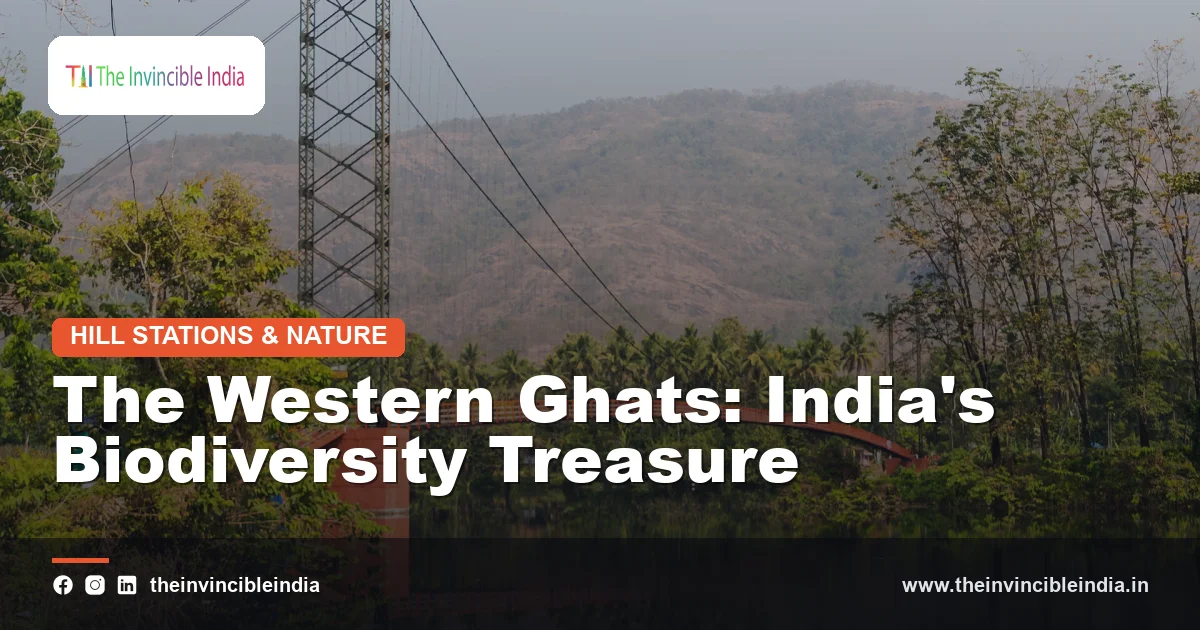
Stretching for some 1,600 kilometres along the western coast of India, the Western Ghats are one of the most important ecological regions on Earth. Older than the Himalayas, this ancient mountain range is a UNESCO World Heritage Site and one of the world’s eight “hottest” biodiversity hotspots, home to an astonishing wealth of plant and animal life found nowhere else. The Ghats shape the monsoon, give birth to great rivers, and sustain the lives of millions of people. This guide explores the extraordinary biodiversity, landscapes and significance of this natural treasure of India.
Quick Facts: The Western Ghats
| Detail | Information |
|---|---|
| Location | Western coast of India, across six states |
| Length | About 1,600 km |
| Status | UNESCO World Heritage Site (2012) |
| Significance | One of the world’s 8 hottest biodiversity hotspots |
| Age | Older than the Himalayas |
| Also called | The Sahyadri range |
An Ancient Mountain Range
The Western Ghats, also known as the Sahyadri range, are not a true mountain range formed by the collision of tectonic plates, but the faulted edge of the Deccan Plateau, believed to have been created when the landmass of India broke away from the ancient supercontinent of Gondwana. This makes them far older than the youthful Himalayas. Running roughly parallel to the Arabian Sea coast through six states, from Gujarat and Maharashtra in the north through Goa, Karnataka and Kerala to Tamil Nadu in the south, the Ghats form a near-continuous chain broken only by the Palghat Gap, rising to their highest point at Anamudi in Kerala.
A Global Biodiversity Hotspot
The Western Ghats are recognised as one of the world’s foremost biodiversity hotspots, harbouring an exceptional concentration of species, a great many of which are endemic, meaning they are found nowhere else on the planet. The region is home to thousands of species of flowering plants, hundreds of species of fish, amphibians, reptiles, birds and mammals, and countless insects, with new species still being discovered. This remarkable richness, combined with the significant loss of the region’s original habitat over the centuries, is precisely what earns it the status of a biodiversity hotspot, a place of both extraordinary value and urgent conservation need.
Endemic Wildlife of the Ghats
The Western Ghats teem with unique wildlife found only within their forests. The lion-tailed macaque, with its distinctive silver mane, and the Nilgiri langur are among the region’s celebrated endemic primates, while the Nilgiri tahr, a mountain goat, clings to the high grasslands. The forests shelter tigers, leopards, elephants, gaur (Indian bison) and the elusive Malabar civet, along with a dazzling array of endemic amphibians and reptiles, including many species of frogs and the striking Malabar pit viper. This concentration of unique creatures makes the Ghats a paradise for naturalists and wildlife enthusiasts.
A Birdwatcher’s Paradise
For birdwatchers, the Western Ghats are among the richest regions in India, home to a spectacular variety of birds, many of them endemic to the range. Colourful species such as the Malabar grey hornbill, the Nilgiri flycatcher, the Malabar parakeet, the crimson-backed sunbird and the Malabar trogon draw enthusiasts from around the world. The varied habitats, from lush evergreen rainforests to grasslands and wetlands, support an incredible diversity of avian life. The forests come alive with birdsong, and a patient observer can spot dozens of species, making the Ghats a premier destination for birding.
The Ghats and the Monsoon
The Western Ghats play a crucial role in shaping the climate of much of India, particularly through their influence on the monsoon. As the moisture-laden winds of the southwest monsoon sweep in from the Arabian Sea, they are forced to rise over the mountains, cooling and releasing enormous amounts of rainfall on the western slopes. This makes the windward side of the Ghats one of the wettest regions in the country, cloaked in dense rainforest, while creating a drier rain shadow on the leeward side. This dramatic effect sustains the region’s lush forests and feeds the rivers that flow across the peninsula.
The Rivers Born in the Ghats
The Western Ghats are the source of many of peninsular India’s most important rivers, earning them a vital place in the life of the subcontinent. Great rivers such as the Godavari, Krishna and Kaveri rise in these mountains and flow eastward across the Deccan to the Bay of Bengal, nourishing vast agricultural plains and supporting hundreds of millions of people. Numerous smaller rivers tumble down the western slopes to the Arabian Sea. This role as a great watershed makes the Ghats not only a treasure of biodiversity but also a lifeline whose forests are essential for the water security of much of southern India.
National Parks and Protected Areas
The Western Ghats are dotted with a network of national parks, wildlife sanctuaries and reserves that protect their precious biodiversity. Among the most famous are Periyar in Kerala, known for its elephants and scenic lake; Silent Valley, a pristine tract of rainforest; Nagarhole and Bandipur in Karnataka, rich in tigers and elephants; Eravikulam, home to the Nilgiri tahr; and the forests of the Nilgiri Biosphere Reserve, India’s first such reserve. These protected areas offer visitors the chance to experience the wild beauty of the Ghats while safeguarding the habitats of their countless unique species.
Hill Stations and Landscapes
Beyond their ecological importance, the Western Ghats are a region of breathtaking scenic beauty, dotted with famous hill stations that have long offered a cool escape from the heat of the plains. Munnar in Kerala, with its rolling tea gardens, Ooty and Kodaikanal in Tamil Nadu, Coorg and Chikmagalur in Karnataka with their coffee estates, and Mahabaleshwar and Lonavala in Maharashtra all lie amid the Ghats. Misty mountains, cascading waterfalls, dense forests and sweeping valleys make these landscapes among the most beautiful in India, drawing travellers and nature lovers throughout the year.
Threats and Conservation
Despite their protected status, the Western Ghats face serious threats from human activity. Deforestation, expanding plantations, mining, dams, roads and growing settlements have fragmented and reduced the natural forests, endangering countless species. Climate change adds further pressure to these sensitive ecosystems. Recognising the region’s importance, conservationists and expert committees have called for careful protection and sustainable development to safeguard the Ghats. Balancing the needs of local communities with the urgent task of preserving this irreplaceable natural heritage remains one of the great environmental challenges facing India today.
The Nilgiri Biosphere Reserve
At the heart of the southern Western Ghats lies the Nilgiri Biosphere Reserve, established in 1986 as the first biosphere reserve in India. Encompassing a vast area across the states of Tamil Nadu, Kerala and Karnataka, it brings together several national parks and sanctuaries, including Mudumalai, Bandipur, Nagarhole and Silent Valley, into one of the most important protected landscapes in the country. The reserve safeguards a magnificent variety of habitats and species, from tigers and elephants to rare endemic plants and animals, and stands as a flagship of conservation in the Ghats, protecting both the natural heritage and the indigenous communities who have long called these forests home.
Forests and Vegetation Types
The Western Ghats support a remarkable range of forest and vegetation types, shaped by variations in rainfall, altitude and soil. The wettest slopes are cloaked in tropical evergreen rainforests of towering trees and dense undergrowth, while drier areas support deciduous forests that shed their leaves in the dry season. At higher elevations, unique montane forests known as sholas nestle in the valleys, interspersed with rolling grasslands, creating a distinctive mosaic found only in these mountains. This diversity of habitats, from lush rainforest to high-altitude grassland, is a key reason for the extraordinary richness of species that the Ghats sustain.
The People of the Ghats
The Western Ghats are home not only to wildlife but also to numerous indigenous and local communities whose lives are deeply connected to the forests. Various tribal groups have lived in and around the Ghats for generations, drawing on traditional knowledge of the plants and animals around them, and practising ways of life closely attuned to the rhythms of nature. Alongside them, farming and plantation communities cultivate the region’s famous tea, coffee, spices and other crops. Balancing the livelihoods and rights of these communities with the protection of the fragile environment is a central challenge in the sustainable management of the Ghats.
Experiencing the Western Ghats
For travellers, the Western Ghats offer an abundance of unforgettable experiences amid some of the most beautiful scenery in India. Visitors can trek through misty forests and rolling grasslands, spot wildlife on safaris in the national parks, marvel at spectacular waterfalls in full monsoon flow, and relax in charming hill stations surrounded by tea and coffee estates. Birdwatching, nature walks, and visits to spice plantations add to the appeal. Whether seeking adventure, tranquillity or a deeper connection with nature, travellers find in the Ghats a rich and rewarding destination that showcases the natural wonders of the region.
Why the Western Ghats Must Be Protected
The Western Ghats are far more than a scenic mountain range; they are a living treasure whose value to India and the world is immense and irreplaceable. As a globally significant biodiversity hotspot, they safeguard countless species found nowhere else, while their forests regulate the monsoon, store carbon, prevent soil erosion and feed the rivers on which hundreds of millions of people depend for water and agriculture. The loss of these forests would be catastrophic, not only for wildlife but for the water and food security of much of southern India. Protecting the Western Ghats is therefore one of the most important environmental responsibilities of our time, essential for both nature and human wellbeing, now and for generations to come.
Best Time to Explore the Ghats
The Western Ghats can be enjoyed year-round, but each season offers a different experience. The monsoon, from June to September, transforms the hills into a lush green paradise alive with roaring waterfalls, though heavy rain can make travel difficult. The post-monsoon and winter months, from October to February, offer pleasant weather, clear skies and excellent conditions for wildlife viewing, trekking and sightseeing, making this the most popular time to visit. Whatever the season, the timeless beauty of the Ghats rewards every traveller who ventures into their misty forests and rolling hills.
Frequently Asked Questions
Why are the Western Ghats important?
The Western Ghats are one of the world’s major biodiversity hotspots, home to countless endemic species, and they play a vital role in shaping the monsoon and giving rise to many of peninsular India’s major rivers. They are a UNESCO World Heritage Site.
Which states do the Western Ghats cover?
The Western Ghats run through six states: Gujarat, Maharashtra, Goa, Karnataka, Kerala and Tamil Nadu, along the western coast of India.
What wildlife is found in the Western Ghats?
The Ghats are home to tigers, elephants, leopards, gaur and many endemic species such as the lion-tailed macaque, Nilgiri tahr and Nilgiri langur, along with a rich variety of birds, amphibians and reptiles.
Are the Western Ghats older than the Himalayas?
Yes, the Western Ghats are considered geologically much older than the Himalayas, having formed as the faulted edge of the Deccan Plateau.


