

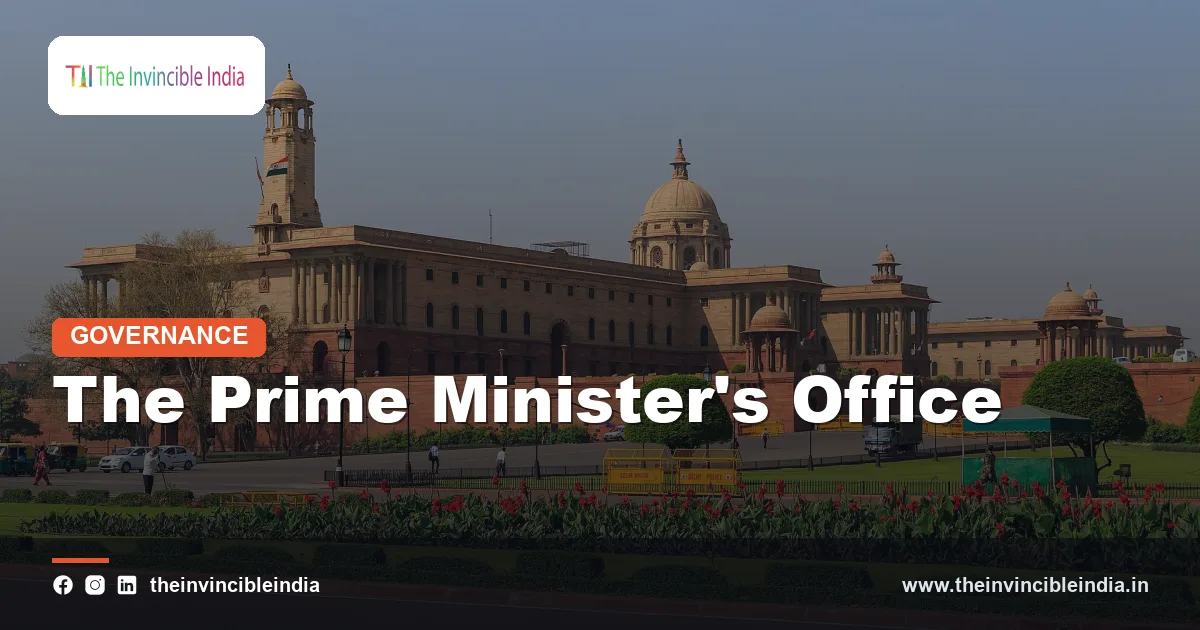
The Prime Minister’s Office, commonly abbreviated as PMO, is the secretariat that assists the Prime Minister of India in the discharge of day-to-day responsibilities. Housed in South Block on Raisina Hill in New Delhi, it brings together senior civil servants, security advisers and specialists who help the Prime Minister to handle policy, coordination, communication and appointments. Although the Constitution never mentions it, the PMO has become one of the most influential offices in the Indian system of government.
Its prominence rests on a simple fact: the Prime Minister sits at the centre of the Union Executive, and someone must process the vast flow of papers, proposals and queries that reach that desk. Over seven decades the office grew from a handful of private secretaries into a full-fledged institution with a Principal Secretary, an advisory team and close links with the National Security Adviser. This explainer traces its history, structure, functions and the debates that surround it.
Quick Facts
| Feature | Details |
|---|---|
| Nature of body | Personal secretariat of the Prime Minister; extra-constitutional and non-statutory |
| Location | South Block, Raisina Hill, New Delhi |
| Head | Principal Secretary to the Prime Minister, usually a senior retired or serving civil servant |
| Earlier name | Prime Minister’s Secretariat, renamed Prime Minister’s Office in 1977 |
| Constitutional anchor | Articles 74 and 75 define the Prime Minister’s role; the PMO has no direct constitutional mention |
| Key associated posts | Principal Secretary, National Security Adviser, advisers, secretaries and special officers |
| Related institution | Cabinet Secretariat, which serves the Cabinet as a whole |
| Core functions | Policy advice, coordination, monitoring, communication, handling of appointments and national security inputs |
What Is the Prime Minister’s Office?
The Prime Minister’s Office is a staff agency created to help the Prime Minister carry out the duties of the office. Unlike a ministry, it does not administer a particular subject such as health or railways. Instead it works across the whole of government, giving the Prime Minister the information, analysis and follow-up needed to supervise ministries and take decisions.
It is important to distinguish the PMO from the Prime Minister’s residence and from the Council of Ministers. The Prime Minister heads the Council of Ministers under Article 74 of the Constitution, and the PMO is the personal bureaucratic machinery that serves the Prime Minister in that role. The office is staffed mostly by officers on deputation from the Indian Administrative Service, the Indian Foreign Service, the Indian Police Service and other services, as well as by experts brought in from outside.
What the PMO is not
- It is not a department listed in the Allocation of Business Rules in the same way as ministries.
- It is not a constitutional authority like the Election Commission or the Comptroller and Auditor General.
- It does not take decisions in its own name; formal orders are issued in the name of the President and the relevant ministry.
Origins and Evolution Since 1947
When Jawaharlal Nehru became the first Prime Minister in August 1947, he worked with a small personal staff and relied heavily on the Cabinet Secretariat and the Ministry of External Affairs, which he also headed. The informal arrangement suited the time, since the government was small and the Prime Minister personally supervised many subjects.
A more formal structure emerged in 1964 under Lal Bahadur Shastri, who set up the Prime Minister’s Secretariat. It was headed by a Secretary to the Prime Minister, and L. K. Jha is remembered as its first head. This was designed to give the Prime Minister an independent source of advice, separate from the ministries.
A short timeline
- 1947: the first Prime Minister functions with a small personal staff.
- 1964: the Prime Minister’s Secretariat is set up under Lal Bahadur Shastri.
- Late 1960s and 1970s: under Indira Gandhi the Secretariat grows in strength and becomes a major centre of policy advice, with senior officers such as P. N. Haksar playing a prominent part.
- 1977: under Morarji Desai the Secretariat is renamed the Prime Minister’s Office.
- 1998: the post of National Security Adviser is created and attached to the PMO.
Since then each Prime Minister has shaped the office according to personal style, expanding or trimming its advisory wings and altering reporting lines.
Constitutional Position: Extra-Constitutional Yet Powerful
The Constitution of India says nothing about the PMO. Article 74 provides for a Council of Ministers headed by the Prime Minister to aid and advise the President. Article 75 provides that the Prime Minister is appointed by the President, that other ministers are appointed on the Prime Minister’s advice, and that the Council of Ministers is collectively responsible to the Lok Sabha. Article 78 imposes a duty on the Prime Minister to communicate to the President decisions of the Council of Ministers on administration and proposals for legislation.
The PMO is therefore described as extra-constitutional and non-statutory. Its existence rests on executive decisions rather than on an Act of Parliament or an article of the Constitution. This has two consequences. First, the office can be reorganised easily, since no legislation is required. Second, there are few formal checks on its functioning, which is a reason for the occasional debate about transparency and accountability.
Despite this, the PMO has real influence. Its authority flows from its proximity to the Prime Minister, the information it controls and the practice of ministries consulting it before significant moves.
Structure and Key Officials
The PMO is led by the Principal Secretary to the Prime Minister. This officer usually holds the rank of Cabinet Secretary or equivalent and is selected by the Prime Minister personally rather than through the regular civil service rotation. Working with the Principal Secretary are several categories of officials.
| Position | General role |
|---|---|
| Principal Secretary | Head of the office; chief administrative and policy adviser to the Prime Minister |
| National Security Adviser | Advises on external and internal security and strategic matters; works with the National Security Council system |
| Additional Principal Secretary or Advisers | Provide senior-level support and specialised advice |
| Secretaries and Joint Secretaries | Handle portfolios of subjects and liaise with ministries |
| Officers on Special Duty and specialists | Work on specific missions, projects or communication tasks |
The Principal Secretary typically sits close to the Prime Minister and sees most important files. Appointments in the PMO are made at the discretion of the Prime Minister and the term of officials is generally co-terminus with the Prime Minister’s tenure.
Main Functions of the PMO
The activities of the PMO fall under a few broad heads. They are not codified in a single statute, but long practice has made them well known.
Assisting in policy formulation
The PMO helps the Prime Minister to examine policy proposals that come from ministries. Its officers study the background, test arguments and, where needed, offer alternatives. They also help prepare speeches, statements to Parliament and briefings for foreign visits.
Coordination and monitoring
Because many issues cut across ministries, the PMO acts as a point of coordination. It reviews the progress of important projects and flagship programmes, and prompts ministries to resolve delays. It works closely with the Cabinet Secretariat, which keeps formal Cabinet records.
Other tasks
- Handling the Prime Minister’s correspondence and public grievances forwarded to the office.
- Managing relations with the media and communicating government positions.
- Overseeing the Prime Minister’s National Relief Fund, which was created in 1948 to provide assistance during disasters.
- Supporting the Prime Minister’s engagements with state governments, foreign leaders and other institutions.
Role in Appointments and Administrative Control
The Prime Minister heads the Appointments Committee of the Cabinet, which decides on senior appointments in the civil service, defence services, public sector enterprises and some statutory bodies. The Cabinet Secretariat processes the formal proposals, while the PMO assists the Prime Minister by examining the credentials of candidates and advising on the choices.
The PMO also has influence over postings within its own sphere, such as officers deputed to the office, and it is consulted on matters relating to senior-level bureaucratic movement. In addition, the Prime Minister has direct responsibility for certain subjects, such as atomic energy and space in the allocation of portfolios, which the PMO helps to monitor.
Why appointments matter
- They shape the leadership of key institutions in government and public enterprises.
- They influence the working relationship between political leadership and the permanent civil service.
- They require confidentiality, which is a reason these decisions are processed in a limited circle.
The Principal Secretary and the National Security Adviser
Two positions give the PMO its particular weight: the Principal Secretary and the National Security Adviser. The Principal Secretary is the chief of staff in all but name, coordinating the work of the office and acting as the principal interface between the Prime Minister and the bureaucracy.
The National Security Adviser, or NSA, is a more recent addition. The post was created in 1998, when the National Security Council was set up, and Brajesh Mishra, who was then Principal Secretary to Prime Minister Atal Bihari Vajpayee, became the first to hold it. The NSA is the Prime Minister’s principal adviser on external and internal security. The holder works with the National Security Council Secretariat, which is part of the Cabinet Secretariat, and is a central figure in the three-tier National Security Council system that includes the Strategic Policy Group and the National Security Advisory Board.
How the two roles interact
- The Principal Secretary focuses on administration, policy coordination and civil service matters.
- The NSA focuses on defence, intelligence, diplomacy and strategic planning.
- In some periods the two roles were combined in one person, and in others they were held separately.
PMO versus Cabinet Secretariat
Many readers mix up the PMO and the Cabinet Secretariat, so it is useful to compare them side by side. Both are located near the seat of power and both work closely with the Prime Minister, but they differ in purpose and character.
| Aspect | Prime Minister’s Office | Cabinet Secretariat |
|---|---|---|
| Serves | The Prime Minister personally | The Cabinet and its committees collectively |
| Head | Principal Secretary, chosen by the Prime Minister | Cabinet Secretary, senior-most civil servant |
| Legal basis | Executive arrangement; no direct statutory basis | Rules of Business under Article 77(3) |
| Main role | Advice, political-administrative coordination, communication | Procedure, record keeping, inter-ministerial coordination |
| Tenure | Generally co-terminus with the Prime Minister | Fixed term under government rules |
Debates, Criticism and Accountability
The growing influence of the PMO has been a subject of discussion among scholars, former civil servants and commentators. Supporters say that a strong secretariat is necessary in a complex government to ensure speed and coordination. They argue that the Prime Minister cannot depend entirely on ministries, which may hold narrow departmental views.
Critics point to the lack of formal accountability. Since the office is not mentioned in the Constitution, there is no parliamentary committee dedicated to it, and its officials are not directly answerable to Parliament, though the Prime Minister is. Some worry that over-centralisation can weaken ministers and dilute the principle of collective responsibility under Article 75(3).
The Right to Information Act, 2005 applies to the PMO as a public authority, which has opened parts of its working to public scrutiny. Administrative reform commissions have also urged clear procedures, transparency and role clarity between the PMO, the Cabinet Secretariat and ministries.
Conclusion
The Prime Minister’s Office is a product of administrative practice more than constitutional design. It began as a modest personal staff and grew into a central institution shaping how the Prime Minister governs. Its Principal Secretary and the National Security Adviser are among the most visible officials in the country. Understanding the PMO, along with its relationship to the Cabinet Secretariat and ministries, is key to understanding how power operates inside the executive branch of the Indian government.
Frequently Asked Questions
What is the Prime Minister’s Office in India?
The Prime Minister’s Office is the secretariat that assists the Prime Minister in policy formulation, coordination, communication and administration. It is headed by the Principal Secretary and works from South Block in New Delhi.
Is the PMO mentioned in the Constitution?
No. The Constitution mentions the Prime Minister and the Council of Ministers in Articles 74 and 75, but it does not mention the PMO. It is therefore regarded as an extra-constitutional and non-statutory body created by executive decision.
Who heads the PMO?
The Principal Secretary to the Prime Minister heads the office. The officer is selected personally by the Prime Minister, is generally of the rank of Cabinet Secretary, and usually serves for the duration of the Prime Minister’s tenure.
What is the role of the National Security Adviser in relation to the PMO?
The National Security Adviser is the Prime Minister’s principal adviser on external and internal security. The post was created in 1998, and the holder works closely with the PMO and the National Security Council Secretariat in shaping strategic and security policy.
How is the PMO different from the Cabinet Secretariat?
The PMO serves the Prime Minister personally and is led by an appointee of the Prime Minister’s choice. The Cabinet Secretariat serves the Cabinet collectively under the Rules of Business and is headed by the Cabinet Secretary, who is the senior-most civil servant.
When was the Prime Minister’s Office given its present name?
The office began as the Prime Minister’s Secretariat in 1964 under Lal Bahadur Shastri. It was renamed the Prime Minister’s Office in 1977 during the tenure of Prime Minister Morarji Desai, and it has retained that name since.


