

Long before Delhi became the seat of sultans, emperors and republics, a Rajput house known as the Tomaras is remembered in tradition as the family that gave the city its earliest recognisable shape. The Tomara story survives through a blend of inscriptions, coins, bardic memory and later chronicles, which means that many details of their chronology remain debated among historians. What is broadly accepted is that they ruled around the Delhi region in the early medieval centuries, fortified a settlement at Lal Kot, and were eventually succeeded by the Chauhans, whose most famous ruler is described in our guide to Prithviraj Chauhan. This article presents the Tomaras in general terms, separating reasonably established history from legend.
Quick Facts
| Detail | Information |
|---|---|
| Dynasty | Tomara (Tomar) Rajputs of Delhi |
| Region | Delhi and the surrounding Haryana plains |
| Associated Fort | Lal Kot, the early fortified settlement |
| Later Rulers of the Region | Chauhans, followed by the Delhi Sultanate |
| Cultural Legacy | Early urban foundations, tanks, and the Dhillika tradition |
| Chronology | Debated; sources are partly legendary |
Who Were the Tomaras?
The Tomaras were a Rajput lineage that emerged in northern India during the early medieval period, when the older imperial order had fragmented into many regional kingdoms. Tradition links them to the area around Delhi and Haryana, where they are said to have held power first as subordinates of larger dynasties and later as rulers in their own right. Because the surviving evidence consists of scattered inscriptions, coins and later bardic accounts, historians approach the exact sequence of rulers with caution. What can be said with reasonable confidence is that the Tomaras left a durable memory in the region and that this memory shaped how later generations imagined the origins of Delhi. Their significance lies less in precise dates than in the lasting association between their name and the earliest recognisable Delhi.
Political Setting of Early Medieval North India
To understand the Tomaras, it helps to picture the political landscape in which they rose. After the decline of large empires such as the one described in our guide to the Gupta Empire, northern India saw the emergence of competing regional powers, many led by clans that later came to be grouped under the label Rajput. Powerful neighbours contended for the fertile plains between the Yamuna and the Aravalli hills, and local chieftains survived by shifting alliances. The Delhi region, positioned between the Punjab and the Gangetic heartland, was strategically sensitive. In such a setting, a locally entrenched family could grow into a recognised ruling house. The Tomaras emerged within precisely this fluid environment of overlapping loyalties and shifting frontiers.
Origins and the Tradition of Foundation
Later chronicles and bardic traditions describe the Tomaras as the founders of Delhi, often under the older name Dhillika, which appears in several medieval references. These accounts preserve genuine memory but also mix it with legend, so the traditional claim that a single ruler laid out the city should be read as symbolic rather than literal. Archaeology suggests that settlement in the Delhi area is far older than any Tomara-era fort, yet the idea of a Tomara foundation endured because their fortified centre became the nucleus of later urban growth. Historians therefore treat the Tomaras as the founders of a recognisable medieval Delhi rather than of human settlement in the region itself. This careful distinction lets the tradition stand without overstating what the sources can prove.
Lal Kot: The Early Fortified Settlement
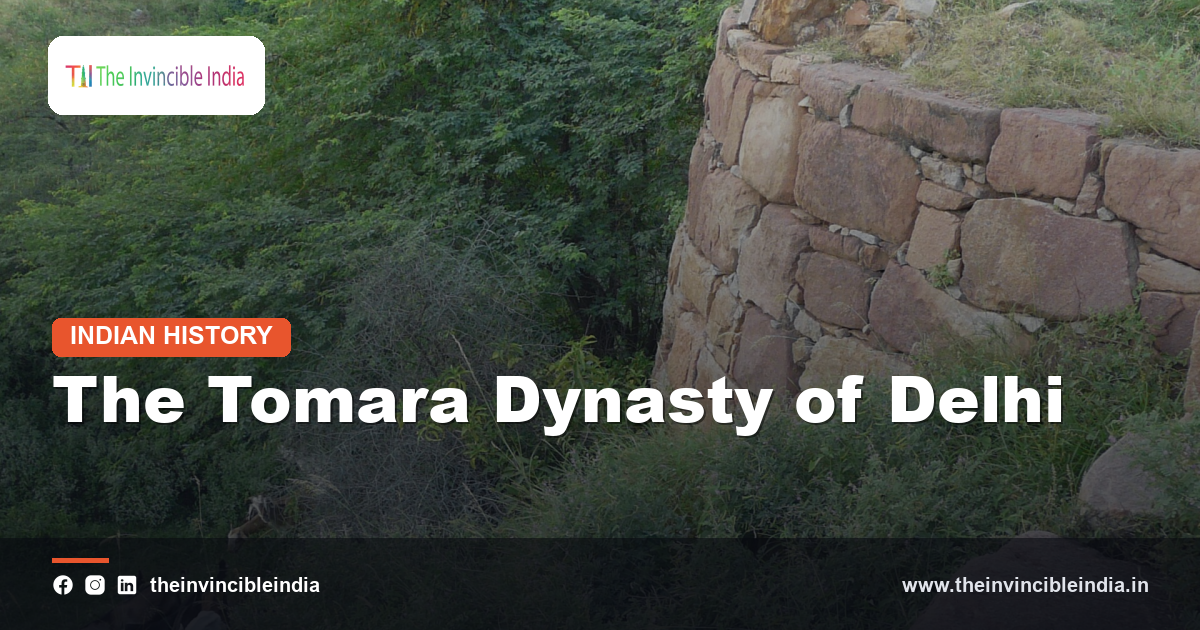
Lal Kot is the name given to the early fortified settlement in the southern part of present-day Delhi, and it is closely associated with the Tomara period. Its rubble-built walls, once strong enough to protect a small urban centre, were later extended and reworked by the Chauhans and then by the early sultans. Visitors to the Mehrauli area can still trace sections of these ramparts, which give a tangible sense of how a medieval fort-town was organised around defensible high ground. The structure is important because it represents the first major fortified core of the city, around which temples, tanks and markets could cluster. In that sense, Lal Kot stands as the physical anchor of the Tomara claim to have shaped early Delhi.
The Iron Pillar and the Anangpal Tradition
A famous tradition connects a Tomara ruler named Anangpal with the iron pillar that stands in the Qutb complex of Mehrauli. According to this account, the pillar was relocated to the Tomara settlement and set up as a symbol of the dynasty’s hopes for a lasting kingdom. Scholars generally agree that the pillar itself belongs to a much earlier age and carries an inscription of a different royal house, so the Tomaras are better understood as its later custodians than its makers. The story nevertheless shows how deeply the dynasty was woven into the memory of the site. Whether or not every detail is accurate, the tradition reflects a genuine habit of rulers gathering venerable objects to strengthen their legitimacy.
Anangpal and the Rulers of Delhi
The name Anangpal recurs in the traditions of the dynasty, and some accounts speak of more than one ruler with that name. Medieval chronicles and later genealogies offer lists of Tomara kings, but these lists differ from one another and cannot be fully reconciled with the inscriptional record. For that reason, a responsible account does not claim to know the exact order or length of each reign. What the sources collectively suggest is a line of rulers who maintained a local kingdom, defended it against neighbours, and promoted the growth of the settlement around Lal Kot. Even with uncertain chronology, the picture that emerges is of a modest but genuine regional state whose rulers took seriously the tasks of fortification, patronage and the maintenance of local order.
Water Works and Tanks Attributed to the Tomaras
In the dry plains and rocky ridges around Delhi, control of water was a mark of good kingship, and several reservoirs and dams in the region are linked by tradition to Tomara rulers. The best-known associations include the great semicircular tank at Surajkund and the embankment works in the nearby Aravalli foothills. Modern scholars debate how much of the visible structure belongs to the Tomara period and how much represents later repair, but the tradition itself is revealing. Rulers of the time justified their authority partly through public works that sustained agriculture and settlement. By attributing such works to the Tomaras, local memory credited them with the practical stewardship that made a growing town possible, reinforcing their reputation as builders as well as warriors.
Temples, Trade and Urban Life
A fortified town needs more than walls, and the Tomara-era settlement is generally imagined as a place where temples, markets and workshops developed together. Medieval references to Dhillika mention it as a place with a functioning coinage, and coins associated with the region circulated widely enough to be remembered in later accounts. Temples of the period were later dismantled or reused, so little survives in its original form, but fragments of carved stone have been identified in later structures. Traders and artisans clustered around the fort, drawn by the security it offered and by the routes that passed through the region. This early urban life provided the social base on which later dynasties would build the far larger city that Delhi eventually became.
Relations with Neighbouring Powers
The Tomaras did not rule in isolation. Their kingdom lay close to more powerful states, and the sources suggest a pattern of service, rivalry and negotiation. In the earlier phase they are often described as holding their territory under the shadow of a larger overlord, while later accounts show them contending with neighbouring Rajput clans for regional influence. Marriage alliances, which were common among ruling families of the period, linked the Tomaras with other houses and helped stabilise frontiers. Such relationships were never permanent, and shifts in the balance of power could quickly change a ruler’s fortunes. The Tomara experience therefore illustrates a broader truth about early medieval India, namely that small kingdoms survived through diplomacy and adaptability as much as through military strength.
The Transition to Chauhan Rule
Tradition holds that the Tomaras of Delhi were eventually displaced by the Chauhans of Ajmer, a process that is described in different ways by different sources. Some accounts emphasise conquest, while others suggest a more complicated mixture of alliance and absorption through marriage. The Chauhans strengthened and enlarged the old fort, giving the settlement a new name in memory and expanding its walls. This transition matters because it shows continuity as well as change: the fort, the tanks and the surrounding settlement did not vanish with the dynasty but passed into new hands. The Chauhans, whose celebrated ruler is discussed in the article on Prithviraj Chauhan, inherited a city whose basic outlines had already been drawn by their predecessors.
The Gwalior Tomaras
The Tomara name is also associated with a later and better-documented ruling family at Gwalior in central India. These rulers, who held power in a different era and region, are remembered for their patronage of architecture and music, and their fort-palace complex remains one of the more striking surviving examples of regional courtly building. Historians generally treat the Gwalior line as a distinct political entity, even though tradition sometimes links the two groups through a shared clan identity. Keeping the two apart is essential to avoid confusion: the Delhi Tomaras belong to the early medieval foundations of the capital region, while the Gwalior Tomaras belong to a later chapter of northern Indian history. Recognising the difference gives a clearer picture of how a single clan name could carry meaning across centuries.
Sources: Inscriptions, Coins and Bardic Memory
Reconstructing Tomara history requires combining several kinds of evidence, none of which is complete. Inscriptions provide fragments of royal genealogy and record gifts or building works. Coins offer clues about prosperity and political authority. Bardic and genealogical traditions, preserved in later centuries, supply names, stories and a sense of how the dynasty was remembered. Each source has limitations: inscriptions are scarce, coins are hard to attribute precisely, and bardic accounts often embellish. Historians therefore weigh these materials against one another and against the findings of archaeology. The resulting picture is necessarily tentative, which is why careful writers describe the Tomaras in broad terms and openly acknowledge where chronology and detail remain uncertain or disputed.
Architecture and Material Remains
The material remains of the Tomara period are modest compared with the monuments of later Delhi, but they are significant. Rubble-built fortification walls, bastions and the layout of the early citadel provide evidence of defensive planning suited to the rocky terrain. Carved stone from earlier temples, reused in later buildings, hints at a sophisticated sculptural tradition that once adorned the settlement. Because later rulers built over and sometimes dismantled earlier structures, the Tomara layer is often visible only to trained observers and archaeologists. Even so, these remains confirm that the dynasty’s reputation rests on real foundations. They demonstrate that the early city was a planned and defended place, whose stones were eventually absorbed into the grander monuments of the sultanate and Mughal periods.
Religion and Culture in Tomara Delhi
The Tomara era belonged to a world in which Hindu temples, Jain communities and village shrines coexisted, and royal patronage supported the religious life of the settlement. Merchants, particularly those with Jain connections, are often noted in connection with early Delhi’s commercial life. Sanskrit and the emerging regional languages shared the cultural space, and the court is imagined as a place where learned men and bards found support. Because few texts specific to the Tomara court survive, these impressions remain general. Still, they fit the wider pattern of early medieval northern India, where regional courts were important centres of devotion, learning and artistic work. The cultural world of Tomara Delhi was thus modest in scale but rich in the traditions that fed later Delhi.
Delhi Under the Sultanate: The Tomara Legacy Absorbed
When the Delhi Sultanate was established, the old Tomara and Chauhan fort became the nucleus of a new imperial capital. The early sultans built mosques, minarets and gateways in the same area, often reusing carved stone from earlier temples. This process erased much of the original Tomara landscape but also preserved it in fragments, since the reused materials carried the memory of the earlier city. The site of Lal Kot thus became a layered monument, where Rajput fortification and Indo-Islamic construction stand side by side. For students of history, this layering is valuable evidence of continuity. It shows that the sultans did not create Delhi from nothing but took over a place that the Tomaras and Chauhans had already established as a centre of power.
The Tomara Dynasty Today
Today the Tomara dynasty survives in the monuments, place names and living traditions of Delhi and Haryana. Visitors to Mehrauli can walk along the remains of Lal Kot, while the crafts fair at Surajkund keeps alive the older association of the area with water and public festivity. Families who identify with the Tomar clan preserve genealogical memories that connect them to this heritage, and historians continue to refine the picture through fresh study of inscriptions and excavations. The Tomaras remind modern readers that great cities have modest beginnings and that early rulers often leave their mark through foundations rather than monuments. Their story, though incompletely known, remains an essential first chapter in the long history of Delhi.
Sources & Further Reading
- Archaeological Survey of India (asi.nic.in).
- Ministry of Culture, Government of India (indiaculture.gov.in).
Frequently Asked Questions
Who were the Tomaras of Delhi?
The Tomaras were a Rajput dynasty traditionally credited with founding the early fortified settlement of Delhi in the early medieval period. Their exact chronology is debated, as the evidence is a mixture of inscriptions, coins and later bardic accounts.
Did the Tomaras really found Delhi?
Tradition says so, but archaeology shows that settlement in the region is much older. Historians generally describe the Tomaras as founders of medieval Delhi, centred on the fort known as Lal Kot, rather than of the area’s earliest habitation.
What is Lal Kot?
Lal Kot is the name of the early fortified settlement in the Mehrauli area of Delhi, associated with the Tomara period. Later rulers, including the Chauhans and the early sultans, expanded and reused the fort.
Who succeeded the Tomaras in Delhi?
According to tradition, the Chauhans of Ajmer succeeded the Tomaras, strengthening the fort and enlarging the settlement. After that, the region passed into the hands of the Delhi Sultanate.
Are the Delhi Tomaras the same as the Gwalior Tomaras?
They are generally treated as separate ruling families who shared a clan name but belonged to different regions and eras. The Gwalior Tomaras are better documented and are remembered for patronage of architecture and music.


