

Tucked into the valley of the Ravi river in the western Himalayas, the kingdom of Chamba is remembered as one of the most enduring hill states of northern India. Its rulers presided over a land of steep slopes, high passes and pastoral communities, yet they also created a refined court culture, left a remarkable record of inscribed copper plates, and sponsored temples that remain active places of worship. Because the hills sheltered Chamba from many of the upheavals that shaped the plains, its traditions survived with unusual continuity. Readers interested in how kingdoms elsewhere shaped their regions may also enjoy our guide to the Rajputs. This article presents Chamba in general terms, noting where tradition and documented history diverge.
Quick Facts
| Detail | Information |
|---|---|
| Kingdom | Chamba, a princely hill state |
| Region | Ravi river valley, present-day Himachal Pradesh |
| Early Seat | Brahmapura (Bharmour), before the move to Chamba town |
| Famous Temples | Lakshmi Narayan complex and the Bharmour group |
| Cultural Strengths | Pahari miniature painting, rumals, metalwork and fairs |
| Later Status | Princely state that merged into Himachal Pradesh after Independence |
Geography of the Ravi Valley
The Chamba kingdom grew in a rugged landscape of forested ridges, alpine meadows and deep river gorges along the upper Ravi and its tributaries. This terrain shaped nearly every aspect of life: it limited the size of settlements, encouraged pastoral and terraced farming, and made central control difficult. At the same time, it offered natural protection from invaders and allowed local traditions to survive with little interruption. Trade routes crossing high passes connected the valley with Kashmir, Ladakh and the Punjab plains, giving the region a quiet but real commercial importance. The mountain setting is therefore essential to understanding the kingdom, because it explains both its remarkable continuity and the distinctive culture that took root within its sheltered valleys.
Origins and the Early Capital at Brahmapura
Tradition places the beginnings of the Chamba ruling line in the upper valley around the settlement called Brahmapura, today known as Bharmour. Early rulers are said to have established a small kingdom among the local hill communities, and the antiquity of the lineage is a matter of local pride. Historians treat the earliest portion of the genealogy with caution, since it rests on later records, and they note that dates assigned to the first rulers are debated. What is clear is that the region possessed an organised polity at an early stage, with inscriptions showing royal grants and the use of Sanskrit. Bharmour thus stands as the earliest recognised centre of the kingdom, and its temples remain among the most important monuments of the entire Chamba story.
The Founding of Chamba Town
A well-known tradition holds that a ruler moved the capital downstream from Bharmour to a broader and more convenient plateau overlooking the Ravi, and named the new town after his daughter. The story, with its mixture of family affection and statecraft, is retold with pleasure in local narrative. Its historical core is the shift of the royal seat to a location better suited to administration, trade and growth. The town that emerged was laid out with a central open ground, temple clusters and a palace on the higher terrace. Whether or not every detail of the tale is literal, it captures how the kingdom came to be identified with its new capital. The transfer marked a turning point in the political and cultural life of the state.
The Remarkable Record of Copper Plates
Chamba is unusual among hill states for the number of inscribed copper plates and stone records that survive from its rulers. These documents record grants of land, the dedication of temples and the names of kings, officials and donors, and they have given scholars a more solid basis for studying the dynasty than many neighbouring kingdoms enjoy. The records show a court that valued written proof of authority and that maintained administrative continuity over a long span of time. Even so, specialists continue to discuss how to read certain dates and genealogies, so chronology remains an area of active research. The inscriptions are best seen as a treasury of local history, preserving the language, titles and religious interests of a mountain state across generations.
The Temples of Bharmour
The temple group at Bharmour is among the oldest and most atmospheric sacred sites of the western Himalayas. Its stone shrines stand around an open lawn, with the highest peaks of the region forming a backdrop. Local tradition associates the complex with a large number of shrines, reflecting a popular belief in the sanctity of the place. The sanctuaries show an early form of hill temple architecture, in which carved stone towers rise above compact sanctums, and they continue to attract pilgrims and local devotees. The site is also linked with the semi-nomadic pastoral Gaddi community, whose seasonal movements with their flocks are an enduring feature of the valley. Bharmour thus joins sacred geography, royal history and living culture in a single remarkable setting.
The Lakshmi Narayan Temples of Chamba
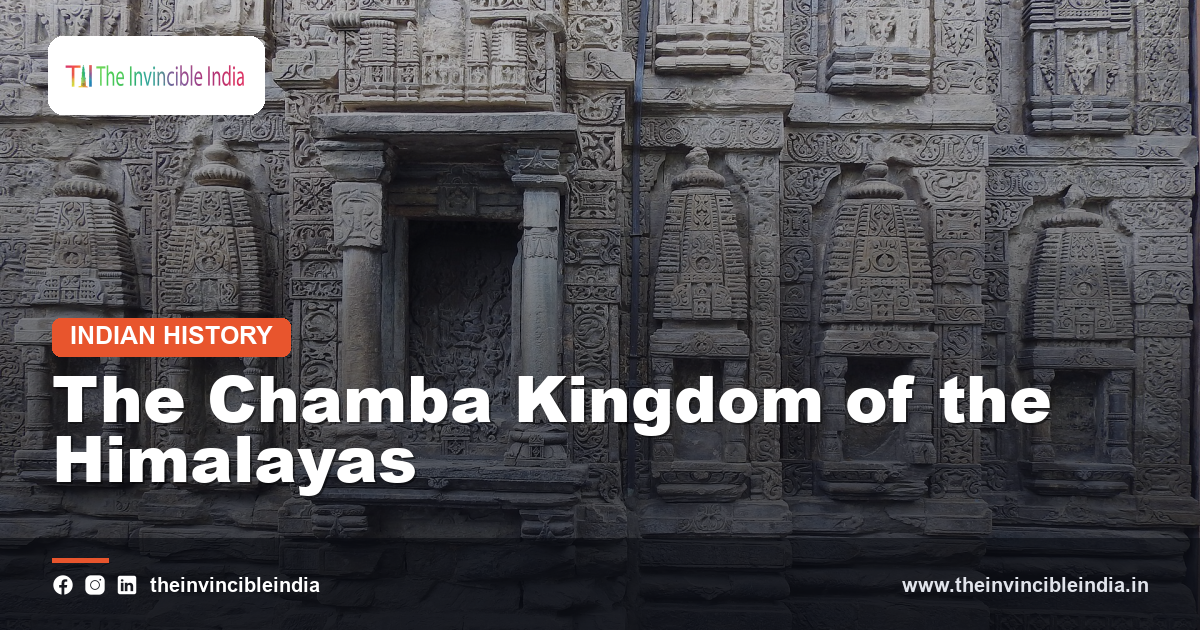
In the heart of Chamba town stands a group of stone temples dedicated mainly to Vishnu and Shiva, known collectively as the Lakshmi Narayan complex. The principal shrines are built in the curvilinear shikhara style, and several are topped with wooden canopies designed to protect the stonework from heavy mountain snow and rain. The arrangement shows how builders in the hills adapted plains architecture to local climate. Royal patronage sustained the complex over many generations, and later rulers added further shrines. Today the temples remain active places of worship and a major attraction for visitors. They are the best-known architectural symbol of the kingdom, illustrating how faith, kingship and craftsmanship combined to create a lasting monument in the Himalayan foothills.
Royal Administration and Court Life
The rulers of Chamba governed through a modest administrative system suited to a mountainous kingdom, with local officers overseeing districts and collecting dues from farming and pastoral communities. The royal court, though small, was a centre of ceremony, patronage and learning, and the palace complex reflects the style of hill-state royalty. Court rituals, festivals and public audiences reinforced the authority of the ruler and the loyalty of the nobility. Because the kingdom was relatively isolated, its customs often preserved older practices that had faded elsewhere. This blend of simplicity and ceremony gave Chamba a distinctive political character, in which close contact between ruler and people coexisted with a strong sense of dynastic tradition and religious duty.
Relations with Neighbouring States and Empires
Like other hill kingdoms, Chamba lived in the shadow of stronger powers on the plains and in Kashmir, and its rulers had to balance independence against prudence. Records and traditions describe periods of conflict with neighbouring hill states, as well as phases of tributary relationship with larger imperial courts, including that of the Mughal Empire. The mountainous terrain gave the kingdom a margin of safety that many plains states lacked, and its rulers often preserved considerable autonomy even while acknowledging external overlords. Later, the arrival of the Sikh and British powers in the region reshaped the political map once more. Throughout, Chamba survived by combining geographic advantage with diplomatic flexibility, a pattern typical of Himalayan states.
Pahari Painting and the Chamba School
The hill states of the western Himalayas nurtured a celebrated tradition of miniature painting known as Pahari art, and Chamba made its own contribution to this tradition. Court artists produced works depicting themes from the epics, devotional poetry and royal life, using delicate lines and a lyrical colour sense. Patronage from the ruling family helped sustain workshops and the movement of artists between neighbouring courts. The Chamba style is often noted for its lively use of colour and its strong sense of decorative pattern. While attributions of individual works can be debated, the broader role of the kingdom in this artistic flowering is widely recognised. Pahari painting remains one of the most refined cultural legacies of the hill states.
The Chamba Rumal and Textile Arts
One of the best-loved crafts associated with the region is the Chamba rumal, an embroidered cloth worked in silk thread on a plain ground. Its designs often draw on the themes of Pahari painting, translating miniature scenes into needlework. The special feature of the craft is that the embroidery appears equally finished on both sides, a result of a careful double-satin technique. Traditionally, such pieces were made by women of the region and used for gifts, ceremonial covers and wedding presents. The craft shows how courtly aesthetics reached the wider community and how painting and textiles influenced each other. Today the rumal is recognised as a significant example of living heritage and a symbol of the creative skill of the Chamba valley.
Metalwork, Footwear and Local Crafts
Beyond painting and embroidery, Chamba has long been known for other crafts that grew from local resources and skills. Metalworkers produced temple images, vessels and decorative objects, while leatherworkers created durable footwear suited to mountain walking. Woodcarvers adorned doorways and temple eaves, and weavers produced woollen goods that matched the cold climate. These crafts served daily needs but also reflected an artistic sense shared across the valley. Royal patronage and temple demand helped keep skills alive over generations. The result is a rich craft heritage in which usefulness and beauty are closely joined, and which continues to support livelihoods and cultural identity in the region.
Festivals and Fairs: Minjar and Beyond
The cultural calendar of Chamba is marked by fairs and festivals that bring together townspeople, villagers and visitors. The Minjar fair, associated with the ripening of crops and celebrated with processions, music and dance, is the best known. Its rituals blend agricultural thanksgiving with devotion and royal tradition, and the central open ground of the town becomes a stage for communal celebration. Other local festivals honour deities, seasonal changes and episodes from sacred stories. These events preserve folk songs, dances and costume traditions that might otherwise fade. For the people of the valley, they are moments of renewal and belonging, linking present generations to the long cultural story of the kingdom.
Religion and Local Belief
Religious life in Chamba combined the major traditions of Shaivism and Vaishnavism with older local cults of mountain deities and goddesses. Temples built by the rulers coexisted with village shrines whose presiding spirits were believed to protect fields, flocks and travellers. Shakti worship was particularly strong in the hills, and several shrines of the goddess draw devotees from across the region. Royal patronage did not suppress local belief but absorbed it, allowing a layered religious landscape to develop. Pilgrimage, ritual dance and seasonal festivals expressed this faith. The result is a distinctive devotional culture in which the great tradition of the plains and the folk religion of the mountains blend naturally.
Colonial Period and Integration
In the later centuries the political environment around Chamba changed profoundly as new powers extended their reach into the hills. The kingdom came under British paramountcy and continued as a princely state, with its ruling family retaining internal authority while accepting imperial oversight. This period brought new administrative practices, roads and institutions, as well as the opening of the valley to wider contact. After Independence, Chamba was integrated with neighbouring hill territories into the new state of Himachal Pradesh. The transition ended the rule of the old dynasty but not the cultural identity of the region. Many of the kingdom’s temples, crafts and festivals survived the change and continue to define the character of the district.
The Bhuri Singh Museum and Preservation of Heritage
The legacy of the kingdom is preserved today in a museum in Chamba town that displays paintings, inscriptions, textiles, weapons and other objects connected with the former ruling house and the wider region. Such institutions play an important role in protecting fragile heritage, from miniature paintings to copper plates. Alongside museums, conservation of temples and old buildings is carried out by public agencies and local communities. The challenge of preserving mountain monuments is considerable, given heavy snowfall and landslides, yet continued care has kept many structures in use. The museum and the living temples together make Chamba an unusually rewarding place for students of Himalayan history and art.
The Chamba Kingdom Today
Today the Chamba kingdom survives as a rich cultural memory and a landscape of living heritage. Visitors can walk through the temple complex at the heart of the town, explore the ancient shrines of Bharmour, and see craft traditions that stretch back across generations. Pahari painting and the Chamba rumal draw interest from collectors and scholars, while festivals such as Minjar continue to unite the community. The kingdom’s record of inscriptions remains a valuable resource for historians of the western Himalayas. Chamba demonstrates how a small mountain state, protected by geography and sustained by faith and craftsmanship, can leave a cultural legacy far larger than its size or political power.
Sources & Further Reading
- Archaeological Survey of India (asi.nic.in).
- Ministry of Culture, Government of India (indiaculture.gov.in).
Frequently Asked Questions
Where is the Chamba kingdom located?
The Chamba kingdom occupied the valley of the Ravi river in what is now Himachal Pradesh. It was a hill state with early roots at Bharmour and a later capital at Chamba town.
What is the Lakshmi Narayan temple complex?
It is a group of stone temples in Chamba town dedicated mainly to Vishnu and Shiva, built in the shikhara style and often fitted with wooden canopies for protection from snow. The complex is the best-known architectural symbol of the former kingdom.
Why are Chamba's copper plates important?
The kingdom left an unusually large number of inscribed copper plates and stone records documenting grants, temples and rulers. They give historians a firmer basis for studying the dynasty, although dates and genealogies are still debated.
What is the Chamba rumal?
The Chamba rumal is an embroidered cloth worked in silk thread, with designs often inspired by Pahari miniature paintings. It is admired because the embroidery looks equally finished on both sides.
What happened to Chamba after Independence?
The princely state was merged with neighbouring hill territories to form Himachal Pradesh. The royal rule ended, but the temples, crafts and festivals of the region continued.


